- Smart City/Mobility Business HOME
- Search by use case
-
Search by product/service

- event·
seminar -
Case studies and columns
- Inquiry

LiDAR as the "eyes" of autonomous driving Towards evolving next-generation mobility
LiDAR sensors that enable safe and reliable autonomous driving
The market for autonomous driving is expanding rapidly, with many companies aiming to enter the next-generation mobility field. Automakers and local governments are also actively gathering information on autonomous driving technology, and this wave of technological innovation is sure to become a part of our daily lives.
autonomous driving is a technology that partially or fully automates human driving operations. Not only are autonomous driving technology are also beginning to be used in airports and factories, and their effectiveness has been proven.
An essential part of these autonomous driving systems is the 3D LiDAR sensor, which acts as the vehicle's "eyes." This technology uses light to accurately detect and measure surrounding objects, and is gaining attention as a key element in realizing safe and reliable autonomous driving.
The mechanism and types of LiDAR sensors required for autonomous driving development
What is LiDAR?
LiDAR stands for "Light Detection and Ranging" and is a sensor that uses laser light to detect and measure the position of objects.
[Types of LiDAR]
There are three types of LiDAR: 1D LiDAR, which measures distance to a single point only; 2D LiDAR, which measures distance in the horizontal direction; and 3D LiDAR, which can measure distance in both the horizontal and vertical directions. 3D LiDAR is more commonly used in autonomous driving.
There are two types of 3D LiDAR sensors: rotating and solid-state (fixed). In autonomous driving, the rotating type tends to be the more popular choice, as it is necessary to obtain a wide range of point cloud data about the surrounding environment while driving.

- Wide viewing angle
- Easy to use for mapping
(Examples of use: drones, autonomously controlled robots)

- Limited viewing angle
- Small and durable
- Easy to operate, stable over long periods of time
(Usage examples: automobiles, ADAS)
How 3D LiDAR sensors work
The 3D LiDAR sensor emits a laser and measures the position and distance of an object (target) using the reflected wave. The data obtained in this way is output as point cloud data.
In recent years, demand for 3D LiDAR sensors has increased, and mass production systems have been put in place, making it possible to introduce even high-performance 3D LiDAR sensors at low cost.

Point cloud image acquired from LiDAR
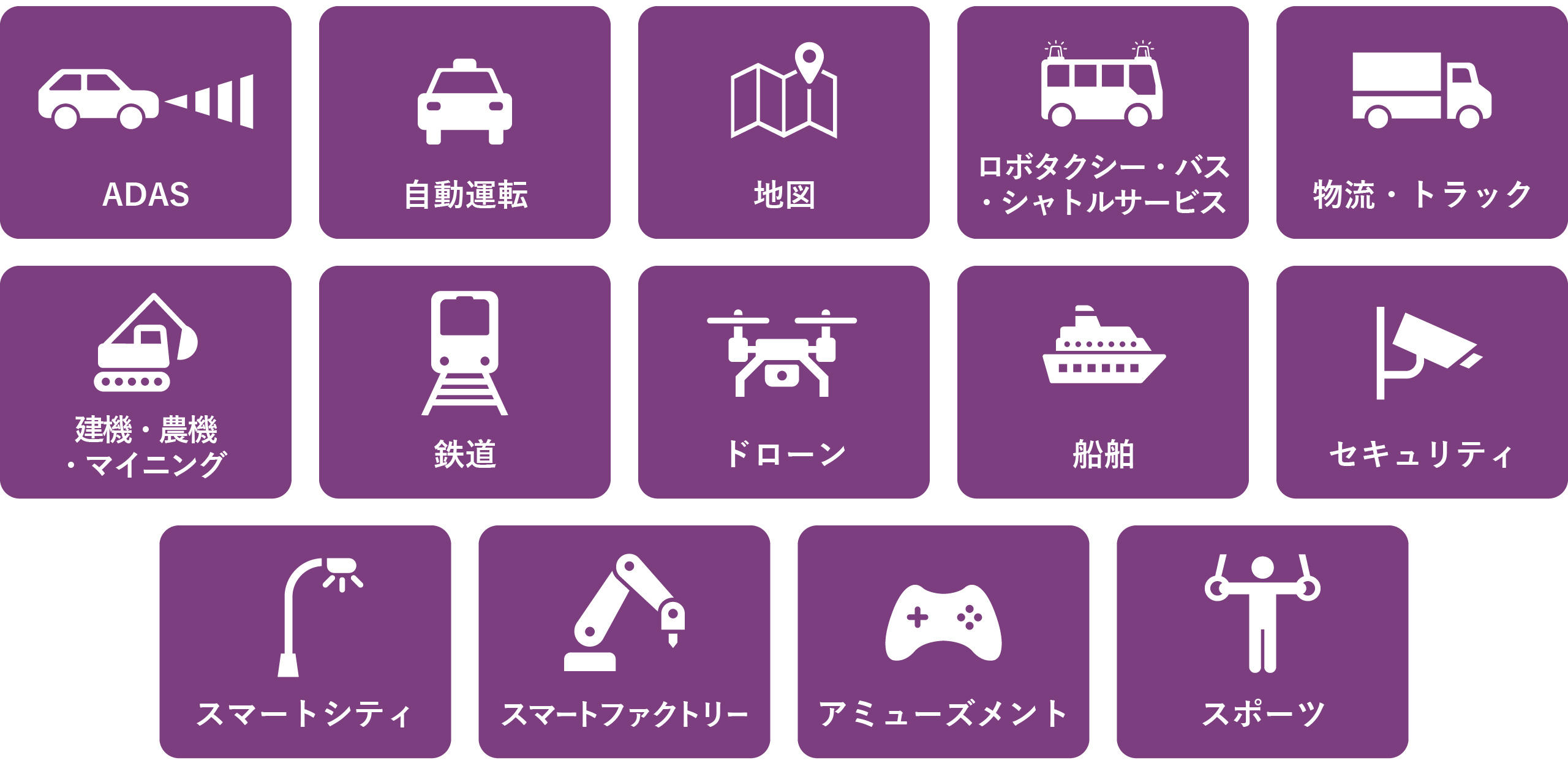
LiDAR sensor use cases: from autonomous driving to security
LiDAR sensors are installed in autonomous driving taxis and autonomous driving and are used to enable the vehicles to navigate while recognizing their surroundings.
Additionally, LiDAR sensors are being installed on large dump trucks that operate autonomous driving at construction sites to detect nearby obstacles and vehicles and measure the distance between them.
LiDAR sensors are also used in creating advanced security environments. Conventional security systems, such as those using video cameras, have issues such as missing detection due to blind spots and false alarms, but LiDAR sensors offer high detection capabilities by continuously tracking objects even if they move behind an obstacle. This makes real-time monitoring possible in places like shopping malls, airport terminals, and entrances and exits of financial institutions. LiDAR sensors are also demonstrating their capabilities in creating advanced security environments.
How to Choose a 3D LiDAR Sensor
3D LiDAR sensors are often chosen for autonomous driving, but what specific criteria should you use to select one? The criteria will vary depending on the application, but the detectable distance and angle will differ depending on the product.
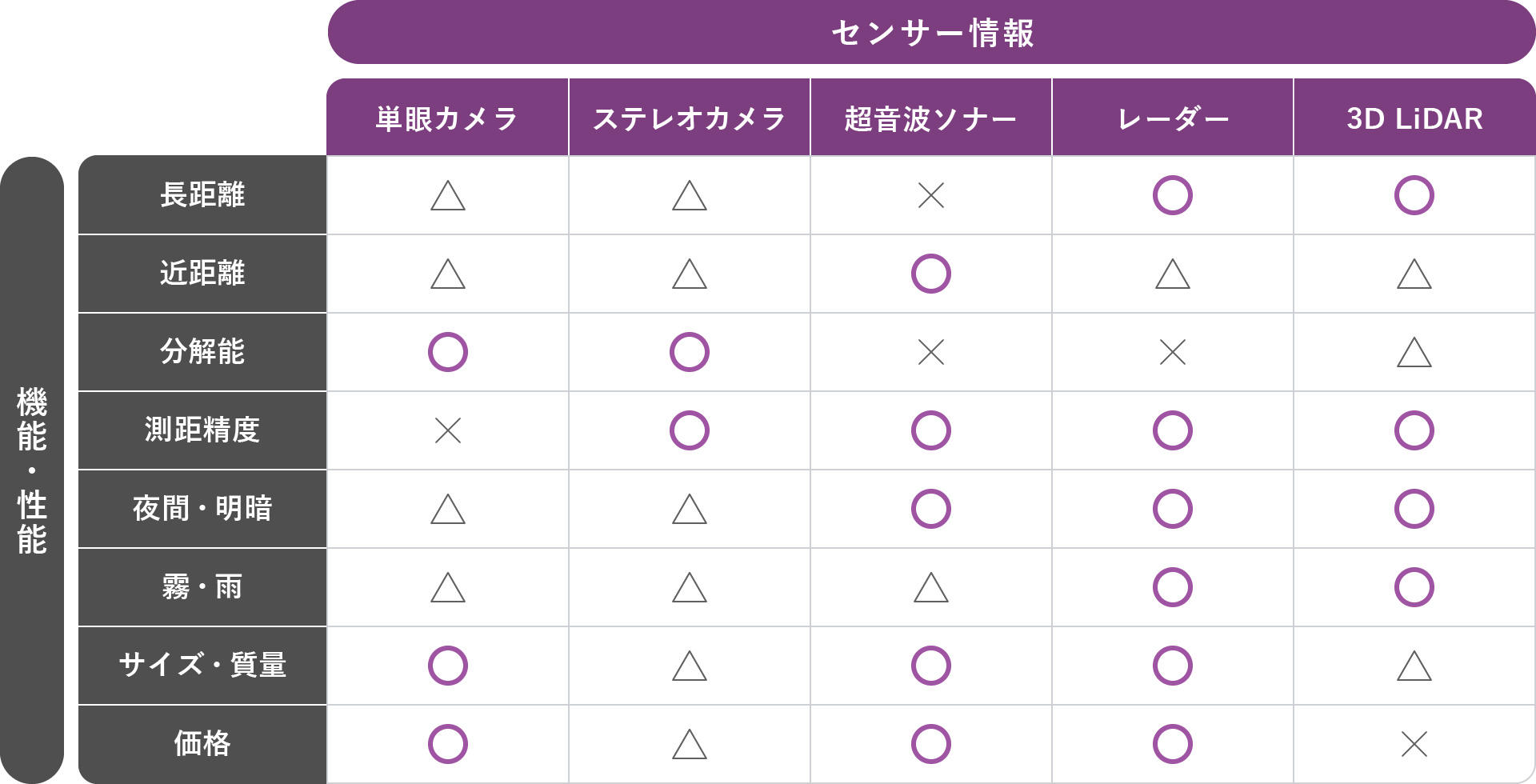
For example, 3D LiDAR sensors have excellent long-range detection capabilities, but ultrasonic sonar may be better suited for short-range detection and measurement.
As shown in the table below, features vary depending on the product, but for more information please refer to the Sensor Consulting link.
─ Product comparison table ─
|
 |
|
|
|
Detection distance |
50m@20% |
200m@10% |
250m@10% |
|
FOV(H×V) |
360° horizontal x 120° vertical |
Horizontal 120° x Vertical 30° |
Horizontal 120° x Vertical 20° |
|
frame rate |
10fps |
10fps |
20fps |
|
Resolution (H x V) |
Horizontal 0.5° x Vertical 1° |
Horizontal 0.25° x Vertical 0.25° |
Horizontal 0.1° x Vertical 0.1° |
|
Power/power consumption |
DC 9 -55V ° 10W |
DC 10-15V 15W |
DC 9-32V 20W |
*The above figures are tentative and not actual specifications.
FAQ
A. If you want to measure distances at night, LiDAR is superior to cameras.
A. No. LiDAR measures position and distance using reflected waves, so you can clearly determine the surrounding situation even in environments with poor visibility.