This time, we interviewed Abe, Deputy General Manager of the Digital Industry Division, about the real challenges faced by those responsible for promoting DX in Japan's manufacturing industry, the solution to these challenges, the "Digital Execution Factory," the essence of support for achieving in-house DX, and the driving force behind this down-to-earth support.
In this series, we will introduce "tips for making DX a culture and helping Japanese manufacturing shine on the world stage again," including the evolution of services leading up to the "Digital Execution Factory" that produces reproducible DX, bottlenecks in manufacturing DX, and key points for resolving them. (This is the second article in a four-part series.)
Interview series
-
Series 2: This article (5 min)
Digital Execution Factory: Eliminating divisions and mobilizing people
Know-how to transform your organization into a "factory (system) that produces DX"
I believe that the "Digital Execution Factory" is a proven know-how that has been used both globally and at Macnica to solve issues such as the "structural gap between IT and business departments" and "Japanese characteristics that are difficult to change." Please give us an overview of the Digital Execution Factory.
Abe: The Digital Execution Factory was originally built to execute Macnica 's IT and DX strategies, based on established global know-how.
The name "Digital Execution Factory" does not simply mean "realizing the digitalization of factories," but rather uses digital technology to give shape to everyone's "feelings," "wishes," "ideas," and "new services," generating profits. This process will transform the organization like a factory running a production line. In other words, it reflects the intention to turn the organization into a "factory that realizes many DX deliverables."
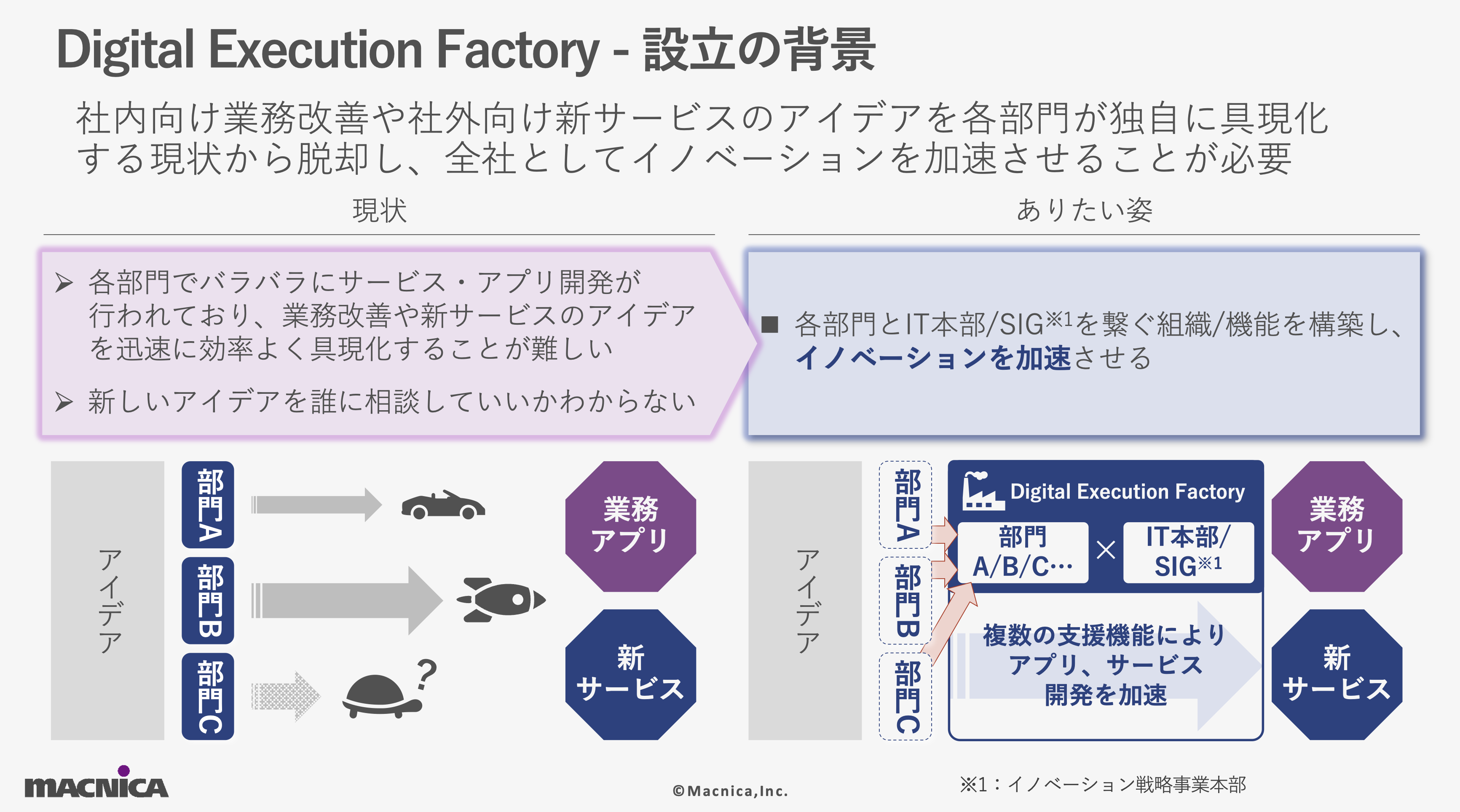
The key here is collaboration between business and IT departments.
Traditional development and service release methods have limitations, including:
- Lack of speed: In the past, it was okay to focus on quality at the expense of costs and time. However, nowadays, if a company cannot quickly keep up with technological advances and market changes, it is highly likely that it will not survive. Also, if it takes too long to release a service, the service may miss opportunities.
- The limits of outsourcing: The approach of "just outsourcing to an SIer when the IT department needs it" cannot keep up with the speed of modern business.
- Dispersion of resources: Even if each department creates new services, implements improvement ideas, and promotes digitalization, this leads to inefficient individual optimization and siloization. Furthermore, capabilities and experience are not accumulated across the organization, resulting in low organizational reusability.
Therefore, by establishing a system where IT and business work together and each department can maximize their capabilities, we can speed up the development of new services and ideas for improving business efficiency, as well as the PDCA cycle, enabling us to release new products one after another.
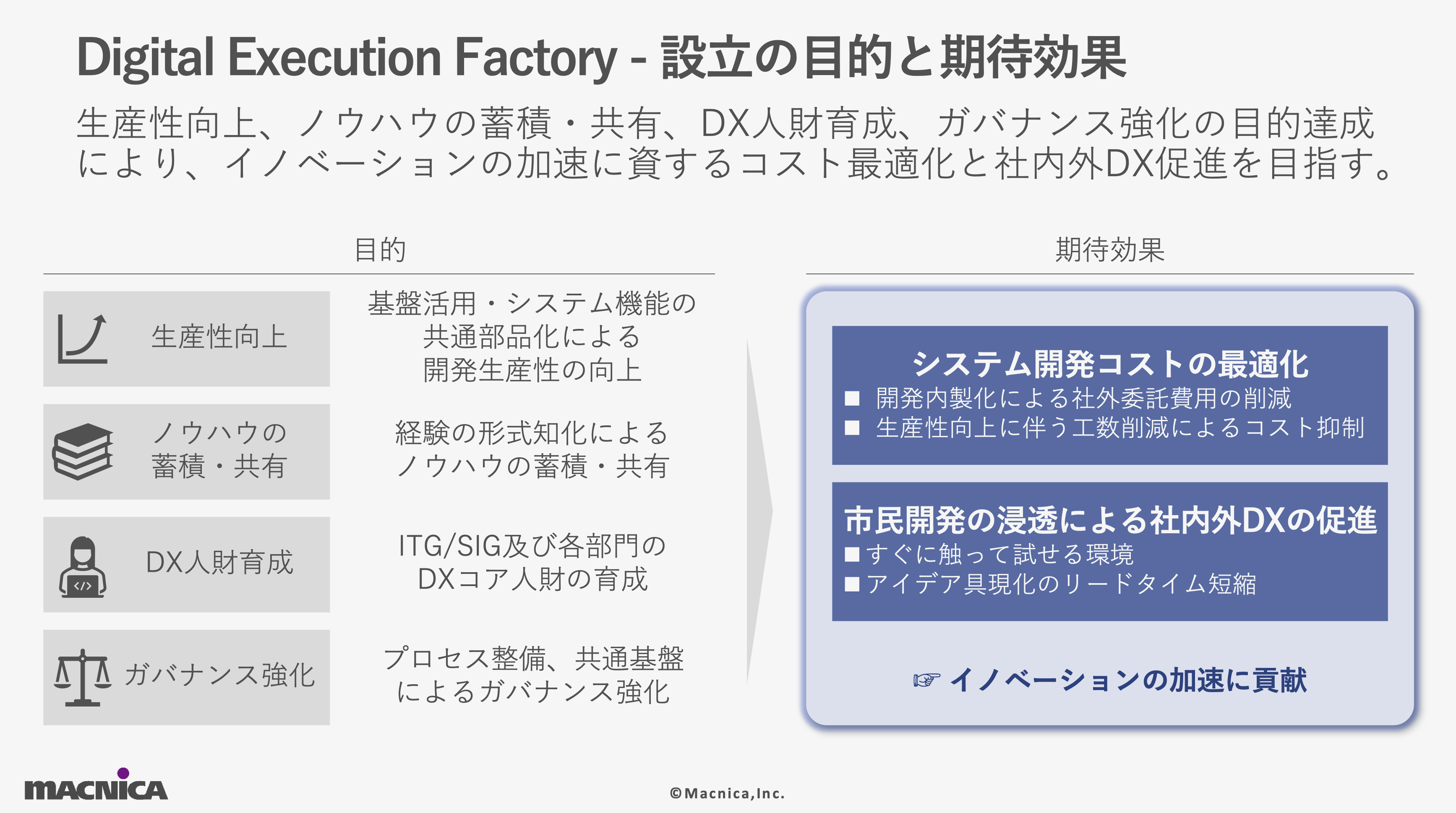
This "mechanism for creating new services quickly, continuously, and in a reproducible manner" is the essence of the Digital Execution Factory.
Furthermore, Digital Execution Factory has a methodology called Digital Execution Practice (commonly known as 5P). This know-how was systematized after much trial and error in a global market where digital transformation is advancing. One of our strengths is that we are the only company in Japan that can optimally adapt this to Japanese corporate culture and provide it.
For an overview of the Digital Execution Factory, please see the article below.
The fusion of IT and Macnica 's efforts to create systems that bring about internal DX and transformation
A "standardized process" to eliminate divisions and conflicts
You mentioned the "structural gap between business and IT departments" as a barrier, but what kind of solution does the Digital Execution Factory offer to this barrier?
Abe: Simply put, the "Digital Execution Factory" can be described as a system for getting the IT and business departments to get along well. It eliminates this gap by systematizing roles and processes for collaborative creation between IT and business.
Simply telling the business and IT departments to get along doesn't move people. Everyone has different ideas, and most of all, they're afraid of DX, which they've never done before. They want a concrete path forward on how to achieve DX.
The Digital Execution Factory addresses this fear by defining, one by one, the roles each party will play in cooperation, the types of personnel and skills required, and how much of them will be needed, and how to create a system that will create synergy, and lays out the path forward.
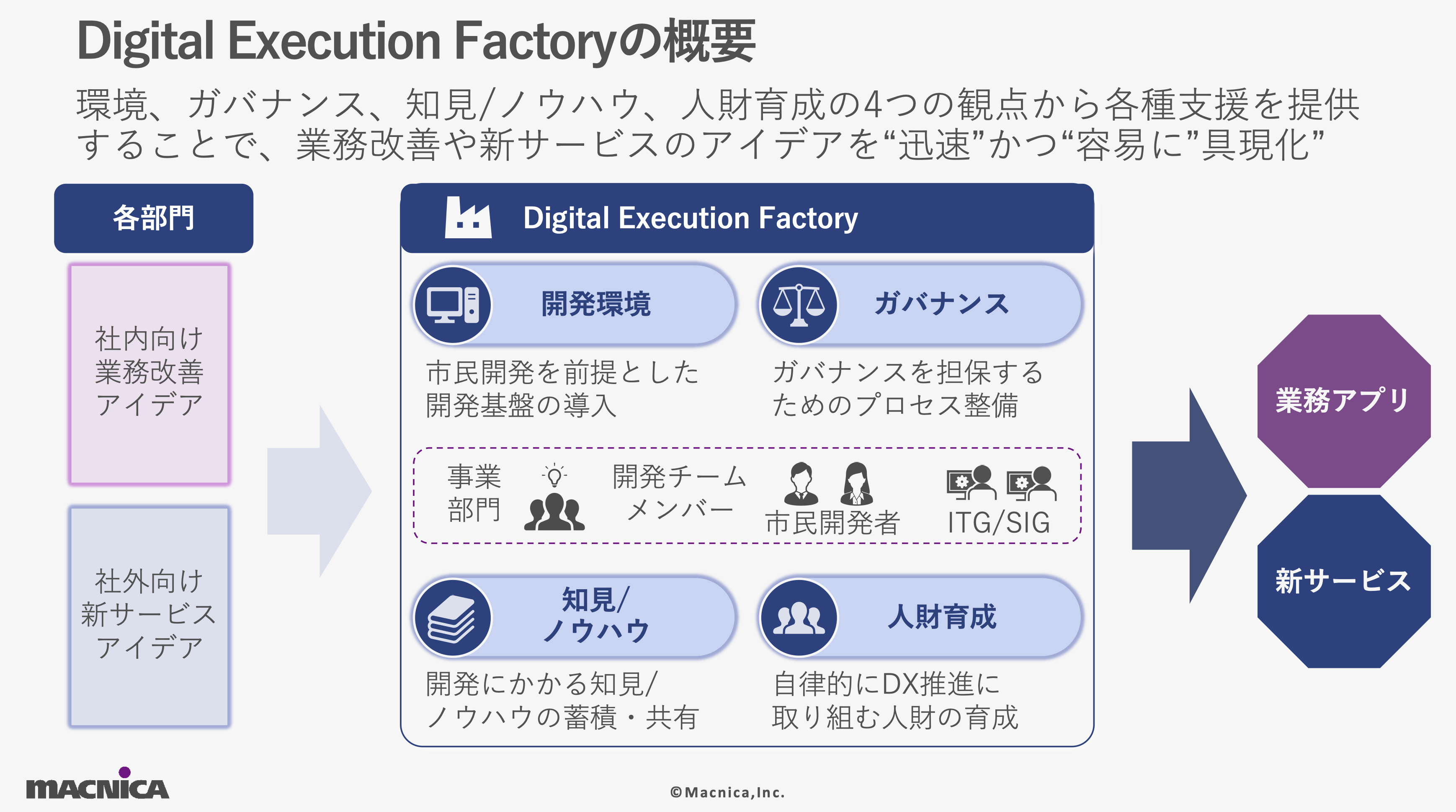
The key to this system is that the roles of these two parties, which have traditionally tended to be in conflict, are redefined as "separation and cooperation of functions."The Digital Execution Factory concept clearly divides roles as follows:
Business Drive Features:
- Ownership: The business department that brings in ideas such as "I want to create a new business" or "I want to reduce inventory" takes ownership of the project.
- Resource concentration: Focus resources on making the business successful, without worrying about behind-the-scenes mechanisms such as governance and security.
Common features:
- Product owner support: To enable business department staff to take the lead in development themselves, we provide training to compensate for lack of experience, and accompany them on practical matters such as process creation and requirements definition.
- Development process support: We provide a wide range of support to business divisions that do not have systems in place for Scrum, from practical support to ensuring smooth agile development.
- Human resource development: To accelerate digital transformation across the company, we will provide practical training and on-the-job training to develop product owners who understand both business and digital aspects and can lead development.
- Governance: To prevent the inefficiencies and risks associated with individual development, we provide common platforms and applications, ensuring security while enabling rapid time-to-market.
In other words, we define roles as "someone who drives the business" and "someone who creates and maintains a system that produces new things with ultra-efficiency." We eliminate this gap by defining these two roles and providing a "path (standardized process)" for them to mesh together.
This system is effective, and indeed, within Macnica, CIO Ando is driving the Digital Execution Factory to bridge this gap. Originally from the IT department of Mitsubishi Corporation, Ando has served as CIO of a business company and president of an IT subsidiary, giving him a deep understanding of both IT and business. Since joining Macnica, he has continued to preach for five years that "IT and business must work together," and has used the Digital Execution Factory to change the organizational structure and lead to DX.
Not only Macnica, but many global companies that are advancing digital transformation also have organizational structures like the one above, where IT and business departments work together. Furthermore, Mendix, the low-code development tool we offer, was originally developed with the idea of "how to connect IT and business," so the know-how to link IT and business departments is highly valued.
We imported this know-how from overseas, and through our own experience both inside and outside the company, we adapted it to suit Japan, and this is what became the Digital Execution Factory.
The significance and concept of the Digital Execution Factory are explained in more detail in the article below.
Macnica Business Unit Heads Discuss Modern DX Promotion
People change to quickly realize the benefits
You mentioned the "Japanese characteristics that are difficult to change because they have refined the current processes" as a barrier, but what kind of solution does the Digital Execution Factory offer to this barrier?
Abe: The Digital Execution Factory breaks down this barrier by encouraging "consensus building through the accumulation of small successes," in line with Japan's emphasis on the tangible (things that can be imagined and understood). As the Japanese manufacturing industry has a term for this, "three realities," DX, which is invisible and highly abstract, is difficult to move forward with and makes problems difficult to solve.
Another characteristic is that it is difficult to make major changes from the top down. In Japanese companies, even if the top says "turn right," the workplace doesn't move. This is because Japanese workplaces have business processes that are like a "secret sauce" that have been added to and improved over many years of trial and error. Therefore, the Western approach of "we're replacing the entire system because the top management's policy has changed" doesn't work.
So how can we reach consensus on the ground? We need to "feel the effects." "Try it out" → "Feel the effects quickly" → "Let's do it properly." This is the process we need to go through.
To achieve this, we need to work quickly and in large numbers in an "agile" format. When we have an idea, we put it into shape in a short period of time, and get a "delightful" experience. This is an approach that expands on this accumulation and leads to overall optimization without falling apart.
People are motivated by the experience of actually releasing an app and experiencing its success. That's why the Digital Execution Factory, which can quickly create this experience, gradually gets people on the front lines and in other departments to take action. In this way, we thoroughly put into practice the words of Isoroku Yamamoto, "People won't move unless you try it, let them hear it, and praise them."
So, although the Digital Execution Factory is a method that has matured overseas, we believe it is actually extremely suitable for Japan.
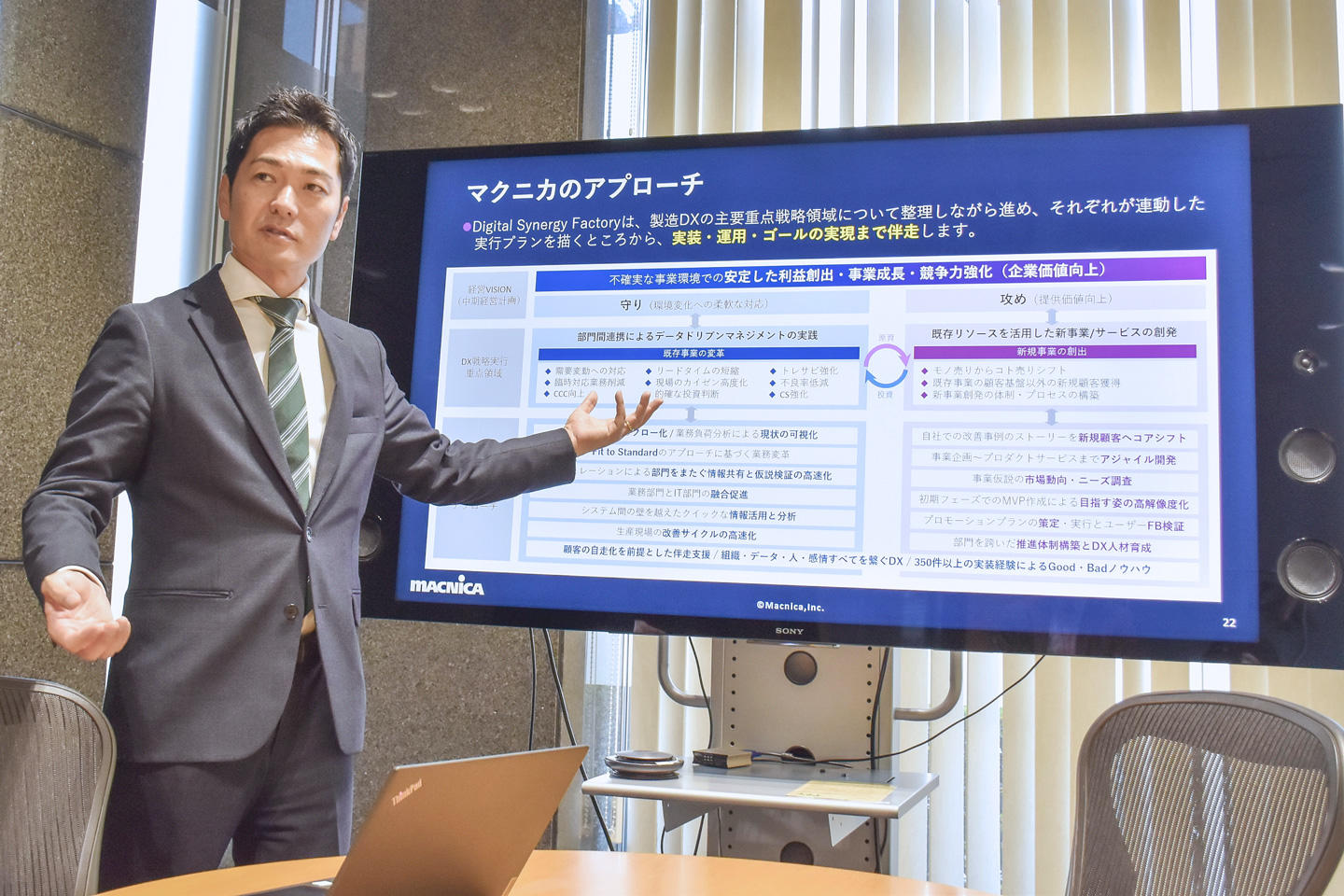
Practical learning born from research and practice creates reproducibility and culture
High reproducibility due to practical learning based on extensive global research and practice
I think one of the features of the Digital Execution Factory is that it allows for highly reproducible execution. Is it really that reproducible?
Abe: It's extremely reproducible because this service is not an idealistic idea, but a systematized know-how established after extensive testing and revision.
It is extremely difficult to create something new from nothing. Creativity and ingenuity are only possible when based on a certain amount of accumulated scientific knowledge. First, introducing a completed reference and then customizing it individually has an overwhelmingly higher success rate and is faster.
The same goes for DX. Everyone can come up with ideals like "It would be nice to have this" or "It should be like this." However, figuring out how to actually put it into practice (how to build it) takes a huge amount of time and trial and error. For many companies, developing DX in-house from scratch is simply too difficult.
Therefore, we import the know-how that has been systematized through extensive research and practice of leading European companies, localize it to suit the Japanese market, and provide it, achieving a proven track record.
In other words, we have a template that has been optimized for Japan based on the vast amount of knowledge that our predecessors have built up over time, and it is designed to ensure success if you follow it exactly. Our offer is also an "enormous time-saver" by providing this template.
This is what underpins the reproducibility of the Digital Execution Factory.
The experience of rapidly repeating trials changes people and becomes a culture
I think that the end result of repeated replication is the development of a DX culture. Will the Digital Execution Factory also lead to the development of this culture?
Abe: It will connect.
First of all, how do we define culture? I believe that "culture is a state that is extremely reproducible and can be carried out as naturally as breathing."
Culture can only be created by people who have had the experience, so we believe that the Digital Execution Factory is a necessary experience for people to have their thoughts and ideas shaped, released into the world, and have an impact.
In the past, only a very small number of people had this original experience of realizing that "the power of IT can change the status quo." However, the more people who have this successful experience, the more an atmosphere of "Let's use IT to change the status quo" is fostered, and this becomes firmly established as a culture.
Speed is key here: you need to run this experience a certain number of times (N) to make it a part of your culture.
Another feature of the Digital Execution Factory is the extremely fast speed at which experience can be gained. If development speed can be quadrupled, then four times as much experience can be gained in the same period. This also speeds up the cycle of reaping benefits.
The key is whether or not you can execute at a high speed. There's no point in spending 10 years building up experience, and the only way to guarantee volume in a short period of time is to increase the speed and increase the number of orders.
Clients who have received support through the Digital Execution Factory have told us that they were surprised by how quickly things took shape, saying things like, "I wouldn't have known until I tried it," and "It's so fast, even I can do it," and that their mindset has changed.
"Seeing is believing," as the saying goes. Even if you understand the theory but couldn't imagine it, seeing and experiencing it for yourself will make it sink in, and you will become a "different person." Conversely, without experience, there is no change. How quickly can you shape ideas and intentionally design aha moments (successful experiences)? This is the key to successful organizational change and culture development.
solution
Digital Execution Factory: Making DX a part of organizational culture in the manufacturing industry
Macnica provides the "Digital Execution Factory" that helps make DX an organizational culture through the following support services:
- Strengthening governance systems that involve the entire company
- Accompanying the CoE, which spans business and IT departments, from concept design to launch and establishment
- A training program for specialists who can lead DX promotion on-site
- Development support using Mendix, a low-code development platform that allows you to gain small successes through agile development
Such
"Digital Execution Factory" is a know-how that only Macnica can provide in Japan, which has been optimized for the Japanese manufacturing industry based on practical knowledge established in Europe and the United States, where DX is advanced. We will accompany our customers, aiming to create a state in which the optimal DX for each customer is "spontaneously and continuously created."