This time, we interviewed Abe, Deputy General Manager of the Digital Industry Division, about the real challenges faced by those responsible for promoting DX in Japan's manufacturing industry, the solution to these challenges, the "Digital Execution Factory," the essence of support for achieving in-house DX, and the driving force behind this down-to-earth support.
In this series, we will introduce "tips for making DX a culture and helping Japanese manufacturing shine on the world stage again," including the evolution of services leading up to the "Digital Execution Factory" that produces reproducible DX, bottlenecks in manufacturing DX, and key points for resolving them. (This article is the first of four in total.)
Interview series
-
Series 1: This article (5 min)
-
Series 2: "A system that transcends division, conflict, and immobility and makes DX a culture"
The optimal solution for manufacturing DX arrived at after many twists and turns
Total support for manufacturing digital transformation
First, please introduce yourself and briefly tell us about your business.
Abe: I'm Abe, the acting general manager of the Digital Industry Division. I manage the business and also support our customers' digital transformation.
Our business involves supporting DX for manufacturing clients. We help clients create systems that allow them to transform their existing business models by utilizing digital and new technologies. Specifically, we provide total support for DX in the manufacturing industry, from actual planning to implementing technologies selected for each company's challenges, and even accompanying clients until results are achieved and in-house development.
After many failures, we have moved towards a system of "thinking together, working together, and achieving results together"
I understand that there were many twists and turns before the service became what it is today. Could you briefly explain the changes the service has undergone since around 2013?
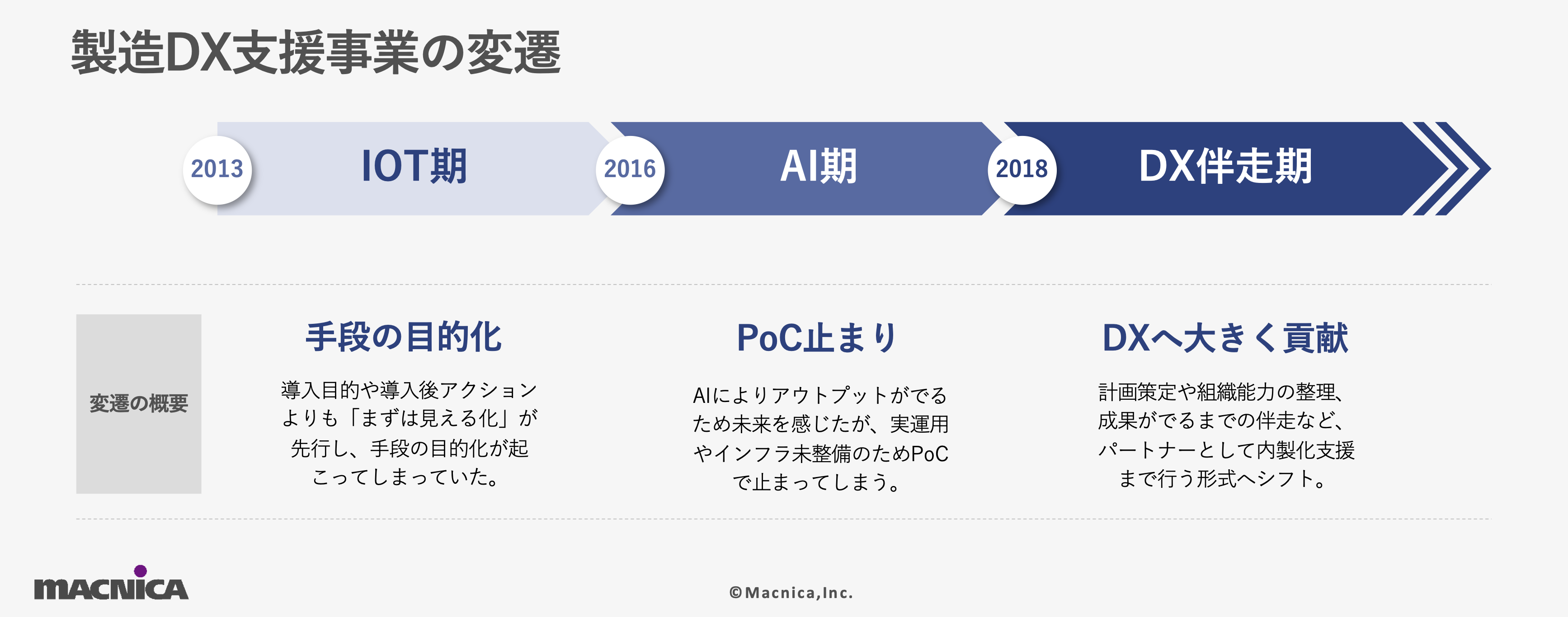
Abe: To sum up, after a period where we focused on supporting the introduction of technology, we have now shifted to a DX partner model where we work together from formulating goals to implementation.
The evolution of our services can be broadly divided into three periods.
The first phase was the "IoT phase," where we worked on visualization using IoT. To be honest, this was quite difficult.
At the time, IoT was booming, and we worked on "visualizing" on-site data, but we faced two major obstacles: "operation monitoring" and "predictive and abnormality detection."
First of all, in "operational monitoring of the entire factory," new and old devices and different models are mixed together, so the technical hurdle of integrating and connecting them is extremely high, and there was an obstacle in that it was difficult to see the cost-effectiveness compared to the effort involved.
On the other hand, although it is technically possible to implement "predictive and anomaly detection," we ran into the following obstacles:
- Ambiguous criteria: The definition of "what constitutes an abnormality or sign" depends on personal judgment, making it difficult to create systematized criteria.
- Difficulty in estimation: It is difficult to estimate the effect of implementation, such as how frequently abnormalities or signs need to be detected before it pays off.
- Lack of action: The operational flow for determining who will take action and how after an abnormality is detected has not been designed.
- Resistance to change: To achieve results, business processes and working styles themselves need to change, but the workplace and the organization do not want such changes.
Certainly, you can't know anything if you can't see it, so "visualization" itself is an essential process. However, there were many projects where the means became the end, with people focusing on "visualization first" rather than "why," without looking ahead to the transformation that lay ahead, and it was a difficult time for businesses.
Next came the second period, the "AI period." This was a time when deep learning attracted a lot of attention, with people saying that "AI is even better at Go and Shogi."
Reflecting on the experiences of the IoT era, both our customers and we have begun to make proposals with a strong awareness of the "purpose" of the proposal. Specifically, this is an area where results, such as improving quality and reducing inventory, have a big impact.
However, here too we hit a wall: we were only able to reach the PoC (proof of concept) stage.
AI was able to produce temporary results even with data created manually using Excel, etc. However, it was not possible to automatically extract data, and a cross-departmental data infrastructure was not yet in place. Even if this could be established after a few years, going so far as to change business processes and work methods would be a major hurdle, just like in the IoT era.
In the end, despite the high hopes that AI would be the future, many projects ended up stopping at PoC and being dismantled before anyone knew it.
After this experience of trial and error, we have arrived at the current third phase, the "DX Accompanying Phase," in which we provide support from conception through to in-house development.
We have shifted to a style of thinking together, working together, and achieving results together, which involves formulating plans based on questions such as "What do we want to achieve in the first place?" and "Where are we headed?", organizing organizational capabilities, and accompanying the team until results are achieved.
Since we changed to this style, the number of customers who trust us has gradually increased, and our "Digital Execution Factory," which we will introduce in the second half of this article, has been able to make a significant contribution to promoting our customers' digital transformation.
─Support for customers during the "DX Accompanying Period"─
The speed limit of DX in the domestic manufacturing industry revealed through years of DX support
"Divided IT departments and business departments" and "resistance to change"
What were some of the major obstacles you faced in promoting DX during this transition?
Abe: There are two main reasons.
One is the structural gap between business and IT departments.
This is a structural gap caused by the difference in organizational roles between business departments, which aim for individual optimization, and IT departments, which are responsible for overall optimization.
For example, if a business division selects a new IT tool that is optimal for its own department in order to promote digital transformation, this may lead to resistance from the IT department.
The IT department has the following concerns:
- "Who will be responsible for operation and maintenance? Does the IT department have the resources to do it?"
- How do you ensure security?
- "How will we collaborate and be consistent with existing vendors?"
Furthermore, when there are multiple such business divisions, the IT department has to maintain all of the tools, which requires a lot of manpower and effort.
In other words, the IT department needs to look at governance as a whole, while the business department and DX promotion department need to select the IT technology that is best suited to DX. There are differences in perspective depending on the role.
However, ideally, the following relationships are required:
- IT department: Understand the business and establish governance that is optimal for the entire organization.
- Business division: Understand IT as a strategy and work with the IT department to avoid partial optimization.
They should truly fit together like the two wheels of a cart, but the fact that this is not the case is the first major issue.
The other is a Japanese characteristic that is difficult to change because the current process has been refined over time.
In other countries, if the top person says "right," things will move, but in Japan, top-down measures are less effective and it is important to gain understanding on the ground. Furthermore, because Japan is good at refining existing processes, there is resistance to changing what is currently in place.
Even when we tried to change business processes for overall optimization, it was difficult to do so. The challenge was that these behavioral patterns and characteristics were not suited to the rapid use of digital technology.
CIOs/CDOs face obstacles even before they reach DX
Most of the clients in this division are DX promotion managers, but I heard that they also have CIOs/CDOs. Are there any issues that CIOs/CDOs face?
Abe: In Japan today, it is rare for corporate transformation to be led by the IT side. This stems from the structural challenges that the CIO/CDO position faces.
To begin with, it cannot be said that the CIO/CDO itself has yet become widespread in society in Japan. In addition, there are cases where the functions and roles of the CIO/CDO are not clearly defined, resulting in the following dilemma:
- Lack of authority: There is no authority to change the business process itself.
- Lack of resources: There are no people or time to implement change.
- Fixed roles: Maintaining existing infrastructure is overwhelming.
- Loss of direction: Even when we are told to "do DX," we don't know what to do.
They may even be seen as merely supporting the business, rather than as the business owner.
In other words, CIOs/CDOs face major challenges even before they can move forward with DX.
solution
Digital Execution Factory: Making DX a part of organizational culture in the manufacturing industry
Macnica provides the "Digital Execution Factory" that helps make DX an organizational culture through the following support services:
- Strengthening governance systems that involve the entire company
- Accompanying the CoE, which spans business and IT departments, from concept design to launch and establishment
- A training program for specialists who can lead DX promotion on-site
- Development support using Mendix, a low-code development platform that allows you to gain small successes through agile development
Such
"Digital Execution Factory" is a know-how that only Macnica can provide in Japan, which has been optimized for the Japanese manufacturing industry based on practical knowledge established in Europe and the United States, where DX is advanced. We will accompany our customers, aiming to create a state in which the optimal DX for each customer is "spontaneously and continuously created."