This time, we interviewed Abe, Deputy General Manager of the Digital Industry Division, about the real challenges faced by those responsible for promoting DX in Japan's manufacturing industry, the solution to these challenges, the "Digital Execution Factory," the essence of support for achieving in-house DX, and the driving force behind this down-to-earth support.
In this series, we will introduce "tips for making DX a culture and helping Japanese manufacturing shine on the world stage again," including the evolution of services leading up to the "Digital Execution Factory" that produces reproducible DX, bottlenecks in manufacturing DX, and key points for resolving them. (This is the third article in a four-part series.)
Interview series
-
Series 2: "A system that transcends division, conflict, and immobility and makes DX a culture"
-
Series 3: This article (5 min)
Macnica 's supportive capabilities to achieve "true in-house production"
Only Macnica can provide true in-house support by transferring know-how
I believe that in order to foster repeatability and a culture, it is important not only to have know-how, but also to have DX experts accompany you. How does Macnica 's accompaniment differ from general DX support services?
Abe: To sum up the characteristics of our support, we don't leave strategies and visions as pie in the sky, but rather we think, worry, and get to work together to make the system familiar to the customer, standing beside them to make DX part of their DNA.
In transformations like DX, where there is no right answer, it is rare for things to go according to plan, so execution is just as important as planning. However, it is not enough to simply create a system in order to execute. We need to accompany our customers through strategy, execution, and implementation, so that they can transform on their own, and that is where we specialize.
The essence of DX is "corporate transformation." To keep up with this rapidly changing era, we must have an internal engine for transformation. Rather than relying on external parties forever, we need to take the reins ourselves.
That is why, as a "partner" in transformation, we stand "side" with our customers to think, worry, and move forward together, and are committed to transferring all of our know-how and knowledge.
In fact, customers have told us, "We feel reassured that we are not being forced to do what is best, nor are we being left to do everything ourselves. We explore the world we are aiming for together and get closer to it. I feel like we can overcome any barriers with Macnica." This is what encourages us more than anything.
As a member of the team, we worry and sweat together
From that position, how exactly do you gain trust and bridge the gaps between departments and get people who aren't moving forward?
Abe: To gain trust, we are conscious of acting as "team members on the same boat." We don't just say it, we get to work together and become part of the team.
I believe there are different types of trust, and while there is trust based on the outcome of "delivering a good product," what we aim for is a deep relationship of trust that is built on a shared process of "working hard together and thinking things through together." As a result, we receive feedback from clients that makes us very happy, such as, "I never thought you would work with us to this extent," or "I've never found a partner who not only provides technical support and mentoring, but also works with us on the nitty-gritty aspects."
To build this relationship of trust, we take the following two specific approaches:
- Open communication and generous provision of information: "People who don't disclose information won't be trusted" is an ironclad rule. We provide raw information, including reproducible know-how and examples of failure. Furthermore, it is important that not only ourselves, but also the promoters who work with us are trusted within the company, especially when supporting in-house development. By being open and not concealing information and know-how, we will not only gain trust ourselves, but also contribute to gaining the trust of the DX promoters within the company.
- Feedforward (early involvement): People won't act if you simply say, "We've solidified it to a certain extent. It's been decided. Please do it." That's why it's important to share information as early as possible and get people involved from the early stages. Co-create by sharing their concerns and hopes. By doing so, a sense of ownership and attachment to the project will gradually be fostered, which will ultimately lead to the elimination of gaps and conflicts.
We believe that this steady effort has built trust, bridged the gap between departments, and led to the resolution of conflicts.
Furthermore, in terms of how information should be disclosed, the "Digital Execution Practice" Promotion that we provide also stipulates how information should be disclosed, as the provision of information and know-how is highly valued not only in Japan but also overseas.
For example, we use a method of disclosing information while giving it a story. When implementing the first project, even if it is a small one, we give it an important story for the company, instilling values like internal branding, and gaining the trust and cooperation of the entire organization.
Many customers already understand the importance of internal promotion in these DX projects. However, when it comes to actual projects, promotion is even more important than previously thought. In fact, Macnica CIO Ando said, "I understood the importance of promotion, but I didn't realize it was necessary to this extent." The Digital Execution Practices, which define each and every aspect of this promotion, are truly powerful.
About the Digital Execution Practice (external site)
Disparities and conflicts cannot be resolved overnight. We will move forward step by step by combining steady support with know-how and systems such as the Digital Execution Factory and Digital Execution Practice.
In summary, we stand beside our customers as their actual members and build trust with each of them. We work together with our clients through trial and error, starting from the process. Furthermore, we promote value throughout the organization while implanting a system that allows the client to operate independently. This is the essence of our support.
Accompanying the DX promotion manager to shape their vision through visualization and conversation
What do you do to support those responsible for promoting DX, including CIOs/CDOs?
Abe: First, we need to clarify what is missing.
The majority of people in charge of promoting DX, including CIOs and CDOs, have a vision. However, the theme of DX is very broad and difficult to grasp. Listening to their stories, it seems like a very difficult situation where "there are things I want to do, but there are various things that are lacking."
So we sometimes start by clarifying what capabilities are currently lacking and working together to fill those gaps. Of course, we listen to your concerns, but I think the first big relief is actually knowing "what you're lacking and to what extent."
At our company, we use something called "maturity analysis" to visualize this, and this alone helps us organize our customers' situations and determine the priorities of what needs to be done.
Another important thing is to "deliberately design in waste (small talk)."
I once had a "chat without a set theme" every Friday evening for about a year with an Member of the Board in charge of promoting DX. During this time, casual conversations like "Oh, that reminds me, this happened" or "I heard this from the field" often led to realizations like "Actually, that's the most important thing."
On the flip side, I think this also leads to the question of whether you can see what's important from the beginning. Of course, meetings with set themes and daily scrums are necessary. However, it's precisely because it's casual conversation without a set theme that you can realize that something you didn't think was important at first is important once you start talking about it.
Especially in new projects like DX, where not everything is clear from the start, it is important to design in waste and margins. Things that can only be noticed from this will become important pieces in achieving the vision of those responsible for promoting DX, including CIOs/CDOs.
I think one of our features is that we can provide this kind of support.
DX is difficult, so it's important to have that mindset
The true nature of Macnica 's people, whose long-standing customers unanimously say, "I want to work with you again"
Many customers cite Macnica 's "personality" as the reason they continue to use the service. If you break down this "personality," what specific actions and stances does it represent?
Abe: It's a little embarrassing, but in one word, it's "bright, fun, and energetic." "Bright, fun, and energetic, open, flat, and fair." This is like our company's motto, and I think it's really important to interact with people with this stance.
This is because the digital transformation we are working on is fundamentally "difficult." Of course, it is rewarding, but changing the status quo still involves a great deal of stress.
In the first place, if you're happy now, there's no need to change. But you have to because you feel a sense of crisis that "if we don't change, we won't survive." In other words, the project starts in a "high-stress state" from the very beginning.
Our clients are already gritting their teeth and working hard to make changes, and if we too were to look like we were struggling, it would be disheartening for them. It is people who carry out reforms. If the people who are carrying out the reforms give up, the reforms will never be realized. Furthermore, we believe that the time spent working together should not be painful.
So, our customers often tell us that we have nice people, but this is not because we are a group of good people with good character and good personalities.
I believe that interacting with people in a bright, fun, and energetic manner, and creating psychological safety, is important so that they can overcome the challenges of DX and approach the project in a positive manner, and I believe this is the true essence of the "personality" that our customers refer to.
solution
Digital Execution Factory: Making DX a part of organizational culture in the manufacturing industry
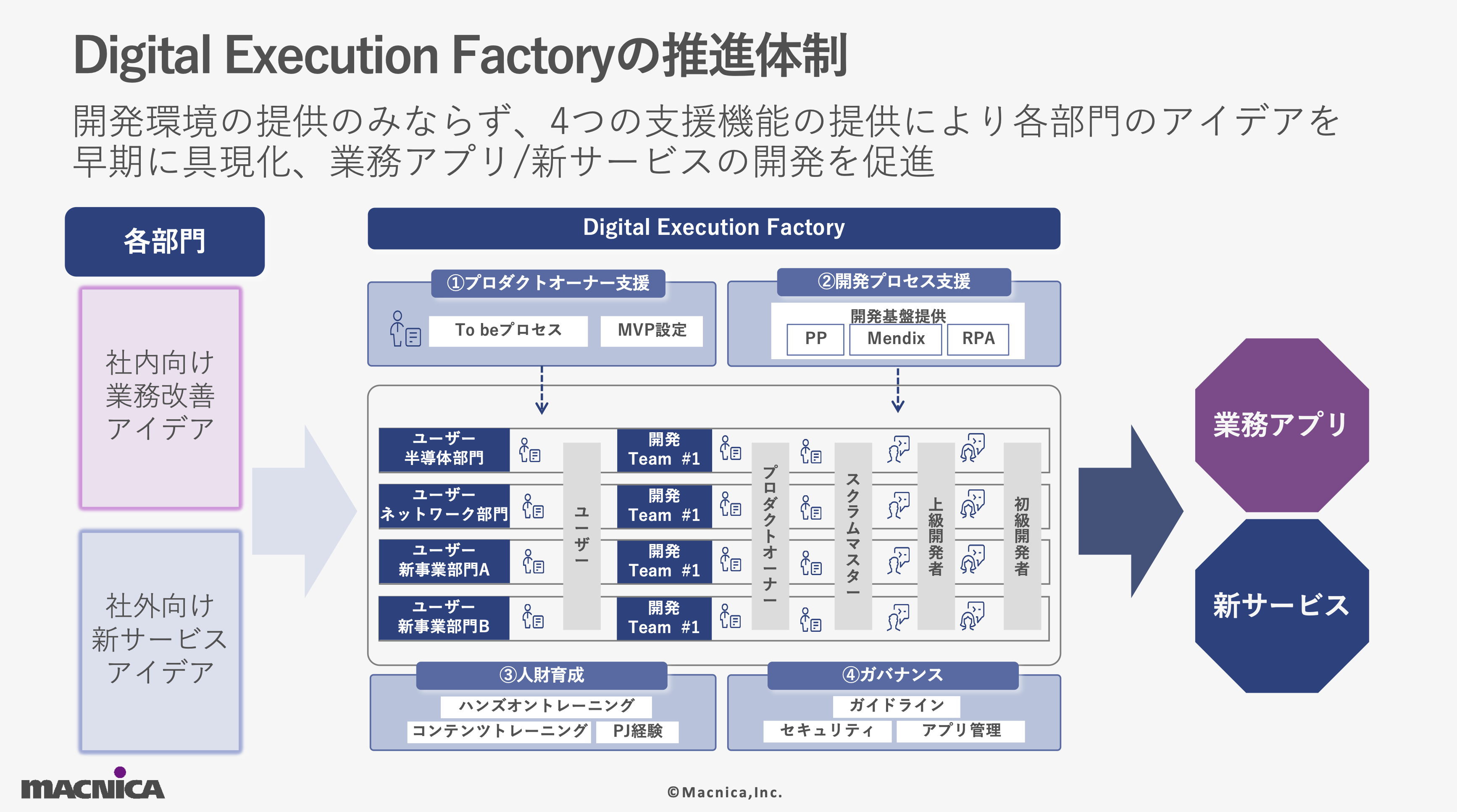
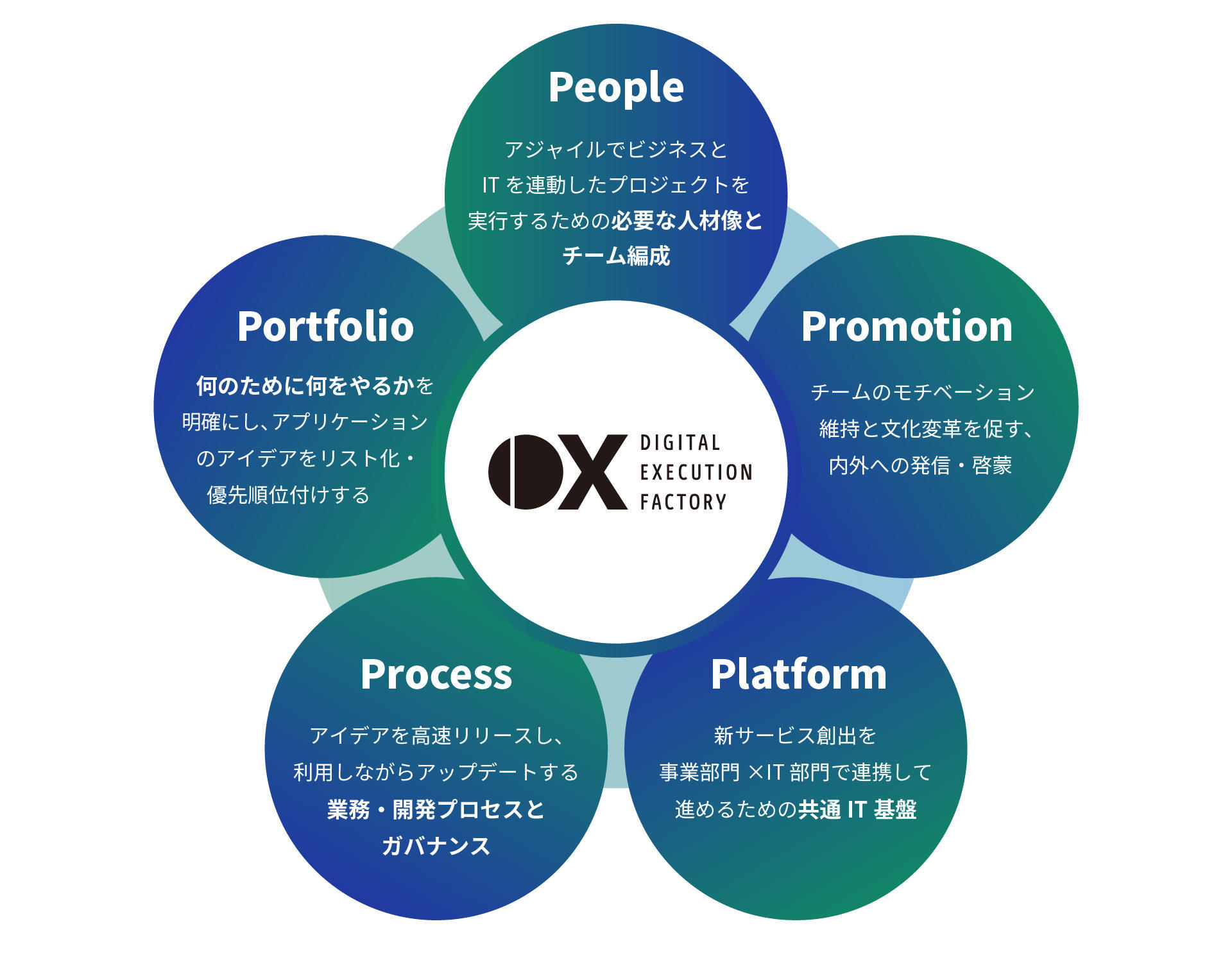
Macnica provides the "Digital Execution Factory" that helps make DX an organizational culture through the following support services:
- Strengthening governance systems that involve the entire company
- Accompanying the CoE, which spans business and IT departments, from concept design to launch and establishment
- A training program for specialists who can lead DX promotion on-site
- Development support using Mendix, a low-code development platform that allows you to gain small successes through agile development
Such
"Digital Execution Factory" is a know-how that only Macnica can provide in Japan, which has been optimized for the Japanese manufacturing industry based on practical knowledge established in Europe and the United States, where DX is advanced. We will accompany our customers, aiming to create a state in which the optimal DX for each customer is "spontaneously and continuously created."