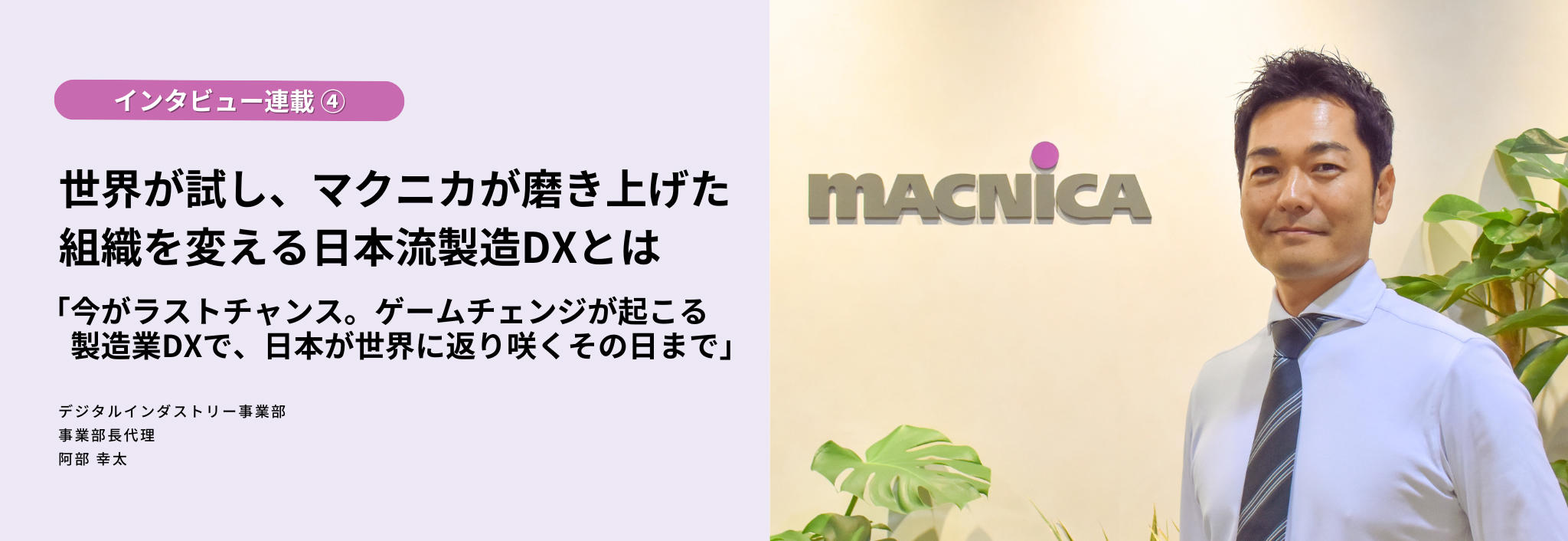
This time, we interviewed Abe, Deputy General Manager of the Digital Industry Division, about the real challenges faced by those responsible for promoting DX in Japan's manufacturing industry, the solution to these challenges, the "Digital Execution Factory," the essence of support for achieving in-house DX, and the driving force behind this down-to-earth support.
In this series, we will introduce "tips for making DX a culture and helping Japanese manufacturing shine on the world stage again," including the evolution of services leading up to the "Digital Execution Factory" that produces reproducible DX, bottlenecks in manufacturing DX, and key points for resolving them. (This is the fourth article in a four-part series.)
Interview series
-
Series 2: "A system that transcends division, conflict, and immobility and makes DX a culture"
-
Series 4: This article (5 min)
Beliefs and driving force as a true DX partner
A true DX partner is someone who says, "I want to work with you."
Nowadays, many companies call themselves DX partners. What do you think a "true DX partner" is?
Abe: The objective variable and explanatory variable are the same, but I think it's about being a "partner" in the truest sense. It's not just a relationship of ordering and receiving, but someone who says they want to work with us. It's about being "comrades" and a "team" who are willing to try something new together.
The background to this idea is the changing times. With the evolution of various technologies, including generative AI, we now live in an age where there are countless ways to do anything if you want to. It is no longer easy to differentiate in terms of "what can be done" technologically. In an age where the means (how) have become commoditized and there are many, the final criterion for selecting customers will likely be "who you want to work with."
At that time, do we have enough value to make you think of us? When asked "who should we work with?", we want you to say "I want to work with you." This is the kind of partner we aim to embody, and we believe it is the key to surviving in the coming era.
Only do things that are truly valuable
What is the one belief that you would never compromise when dealing with customers?
Abe: "We won't do anything unless it's valuable to our customers." This is also our belief at Macnica.
Sometimes it can be difficult when people look at us with a cynical attitude, saying things like, "But you really want to sell something, don't you?" (laughs), but our policy is clear: we don't "sell what we want to sell," but "sell what is effective (take effective initiatives)."
There is one point here that I absolutely do not want to compromise on.
It's about how committed we are to our customers' success (happiness). To put it bluntly, if we don't think that introducing a product will make the customer happy, we won't sell it to them even if they say they want to buy it.
Providing true value rather than short-term sales is a belief I will never compromise on.
I don't want to create a society where people who work hard end up exhausted and losing out.
Mr. Abe, why are you so passionate about "manufacturing digital transformation"? Please tell us what motivates you.
Abe: In a nutshell, my driving force is my strong desire to avoid creating a society where people who work hard with ambition simply end up exhausted and losing out.
Macnica 's original business was to provide various cutting-edge technologies from around the world to Japanese manufacturing customers. However, as we worked on projects together with our customers, we began to realize something.
One is that the more technology advances, the more important it is to have a clear purpose and vision of what you want to achieve, rather than just "bringing the best technology" in order to achieve your customer's objectives.
Another thing is that what determines the success or failure of a project is people, not technology.
In the end, we are all human beings, whether we feel happy when we achieve something or sad when things don't go well. The clients we deal with have a strong sense of mission and responsibility to improve their companies, and they live under incredible pressure. Changing the way things have been done up until now places a tremendous amount of stress on the organization. This can essentially make them targets for attack. They'll often say to you, "Why do we have to do this?" or "It's a pain," or they'll support you on the surface by saying, "That's a good idea!" but behind the scenes they'll hold you back. I've even received calls from clients crying at night.
When I come into contact with people who continue to move forward despite being hurt in this way, I want them to succeed. I don't want our society to become one in which people who work hard with their own will and sense of mission end up losing out or simply becoming exhausted.
That's why we think together about what we really want to do, fight stress together, create success stories together, foster a culture, and lead to change. To do this, we thoroughly engage with people and become partners in realizing their ambitions.
I'm not the only one who has realized this role and how much fun it is, and is becoming absorbed in it. I think most of our business members are doing it with the same kind of feeling.

Japan's manufacturing industry is just beginning
Now is the last chance for Japanese manufacturing to make a comeback on the global stage
Finally, please give us a message.
Abe: I believe that now, when global technological trends and Japan's strengths are beginning to mesh, is the perfect time and opportunity for Japanese manufacturing to shine on the world stage once again.
Up until now, DX has been the "first round," so to speak, of infrastructure development and creating something from nothing. To be honest, Japan, which is not good at large-scale investments or rule-making, has fallen behind in this area.
However, as technology has matured, the situation and the rules of the game have changed. From here on, we will enter the "second round" of mastering existing technology and improving quality. This is an area in which Japan excels, and we have a good chance of winning.
There are three main reasons why now is the time.
One is the elimination of "infrastructure handicaps" through technological advances.
In the past, the key to success was whether or not you could develop a large-scale, company-wide digital infrastructure. However, advances in technologies such as low-code platforms and generative AI have simultaneously increased the sophistication of technology and lowered the barriers to its use. In other words, we now have an environment in which you can start by simply "using" advanced digital data, even if your infrastructure isn't perfect.
This has enabled Japan to use its strengths in on-site ingenuity to bridge the gap in areas where it is weak, such as investment and infrastructure development involving large-scale changes.
In other words, the playing field is changing.
It's important to note that this doesn't mean that infrastructure development is not necessary. Technological advances have made it possible to do a variety of things even without perfect data infrastructure. We can start with what can be done without perfect infrastructure, and once we see results, we can begin to develop infrastructure. In other words, Japan could undergo even greater change if it entered a loop of "utilizing technology locally → achieving results → developing infrastructure → further utilizing technology → achieving results → developing infrastructure."
Secondly, it allows us to utilize the characteristics of Japanese people as strengths.
I think Japanese people have a tendency to be reluctant to act based on image alone. That's why they started late. However, now that the image of DX is taking root in society, the idea of "this is what DX is" has become widespread. In other words, the pace will be fast from here on out.
In addition, the Japanese people's "seriousness in faithfully carrying out what has been decided" and "honest ability to execute and improve" are also great weapons.
"Execution ability" means accurately executing processes defined digitally in the real world. And precisely because of this accurate execution, "improvement ability" allows for rapid PDCA to close the gap between forecasts and actual results (digital and real).
First of all, if you can't execute accurately, you can't perform accurate analysis to match your forecasts and results. This will lead to people saying, "You weren't doing it properly in the first place." And once the discrepancy is identified, you have a very high ability to make improvements to eliminate it. And the trait that supports this is "seriousness."
In other words, Japan can demonstrate overwhelming strength in this process of implementing the obvious things in an obvious way, working toward an image of what is possible, and accelerating the improvement of quality.
Finally, hospitality will increase the value of data assets.
Japan has a culture of "omotenashi" (hospitality) where customers are treated individually, and a wealth of experience in face-to-face communication.Until now, this "unstructured data (customer's raw words and interaction history)" has been considered inefficient overseas, but it can now be analyzed and utilized using the latest technology.
This is a unique asset of Japan that cannot be imitated overnight by overseas countries that have not been able to maximize efficiency and spend time with each individual customer, and I believe it will be a factor in adding value and differentiating the last mile. This is my third reason.
Looking back at history, Japan has dominated the world not by "creating something from nothing" but by "maximizing the quality of what we have and making full use of it (mass production and improvement)," in other words, by the "second round." The rules of the game have changed in DX as well, and now that we've entered the second round, I believe this is the last chance to transform organizations through Japanese-style DX.
The reason why it is last is because overseas leading DX companies are paying attention to and starting to learn from Japan's points mentioned above. Furthermore, the second round is Japan's forte, and losing here would be a major defeat.
Therefore, it is dangerous to become complacent and think, "This is our time." They have already established the infrastructure, and DX in terms of standardization and efficiency is mature. Seeking further growth, they are paying attention to incorporating Japan's strengths with a humble attitude.
In other words, we must not miss this opportunity, and aim to once again have Japanese manufacturing dominate the world, by continuing to support Japanese manufacturing in increasing its international competitiveness as a "catalyst that combines Japan's strengths with cutting-edge technology." This is our vision.
solution
Digital Execution Factory: Making DX a part of organizational culture in the manufacturing industry
Macnica provides the "Digital Execution Factory" that helps make DX an organizational culture through the following support services:
- Strengthening governance systems that involve the entire company
- Accompanying the CoE, which spans business and IT departments, from concept design to launch and establishment
- A training program for specialists who can lead DX promotion on-site
- Development support using Mendix, a low-code development platform that allows you to gain small successes through agile development
Such
"Digital Execution Factory" is a know-how that only Macnica can provide in Japan, which has been optimized for the Japanese manufacturing industry based on practical knowledge established in Europe and the United States, where DX is advanced. We will accompany our customers, aiming to create a state in which the optimal DX for each customer is "spontaneously and continuously created."