What is a Smart Lifecycle Contract (SLC)?
Downtime caused by equipment failure not only reduces productivity but can also have a serious impact on business operations. Particularly for equipment that has been in operation for a long time, obtaining parts and carrying out repairs takes time, making the time until recovery a major issue.
Siemens' Smart Lifecycle Contract (SLC) is an annual service contract designed to address these challenges. By signing the contract, Siemens will stock all applicable Siemens products in its domestic warehouses, establishing a system for immediate delivery. This enables rapid recovery in the event of a breakdown, significantly reducing equipment downtime. Furthermore, because companies no longer need to keep expensive parts in stock, financial benefits are realized, such as reduced inventory management costs and the elimination of the need to account for assets.
Main benefits of the contract
| Item | Value gained by customers |
|---|---|
| Quick recovery in the event of a breakdown | Even if the equipment breaks down, it can be shipped immediately from our domestic warehouse, significantly shortening the time to recovery and minimizing losses due to production stoppages. |
| No inventory management required | There is no need to store expensive spare parts in-house, reducing the effort and costs of inventory management and the burden of capital accounting. |
| Quality-assured storage environment | Parts are stored in a temperature and humidity controlled environment, so quality is maintained even during long-term storage, allowing for safe use. |
| Use of optional services | By adding regular inspections, training, and digital services (measurement, diagnosis, backup, preventive maintenance, visualization of production processes, etc.), you can ensure stable equipment operation and improve your technical capabilities. |
Target users
Differences in response depending on whether or not there is a contract: How does having an SLC change things?
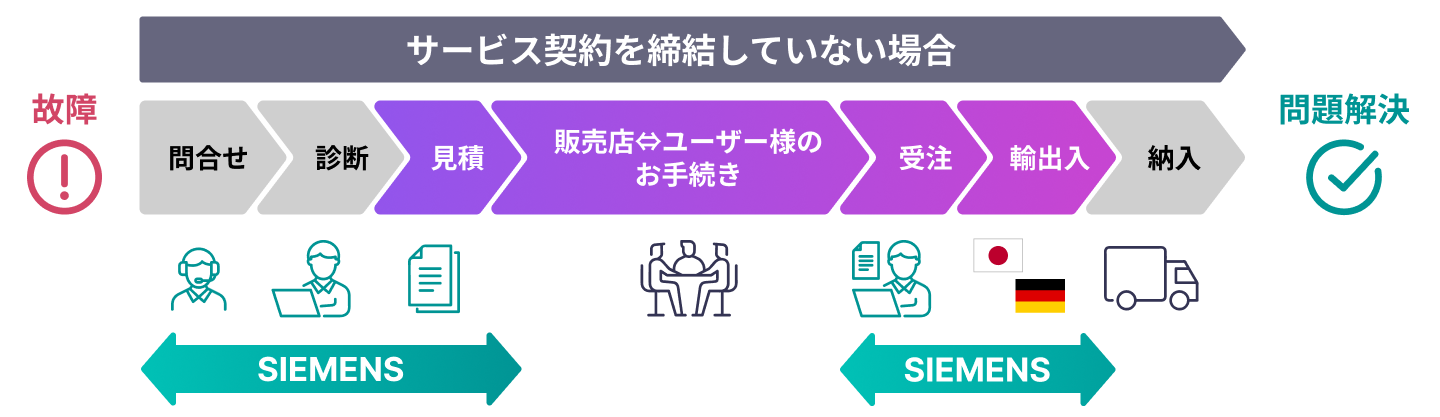
When equipment breaks down, the speed and burden of response will vary greatly depending on whether or not an SLC (Smart Lifecycle Contract) has been concluded. As shown in the diagram below, the process leading up to recovery will differ greatly depending on whether or not a contract has been concluded.
If you don't have a contract
When a breakdown occurs, the user first contacts the dealer, who then relays the information to Siemens. After that, the parts are finally delivered after going through multiple steps, including diagnosis, quotation, arrangements, orders, import and export, etc.
If you have an SLC agreement
When a failure occurs, Siemens already has information about the contract, affected parts, and equipment, which allows parts to be shipped from our domestic warehouse immediately after diagnosis, significantly shortening the time to recovery.
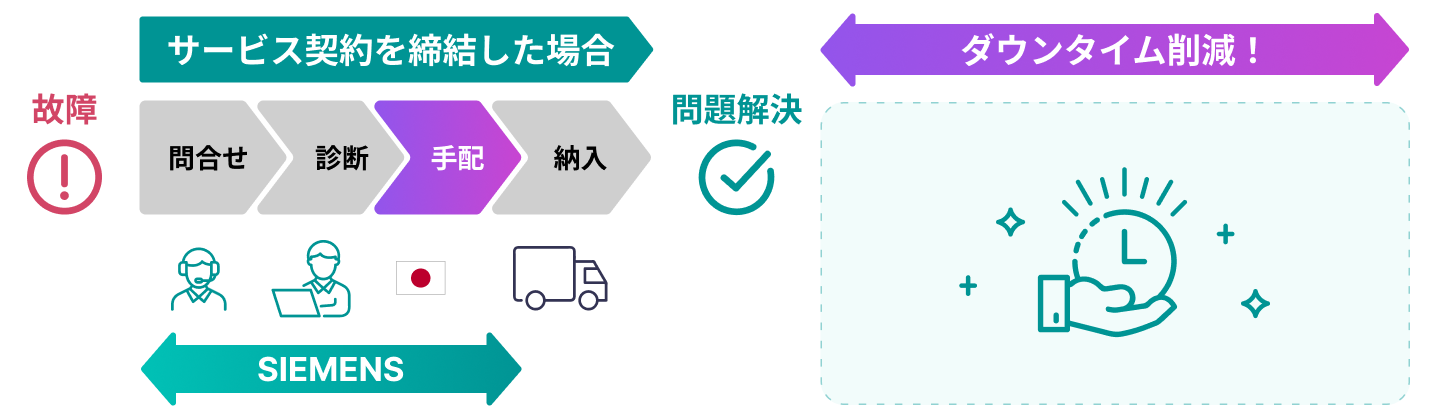
Comparison with and without SLC contract
| Comparison item | No contract | SLC contract available |
|---|---|---|
| Siemens begins support | After receiving information after a failure | Facility information is already known at the time of signing the contract |
| Parts Arrangement | Quotes and orders on a case-by-case basis | Immediate delivery of contract parts |
| deadline | Prolonged due to imports and exports | Immediate shipping from domestic warehouse |
| Downtime | Possibility of prolonged | Can be significantly shortened |
Contract details: Target parts and selectable service configurations
SLC (Smart Lifecycle Contract) is a flexible contract model that supports stable operation of equipment by keeping parts in stock and providing immediate delivery, while also allowing for the addition of optional services as needed.
Contract parts target categories
With an SLC contract, you select one of three contract plans (S, M, or L) depending on the type of parts covered. The contract period can be selected from an initial 3-year or 5-year period. As shown in the diagram below, the contract plans are organized in a way that they can be expanded in stages depending on the configuration of parts.

These are components related to the operation and control interface, and form the basic operating system of the device.

This is a group of parts used to control motors and drive devices, and supports power system maintenance.
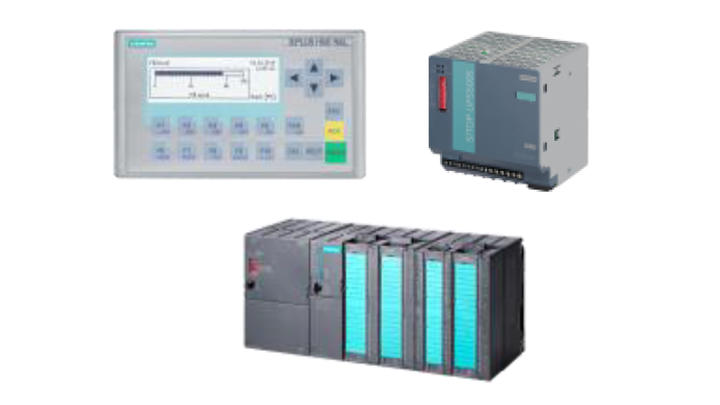
This control device is the core of the control panel and is an important element in managing the operation logic of the equipment.
Optional services (can be added)
Optional services that can be added to the contract improve the quality of maintenance and support preventive maintenance of equipment and improving technical capabilities.
| Option Name | content | Expected effects |
|---|---|---|
| Regular inspection | Regularly check the status of the equipment and help detect abnormalities early | Preventing breakdowns and improving the accuracy of maintenance plans |
| training | Providing technical training on maintenance and operation | Raising the level of in-house technical capabilities and standardizing responses |
| Digital Services | Measurement, diagnosis, backup, preventive maintenance, visualization of production processes, etc. | Detecting signs of trouble, visualizing equipment operating status, and improving maintenance efficiency |
Inquiry
If you have any questions about this service, please contact us using the form below.
Go to Siemens OT (Operational Technology) product page
If you are interested in Siemens OT (Operational Technology) products, please visit the following page.