While DX is becoming more widespread, many companies are unable to determine what they need to transform and end up just implementing the technology. Behind this lies the issue of not fully understanding the difference between the essence of DX and digitalization, and being bound by thinking that is an "extension of the past."
This time, we will bring you a perspective on rethinking DX from a lecture by Eric Matsunaga Masafumi, Dean and Professor at Aoyama Gakuin University.
*This article is based on a speech given at the "Executive Knowledge Sharing Forum - Beyond DX, sparked by excitement and empathy" held by Macnica on Thursday, November 27, 2025. Part 2 features a conversation between Yuichi Sukematsu of Ebara Corporation and Kota Abe, evangelist for the Digital Industry Division Macnica
[Speaker information]

Dean and Professor, Aoyama Gakuin University
Eric Masafumi Matsunaga
Why I Talk About Digital Transformation: A Career Spanning Music and Technology
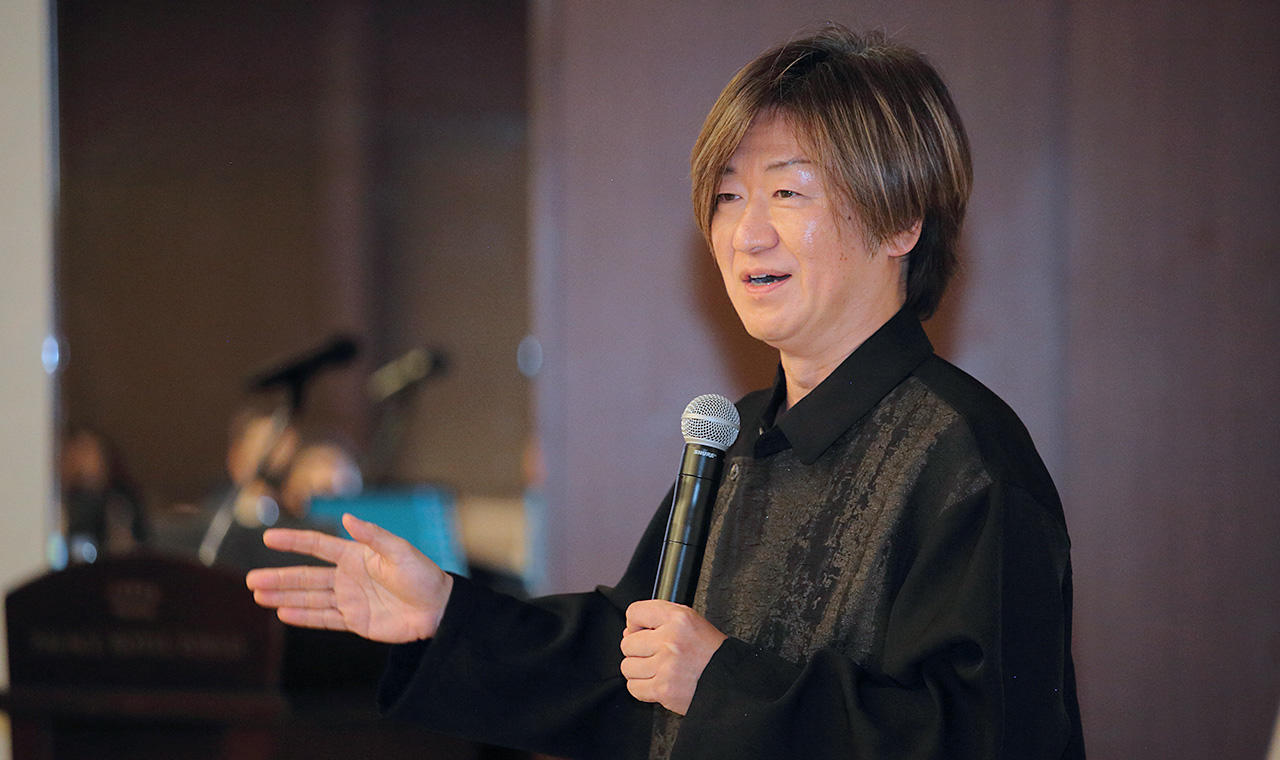
What I want to talk about today is not just the technical aspects of how to proceed with DX. My goal is to help you understand what DX is and its essence in the first place, so that you can bring about fundamental transformation in your own business.
Furthermore, I would like to introduce "artist thinking" as one lens through which to rethink DX as "innovation" rather than simply digitalization and come up with various ideas.
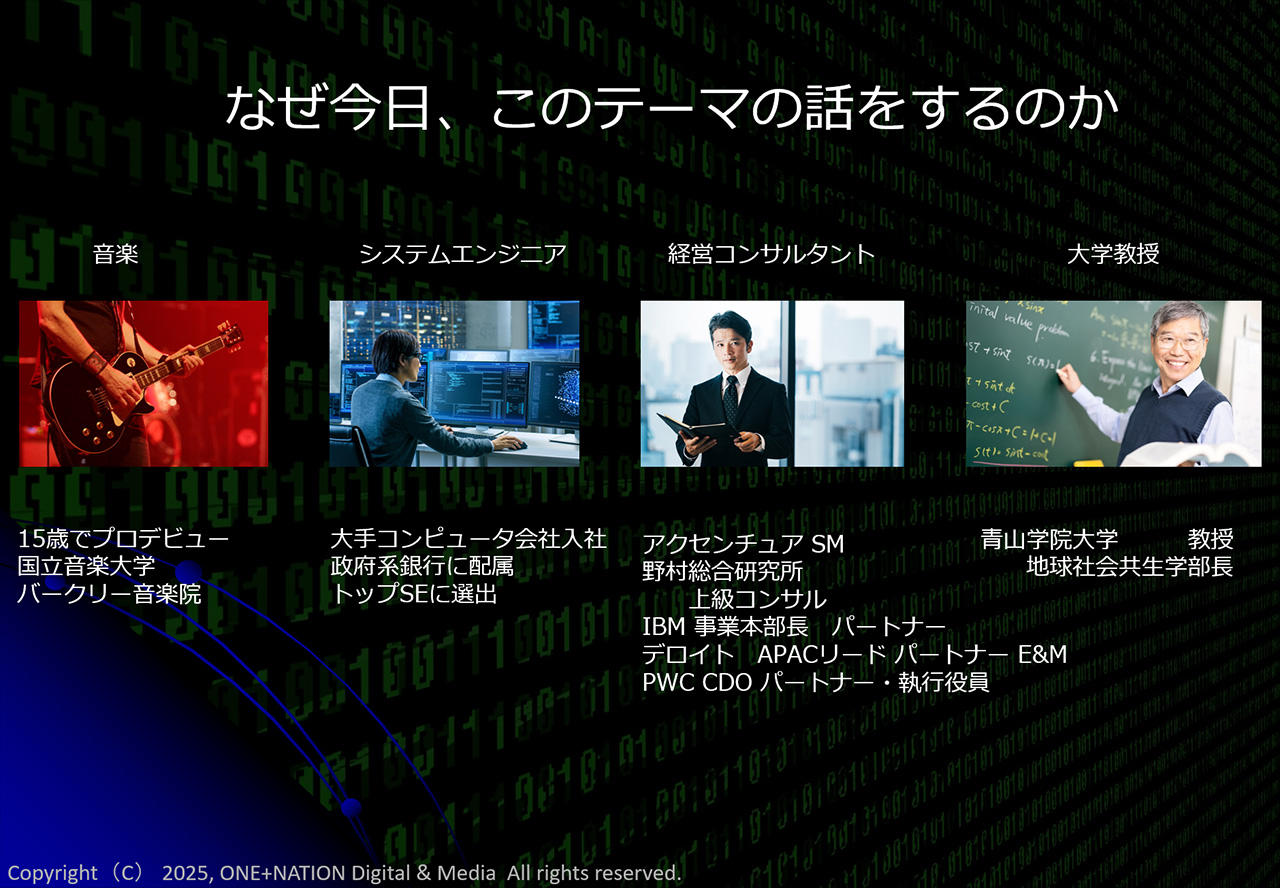
To explain why I'm talking about this topic, let me first give you a little background. My roots are in music. I made my professional debut in my third year of junior high school and have supported a wide range of artists, from enka to idols. I studied composition and jazz at Kunitachi College of Music and Berklee College of Music, and have been active at the forefront of fashion as a professional.
However, feeling that there were limitations to my musical activities in the US, I decided to re-enter Aoyama Gakuin University with the desire to work professionally with a different perspective, and embarked on a career as a systems engineer. After that, I was involved in the design of large-scale networks spanning the world at AT&T, which gave me the wonderful opportunity to work on a global stage.
Later, wanting to get involved in management, I studied for an MBA and built a career as a business consultant at Accenture, Nomura Research Institute, IBM, and Deloitte. I experienced a variety of projects, from launching a partnership in the entertainment x technology field to launching cutting-edge media, and witnessed cutting-edge "customer-centric" transformation firsthand. Amid the trend toward digital transformation, I was tasked with launching a digital division at PwC, and eventually served Member of the Board of digital management for the entire group.
My experience working in both music and technology has become a major foundation for my view of digital transformation.
What is DX? Thinking from the perspective of the future, not digital
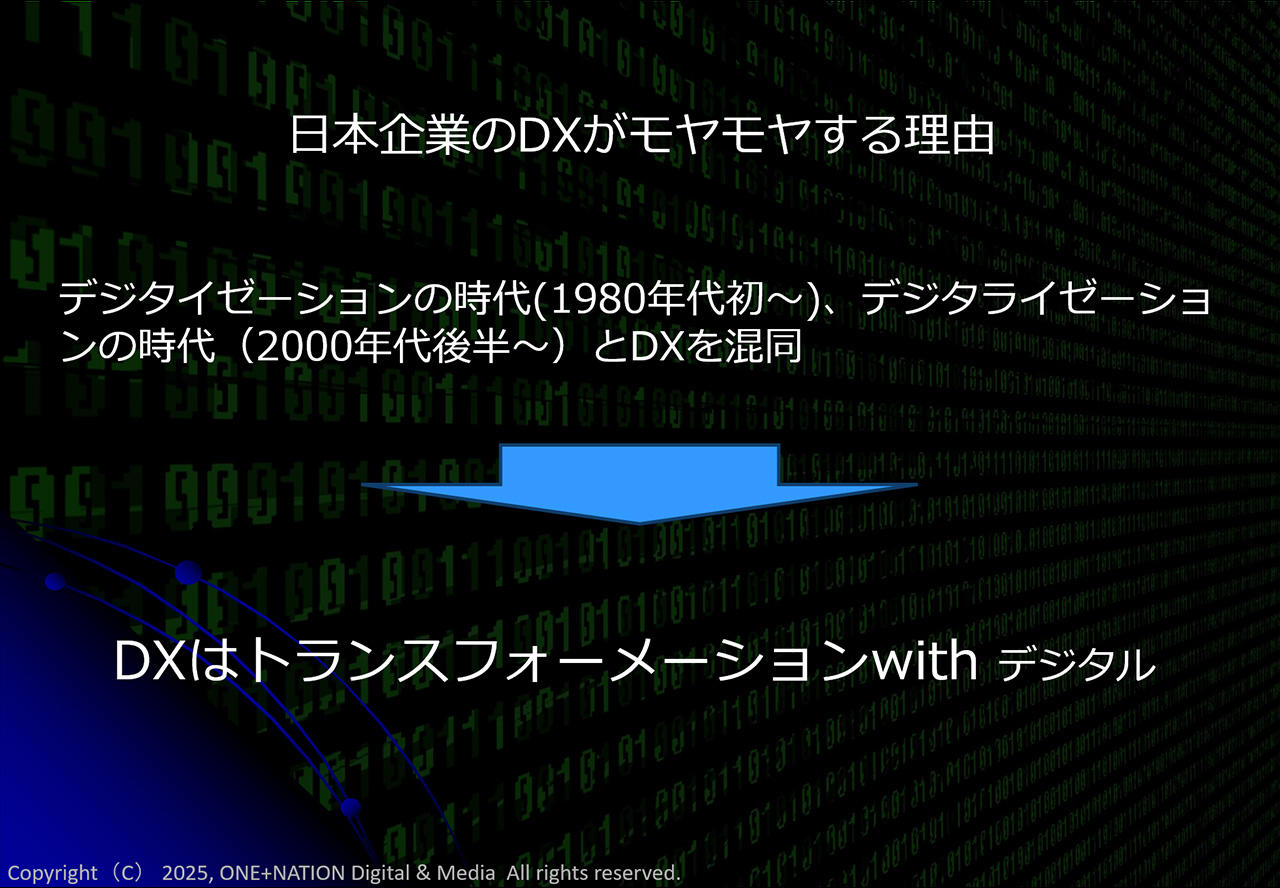
Now, let's get to the main topic. DX is difficult to understand because people are confusing it with the previous concept of "digitization."
When I started my career, host computers were in their heyday. Switching from paper to computers for high-volume processes like payroll calculations was a major transformation in itself. Next came the digitization of analog to digital, symbolized by the arrival of CDs, followed by the appearance of PDAs and early personal computers, and everyone was excited about the idea of data becoming digital. Then came the emergence of ERP, and consulting companies expanded in scale to adapt business processes to the system, leading to a rapid shift to IT in business systems. This was due to the introduction of IT, which improved business operations and processes.
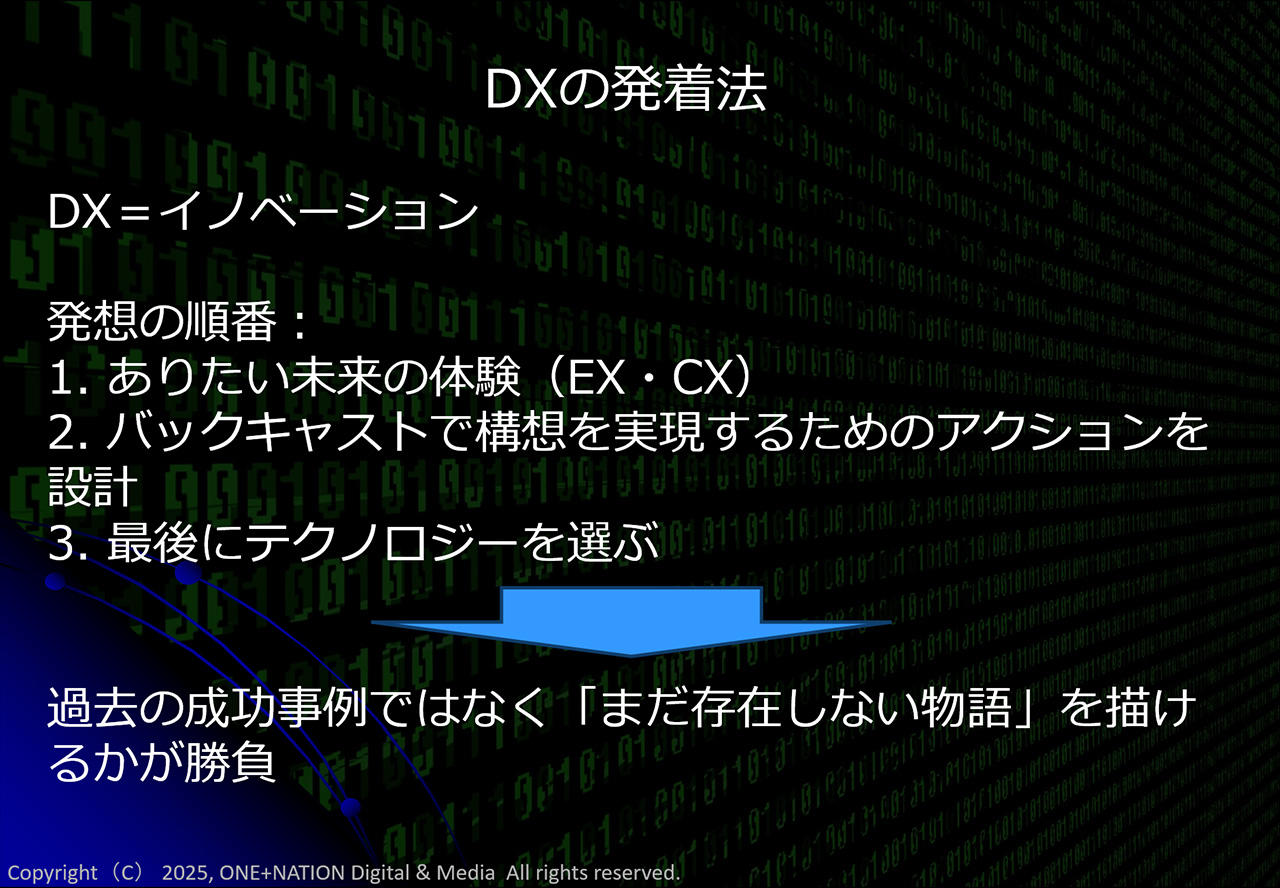
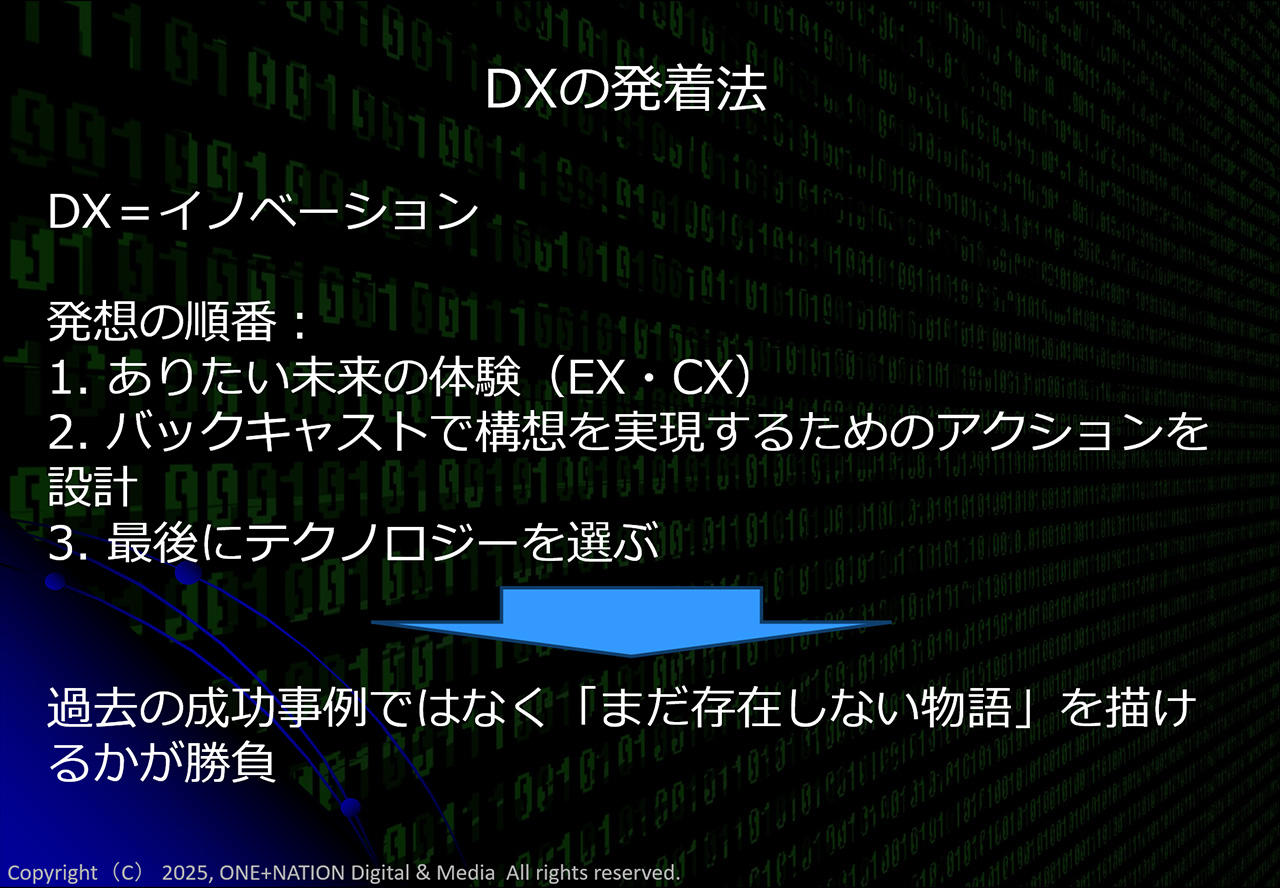
However, DX is a completely different concept. Simply put, DX is "Transformation with Digital," a redefinition of value creation calculated backward from the future.
The goal is not to simply incorporate digital technology, but to paint a picture of the "future we want" and use digital technology as a means to realize that future. Of course, using digital technology is not the goal, so the option of not using it is also DX. I always say, "The moment you start thinking with digital technology as a premise, it is no longer DX centered on transformation."
Sansan is a prime example. When it comes to business card management, everyone thinks of OCR, but what users want is "accurate data conversion." Rather than using OCR technology, which at the time was not very accurate, they chose to input data manually from the customer's perspective. This is a good example of DX that is not driven by technology.
The role of a DX specialist is to thoroughly consider what kind of transformation should be brought about for their company's customers.
Artistic Thinking: "Imagine the future and work backwards"
The key to promoting DX is what I advocate: "artist thinking." Artists freely imagine the future they want, and then work backwards from that future to design the present. Doraemon is a good example. First comes the future of "I wish this was possible," and then the secret gadgets that make it happen appear later.
DX has exactly the same structure. You paint a big picture of where you want things to be in 10 years, and where they should be in five years. Then, to make that a reality, you take concrete action to determine what you want things to be like in a year, and what you will do this week, today, and you will make that future a reality. Backcasting from the future is important. If you paint a picture of the future without taking action (action to make it happen), it will end up just being a pretty picture.
So how do you actually launch DX? The key is very simple: put yourself in the client's shoes as much as possible and envision the desired future based on the worldview that the client desires.
Also, the most hindrance to innovation is the question, "Is there a precedent?" If there is a precedent, it is not innovation. I would like the DX department to approach this with confidence, knowing that it is a department that does things that have no precedent.
DX starts with empathy: Observing the workplace and turning tacit knowledge into explicit knowledge
Next, let's talk about "empathy." The first step in design thinking is empathy. However, a young consultant might arrogantly tell a person with 30 years of experience in the field, "Here are the challenges facing your industry." This does not create empathy.
Empathy means seeing things from the other person's perspective, sometimes even seeing things a little lower than the other person's.
The most important thing for DX promoters is to "not forget the field." If the field is not open-minded, the real issues will not be apparent. The foundation of DX is to collect the tacit knowledge of the field, put it into words, and convert it into explicit knowledge for the organization.
The same is true in the world of art. Picasso's Cubism was not the brainchild of a genius, but was based on Cezanne's theory that "forms in nature can be expressed through geometry."
Putting tacit knowledge into words and sharing it as explicit knowledge. When we envision the future, it is important to verbalize our vision and turn it into explicit knowledge. It is also extremely important to build a team that combines young and experienced people and can discuss the future from a common perspective.
Digital Triplets and Narrative: Connecting the Real and the Digital through Stories
Finally, I will talk about the "Digital Triplet," a concept that explores how to connect the three worlds of the real (physical), the digital, and the "human mind/context."
Today's younger generation doesn't distinguish between the real world and the digital world. Romance, communication, and everyday life all exist online with the same weight as in the real world. Therefore, the idea of clearly separating the real world and the digital world is now just an adult assumption.
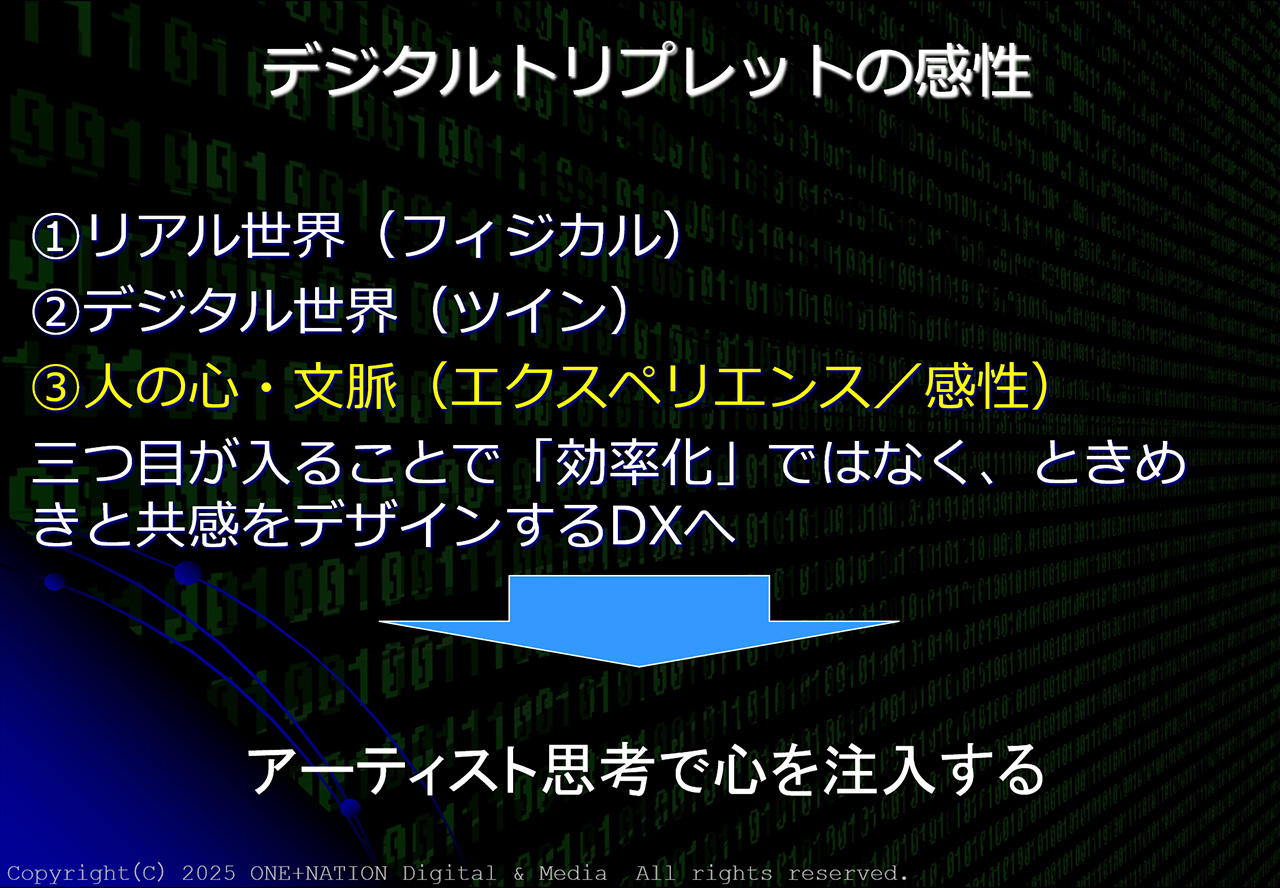
What excites people? It's the narrative. People are more moved by the story behind the product than by the product itself. DX is not about connecting technology with technology, but about connecting stories with stories.
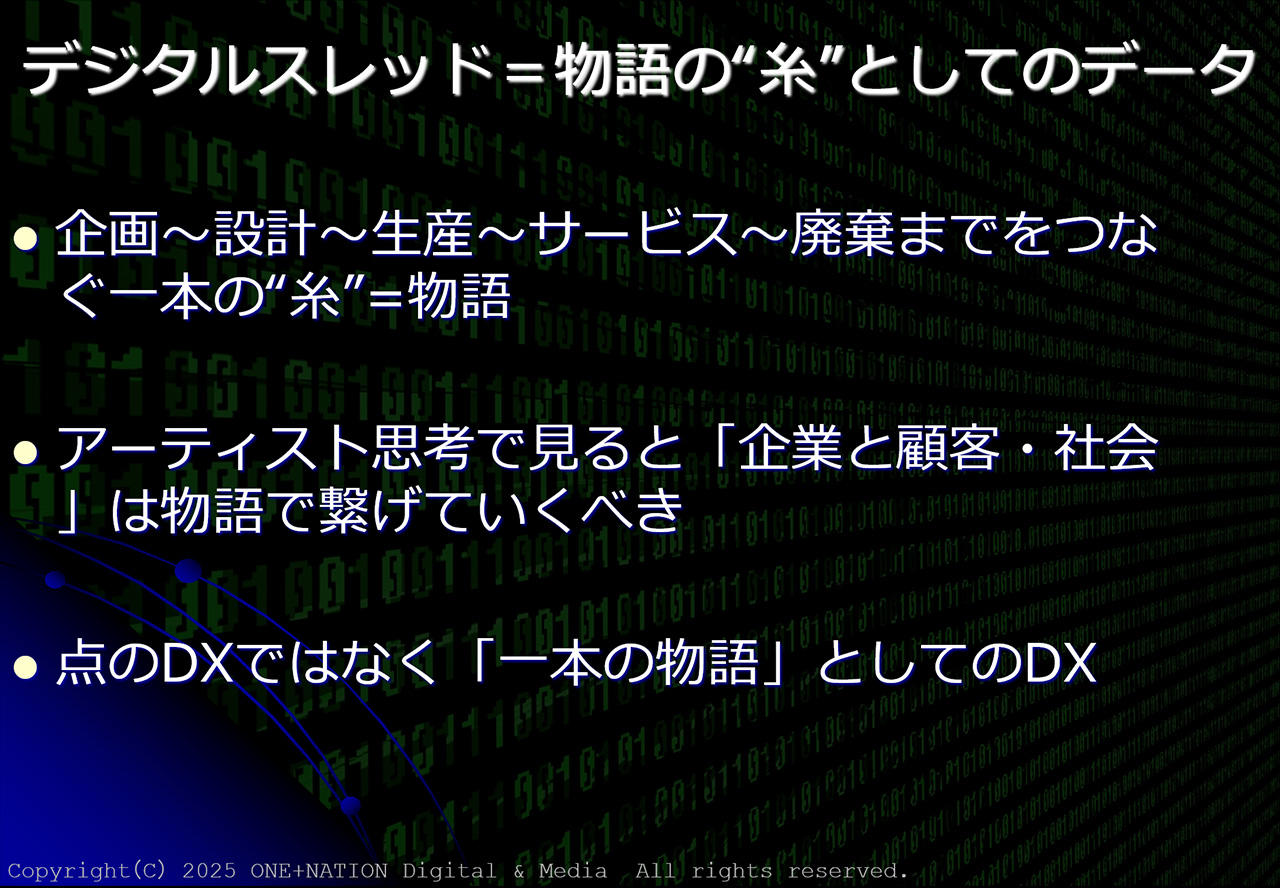
However, many companies do not have a "digital thread." They do not design how their services fit into the "emotional flow" of users' lives, from the moment they wake up in the morning until they go to bed at night. This is why they are unable to create an emotional connection.
DX is about designing stories that connect the real and digital worlds and creating experiences that move people's hearts.
It's also important to engage with the things that young people find exciting. Low-performance digital cameras, instant cameras, records. These are all new experiences for them. When adults understand the sensibilities of young people, and conversely, when adults share the things that excited them in the past, empathy is born that transcends generations.
DX is truly a thread (connection) that connects sensibilities.
Expectations for the manufacturing industry and future co-creation
I am also working on "intent AI," an AI that predicts the future, which has the potential to fundamentally change the manufacturing industry. This is why the manufacturing industry should be at the forefront of digital transformation.
I want to make people feel the same excitement they had when they bought a PDA or VAIO computer through real manufacturing. It is those in the manufacturing industry who can change the world where even when a new iPhone comes out, people just think, "Oh well, maybe it's time to buy a new one."
DX is a world where even competitors can co-create. I gathered the digital leaders of Dentsu, Hakuhodo, Accenture, and PwC to discuss how to weave the stories of our customers. DX is not about competition, but about co-creation.
Envisioning the future, creating stories based on empathy, connecting the real and digital worlds, and moving people's hearts - DX is the approach to achieving this.
I would be very happy if today could be the start of a thread (connection) between us. I look forward to your continued support.
The true aim of Ebara DX, which is human-centered [Event Report Part 2] >