Issues occurring in facility development
If the actual device doesn't arrive, development will come to a halt -- a common problem in the field
"I have the PLC program, but I can't do anything because the machine hasn't arrived yet."
These were the words of a developer at a machine OEM: In the development of automated machines and custom machines, even if the PLC control logic is complete, it is often impossible to check its operation until the actual machine arrives.
As a result, the trial run process is pushed back and on-site adjustment work takes longer. The increased trial run man-hours and longer on-site adjustment time not only extend the development lead time, but also lead to increased quality risks. There is a constant stream of complaints from on-site users saying, "If only we could have checked this sooner."
Inefficiency caused by "waiting time" when building a control system using PLC
Even if you want to proceed with the design and debugging of a control system using a PLC, situations where work comes to a halt due to a lack of actual equipment are often seen at machine OEM sites. This"waiting time"is a factor that significantly reduces the efficiency of the entire development.
In particular, with equipment that involves complex operations, unexpected behavior or bugs are often discovered when the equipment is first operated on-site, leaving the development team scrambling to deal with them. This "first operation on-site" approach tends to put trouble shooting off the line, and increases the burden on the development team.
Bottlenecks in building control systems using PLCs
The reality is that the offline debugging environment is not yet in place
Many machine OEMs are faced with the problem of not having an environment for offline operation verification when designing control systems using PLCs. Even if they design control logic, they have no way to verify its operation until the actual machine is completed, and they are left in a situation where they have no choice but to "wait until the actual machine arrives."
In such an environment, it is difficult to detect defects early on in the design stage, and troubleshooting tends to be delayed. As a result, on-site trial runs and adjustment work take longer, reducing the efficiency of the entire development process.
What makes virtual commissioning so special?
Virtual commissioning is an effective means of verifying control logic without using an actual device, but it is still perceived in the field as a special technology used only by a select few advanced companies.
The reasons for this include the high hurdles involved in building a simulation environment and concerns about compatibility with existing development flows. In particular, linking a PLC with a 3D simulator requires specialized knowledge, which has prevented many companies from embarking on the implementation.
Structural issues hindering front-loading
Ideally, control system design should be front-loaded (design in advance) to ensure quality early on and reduce the burden on later processes. However, a development style that relies on actual equipment makes it difficult to conduct sufficient verification in the early stages of design, and rework in later processes becomes commonplace.
To solve these structural issues, it is essential to utilize simulation technology, including virtual test runs. Even when building control systems using PLCs, creating a verification environment without using actual equipment makes it possible to achieve both quality and speed in development.
It works even without the actual device - PLC simulation changes development style
Breaking away from dependency on actual devices will change the way we think about development
In conventional equipment development, PLC The premise was that verification of control systems using AI could only be carried out after the actual equipment was completed. This not only created "waiting time" for designers, but also posed a structural challenge, forcing designers to allocate a large amount of man-hours to test runs and on-site adjustments.
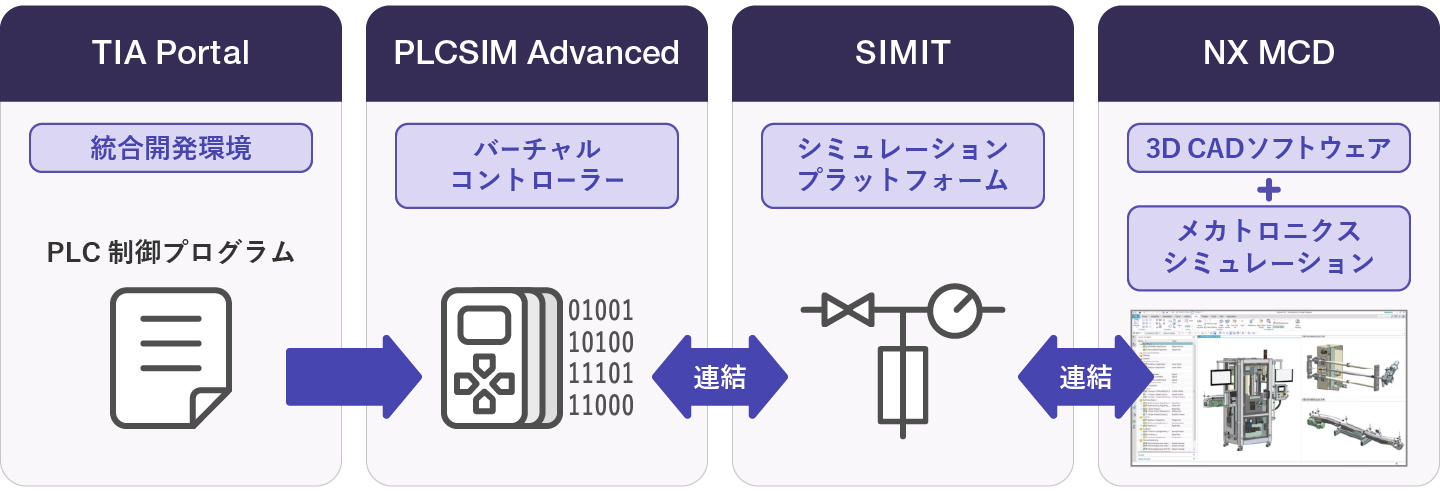
PLC By utilizing simulation, this assumption can be completely overturned. For example, Siemens of TIA Portal With , you can run ladder programs in a virtual environment and check the operation of control logic without using an actual device. This allows you to verify the control flow from the early stages of design, making front-loading a reality.
In this way, computers have three functions: "calculation," "memory," and "input/output." 3 This configuration consists of three elements that work together. Z80 There is basically no difference between systems that use old microprocessors like this and modern microcomputers. 1 It is a single chip that embodies the workings of a computer in a compact form.
Five changes in development style
|
Traditional development style |
Style after introducing PLC simulation |
|---|---|
|
Operation can only be confirmed after the actual machine is completed |
Control logic can be verified without using an actual device. |
|
Test runs and on-site adjustments take time |
Operation can be checked and adjusted in advance in a virtual environment |
|
Troubleshooting is delayed |
Defects can be detected and corrected at the early stage of design |
|
Long development lead time |
Frontloading shortens development time |
|
Quality depends on on-site adjustments |
Quality built into the design stage |
1. Operation can only be confirmed after the actual device is completed → Control logic can be verified without the actual device
In previous developments, it was not possible to check the operation of the control program until the actual machine was completed, leaving designers in a situation where they had no choice but to "wait." By introducing simulation, it is now possible to check the operation of the control logic from the design stage, making it possible to discover and correct problems at an early stage of development.
2. Test runs and on-site adjustments take time → Operation can be checked and adjusted in advance in a virtual environment
On-site trial runs are prone to unexpected problems, which can prolong adjustment work. By utilizing virtual trial runs, operation can be checked in advance and adjustment points identified, significantly reducing the time required for on-site work.
3. Troubleshooting is often delayed → Defects can be detected and corrected at the early design stage
In the past, problems were often discovered when the system was first operated on-site, and responses tended to be delayed. In a simulation environment, multiple operation patterns can be tested at the early design stage, enabling trouble prevention and early response.
4. Long development lead times → Frontloading shortens development time
Development lead times were lengthened due to the time required to wait for the actual equipment and make on-site adjustments. By testing in a virtual environment, design and testing can be carried out in parallel, shortening the overall development period. In one case, an equipment manufacturer reduced their development period by 30%.
5. Quality depends on on-site adjustments → Quality can be built in at the design stage
In the conventional approach, ensuring quality relied on on-site adjustments, which inevitably led to dependency on individuals and variations. By utilizing simulation, quality can be built in at the design stage, enabling standardization and highly reproducible development.
Benefits of implementation: Shortened development time and improved quality
Automating software verification through virtual test runs achieves both development speed and quality
By utilizing PLC simulation, it is now possible to verify control logic from the early stages of design, significantly reducing the need for rework and troubleshooting that would otherwise occur in the latter stages of the development process. Equipment manufacturers that have introduced virtual trial runs have achieved shorter development times and more efficient on-site adjustments.
For example, machine tool manufacturer TRUMPF combines Siemens'Mechatronics Concept Designer with SIMIT to generate a digital twin of each machine and perform automated software testing in a fully virtual environment. This has enabled software release testing to be completed overnight, instead of the four weeks it previously took, significantly reducing time to market.
Additionally, casting machine manufacturer Kurtz is now using virtual test runs to verify control software without using a physical machine. This has significantly reduced on-site adjustment work and strengthened collaboration between the design and manufacturing departments, resulting in improved quality and development efficiency. Testing in a virtual environment has enabled problems to be identified early on in the design stage, making the overall development process proceed more smoothly.
This result is not just due to faster verification, but also because the design and test run processes can now proceed in parallel. Previously, processes had to be carried out in a virtual environment, but now they can be carried out in advance, creating more flexibility in the overall schedule and improving the rate of on-time delivery.
The Siemens official website also introduces examples of how the introduction of virtual commissioning and simulation technology has shortened the time from design to construction of a production line. For more details, please see the link below.
Reduced on-site troubleshooting and stable quality
Verification in a virtual environment has made it possible to detect defects at the design stage, significantly reducing the need to deal with problems on-site. Previously, problems were only discovered when the equipment was first launched, and there were many cases where on-site adjustments had to be made, but after introducing simulation, it became possible to identify problems in advance and take measures to deliver the equipment to the site.
As a result, not only is on-site work time reduced, quality variations are reduced, and standardized control designs are realized. Adjustment work, which tends to be dependent on individuals, can now be done by sharing verification results from the design stage with the team, which has the secondary effect of helping to pass on skills and develop human resources.
Summary: Proposing a new development style
In the Japanese manufacturing industry, the development style of "verifying the control program after the actual machine is completed" is still mainstream. However, by utilizing PLC simulation, it is possible to move away from this development that relies on the actual machine and shift to a"front-loaded"development style in which verification is carried out from the early design stages.
This new style not only shortens development time, but also brings many other benefits, such as stabilizing quality, streamlining on-site adjustments, and standardizing technology. For machine OEMs in particular, it is a powerful means of efficiently advancing development with limited resources.
It is expected that approaches such as model-based development and FA simulation will become mainstream in future equipment development. By utilizing the benefits of PLC simulation, it will become possible to improve the operational efficiency and reduce development costs for machine OEMs.
Why not take the first step by implementing virtual test runs?
Inquiry
If you have any questions about this article, please contact us using the form below.
Go to Siemens OT (Operational Technology) product page
If you are interested in Siemens OT (Operational Technology) products, please visit the following page.