
"I was instructed to advance digital transformation, but I don't know where to start." "I'm so busy with work that I don't have time to try new things."
Do you have any of these concerns?
Promoting DX may seem like it requires major changes, but the key to success is actually to "start small and steadily achieve results." Start with "business efficiency" initiatives that can be implemented in a short period of time, and by starting small and building up successful experiences, you can accelerate DX while gaining understanding within the company!
This article also introduces a successful example of business improvement achieved by utilizing the low-code development platform "Mendix."
What is DX in the manufacturing industry?
DX in the manufacturing industry refers to the use of data and digital technology from manufacturing sites to improve business processes, such as improving productivity and quality and reducing manpower, as well as transforming organizational culture and business models. As such, it is an important initiative that is also positioned as a management issue for improving competitiveness and achieving sustainable growth.
Why DX is needed in the manufacturing industry
Labor shortages and the issue of skill transfer are becoming more serious at manufacturing sites, and traditional improvement activities alone are beginning to show their limits.
Furthermore, with markets and technologies changing at a dizzying pace, it is essential to build a flexible organizational structure. Furthermore, the use of digital transformation (DX) is becoming essential from the perspective of maintaining competitiveness in the market.
Successful examples of DX in the manufacturing industry
[Case 1] Moving away from Excel! A successful case of digitalizing business processes in the manufacturing industry: Achieving efficiency with a small start
■Challenges
A manufacturing company was using Excel to manage work progress and input data, but the huge amount of data and complex processes was causing work efficiency to decline.In particular, information was not centrally managed, and work progress was managed by relaying data output from Excel and sharing it via email, so an average of 15 hours per week was spent just tracking progress.To improve this situation, it became necessary to promote digitalization.
■Solution
Mendix was introduced to begin the digitalization of business processes. By utilizing Mendix, processes that had previously been managed in Excel were digitized, enabling information to be updated in real time. The implementation began as a small start with a team of 10 people, and after demonstrating its effectiveness, a strategy was developed to roll it out company-wide.
■Effects
As a result of the small start, progress management efficiency improved significantly, reducing weekly management time from an average of 15 hours to 5 hours. Furthermore, data could be centrally managed, enabling information to be checked in real time, improving decision-making speed by 50%. Furthermore, manual work previously done in Excel was reduced by 60%, significantly reducing human error.
■Points
The biggest factor in adopting Mendix was the small-start approach. By first implementing it with limited resources and then scaling it up once the effectiveness was assessed, they were able to minimize risk and achieve reliable results. Furthermore, taking advantage of the characteristics of low-code development allowed them to rapidly promote digitalization and move away from Excel-dependent operations, which was a major factor in their success.
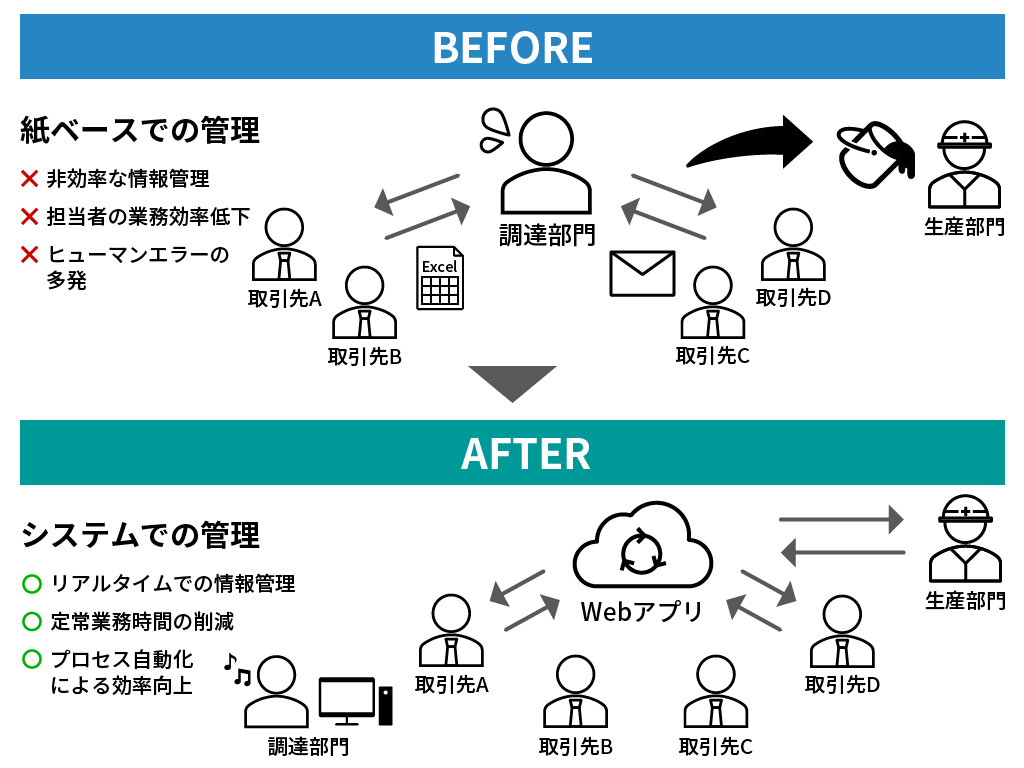
↑Example of a small start app (Excel app)↑
[Case 2] Achieve efficient inventory management! Start with small success by systemizing your operations and visualizing your data!
■Challenges
In a certain manufacturing company, inventory management was done manually and using Excel, making it difficult to grasp inventory in real time, resulting in frequent excess inventory and shortages.Furthermore, in addition to human errors such as recording errors and calculation errors, the reliance on specific personnel led to inefficiencies in operations.
■Solution
An inventory management app was developed using Mendix that follows the current business flow but does not require major operational changes.
The implementation was carried out with the aim of achieving real-time data visualization by partially integrating with the existing core system and centrally managing order information and shipping status.
■Effects
This has enabled real-time inventory management and significantly improved the efficiency of ordering work for field staff. Not only that, but data visualization has also helped create an environment where management can make decisions quickly.
■Points
The deciding factor in adopting Mendix was that its low-code nature allows systems to be built in a short period of time, making it suitable for small starts. Another major advantage is that it can instantly reflect feedback from the field and flexibly build a system that fits the business. Another important point is that it is highly compatible with other systems and can be easily expanded according to needs.
As a future step, we are considering further promoting centralized data management and realizing advanced data utilization such as demand forecasting.
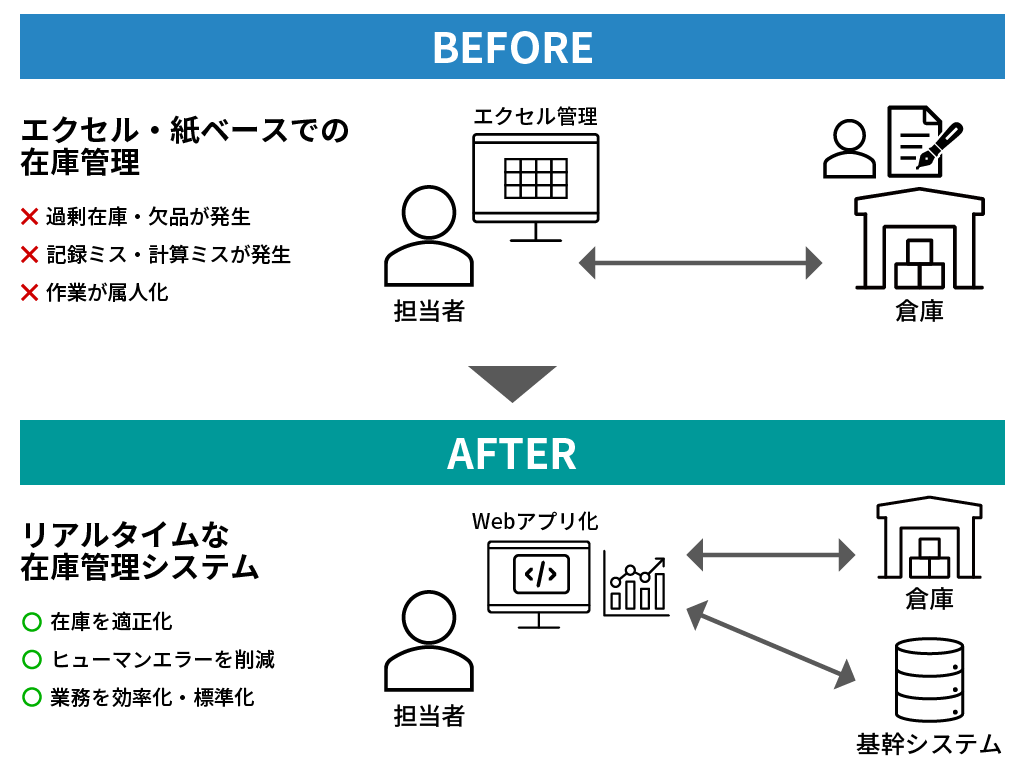
↑Example of a small start app (inventory management app)↑
Key points for success in manufacturing DX
The essence of DX is not the introduction of technology, but company-wide operational and organizational transformation. Results can only be achieved with the understanding and cooperation of all parties involved, the gradual evolution of data utilization, and an organization-wide promotion system.
Think of DX as an extension of on-site improvements
Because DX is an initiative that changes the way we work, it can create a sense of burden and resistance among employees on the front lines. Therefore, rather than treating DX as a special project, it is important to start with it as part of the ongoing improvements being made on the front lines.
By quickly achieving small successes such as reduced workload, fewer defects, and improved safety, and clearly demonstrating the benefits to the workplace, it becomes easier to gain cooperation and advance DX.
Start small and make big changes when using data and digital technology
The first step in utilizing data is to collect information that is easily obtained on-site, visualize it, and use it for improvements. For example, starting on a small scale with information such as equipment utilization rate, work time, and sensor information such as temperature and vibration lowers the operational hurdles.
Cost-effectiveness can be maximized by selecting tools that are easy to get started with and use, such as low-code, no-code, and generative AI, rather than introducing advanced systems. Creating a sustainable system is the key to success, rather than large-scale investment.
Establish a cross-organizational promotion system
To ensure DX progress, it is essential to have a promotion system that unites the field, administrative departments, and management. By establishing a DX promotion department and a cross-departmental project team, information can be shared and issues can be resolved smoothly, creating a system that allows employees to focus on DX initiatives.
If your company lacks DX personnel, it is recommended that you utilize external vendors who have the know-how and track record to assist you with the tedious tasks such as internal coordination and even in-house development.
We recommend using Mendix for manufacturing DX
In the manufacturing industry, digital transformation often faces challenges, such as the existence of different processes and systems at each site, the inability to find tools that fit existing systems, and a lack of in-house digital transformation/IT personnel. The low-code development platform Mendix is a powerful tool in these situations.
Why is Mendix good for manufacturing DX?
Mendix 's strength lies in its ability to flexibly address challenges specific to manufacturing sites. Specifically, it has a high level of adaptability to the complex data structures unique to manufacturing sites, and it also facilitates the integration of IT and OT through the ecosystem of Siemens, a major industrial automation company. Furthermore, since business applications can be developed in a short period of time without specialized programming knowledge, systems tailored to the needs of the site can be quickly built.
It also makes it easy to connect to the cloud and import equipment data, enabling gradual digital transformation while utilizing existing systems. On-site personnel can also turn their own improvement ideas into apps, making it easier to promote "on-site digitalization" and contributing to the creation of an organization that is resilient to change.
"Digital Execution Factory" turns small successes into organizational change
Macnica 's "Digital Execution Factory" localizes reproducible DX that has been proven in numerous global companies into a Japanese version and provides support to help make DX a part of the organizational culture.
This service transfers know-how for in-house DX, including support for development and training using Mendix, strengthening governance systems that involve the entire company, and establishing and establishing a specialized organization (CoE) that spans business and IT departments.
In particular, our strength is our ability to adapt to challenges facing the manufacturing industry, such as siloed data and tools, complex analog business processes, a shortage of DX /IT personnel, unstable security and service quality, and the failure to establish in-house DX.
Let's make DX in the manufacturing industry a success based on case studies
DX, which starts small and makes big changes, has the benefits of "being able to see results in a short period of time," "being able to steadily improve operations while keeping development costs down," and "being able to share successful experiences within the company and lead to even bigger changes."
By using the low-code development platform "Mendix," you can achieve business improvements in a short period of time. First, let's accumulate small successes and steadily advance DX!