
The term DX has become widely used in society, but there are many voices saying that "Japan is lagging behind in its promotion." What is the reason for this, and what measures should companies take? In this article, we bring you an excerpt from a lecture by Akira Iriyama, professor at the Waseda Business School, Graduate School of Business and Commerce, Waseda University, from a perspective centered on business administration.
* This article is based on a lecture given at the "Executive Knowledge Sharing Forum- The Fusion of Business and IT and the Frontline of Generative AI Utilization" held by Macnica on Tuesday, August 27th. [Part 2] The article features a lecture by Keigo Ando, General Manager of Macnica IT Division, and a discussion with Professor Akira Iriyama.
\Click here for the second half of the report!/
[Speaker information]

Professor, Graduate School of Business and Commerce, Waseda Business School, Waseda University
Akira Iriyama
Digital transformation challenges
Business administration provides an approach that allows us to explain extremely complex businesses based on the principles of human behavior. I would be happy to have a discussion with you today, including thoughts like, "I wonder if using business administration to explain things that I couldn't think of before?" and "This is a little different from how I feel in the field."
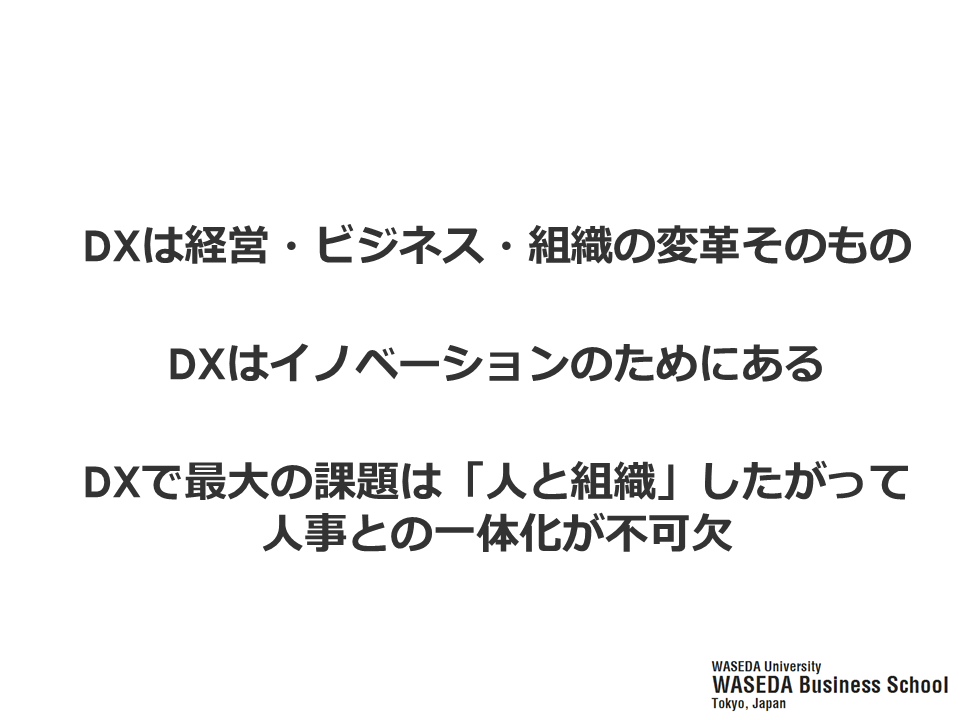
To get straight to the point, digital transformation alone is almost meaningless when it comes to DX; what is required is transformation of management, business, and organization itself.
And because DX is about innovation, the key to making it happen is people. In other words, I believe that integration with HR holds the key.
However, in Japan, due to the influence of the media and other factors, the term DX has taken precedence, and as a result, DX is seen as a magic wand. What is really needed is a company-wide transformation, and the idea of "path dependency," which is the most important theme of this session, can explain this logic.
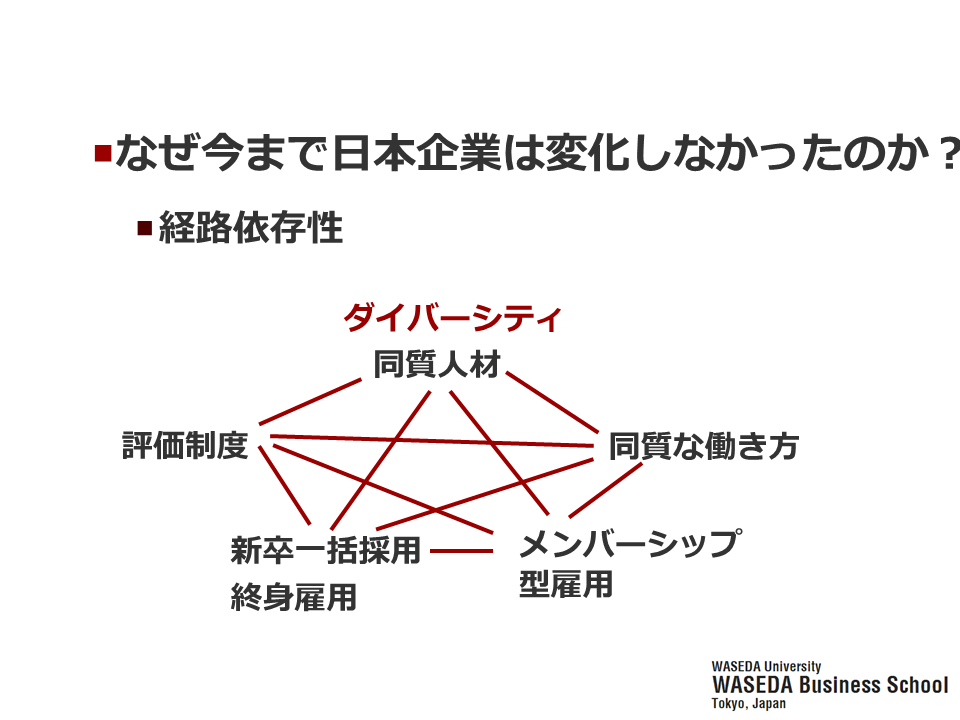
A company is complex and has many different elements, but it only functions because they work together rationally. However, because the whole works together, if one part is out of step with the times, it cannot be changed. A good example is diversity management, which has not made much progress in Japan despite being loudly advocated for in the public. I often give lectures on this topic, and I always say, "It's impossible to achieve diversity alone." This is because the other elements are tightly interlocked with homogeneous human resources, which is the exact opposite of diversity.
If we are serious about promoting diversity, we must reconsider the mass hiring of new graduates and lifetime employment in order to hire diverse people. There are some people in Japan who stubbornly say, "We will promote diversity while protecting mass hiring of new graduates and lifetime employment," but that is impossible. We also need to review the evaluation system, but Japanese companies use a uniform evaluation system, and if we really want to hire diverse people, we need to diversify the way we work. However, there was no change before COVID-19. DX is essential to change the way we work, but DX has not been done. In other words, working only on diversity and innovation is the worst move, and corporate transformation that changes the whole is important.
I personally believe that in order to break down path dependency in promoting DX, the head of the digital field should also serve as the head of HR. This is because serious promotion of DX requires different working styles and hiring methods, and will inevitably clash with HR at some point. This may seem extreme at first glance, but surprisingly, in the companies around me that have successfully adopted digital, someone in the digital field also serves as the head of HR.
Two major possibilities brought about by DX
If I were to express the possibilities that DX brings in a scholarly way, I believe there are only two possibilities, as shown in the diagram below. Needless to say, the future of society will be highly uncertain, so unless we continue to innovate, corporate value will not increase. There is no doubt that digital is one method for achieving this.
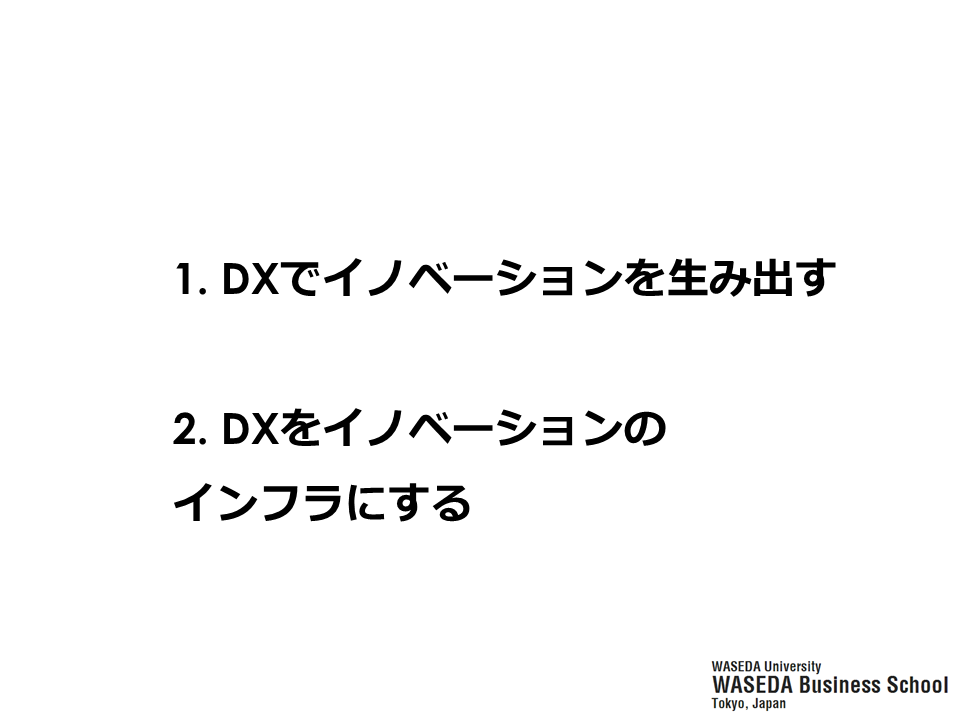
Ideas are necessary to generate innovation. And the key to generating new ideas is the combination of knowledge and knowledge. Joseph Schumpeter has been talking about this for 90 years in his New Combinations. However, human cognition has limitations, so we can only combine what is in front of us. Most people stay in the same industry for decades, and because they are surrounded by the same kinds of people through the mass hiring of new graduates, they end up only combining the knowledge and knowledge in front of them over their long careers. This is the reason why innovation does not occur.
To overcome this, we need to "explore knowledge" by looking as far as possible at distant places and combining unrelated things, and then, when we think there is potential for profit, we need to "deepen knowledge" by thoroughly streamlining it and digging deeper.
There is a near consensus among business scholars around the world that companies and organizational managers who can achieve a high level of balance between exploration and evolution are more likely to create innovation. I have dubbed this "ambidextrous management."
However, if left unchecked, companies will become biased toward deepening knowledge. This is because although it is easy to say that knowledge exploration is difficult in reality, it takes time, people, and money. Furthermore, knowledge exploration often leads to failure, so it seems like a waste. As a result, companies will only deepen their knowledge. At first glance, this is not a bad thing, as it may bring in some profit, but in the long run, this behavior will neglect the exploration of knowledge that is essential for innovation.
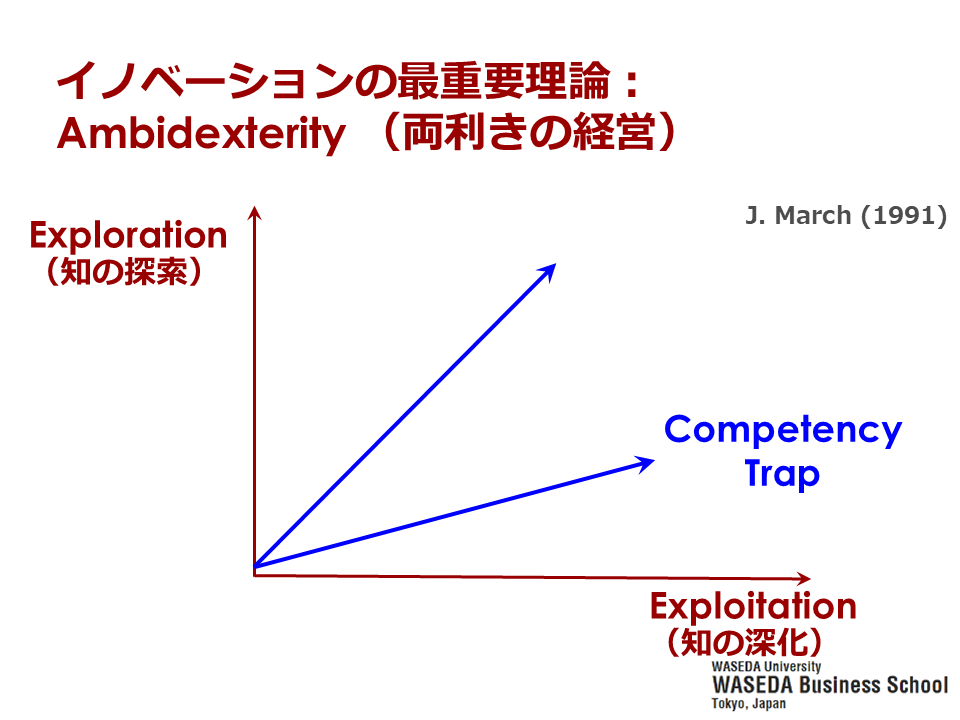
As a result, innovation is not occurring in companies all over Japan, and business performance is not improving. In the graph above, we need to somehow make the horizontal line vertical. Of course, deepening knowledge is important because we need to make profits, but at the same time, it is important to explore knowledge, and that is what digital technology is for.
Using digital technology as a means of knowledge exploration
Nowadays, digital means have made it possible to obtain knowledge of places far away that we could not obtain before, even beyond our own perception. On the other hand, it will of course continue to be important for humans to go to the site and see things. These days, we have digital and AI, so the trend is to make good use of them.
Knowledge exploration is a big hurdle to execute, but it is something that only humans can do. On the other hand, deepening knowledge is an area where digital technology is overwhelmingly strong, but up until now, your company's employees have likely spent a lot of time on it. In the future, we will thoroughly replace the deepening of knowledge with digital technology, and allocate human man-hours to knowledge exploration.
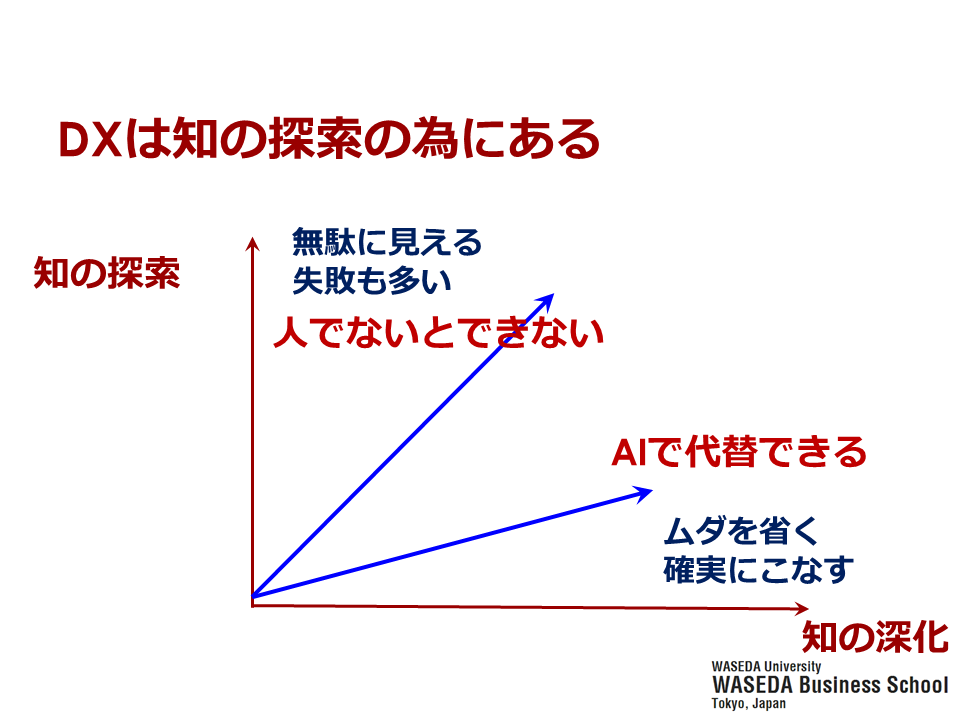
As everyone knows, ChatGPT is good at saying safe things, but not surprising things. Even if they say something, they can't test it and they can't take responsibility, so it's not something to be afraid of. This is very important. For example, when you are scolded and asked, "Why did you act like this in this project?", you don't say, "Because ChatGPT told me to," but you take responsibility yourself. In Japan, it is often unclear where responsibility lies, but in the future, the job of humans is to take responsibility.
The responsibility I'm talking about here doesn't mean firing people, but rather accountability, such as, "As a result of our challenge, our hypothesis here was wrong. We can fix it like this, so please let us try again." Developing human resources who can do this is also essential along with digital recruitment.

There are many companies in Japan that are strong in the field, but this has resulted in too much tacit knowledge, which has prevented digitalization. However, I believe that Japan's winning strategy is for companies with strengths in the field to team up with digital technology, so I hope they will reform in a good way and create more and more innovation.
\Click here for the second half of the report!/