In recent years, smart factories have progressed rapidly. Many companies have acquired data from PLCs (Programmable Logic Controllers) and various equipment, and have realized visualization of production. However, an increasing number of companies feel that it is difficult to obtain sufficient benefits commensurate with the system investment through simple visualization alone. Therefore, as the next step, the new focus of promoting smart factories is "improvement," which aims to improve management indicators and KPIs by utilizing data collected from equipment.
To maximize the return on investment in smart factories, it is essential to make improvements using visualized data. First, check the visualized data, and if it is insufficient, visualize the data again from a different perspective. From there, consider it in depth to identify areas for improvement and implement improvement measures. After that, evaluate the reduction in lost time and costs before and after the improvement, and measure the actual effects. This process is repeated as needed, and in some cases it may be carried out monthly.
Even though smart factories have made progress in the automatic acquisition and visualization of equipment data, effective improvements require data-savvy experts and personnel who can use the tools. In particular, if IT literacy is not high, workers must start by understanding the data and learning how to operate it, and training personnel takes time and money. This is an issue that remains amid the progress of smart factories. Therefore, the use of "generative AI" is attracting attention in the future evolution of smart factories.
What is generative AI?
Generative AI is an artificial intelligence that automatically generates new ideas and solutions based on large amounts of data. This makes it possible to automate and efficiently carry out tasks that previously took a lot of time and effort by humans.
There are three main areas where generative AI excels:
- Automatic data analysis: Instantly analyze huge amounts of data to find useful information.
- New discoveries: Discover new insights from the data.
- Improvement proposals: Propose specific improvement measures based on the analysis results.
Next, let's look at some examples of using generative AI.
Example of using generative AI [Identifying equipment anomalies and taking countermeasures quickly and automatically]
Here is an example of using the manufacturing performance system DSF Cyclone. DSF Cyclone is a tool for organizing data collected from equipment and using it for kaizen. By using DSF Cyclone, the work of aggregating data and consolidating scattered data, which was previously done on paper, can be automated, allowing you to check the latest production information at any time.
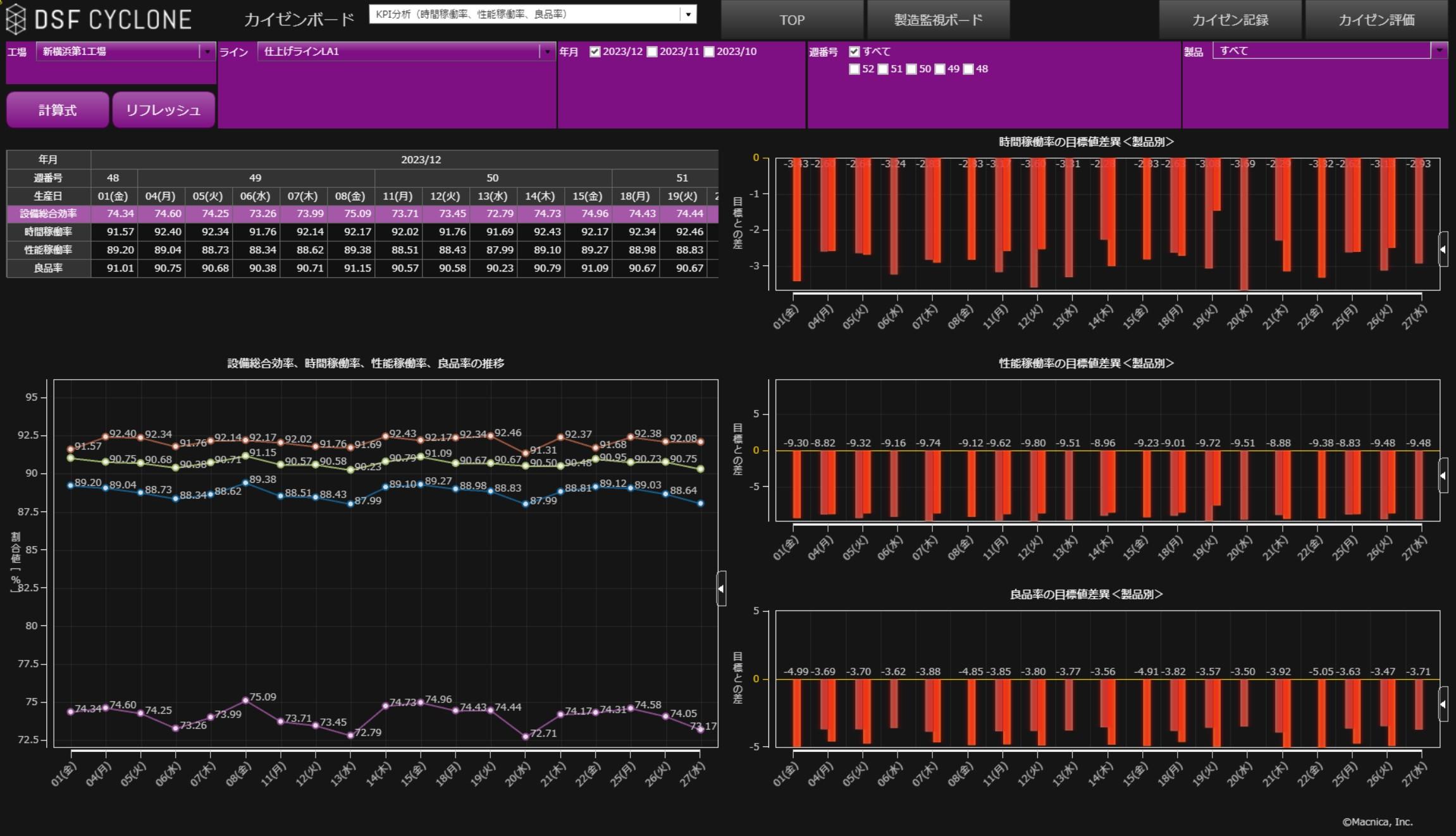
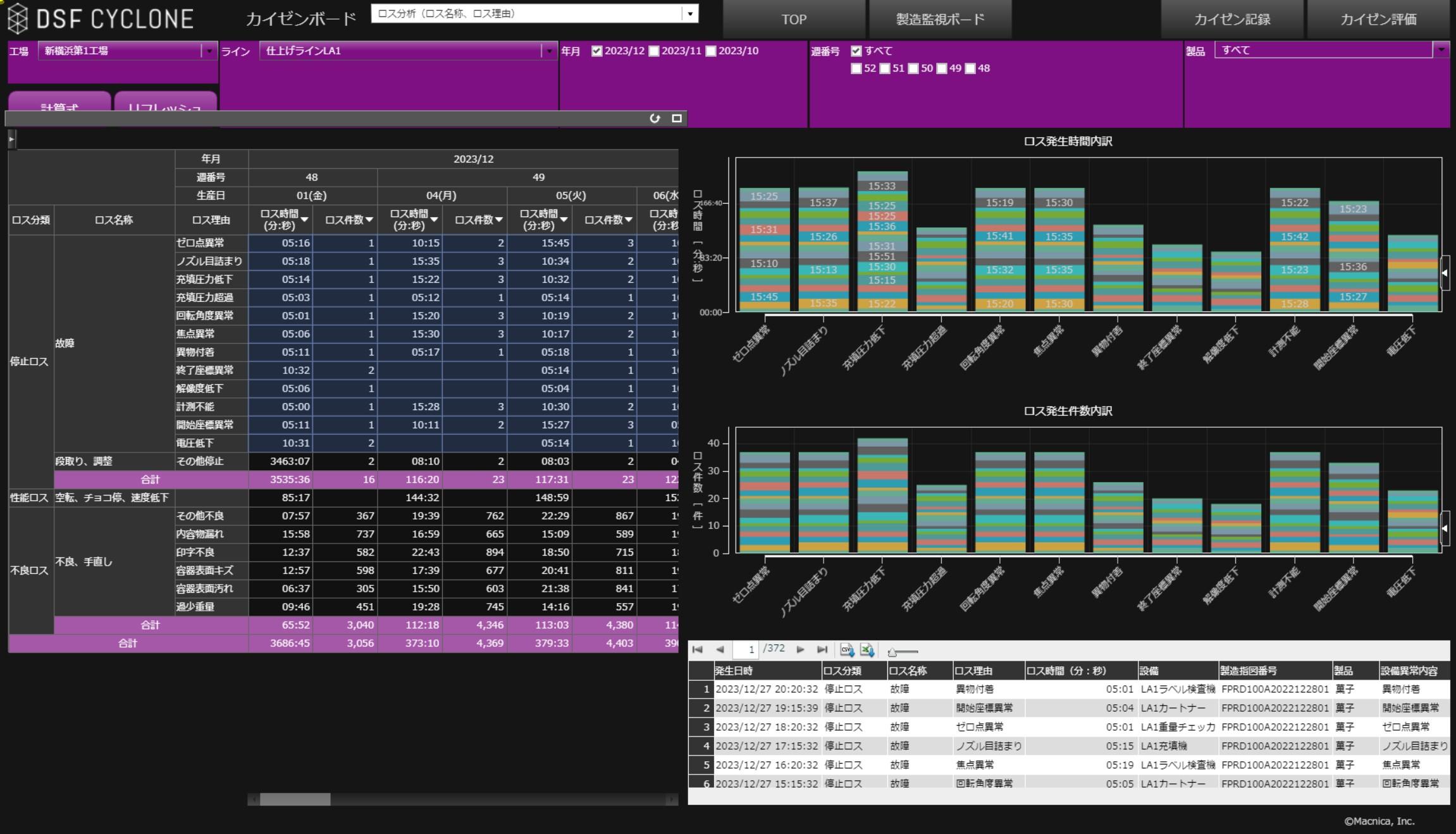
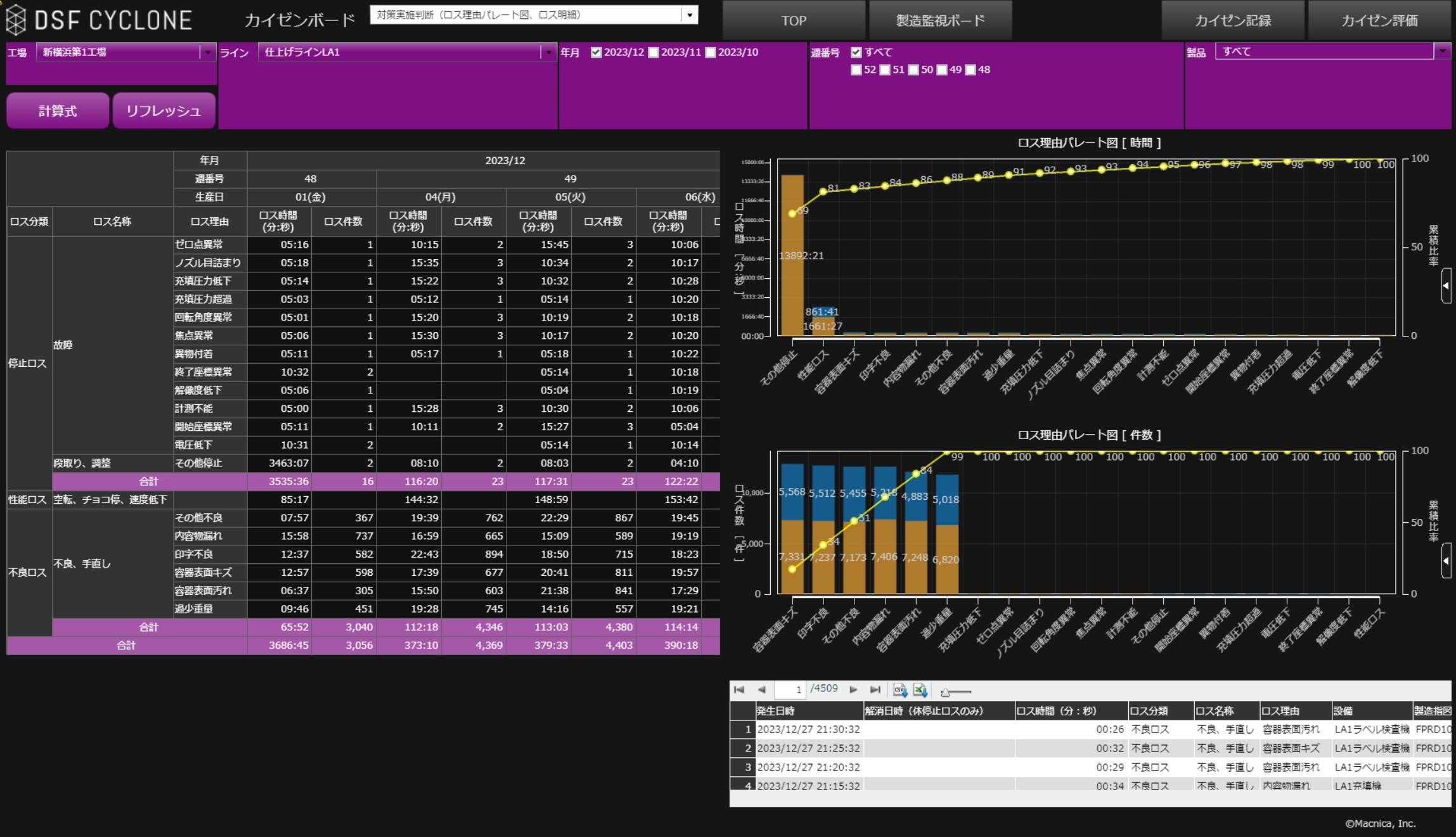
In addition, deeper data analysis may be required to solve problems that occur on the production line. For example, to reduce equipment downtime, it is useful to look for the following data:
- See when outages are most prevalent:
By checking which times of day outages are most common by month, week, or day, and investigating whether outages are concentrated at certain times, you can find problems by time period.
- Line by line comparison:
By comparing multiple production lines to see which lines have particularly frequent stoppages, you can see whether problems are concentrated on specific lines.
- Product Comparison:
By examining which products have the most outages for each product you manufacture, you can find problems related to specific products.
- Comparison by facility:
Identify the equipment that is experiencing outages and investigate whether the operation or maintenance of that equipment needs to be reviewed.
- Comparison by production order:
Analyzing stoppages per production order and identifying issues with specific orders helps improve work planning.
- Separate analysis of short and long outages:
By distinguishing between short and long outages and analyzing their causes, you can take appropriate measures for different types of problems.
By using these methods, it is possible to discover problems that could not be found before and come up with more specific improvement measures. However, performing this analysis manually requires a lot of time and knowledge. Therefore, the aim is to use generative AI to automate these tasks and perform them in a short time.
DSF Cyclone 's data is pre-organized, and by passing it to the generation AI and providing appropriate instructions, it can automatically perform processes from data analysis to countermeasure planning.
In the demo video above, the generation AI was given outage loss data generated by DSF Cyclone. It was then instructed to identify the most common equipment anomaly in November from that data and provide specific countermeasures. As a result, the AI successfully output the most common equipment anomaly in November and its general countermeasures. Based on this information, workers can take countermeasures appropriate for the actual site. Next, to check the credibility of the results output by the generation AI, the AI was instructed to visualize the November data, and graphs from various perspectives were immediately output. This allows users to check for other equipment anomalies of concern and take countermeasures.
Democratization of Data and the Role of Generative AI
"Democratization of data" is important for data utilization in future smart factories. Data democratization means enabling anyone to use data to make decisions and make improvements. Until now, data analysis and interpretation had to be done by experts, but with the introduction of generative AI, even on-site personnel can effectively use data.
Key benefits of generative AI include:
- Rapid response: Data can be viewed on-site and improvements can be implemented immediately.
- Increased work efficiency: Spend less time analyzing data and focus on other important tasks.
- Reduced training costs: The cost of training personnel with specialized knowledge can be reduced.
Summary
With the advent of generative AI, smart factories are entering a new era of data analysis. Traditionally, data analysis required specialized knowledge, and improvements based on the results were limited in scope. However, generative AI has completely changed this process. By automating faster and more accurate data analysis, it can improve the efficiency of the entire factory and achieve sustainable improvements.
In the future of smart factories, generative AI will play a key role in data utilization and will be the key to revolutionizing conventional wisdom. This will advance the democratization of data, creating an environment where even on-site personnel can easily use data and immediately carry out kaizen activities. In the new era of data analysis using generative AI, it is expected that the transformation of factory operations will strongly support corporate growth.
Supporting quick start & quick win of smart factory
"DSF Cyclone" connects manufacturing results and production plans with structured data to realize a "highly productive factory".
If you are interested, please refer here.