In-house production accelerates on-site visualization!
"DSF Cyclone" for monitoring manufacturing sites and analyzing performance
──DIC Corporation
DIC Corporation operates three business divisions, Packaging & Graphics, Color & Display, and Functional Products, based on the basic materials of organic pigments and synthetic resins. The company is currently promoting digital transformation across the entire company. As part of these efforts, the Tatebayashi Plant is using Macnica 's DSF Cyclone to visualize on-site data for remote monitoring and performance analysis, as well as to improve the environment for developing digital talent. We asked them about the background to this move.
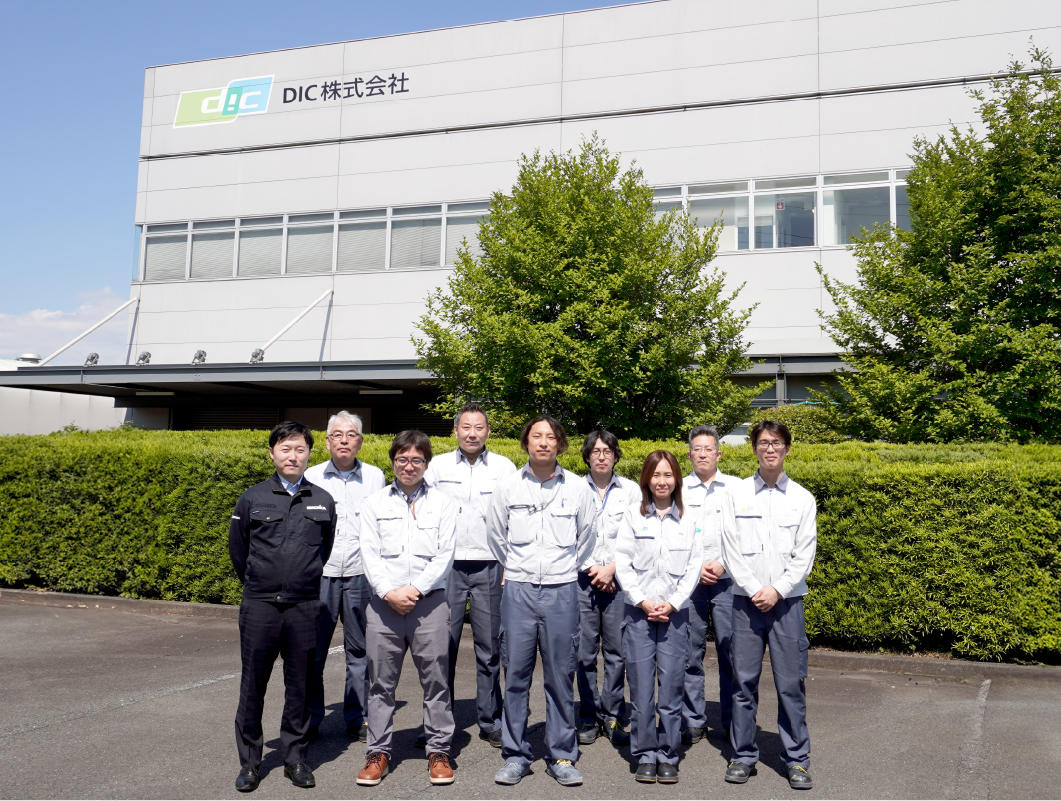
Participating members of this project
People from DIC Corporation
- Takanori Yoshii, Manager, Manufacturing Group 3, Production Technology Department, Production Technology Development Group
- Production Technology Development Group, Production Technology Department
- Mayumi Nakamura, Manager of the Manufacturing Group at the Tatebayashi Plant
- Mr. Hiroki Yukawa, Functional Compound Manufacturing Section, Manufacturing Group, Tatebayashi Plant
- Everyone at the Tatebayashi Factory
Macnica
- Digital Industry Division, Technology Department, 3rd Section, Shunsuke Sakura
- Task
-
- Workers make multiple visits to the site to check the situation
- Dealing with time-consuming past data
- A visualization system that requires costs for each change in requirements
- Purpose
-
- Creating an environment where equipment operation status can be remotely monitored
- In-house production with limited human resources
- Promoting the use of acquired data
- effect
-
- Creating a dedicated screen to make checking the situation more efficient
- Clarifying the cause of problems by collecting data
- Achieve advance planning by predicting timing for replenishing raw materials
The start of a new project
Nakamura: We were founded as a printing ink manufacturer and distributor, and now have over 180 group companies in 62 countries and regions around the world. We hold the world's top market share in printing inks, organic pigments, and PPS compounds, and are expanding our business domain based on the basic materials of organic pigments and synthetic resins. We are also currently expanding into a variety of fields, including packaging materials such as packaging adhesives and multi-layer films, pigments for displays, pigments for cosmetics, high-performance resin products for the semiconductor and mobility fields, industrial tapes, hollow fiber membrane modules, and health care foods.
The Tatebayashi Plant, which began operations in 1993, is the mother plant for the resin colorant business and is primarily used for production by mixing and molding resins. Currently, the company manufactures functional compounds, materials that give resins high added value.
Exploring a remote monitoring system that will help improve work efficiency as a stepping stone to digital transformation
Yoshii: The company-wide promotion of digital transformation began around 2019, but since around 2017, the Tatebayashi Plant has been promoting digitalization, primarily in the production department, and has been working on various initiatives to become a smart factory. As we deal with aging and maintain and continue production equipment that requires ongoing maintenance, the company-wide need to develop a log collection infrastructure that would lead to data utilization. In fact, we had been introducing a log collection infrastructure on a spot basis even before full-scale digital transformation began, but there was a growing momentum to reconsider it as part of creating an environment that will be necessary in the coming era with an eye to the future.
Nakamura: The movement to improve work efficiency even a little by promoting digitalization has been promoted as an extension of measures to improve the site from before. In particular, the Tatebayashi Plant is divided into four major sites, and logs are collected at each site to help visualize the equipment status and check the history.
In this new initiative, we aimed to create an environment where we could remotely monitor the equipment's operating status and trend information, and quickly grasp the situation from a smartphone, etc., without having to rush to the site. Although the previous log collection platform was indeed capable of acquiring data, there was no mechanism for visualizing it anywhere other than the machine itself, so we decided to proceed with the creation of a new environment that met our current objectives.
Due to the structure, we have no choice but to rush to the site using stairs, which can easily result in waste.
Yoshii: If we can build a system that enables remote monitoring, we can grasp the situation without having to go to the site each time an alert is issued from the equipment, and if we can determine the equipment status early, we can respond quickly, which results in improved production efficiency. Due to the change in the scope of work, which meant that the same members had to be in charge of a wider range of sites than before, we also needed to move away from the approach of sending people to the site to grasp the situation.
Mr. Yukawa: The target line this time has processes spread across multiple floors of a four-story building, but when checking the status of the equipment or resolving abnormalities, we go to the site by stairs. In addition, the on-site members often work in their own places, making it difficult for them to understand the timing of their response, resulting in unnecessary travel such as running into other members on-site for the same purpose. Furthermore, we had to go to the on-site management room once to check which equipment was generating an alert before we could understand the target equipment and its status, which resulted in an inefficient situation where we could not go directly to the site from the work site.
Mr. Yoshii: We mainly compared solutions offered by equipment manufacturers and solutions offered by IT vendors and SIers. We had a track record of doing business with Macnica at our other factories, so we decided to talk to them and that's how we got to know them.
Although the objective this time was remote monitoring, we naturally wanted to promote the utilization of the collected data. We focused on Macnica, which has a wide range of experience and knowledge in this area, as well as a proven track record in data integration. Previously, log collection was provided by a facility manufacturer, and although we were able to collect data, we did not have much experience in utilizing it. Another factor in our decision was that if we asked the facility manufacturer to do the work, it would be difficult to support the development of the system.
Also, if it's too complicated, it will be difficult to operate on-site. As for "DSF Cyclone," we were impressed with the way they initially built the data acquisition section, and then used the data with a general-purpose solution called "MotionBoard."
Selected "DSF Cyclone" and Macnica
Inevitably, change requests arise, and in-house development is desirable
Yoshii: We have four sites with more than 20 lines in operation, so we couldn't include all the lines in the remote monitoring target at once. We decided to first determine a test line and then deploy it to other lines. Therefore, instead of asking an outside party to do it each time, we designed the system with a mechanism to make it possible to in-house line expansion as much as possible. We expected that there would be requests to add items or change the screen, so we wanted something that we could modify ourselves. In fact, the visualization mechanism we had previously introduced was completely developed by an outside party, but we still incurred costs every time we made a change due to a request from the site. Even with limited human resources, we wanted to choose a system that we could in-house.
Nakamura: We actually compared several companies, but since none of the project members were familiar with the IT field, we placed importance on whether they could provide solid proposals and support, and whether they could provide support to work with us to create the product. Since we couldn't just sell the product, a major point for us was whether they could transfer skills, including the possibility of in-house development in the future.
I would like a system that reduces the burden of data utilization as much as possible
Irikura-san: I had just joined the company and did not yet fully understand the factory. However, at the time, we had to obtain CSV data from several sites and piece it together while checking the dates, which made it very time-consuming to use past data. It also took a long time to create graphs, and the data was not in a satisfactory state to use. Therefore, when we entered the project, we wanted to make it as easy to handle the data as possible, so we were looking for a solution that was not only easy to use, but also easy to handle.
Increasingly visualized current operations
"DSF Cyclone" deployed on two lines, achieving on-site visualization
Yukawa: This time, we introduced "DSF Cyclone" to the first line, and then expanded it to another line. Although there are technical differences, each line acquires data from almost the same machines. However, since the information required differs depending on the line, the content of the second line is completely different. The first line is quite simple, but the second line has a fairly complex structure and there were many checkpoints to acquire.
Not only is the information obtained from the extruder itself different, but the type of resin and the compounding products differ for each line, and the temperature and pressure information required also differs. Naturally, the locations where the data is obtained are also different, so in terms of the number of data obtained alone, the first line obtains about 200 pieces of information, while the second line obtains nearly twice as much. Data is updated once every five seconds, so it is possible to grasp the situation in almost real time.
Irikura: Specifically, it is to know how much of the raw materials such as resins and pigments are left in the tanks where they are stored, and what kind of errors have occurred in each piece of equipment, such as the raw material tanks, measuring instruments, extruders, and filling and packaging machines. When the contents of the raw material tanks run low, they need to be replenished, but in the past, this required multiple visits to the site, such as going close to the equipment to check the screen. Now, by visualizing the status of the raw material tanks on a smartphone, it is possible to appropriately determine the timing for refilling no matter where you are.
When an alarm sounds, staff can rush to the first floor to get a rough idea of the situation, but after checking, staff must then head to each floor to check the problem. Visualizing the situation on a smartphone has the added benefit of allowing staff to check on the spot where the problem is and then go directly to the required floor to check.
The dashboard provided by "DSF Cyclone" includes the equipment operation status, which shows the situation such as machine shutdowns, as well as trend graphs of temperature and pressure, and a trouble list screen based on alert information.
Enabling on-site situation monitoring via smartphone
Yukawa: My first priority was to create a screen that would allow users to easily grasp the situation on their smartphones using "MotionBoard." We have a three-shift system, and if there is anything going on, it can be checked on the system's dedicated smartphone. Currently, anyone with the necessary environment can grasp the operating status, but there are cases where multiple members end up heading to the site, so I would like to be able to register who will be going from the dashboard screen in the future. Currently, we decide in advance who will be going.
Irikura: Sometimes we input information such as production plans that cannot be obtained from the equipment in CSV format, but if the equipment on the line stops, it is automatically recorded. In some cases, we register the cause directly in "DSF Cyclone" and search by date, time, and lot to check the data from when the problem occurred. Collecting data helps us clarify the cause, which is useful for making improvements.
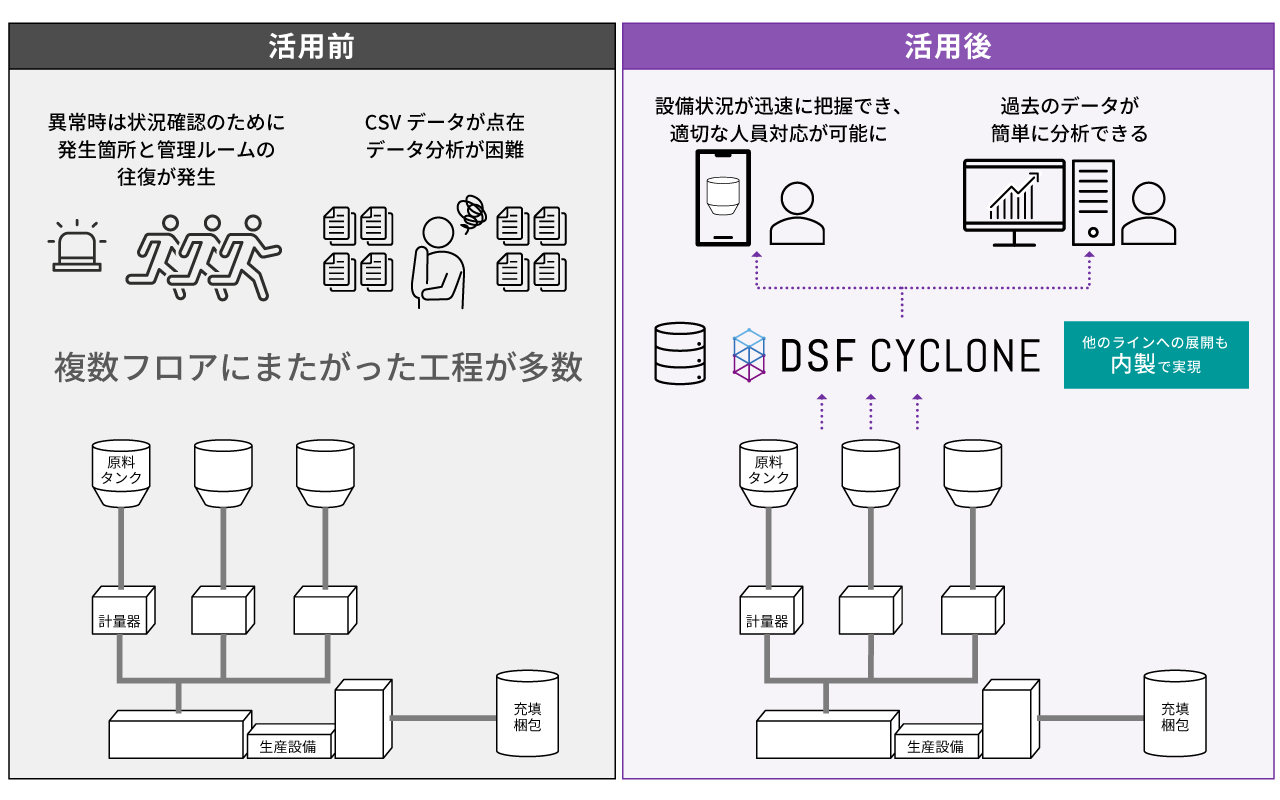
Benefits of introducing "DSF Cyclone"
Nakamura: We have a streamlining budget that quantitatively evaluates improvements and converts them into monetary value, and this information is also entered into "DSF Cyclone" as a performance record. In addition, we hold monthly improvement activity report meetings for the entire factory, and receive reports from Yukawa's team on the extent to which time loss reduction has progressed based on the average hourly wage.
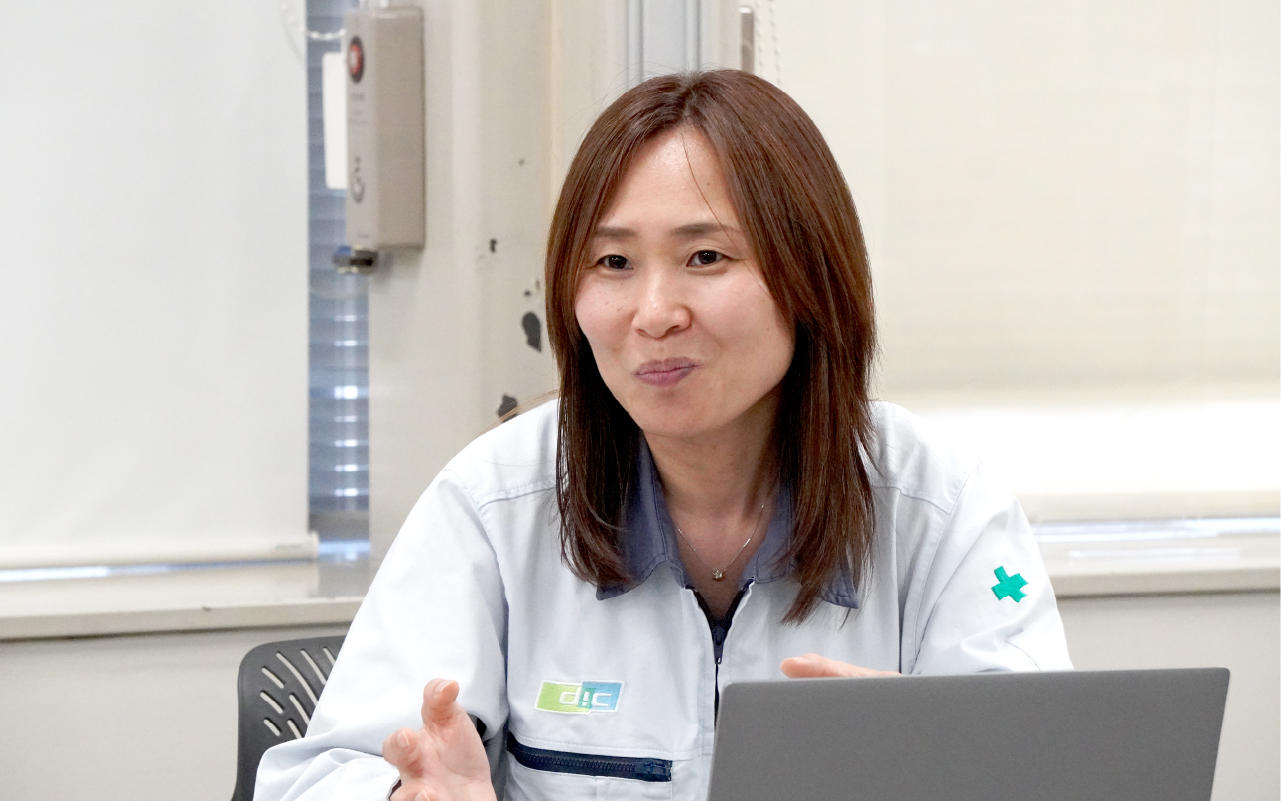
Yukawa: Based on calculations, by being able to visualize the site with "DSF Cyclone," we have calculated that the time saved when the machines are operating at full capacity is 260 minutes per day. There is no doubt that the time spent checking the site can be greatly reduced. In particular, it has become possible to predict the time required to replenish raw materials, and it has become possible to properly plan work in advance.
In-house development contributes to the development of digital talent
Nakamura: By developing and running "DSF Cyclone" in-house, we believe that we have definitely contributed to developing digitally-savvy DX talent within the company. We do not have a clear definition of what DX talent should look like across the company, but rather we are working on it while considering what each base and factory should look like, but at least at the Tatebayashi factory, the use of "DSF Cyclone" in this initiative has contributed to talent development.
Irikura-san: It was only thanks to "DSF Cyclone" that we were able to realize on-site visualization through in-house development, which we had in mind from the beginning, and I really appreciate that. Naturally, visualization is important in terms of how the site wants to see it, so I was able to make use of the knowledge I had acquired and have the site take the lead in moving forward.
The difficulties of setting up and building the environment for the first time
Irikura-san: This time, the focus was on data collection and visualization using BI tools, but to be honest, it was not easy as it was my first experience with data collection. If you try to collect a lot of data, the amount of work increases accordingly, and if you collect too much data, it becomes difficult to organize it, so we had a lot of difficulties. However, by asking Macnica for advice each time, we were able to create it somehow.
Even without any programming knowledge, we were able to achieve this much thanks to the tool "DSF Cyclone" and the support of Macnica. When adding a line, it can be done on the "DSF Cyclone" GUI without touching the database directly, and by using IDS, new data acquisition can be done in-house.
Yukawa-san: I mainly used "MotionBoard" as a visualization tool. I'm a person who can only use Excel to begin with, but I think I was able to create it by just playing around with it. Irikura had experience in creating the first machine on the line, so I was able to use his knowledge as a reference and successfully visualize it.
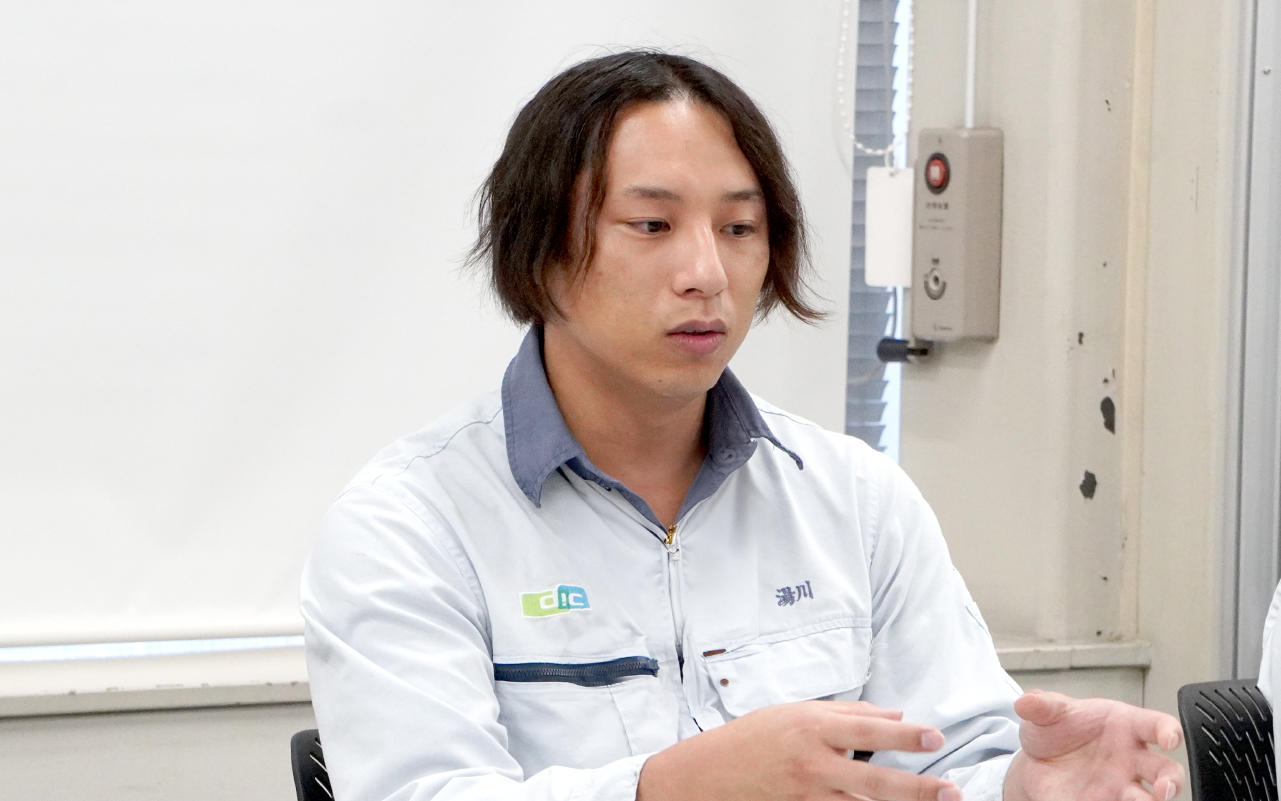
Gaining momentum towards in-house production with two weeks of generous support
Irikura-san: Before deploying to the second line, some specification changes occurred on the first test line, and we had to change the IDS. At that time, Macnica provided us with generous support for about two weeks, such as teaching us the procedure for specification changes and managing the schedule. Since we had asked Macnica to handle the first line, it wasn't like we were familiar with "DSF Cyclone". It was quite Spartan, but I'm grateful that these two weeks helped me to get the hang of it myself.
Yukawa-san: I once tried out "MotionBoard" which is used in the visualization field, but it was quite difficult to create what I wanted because it has a high degree of freedom. However, since it is a general-purpose tool, there are many videos posted on YouTube, and I was able to create what I wanted by deepening my knowledge by participating in seminars held by vendors and doing my own research.
Future developments
I want to utilize my knowledge as a DX professional in my work.
Nakamura: I think that the actual use of the introduced tools in this project was a huge burden for the site, which is busy with its usual work. Nevertheless, through repeated discussions on-site, we were able to realize visualization using digital technology, and I am very grateful to the project members and site members. As for the future, we need to consider the future potential of the factory, and at the moment it is unknown. Although the situation is uncertain, we would like to continue to actively develop activities that will lead to improved efficiency and productivity in the factory, while reconsidering the purpose of our promotion at some point.
Mr. Yoshii: If we can expand this system to other factories, we should be able to make better use of the skills and knowledge we have acquired. If we can set goals, unify the system, and properly plan the allocation of resources, there is a possibility that it will spread even further.
Irikura-san: By developing the system in-house, I was able to get a general idea of how to introduce and operate the system by touching not only "DSF Cyclone" but also the inside of the equipment. I'm sure that this experience will be useful not only for "DSF Cyclone" but also in situations where I am involved in areas such as DX in the future.
Yukawa: It was definitely a valuable experience to be involved as a manufacturing worker. I'm not sure if I'll be able to continue to be involved in DX promotion in the future, but I'd like to help out in any way I can, including by improving my own skills.

DIC Corporation
- Business
- Manufacture and sale of printing inks, organic pigments, synthetic resins, etc.
- founding
- 1908
- Number of Employees
- Consolidated: 22,255 employees Non-consolidated: 3,973 employees (As of December 31, 2023)
- website
- https://www.dic-global.com/ja/
PRODUCT/SERVICE
Click here for products and services related to this case study
Improving Production Efficiency × Digital Manufacturing “DSF Cyclone”
A service solution that realizes a highly productive factory by connecting manufacturing results and production plans with structured data
DOCUMENT
Recommended reading for readers of this case study:
14 Use Cases for Data Utilization in the Manufacturing Sector
Moving beyond mere visualization
We will introduce a framework and use cases for data utilization in manufacturing sites.
*Application is required for download.
CONTACT
Please feel free to contact us with any inquiries regarding this case study or product implementation.