- Smart City/Mobility Business HOME
- Search by use case
-
Search by product/service

- event·
seminar -
Case studies and columns
- Inquiry
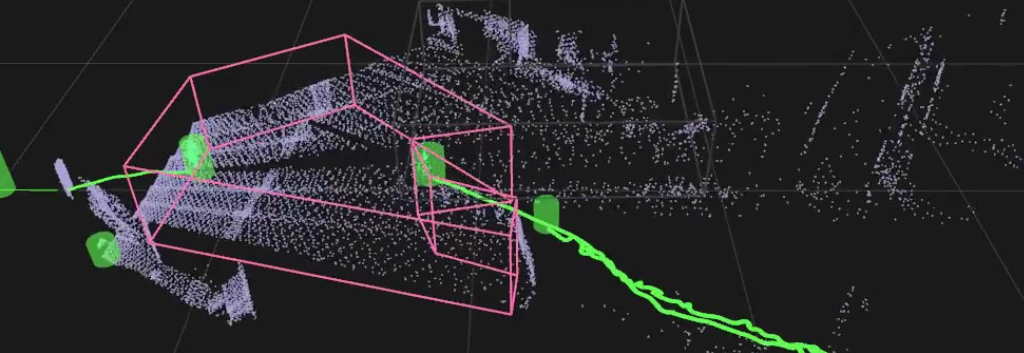
A system that records or issues an alarm when a person or moving object intrudes into a designated area is called an "intrusion detection system." Such systems are used in many places. I'm here.
In so-called security applications represented by surveillance cameras, they are widely used for crime prevention purposes, from shops and factories to private residences.
Recently, many of them have been installed in the city, and they are also effective in criminal investigations.
In addition, various intrusion detection systems are used for safety monitoring in dangerous places such as construction sites and railroad crossings.
In this column, we will explain the methods of diversifying intrusion detection systems and the construction of intrusion detection systems using state-of-the-art sensors.
Various Intrusion Detection System Methods
There are various methods of intrusion detection systems that are used in many situations.
The most common is an intrusion detection system using cameras. This is due to the fact that the camera itself has become cheaper, and digitalization and high-speed large-capacity communication have made it possible to check and record in real time via the Internet.
In addition to detection, advanced analysis such as identification by AI is now possible, and there are high expectations for the development of such technologies and the utilization of acquired data in the future.
For simple intrusion detection, there are various sensors, such as an infrared laser sensor that detects when the infrared laser is blocked between the light emitting part and the light receiving part, and a human sensor that detects infrared rays emitted by humans.
These are single-function devices with low installation and running costs, but they have features such as a short detection distance and inability to perform complex detection and identification. It is used for lights that turn on only when
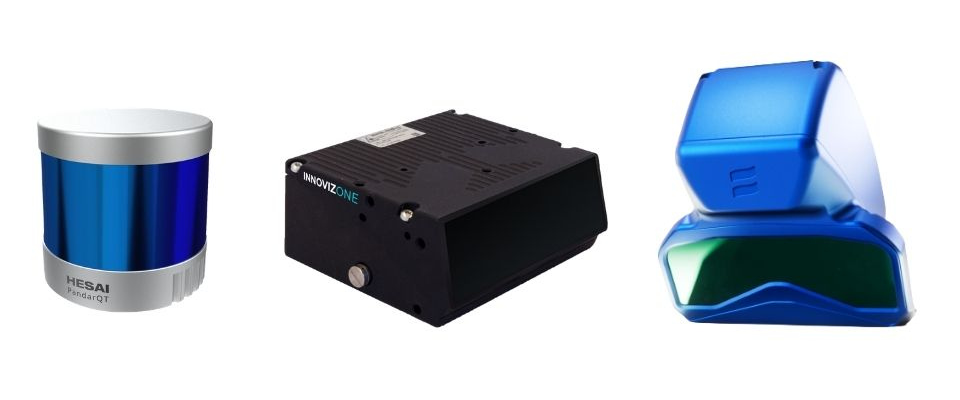
Various LiDAR sensors
In addition to these, LiDAR, which is capable of 3D spatial recognition, has recently been attracting attention.
This is a sensor that emits an infrared laser and receives the reflected light to measure distance and position.
The data obtained by LiDAR is 3D data called"point cloud", and it looks like an image like a camera, but each point has 3D coordinate information, so unlike a camera image, the viewpoint cannot be changed. or the distance to an object.
The LiDAR intrusion detection system applies these for surveillance purposes.
Unlike a camera, it emits an infrared laser itself, so it can be detected even in complete darkness.
In addition, it is not just a sensor, but a sensor that can recognize the shape, so by processing with software, it is relatively easy to distinguish between humans and animals, and between humans and adults.
Software for human detection and motion detection has already been developed, and it is also possible to set zones, output intrusion detection, count people, and stay time, and apply it to people flow analysis. Furthermore, it is also possible to track and predict movement once detected.
Easy-to-build LiDAR intrusion detection system

Construction of an intrusion detection system using LiDAR
We will introduce the procedure for building an area intrusion detection system using LiDAR and software, along with a demo video.
The setting is very easy, and you can do it in"5 minutes" in the following 6 steps.
(1) Start software
② LiDAR connection
(3) Point cloud data display
(4) Setting the ground level (the plane that becomes the ground) and automatic calibration
⑤Zone setting
⑥ Once the environmental learning is complete, the settings are complete!
Demo video "I tried intrusion detection in 5 minutes"
Application of LiDAR Intrusion Detection System
The LiDAR intrusion detection system can not only detect intrusion into an area, but also count people and track the length of stay as described above, so it is possible to analyze how people behave, so-called people flow analysis. .
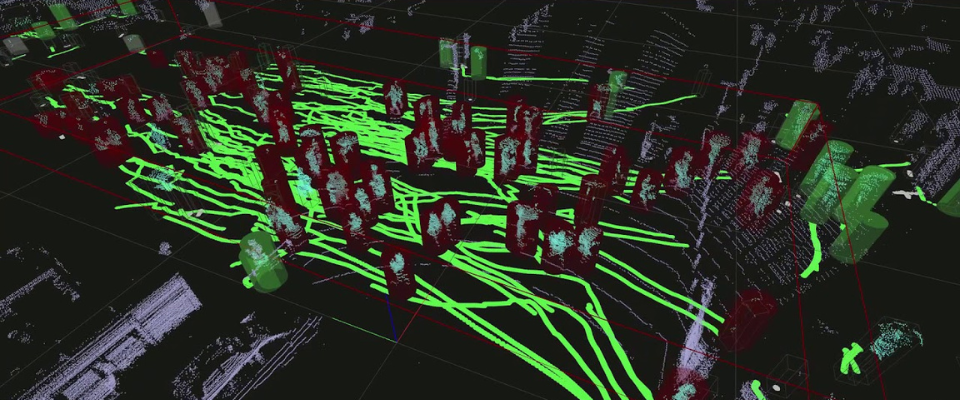
People flow analysis by LiDAR
Analyzing the behavior of a large number of people helps optimize the movement of people in the factory process. In stores, optimization of store design and product display based on customer behavior analysis.
In smart cities, various applications are conceivable, such as intelligent vehicle allocation and product display based on congestion status and behavior analysis.
Macnica provides consulting for these applications and implementation support by accompanying customers.
Inquiry
If you have any questions about the content of this article, or if you have any problems in selecting sensors such as LiDAR, please feel free to contact us from the following.