Kracie's challenge to create a "thinking workplace"
──"DSF Cyclone"Building a foundation for improvement together
Evolving into a "thinking workplace" - Takaoka Plant at the forefront of smart technology
--Kracie Co., Ltd.
Kracie Co., Ltd. operates three businesses: toiletries, food, and pharmaceuticals. In the pharmaceutical business, they offer both prescription and over-the-counter herbal medicines.
The final manufacturing process is carried out at the Takaoka Plant in Toyama Prefecture, which processes raw pharmaceutical ingredients (extract powders) procured from Japan and overseas into final products such as tablets and granules, supporting Kracie's formulation technology and production system.
The Takaoka Factory is one of the Kracie Group's manufacturing plants that is most focused on promoting smart manufacturing. This cutting-edge initiative is supported by an understanding of capital investment, the presence of a dedicated person in charge, and the earnest attitude of the employees who "follow through once they've decided to do something."
The Takaoka Factory is currently taking on the challenge of radically transforming its production by becoming a smart factory. The background to this is the growing demand for herbal medicines in recent years, driven by increased exposure in various media such as television and the internet. In response to this change, which cannot be addressed by investment in manufacturing equipment alone, Kracie chose to take the approach of linking on-site knowledge and data to create a"thinking workplace"where continuous improvement is promoted.
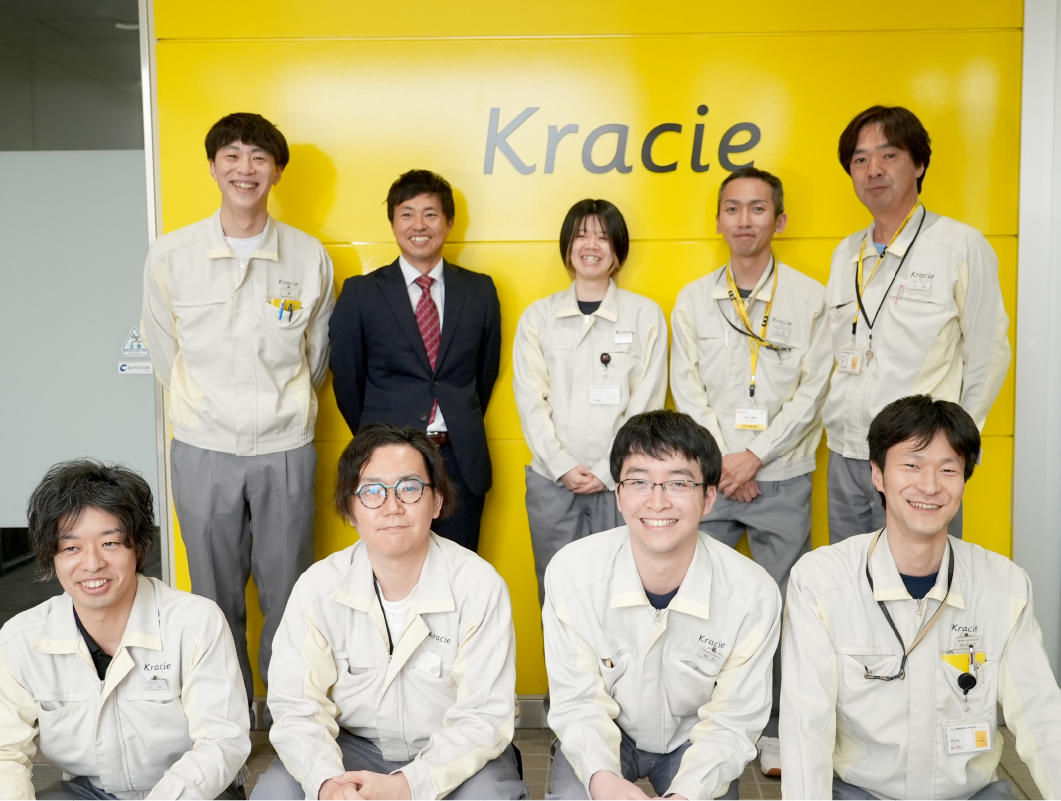
Participating members of this project
Members of Kracie Co., Ltd.
- Aya Yamamoto, Chief, Information Technology Promotion Section, Technology Development Division, Takaoka Plant, Pharmaceutical Company, Pharmaceutical SCM Office
- Shuhei Doai, Section Chief, Information Technology Promotion Section, Technology Development Division, Takaoka Plant, Pharmaceutical Company, Pharmaceutical SCM Office
- Masaru Mutsuda, Manager of Takaoka Plant, Pharmaceutical SCM Department, Pharmaceutical Company
- Mr. Norimi Hasegawa, Chief, Information Technology Promotion Section, Technology Development Department, Takaoka Plant, Pharmaceutical Company, Pharmaceutical SCM Office
- Yuji Itagaki, Deputy Manager, Information Technology Promotion Section, Technology Development Division, Takaoka Plant, Pharmaceutical Company, Pharmaceutical SCM Office
- Mr. Sho Tanaka, Section Chief, Technology Development Section, Technology Development Division, Takaoka Plant, Pharmaceutical Company, Pharmaceutical SCM Office
- Mr. Takeomi Kyoda, Section Chief, Finishing Section 1, Finishing Department, Takaoka Plant, Pharmaceutical Company, Pharmaceutical SCM Office
- Mr. Naoki Azuma, Deputy Chief, Finishing Section 4, Finishing Department, Takaoka Plant, Pharmaceutical Company, Pharmaceutical SCM Office
Macnica
- Yuta Kageyama, Section Manager, Professional Services Division 2, Section 3, Digital Industry Business Department
- Task
-
- No records are kept, making it difficult to review and take measures
- People's judgments are not picked up, and the starting point for improvement is unclear
- The data was meaningless and the field was not moving forward.
- Purpose
-
- Building a system that integrates recording, analysis, and improvement
- Fostering a culture of "seeing and thinking" from the field
- Developing a smart factory infrastructure that supports social responsibility
- effect
-
- Convincing improvements based on data have taken root
- Increased worker autonomy and voice
- A system that can be deployed horizontally and ensures future scalability
The sense of crisis on the ground became the starting point for change
With the increasing demand for herbal medicines, the Takaoka factory's conventional methods were reaching their limits.
Dogo: As our products were increasingly featured on television and other media, we noticed a sudden increase in demand for herbal medicines. In this situation, the Takaoka factory felt a growing sense of crisis that it would no longer be able to survive using traditional methods. Even if demand exceeds our original production capacity, it is difficult to respond all at once with capital investment. We cannot suddenly double the amount starting tomorrow. The manufacturing team was also having a very difficult time.
Facing an invisible wall - the conflicts that arose before the introduction
Even though the equipment and systems were connected, information that could lead to improvements was not being accumulated.
Dogo: Although we set the goal of converting to a smart factory, it wasn't that simple in reality. Everyone on the factory floor knew in their heads that it was a good idea to do it. However, when we actually tried to do it, we ran into a number of obstacles.
The first hurdle was a fundamental system problem: "no data was saved." At the Takaoka Plant, the integration of manufacturing equipment and the manufacturing execution system had progressed to a certain extent, and both the equipment and the system were working. However, this was only for "that moment." Even though the signals and status sent from the manufacturing equipment were displayed on the screen in real time, no records were saved.
Even if the manufacturing equipment and systems are connected, the interaction only lasts for "that moment," and no logs are left behind. On which line, at what time, and for what reason did the machine stop? Such information should be the starting point for improvement activities. However, if there are no records, it cannot be verified later. In the first place, there is no material to look back on in order to make continuous improvements or implement the PDCA cycle.
Seeking a system that can record on-site decisions
DSF Cyclone was the breakthrough that didn't require expensive dedicated development or place a burden on the workers.
Dogo: Regarding this issue, we considered consulting with equipment manufacturers and system vendors. However, creating a system individually would be costly and time-consuming, and when you consider maintenance and operation, to be honest, we didn't feel like we could continue. In addition, the reason for equipment shutdowns is often not clear from signals alone, and in the end, there are cases where a worker's judgment is required. However, asking on-site workers to enter new data would be too much of a burden. We want to record "human judgment" that cannot be picked up by communication alone, but we don't want to increase the burden on the site. This was our biggest concern.
That's when we came across Macnica 's DSF Cyclone, which provides consistent support from data collection to visualization and linking it to improvement activities-it was a truly valuable tool for us as we were trying to figure out what to do.
DSF Cyclone usage example video
You can see how Kracie is using DSF Cyclone in the video below, divided into four cases, along with actual footage from the site.
CASE 1: Real-time monitoring
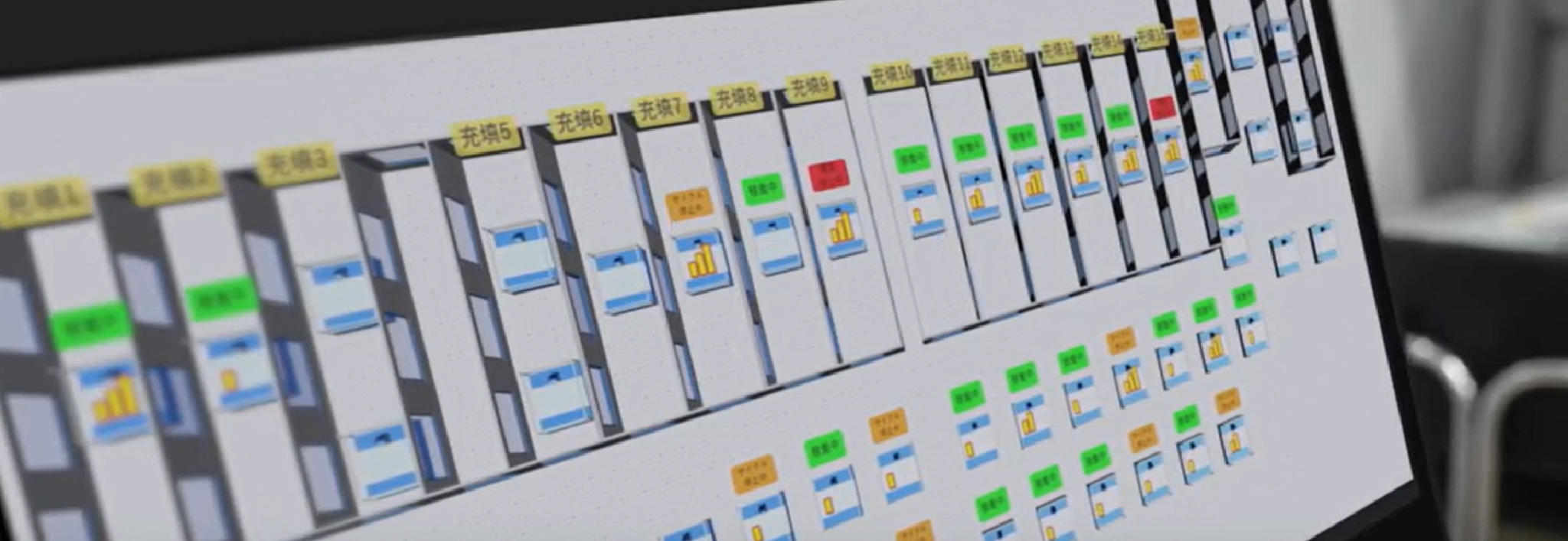
In manufacturing, a monitor installed in the filling room monitors the status of equipment in a remote location in real time. This will demonstrate how the system quickly detects abnormalities and makes decisions on recovery, supporting stable operation of the entire line.
CASE 2: Production efficiency analysis
In production technology, we will identify the causes of inefficiency through an analysis of the time utilization rate. We will also introduce the process of holding an improvement meeting and formulating measures that integrate the actual situation on-site with data.
CASE3: Statistical analysis
In production technology and manufacturing, we will introduce a method for statistically analyzing accumulated loss information and scoring abnormal trends, visualizing improvement priorities and addressing issues that are difficult to notice on-site.
CASE4: Performance report
In production technology, production performance reports are automatically compiled and visualized on monitors in the cafeteria. We will introduce our efforts to create an environment where everyone can share operational status and foster a culture of improvement.
Visualization alone did not move the field
Although the numbers were displayed, there were no hints for improvement.
Dogo: When we first introduced DSF Cyclone, the goal at the site was simply to "show the data."Equipment operation data was imported and displayed on a standard visualization board. The data was certainly there. However, the reaction of the people at the site when they saw it wasn't very positive. The boards had already been prepared, but when we showed them to the people at the manufacturing site, there wasn't much discussion about how to improve things with them.
The data was simply "visualized," but it did not become "meaningful information" for the people on the ground. I think there was an invisible confusion there, asking, "So? What can we learn from this?"
Dialogue between the workplace and Macnica created the foundation for improvements
The board evolved in response to the demand for "this is what I want to see."
Dogo: So we decided to take the next step. We shared with Macnica the parts of the existing board that were difficult to understand, and communicated our requests for more data like this.
Through this process, we repeatedly exchanged messages like a game of catch, and while they understood our intentions, we repeatedly adjusted the way we processed and displayed the data. As a result, little by little, discussions began to emerge on the ground about whether we should improve this.
However, this process took time. Retrieving the data from our hands, processing it for analysis, compiling it into a report, and then feeding it back to the workplace took about two to three weeks, and sometimes more than a month. During improvement meetings, there were many times when we found ourselves recalling events we had almost forgotten, thinking, "What was this about?" This would not speed up improvements, and we felt it would be difficult to continue this process on an ongoing basis.
Macnica presented us with a new system that went beyond visualization templates. They designed a more flexible board that incorporated perspectives commonly used in improvement activities, allowing us to automatically display daily operational data.
Thanks to this, we can immediately analyze the situation from the previous month at the next improvement meeting. With this system in place, we felt that we were finally at the starting line of a system where we could "look back on things monthly and make improvements immediately."
The issues that have emerged and "from hypothesis to action"
Data-backed rule changes were implemented in response to issues identified through analysis
Dogo: Since we introduced the new board, the issues at the site have gradually become more visible. For example, there was an issue with the coordination between "packaging" and "filling," which are part of the finishing process. One time, during the analysis, data came out that showed "an abnormally high amount of stoppage loss on the filling side." The figure was much higher than we had felt intuitively, and there were voices of surprise at the site, asking, "Were there really that many stoppages?"
So why is it stopping for so long? After discussing the cause, one thing that became clear was that the timing at which the filling work began was delayed.
When the packaging side finished its work, the filling side was not properly notified. Moreover, the system for following up on this was not properly institutionalized. As a result, there were situations where the machines were left in standby mode, wasting time doing nothing.
By reviewing the rules and saying, "Let's change it like this," we were able to reduce losses by about three minutes per instruction. These kinds of"convincing improvements"are now being born from data.
Workers' behavior began to change proactively
From "inputting what you're forced to do" to "a culture of thinking for ourselves" - A change in awareness on the ground
Dogo: As we continue these efforts, I feel that we have begun to see a change in the reactions of the people on the ground. When we talk while looking at the board at improvement meetings, the people on the ground have started to give specific opinions such as, "This timing was bad," or "Maybe this machine was the bottleneck."
In one case, a worker on-site entered their own comments before a meeting. This was something that would have been unthinkable before. I feel that we are gradually developing a culture of "seeing and thinking for ourselves," rather than just "doing things because we're told to."
Just introducing a smart system doesn't mean that something will change immediately. But by properly communicating the meaning and patiently and carefully continuing to connect it, the workplace will change little by little. The workplace has started to "think" about data that it used to just look at. I think that change is the biggest thing of all.
Support from Macnica: a supportive attitude
They were very supportive of the issues we faced on-site and were always thinking about our next steps.
Dogo: Although the reaction from the field has changed, it was still a continuous process of trial and error to get to this point. It was through a series of improvements that we finally arrived at the current form. During that process, Macnica was our partner, listening to the concerns of the field and noticing issues that had not yet been put into words.
In the early stages of implementation, Macnica led almost every step of the process, providing consistent support from data collection to visualization and even designing how to utilize it.
All we had to do was provide the necessary information, and they would take care of the rest. They even helped us see things that we hadn't seen before. That gave us a really strong sense of security.
We were also grateful for the support we received in expanding the system to multiple production lines. Using the knowledge we gained through the implementation, we were able to expand the system to multiple production lines. They generously provided us with the necessary know-how so that we could handle this task ourselves. If there was anything about the settings that we didn't understand, we asked and they responded immediately. They responded with such speed that we ended up having to wait for a reply, which was really reassuring.
What impressed me most was the approach to the proposal.
For example, when we felt there was an issue with the coordination between workers and leaders on-site, Macnica didn't just wait for our requests, but proactively came up with specific suggestions.
Rather than changing the behavior of the workers, we change the "environment" to naturally draw out their actions. I think this way of thinking ultimately helped us to become closer to the workplace.
He was someone who was always thinking about the next step. I think the word "running alongside" really suits him.
Beyond the "visible factory" - Expanding challenges and responsibilities
Smart factories continue to evolve as a mechanism for supporting stable supply
Dogo: Our smartification efforts are still ongoing. At the Takaoka Plant, we plan to expand the use of communication-enabled equipment in the formulation process as well, further expanding the scope of visualization using DSF Cyclone. Ultimately, we aim to create a truly "visible plant" where we can grasp the operating information of all manufacturing equipment in real time.
And beyond that, we have the idea of promoting smart factories across the entire Kracie organization. We want to create a situation where information from each factory is virtually connected, allowing the entire company to share and create optimal solutions to issues at each site. This is the future that Kracie's manufacturing division envisions.
We are currently in the process of steadily advancing visualization within the Takaoka factory, but we would like to continue moving forward steadily while also considering collaborating with other factories.
Recently, the shortage of pharmaceutical supplies has been increasingly raised as a social issue, and I believe that whether or not a company can maintain a stable supply is directly linked to its credibility.
If we can improve production efficiency and prevent problems before they occur through smart factories, this will ultimately lead to a stable supply. We believe that it is our responsibility to contribute to society in this way.
Efficiency and visualization are not simply a means to increase productivity. Beyond that, we believe that factories will continue to evolve as a force that supports society.

Kracie Co., Ltd.
- Business
- Manufacture and sale of toiletries, cosmetics, prescription and over-the-counter medicines, mainly herbal medicines, sweets, frozen desserts, etc.
- Established
- July 2007 (company name change)
- Number of Employees
- 1,827 (as of the end of December 2024)
- website
- https://www.kracie.co.jp/
PRODUCT/SERVICE
Click here for products and services related to this case study

Improving Production Efficiency × Digital Manufacturing “DSF Cyclone”
A service solution that realizes a highly productive factory by connecting manufacturing results and production plans with structured data
CONTACT
Please feel free to contact us with any inquiries regarding this case study or product implementation.