- Semiconductor BusinessHOME
- Products and Services of Macnica,Inc.
-
technical information

-
Events and Seminars
- Handling Manufacturer
- Support
- Inquiry
- Click here to purchase products
- Semiconductor business e-mail magazine registration


 Narrow down by specifying conditions
現在2153件がヒットしています。check
Do you recall any instances of "checking for the sake of checking" being left unresolved at a work site?
Are your staff walking around the premises every day just to "confirm that there are no problems," such as checking the remaining amount of alcohol disinfectant, verifying warehouse inventory, recording refrigerator temperatures, and checking for unusual noises in equipment? Moreover, 99% of these checks end up being fine.
Routine work that continues simply because "it can't be stopped," even though nothing unusual happens, shares a common structural problem.
- The ambiguity of "Did I already do that?": It relies on memory to remember who checked it and when. Double-checking is ineffective, and omissions and errors can occur.
- The same amount of work is required even on days when there are no problems: 99% of the time, it's just a matter of confirming "no issues," yet people have to go through the process every time.
- Personalization: Relies on the intuition and tacit knowledge of veterans, making handover difficult.
- Reliability of memory: Handwritten or manually entered records carry the risk of transcription errors and omissions.
These problems can be fundamentally solved through automation using IoT sensors. In this article, we will explain the mechanism and benefits of automating routine tasks with IoT sensors, based on three implementation examples that Macnica has actually supported.
Automation using IoT sensors: Eliminating "verification work" in 3 steps
Improving business efficiency with IoT sensors consists of three simple steps.
|
Step |
content |
Specific example |
|
① Measurement |
The sensors continuously acquire temperature, weight, vibration, liquid level, and other data. |
A weight sensor is installed on the shelf to measure the weight of the inventory. |
|
② Send |
Automatically transmit data using wireless communication methods such as Wi-Fi, Bluetooth, and LPWAN. |
Real-time transfer of measurement data to the cloud |
|
③ Notification/Visualization |
An alert is automatically sent when the threshold value is exceeded, and the results are displayed in a list on the dashboard. |
"Inventory has fallen below 20%" notification on smartphone. |
The key is the shift from "regular patrols" to "responding only when necessary." If there is no abnormality, there is no need for human intervention, and if there is an abnormality, the sensor will immediately notify the user. The anxiety of "Did I already do it?" is eliminated. Below are three examples of implementation.
Case Study 1: Automatically managing inventory and consumable levels using weight sensors
Problem: Daily patrols and checks become a burden on on-site staff.
In many cases, such as restaurants stocking commercial supplies, retail stores managing their shelves, and hospitals providing hygiene products, staff regularly patrol the premises to check whether replenishment is needed.
- Most of the time, even after a round of inspections, the conclusion is "there's still plenty left."
- Inconsistent replenishment timing leads to shortages and excess inventory.
- I spend several hours a day checking multiple locations.
Solution: Use a weight sensor to "notify when weight decreases".
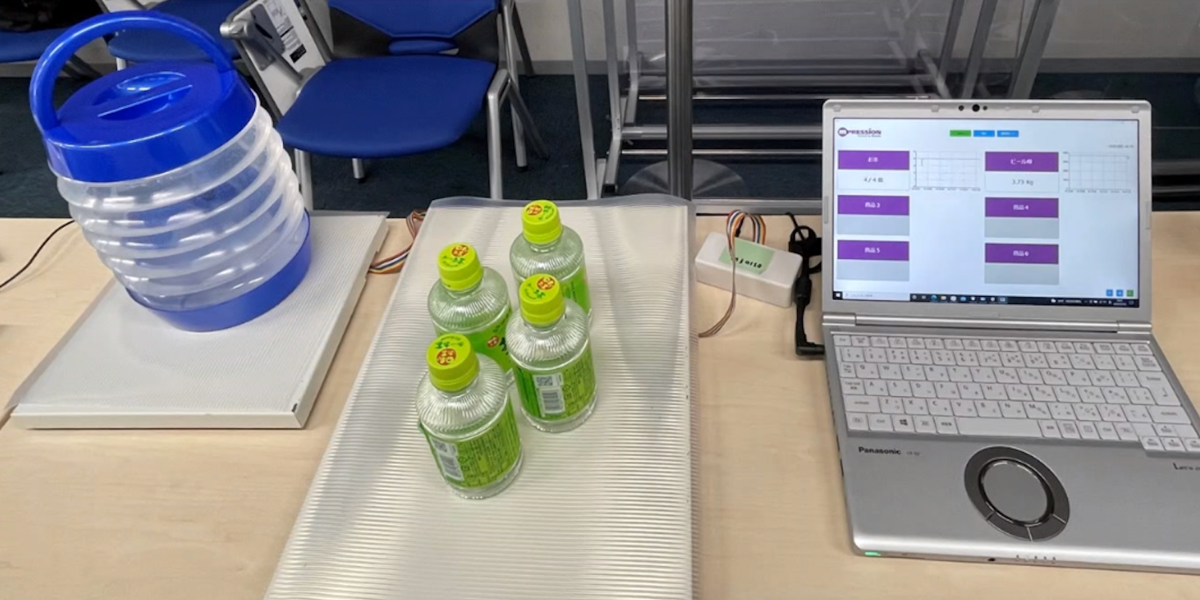
Weight sensors are installed under consumables and inventory to measure weight changes in real time. When the weight falls below a pre-set lower limit, an automatic notification is sent to the employee's smartphone or PC.
We've been receiving a flood of inquiries from unexpected industries.
Macnica 's weight sensor solution receives the most inquiries on MonoCon Web. Initially developed for applications such as server capacity management in restaurants and shelf inventory management in retail stores, we have actually been receiving numerous inquiries from other industries as well.
For example, public facilities need to keep a certain amount of supplies in stock at all times, but often they don't have the manpower to check the inventory on each floor of each facility. By installing weight sensors, it becomes possible to remotely determine "what percentage remains," and replenishment only needs to be done on the floors where it is needed.
Furthermore, the system is increasingly being implemented for inventory management at distribution centers of logistics companies. This includes systems that allow headquarters to monitor the remaining quantities of packaging materials and delivery slips at each distribution center in real time, and automate ordering for each center.
Benefits
|
Traditional methods |
After IoT implementation |
|
We conduct daily rounds of all floors and all shelves at a fixed time. |
Only locations where the remaining amount falls below the minimum level will be addressed. |
|
"Is there any left?" I checked visually. |
The dashboard displays a list of remaining resources for all locations. |
|
The timing of restocking is determined by the staff's intuition. |
Replenish at the optimal timing based on data. |
|
Confirmation records are handwritten notes. |
Automatically recorded to the cloud. History can also be traced. |
▶Click here for examples of how weight sensors are being used.
This system can be used in a variety of industries, including restaurants, retail stores, and logistics centers. We explain the specific mechanisms and provide examples of configurations.
![Automatic management of inventory and remaining amount using weight sensor + IoT [for retail stores and restaurants]](/business/semiconductor/articles/Mono_Article_Cover_8.png)
Macnica has developed a prototype of an "AI smart shelf" that can check inventory and remaining stock using weight sensors. A video demonstrating it is available online, so please take a look.
Automatic inventory and remaining quantity management using weight sensors and IoT [For retail stores and restaurants]

Automatic inventory and remaining quantity management by weightWe made a coaster using this technology! When you're at a drinking party and your beer or drink is running low, it will flash to let you know, so you won't miss the chance to get a refill!
Improve your restaurant experience with refill coasters | Weight sensors can now detect remaining drink levels!
Case Study ②: Continuous monitoring of temperature, humidity, and CO2 using environmental sensors
Challenge: Manual temperature recording tends to become "a task for the sake of recording."
Food processing plants and pharmaceutical warehouses are required to keep regular records of temperature and humidity to comply with HACCP and quality control standards. However, many facilities are experiencing the following problems.
- Manual recording every two hours → interrupts staff work.
- Paper record sheets → Risk of transcription errors, omissions, and later tampering.
- Delays in detecting anomalies → May go unnoticed until the next inspection, leading to quality problems.
Solution: Use environmental sensors for "continuous monitoring + automatic recording + deviation alerts"
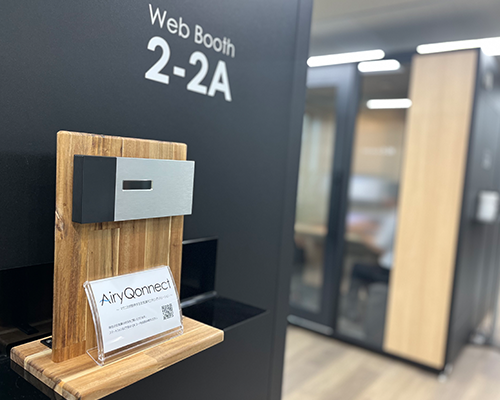
Environmental sensors measuring temperature, humidity, and CO2 concentration are installed, and the data is automatically transmitted to the cloud. The moment the values deviate from pre-set standards, an alert is sent to the person in charge. Manual recording is completely unnecessary, as the data is automatically stored in the cloud, and audits can be handled simply by specifying the period and outputting the data from the dashboard.
The following illustration shows an example of an alert notification in a hospital room.
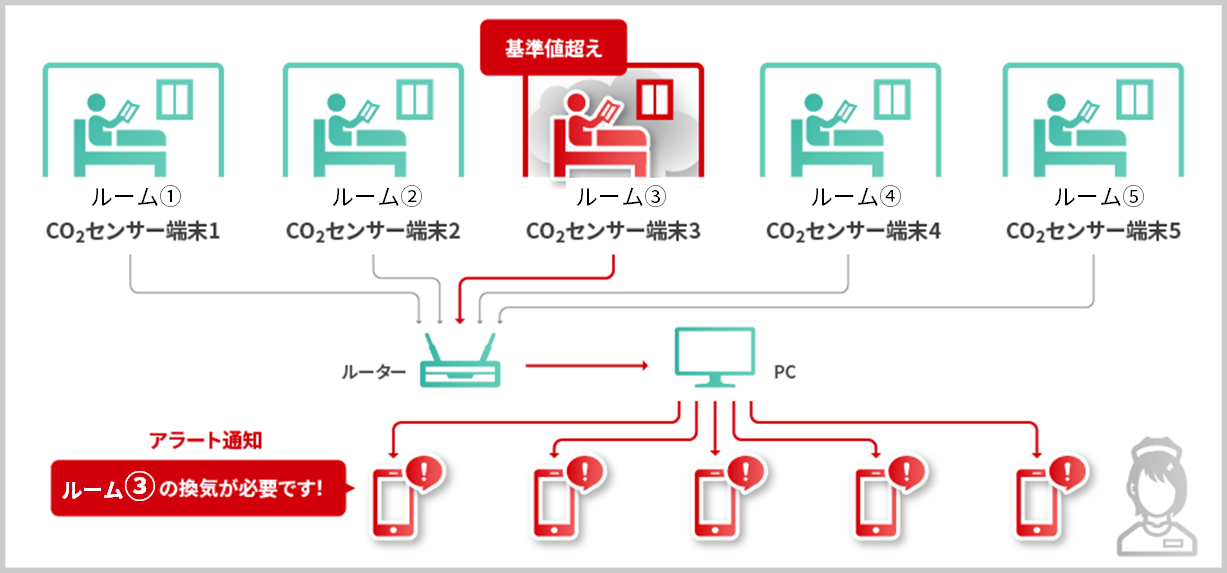
Method of notifying all staff
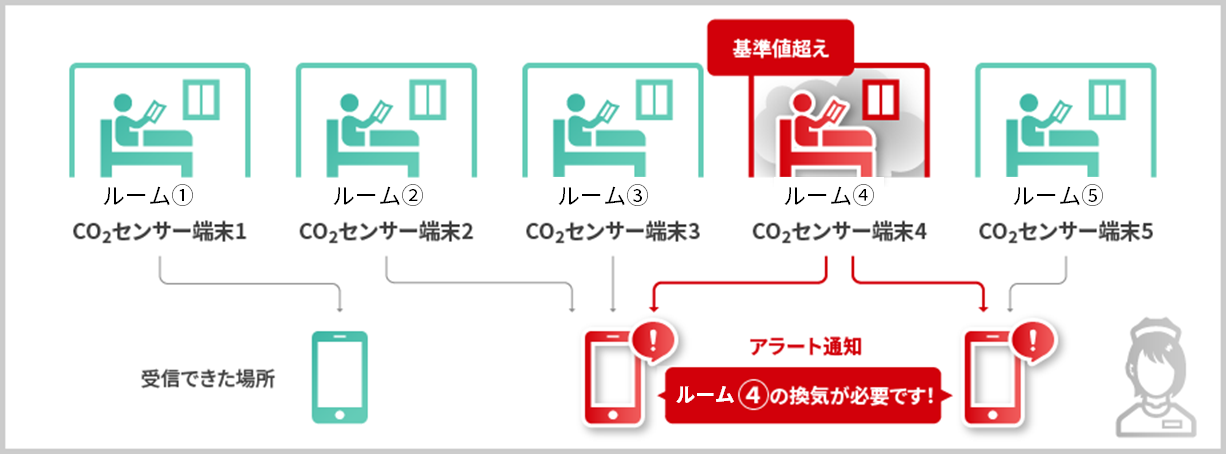
A method of notifying only smartphones that have received nearby
Macnica 's track record: Analyzing defects in environmental sensor prototypes and achieving mass-production quality.
In one case supported by Macnica, a housing equipment manufacturer was plagued by frequent malfunctions and inaccurate measurements in a prototype environmental sensor developed through joint research with a university. Furthermore, the research lab had been disbanded, leaving the company with no one to consult.
Macnica MonoCon® team then analyzed the remaining development information to identify the problem. They identified the issue, achieved stable measurement accuracy, and provided comprehensive support from establishing a mass production system to maintenance. This case demonstrates how a customer's challenge of "having a prototype but not meeting mass production quality" was solved. Macnica 's unique strength lies in its ability to provide support not only for sensor implementation but also for product commercialization and mass production.
Industries where its use is expanding
|
industry |
Main uses |
Monitored items |
|
Food factory |
HACCP-compliant temperature control |
Temperature/humidity |
|
Pharmaceutical warehouse |
Compliance with GDP (Good Distribution Practice) for Pharmaceuticals |
Temperature/humidity |
|
office |
Achieving both comfort and energy efficiency |
Temperature/humidity/CO2 |
|
Agricultural greenhouse |
Optimization of the growing environment |
Temperature, humidity, CO2, solar radiation |
Case Study ③: Predictive Maintenance of Equipment Using Vibration and Current Sensors
The problem: "Repairing after it breaks" will halt the production line.
In many factory settings, equipment maintenance is still based on "regular inspections plus reliance on the five senses."
- Checks performed visually, auscultally, and palpably become dependent on individual expertise, leading to a decline in quality when experienced staff retire.
- Abnormalities may be overlooked during regular inspection intervals → Production stoppage due to sudden failures
- "Replace it early just to be safe" → Discarding a part that is still usable (over-preservation)
Solution: Use vibration and current sensors to "notify before it breaks."
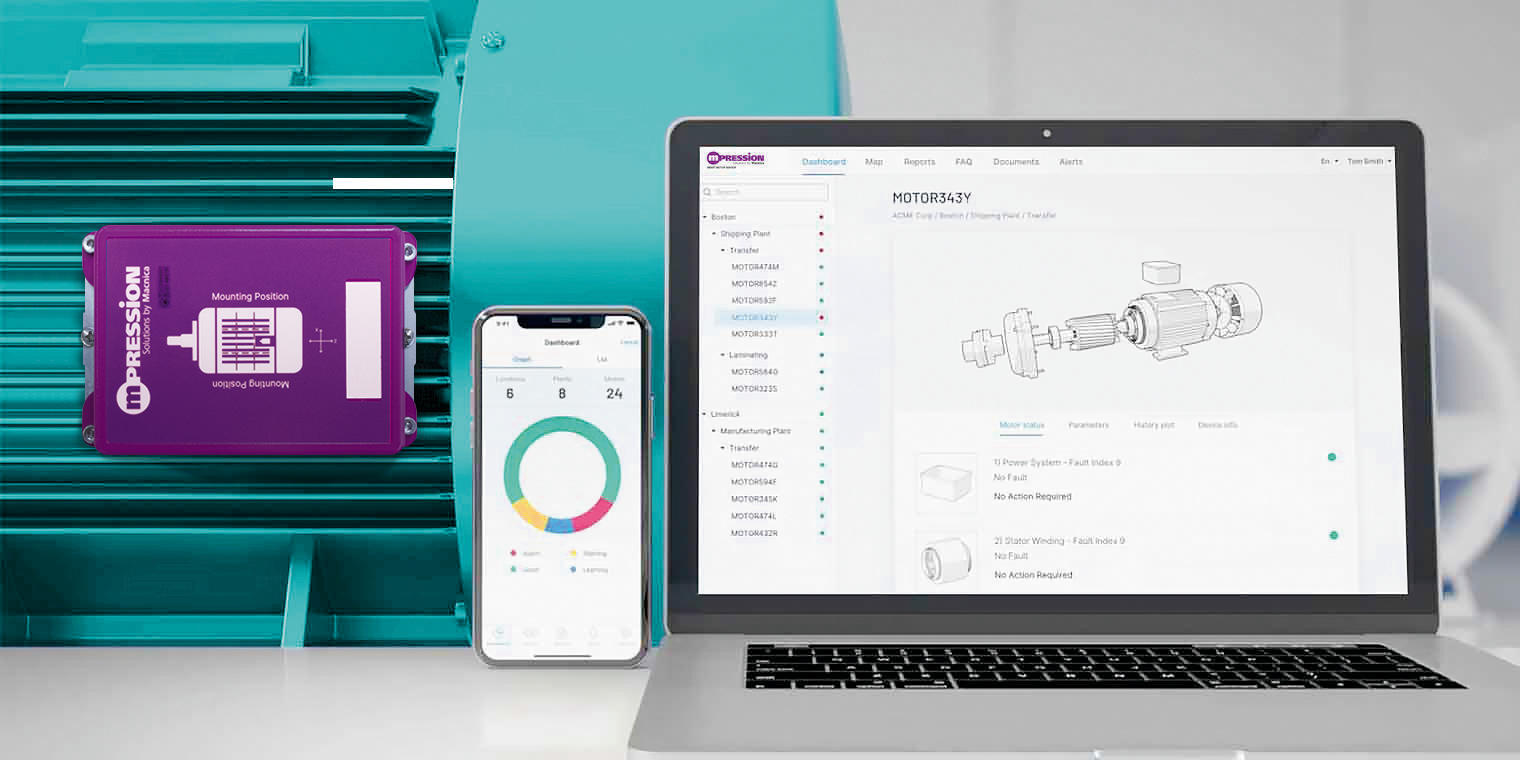
By attaching vibration and current sensors to rotating machinery such as motors and pumps, their operating status is constantly monitored. When a deviation from normal values is detected, an alert is issued, allowing for planned maintenance before a failure occurs.
From "periodic inspections" to "condition-based maintenance"
|
Maintenance method |
Overview |
assignment |
|
Post-mortem maintenance |
Repair after it breaks |
Sudden shutdown, significant losses |
|
Time-Based Maintenance (TBM) |
Inspect and replace at regular intervals. |
Over-maintenance, high costs |
|
Condition-Based Maintenance (CBM) |
Sensors constantly monitor the system's condition and respond to any abnormalities. |
The introduction of IoT sensors is necessary. |
Predictive maintenance using IoT sensors offers a third option: neither "repairing after a failure (corrective maintenance)" nor "replacing at fixed intervals (time-based maintenance)." Because it makes decisions based on the actual condition of the equipment, it can optimize maintenance costs while preventing unexpected shutdowns.
Industries where its use is expanding
|
industry |
Target of surveillance |
Main sensors |
|
manufacturing industry |
Motors, compressors, pumps |
Vibration/current/temperature |
|
Building management |
Air conditioning equipment, elevators |
Vibration and electric current |
|
Logistics facility |
Conveyors, automated warehouses |
Vibration and electric current |
|
infrastructure |
Bridges, tunnels |
Vibration/tilt |

motor
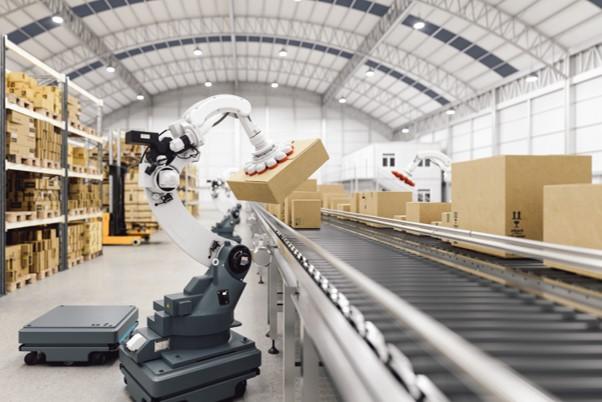
Conveyor

A dilapidated bridge
Five Benefits of Introducing IoT Sensors
"What benefits will our company gain from implementing IoT sensors?" To answer this question, we've summarized five key advantages.
|
merit |
content |
|
① Significant reduction in patrol and inspection work |
There will be no need for people to move around just to "confirm that there are no abnormalities." |
|
② Resolving the question, "Have I already done this?" |
Sensor data is automatically recorded in the cloud, providing real-time information on the current situation at the site, rather than just showing when and who checked it. |
|
③ Improved speed of responding to anomalies |
You will receive a notification the moment an anomaly occurs, without having to wait for the next patrol. |
|
④ Elimination of reliance on individual expertise |
Decisions that previously relied on the intuition of veterans are being replaced by data-driven decisions. |
|
⑤ Fundamental measures to address labor shortages |
By replacing tasks that don't require human intervention with sensors, limited personnel can be allocated to higher value-added tasks. |
Sensor Selection Guide by Application
"Which sensor is right for our company's specific needs?" To answer this question, we've compiled a list of selection points based on application.
|
Things to detect |
Optimal sensor |
Selection points |
Typical uses |
|
Changes in inventory/remaining quantity |
Weight sensor |
Selecting the appropriate measurement range (from a few grams to several hundred kilograms) is crucial. |
Shelf inventory, consumables, beer dispensers |
|
Temperature/humidity |
Environmental sensors (temperature and humidity) |
Determine the required accuracy (±0.5℃ vs ±2℃) based on the application. |
Food factories, pharmaceutical warehouses, offices |
|
CO2 concentration |
Environmental sensor (CO2) |
The NDIR method offers high accuracy and is directly linked to ventilation control. |
Offices, nursing homes, schools |
|
Liquid level |
Battery level sensor (ultrasonic/capacitive) |
Select the method based on the tank material and type of liquid. |
Drink dispenser, chemical tank |
|
Equipment vibration/abnormality |
Vibration sensor (accelerometer) |
Sampling rate and frequency bandwidth are key. |
Motors, pumps, compressors |
|
People's movements and occupancy |
microwave sensor |
The method changes depending on whether detection through walls is required. |
Toilet occupancy detection, lighting control, intrusion detection |
As a leading semiconductor technology trading company in Japan, Macnica boasts one of the largest selections of components, and its engineers, who possess a deep understanding of sensor characteristics, select the optimal sensor for your application. We provide support that includes technical assessments, such as "Can this sensor truly meet your requirements?"
Macnica 's support system solves the problem of "We want to introduce sensors, but we don't know what to do next."
Implementing IoT sensors isn't just about buying the sensors and being done with it. It involves designing the communication infrastructure, building a cloud environment to receive data, creating an alerting system, and mass production after operations have stabilized. Macnica receives many inquiries from people who say, "We know what we want to do, but we don't have the means to make it happen."
Macnica 's manufacturing consulting service (MonoCon®) can provide comprehensive support from the idea stage to mass production.
|
Support Phase |
content |
|
① Problem identification and planning |
You can start even without blueprints, just with "This is what I want to do." |
|
② Sensor selection and evaluation |
We select the optimal sensor from our 26,000 suppliers and also provide loaner samples for evaluation. |
|
③ PCB and communication design |
Circuit design, implementation of communication modules (Wi-Fi / BLE / LPWAN) |
|
④ Cloud application development |
Development of data visualization dashboards and alert notification functions. |
|
⑤ Establishment and maintenance of mass production system |
We select the optimal manufacturing partner from our global network of 91 locations in 28 countries. |

Many IoT solution companies either "sell sensors" or "build systems." Macnica, however, can handle everything from sensor component selection and board design to enclosure, cloud services, and mass production, all through a single point of contact. This eliminates the need to place separate orders with multiple vendors, optimizing the speed and cost of the entire project.
Frequently Asked Questions (FAQ)
Q1. What is the cost of implementing IoT sensors?
A single sensor module costs between a few hundred and a few thousand yen. The cost of the entire system, including communication modules, cloud environment, and application development, varies depending on the scale and specifications. Please tell us about your challenges, and we will provide you with an estimated quote.
Q2. Can it be retrofitted to existing facilities or buildings?
Yes. IoT sensors are small and lightweight, and in most cases can be retrofitted to existing shelves and equipment. Many are wireless communication types that do not require wiring work, so they can be introduced without major construction.
Q3. Is the data security adequate?
We design solutions to meet security requirements, including communication encryption and access control for cloud environments. On-premise (company-hosted server) deployments are also available.
Q4. Can we try it on a small scale first?
Absolutely. Macnica recommends starting with a Proof of Concept (PoC) using one or two locations and a few sensors. This allows you to test it on a small scale, confirm its effectiveness, and then move on to full-scale implementation. We also offer loaner evaluation samples.
Q5. How long does it take to implement the system?
For cases where off-the-shelf components can be used, the process typically takes a few weeks to a month. For cases involving custom development, the estimated timeframe is three to six months. Macnica can handle everything from sensor selection to cloud development, allowing for faster progress than distributing orders across multiple vendors.
Summary: From "human verification" to "sensor-based notification system"
The essence of routine work is "confirming that there are no abnormalities." IoT The sensors automate the verification process itself, creating a system where humans only need to act when an anomaly occurs.
This allows you to free up limited personnel from "checking for the sake of checking" and dedicate them to tasks that they should be focusing on. IoT Improving work efficiency through sensors is essential to solving the current labor shortage. "This job could probably be replaced by sensors." "I'd like to start by discussing whether IoT sensors can be used in my company's operations." Macnica MonoCon® accepts inquiries at that level.

Related article
- Automatic inventory and remaining quantity management using weight sensors and IoT [for retail stores and restaurants]
- Automatic management of remaining amount using remaining amount sensor and IoT. The remaining amount sensor ensures that your drink server will never be empty!
- Restaurant DX with refill coasters | Detecting remaining drink volume using weight sensors
- [Manufacturing DX] IoT visualizes the availability of inspectors, reducing minor stoppages and downtime!
- What are microwave sensors? We explain the differences from infrared sensors, their applications, and how to implement them.
- "Manufacturing consultation" based on an idea