- Semiconductor BusinessHOME
- Products and Services of Macnica,Inc.
-
technical information

-
Events and Seminars
- Handling Manufacturer
- Support
- Inquiry
- Click here to purchase products
- Semiconductor business e-mail magazine registration


 Narrow down by specifying conditions
現在2239件がヒットしています。check
![Automatic management of inventory and remaining amount using weight sensor + IoT [for retail stores and restaurants]](/business/semiconductor/articles/Mono_Article_Cover_142599.png)
"You will receive a notification when the weight changes." Are you looking for such a system?
In retail, food service, and logistics warehouses, accurate inventory management is essential to maximize profits. By providing the right amount of products at the right time, you can meet customer expectations while maximizing profits.
However, in these days of labor shortages, there are limits to the amount of "visual checks" that humans can perform on a regular basis. In such cases, how much easier would your work be if a system could automatically notify you by email or LINE that a product shelf or storage box was "about to be empty"?
This article uses the "AI Smart Shelving" developed by Macnica as an example to explain how weight sensors and IoT technology can be used to automate inventory management and dramatically improve operational efficiency. Features such as inventory status visualization and low-stock notification can be demonstrated in physical stores. By utilizing AI and IoT technologies in this way, the retail industry can achieve more efficient store operations and customer experiences, thereby maintaining a competitive edge.
What is an inventory management system using weight sensors (IoT)?
Conclusion: A system that digitizes physical "weight" and visualizes inventory and remaining quantities in real time
Inventory management using weight sensors (IoT) is a technology that constantly measures the weight of items using sensors installed on shelves and in storage areas, and automatically calculates and manages stock numbers and remaining quantities by sending that data to the cloud or an app. This system breaks away from the traditional management method of "people making regular rounds" and realizes "data-driven" management that takes necessary action when needed.
Key Benefits
- Automated inventory check: No need for manual counting.
- Prevent lost opportunities: Detect out-of-stock items in real time.
- Liquid and irregular object management: Accurately grasp the remaining amount of liquids (such as beer barrels) that are difficult to determine visually.
Inventory check challenges faced by retail stores, restaurants, and logistics warehouses
On the sales floors and backyards of retail stores, restaurants, bars, and distribution warehouses, operations are performed to display and stock products on shelves and replenish them as needed in order to deliver products to customers.
Many stores replenish inventory by checking inventory on a regular cycle. This method is also called TBM (Time Based Maintenance). If the check cycle becomes longer, the operational load will be reduced, but the necessary products will not be provided, resulting in opportunity loss. However, if the check cycle is shortened, the operational burden will increase and employees will be forced to bear the burden in the midst of a labor shortage.
Inventory status changes depending on the external environment, such as the influence of weather, surrounding events, and the operation of business partners, so it is extremely difficult to replenish inventory in an optimal cycle. In Japan, which has entered an era of population decline, a shortage of human resources is an issue in all industries. Utilizing digital technology, AI, and IoT technology is effective in maximizing profits with limited personnel and without imposing any burden.
Limitations of TBM and transition to CBM
One approach to solving the issues with TBM is Condition Based Maintenance (CBM). This is a method of diagnosing the condition of equipment and determining the appropriate timing for maintenance. Advances in IoT devices such as sensors and cameras, as well as computing, have made it possible to achieve CBM without the burden on people.
| item | TBM (regular maintenance, conventional type) | CBM (state maintenance/IoT type) |
| Management method | Personnel patrol and check at set times and frequencies | Constant monitoring using weight sensors, etc. |
| Labor costs and man-hours | Increases in proportion to check frequency | Minimal (only responds in the event of an abnormality) |
| Risk of stockout | I don't notice the shortage until the next round. | Immediate detection possible |
| Suitable environment | Abundant staff and stable inventory fluctuations | Labor shortages and irregular inventory fluctuations |
Macnica 's Solution: How AI Smart Shelves Work
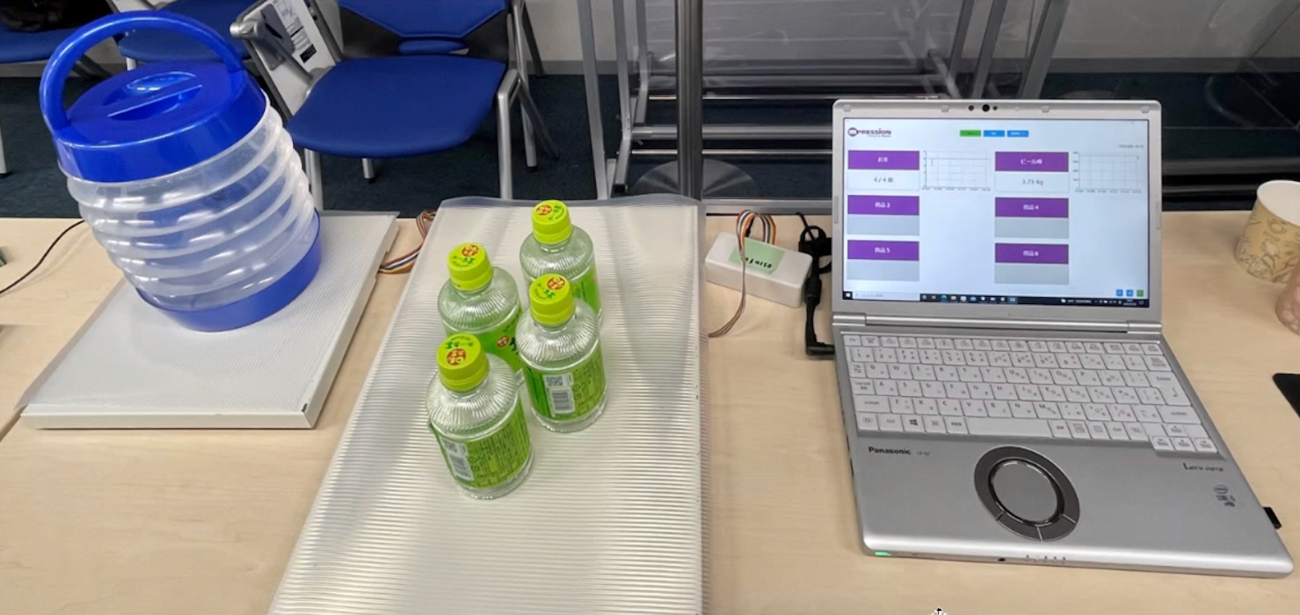
Macnica has developed a prototype of an "AI Smart Shelf" to realize CBM for inventory management in retail stores and restaurants. This is a solution that supports the optimization of store operations by using sensors to measure the weight of products and items on the shelves and sending that information to a management app via Bluetooth, enabling the monitoring of quantities and remaining stock.
-
System configuration and operation flow
- Sensing: Weight sensors (large and small) installed on the shelves measure the total weight of the products placed on them.
- Data transmission: Measurement data is sent to the management app (gateway) via Bluetooth.
- Data processing: Calculates the number of items and remaining amount (%) based on the "weight of the individual item" preset on the app.
- Notification (alert): The moment inventory falls below a threshold (e.g., 3 bottles remaining), an email notification is automatically sent to the person in charge.
-
Use case: Managing "invisible inventory" in restaurants
This idea was originally conceived from the challenge of replenishing beer servers (barrels) in an izakaya. Since the beer server does not know the remaining amount from the outside, the beer in the server may run out in the middle of pouring beer. Moreover, at that time, the gas filled in the server will blow out, causing inconvenience to customers with noise and scattering of beer, so care must be taken when handling it. We thought that by measuring the weight of the beer server even if we couldn't see it, we would be able to notice the beer just before it ran out.
With the "AI Smart Shelf" management app, if you set the unit weight of the products you handle, you can check how many products are on the shelf. You can also measure and manage the remaining amount of liquid like a beer server. And if you set the alarm reference value for the remaining number and remaining amount, you can receive a replenishment notification e-mail when it falls below that. This eliminates the need for regular patrols and checks, and enables CBM to replenish inventory before it becomes insufficient.
Demonstration: Visualization using weight sensors
Here we present a demonstration of a prototype of "AI Smart Shelf," which optimizes inventory and remaining quantity management on shelves in supermarkets and other retail stores, as well as restaurants with beer dispensers. This demonstration confirmed that high-precision management is possible for both solid items (plastic bottles) and liquids (water tanks). We hope this will provide some hints for practical use.
Verification 1: Quantity management (PET bottles)
How it works: When you take a plastic bottle off the shelf, the stock count on the app immediately decreases.
Result: The moment the set threshold (3 bottles or less) is reached, an alert email is sent to your smartphone requesting a replenishment.
Verification 2: Remaining amount management (water tank)
How it works: As the water level in the tank decreases, the indicator (remaining % level) on the app changes in real time.
Result: Visual inspection is no longer necessary, and replenishment timing has been successfully optimized.
System configuration
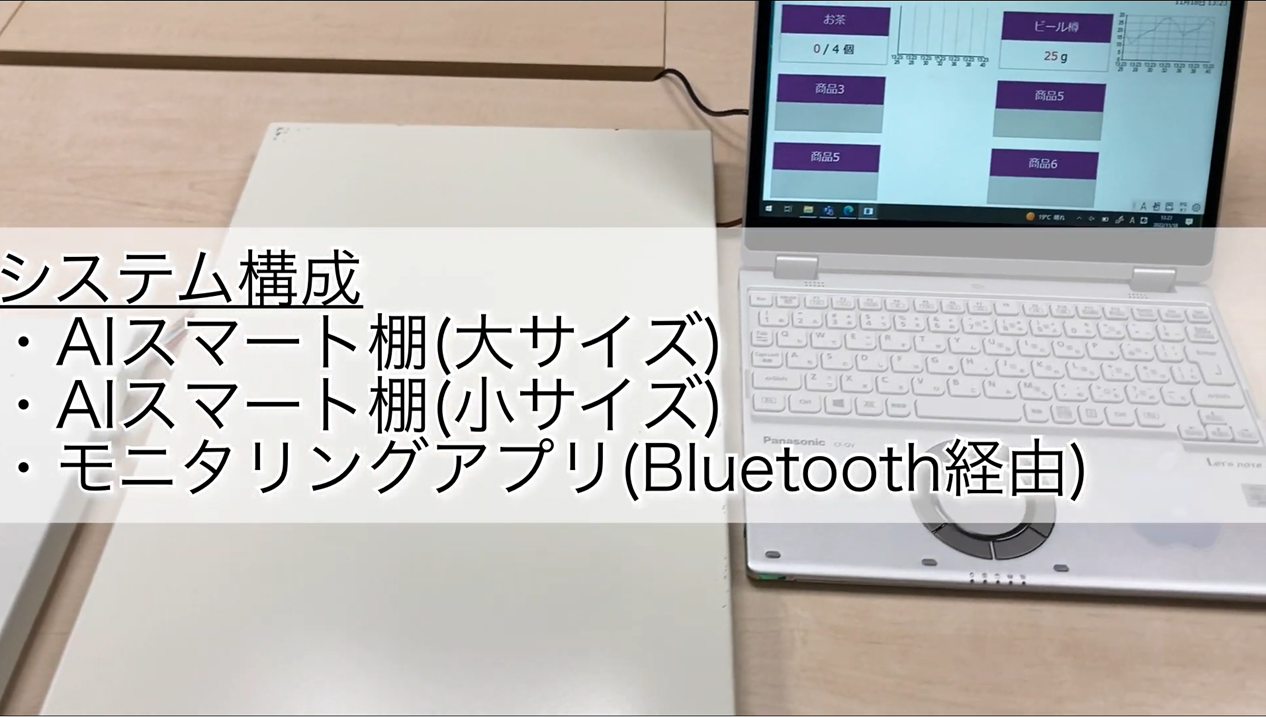
・ AI smart shelf (weight sensor: large size)
・ AI smart shelf (weight sensor: small size)
・Monitoring app (PC: via Bluetooth)
Assumption
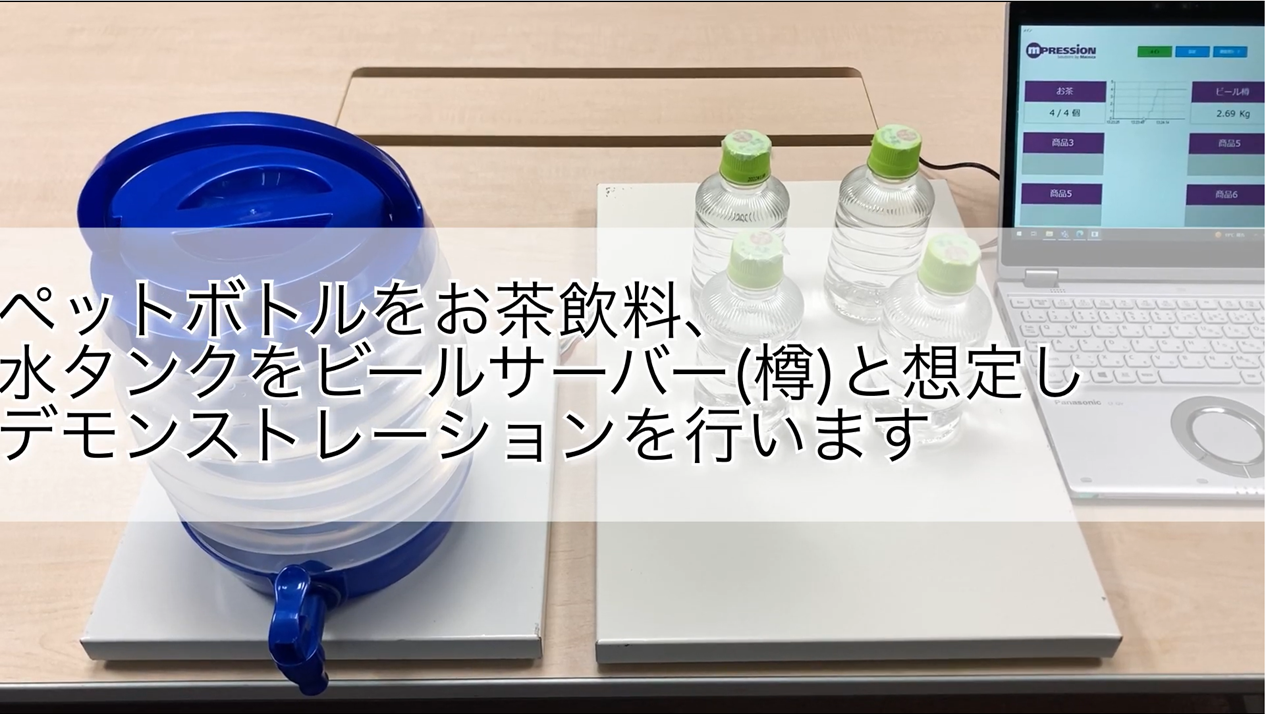
We will conduct a demonstration by imagining a plastic bottle as a tea beverage and a water tank as a beer server (keg).
Demo 1: Monitoring the number of plastic bottles
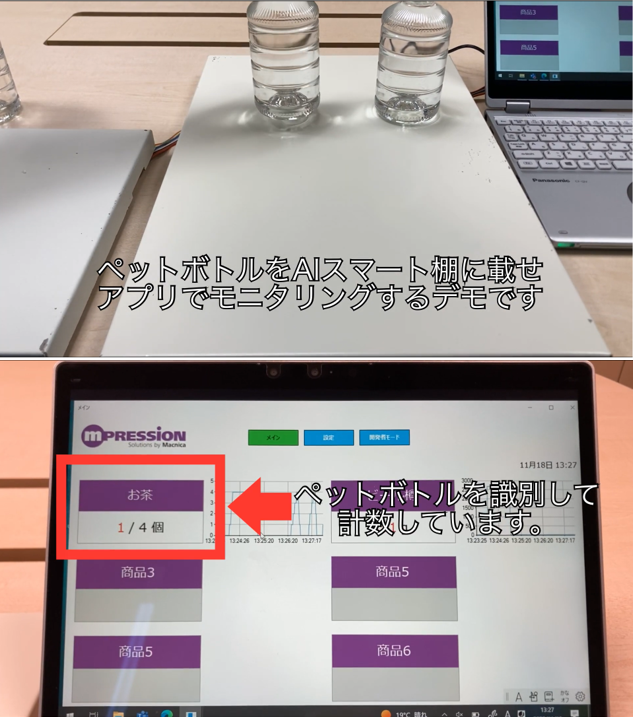
The first demo is a demo that uses an app to monitor the number of plastic bottles.
Identifying and measuring plastic bottles. You can see that each time the number of plastic bottles on the AI smart shelf increases, the number displayed in the "Tea" column in the app also increases.
Demo 2: Monitoring the remaining amount (weight) of the water tank
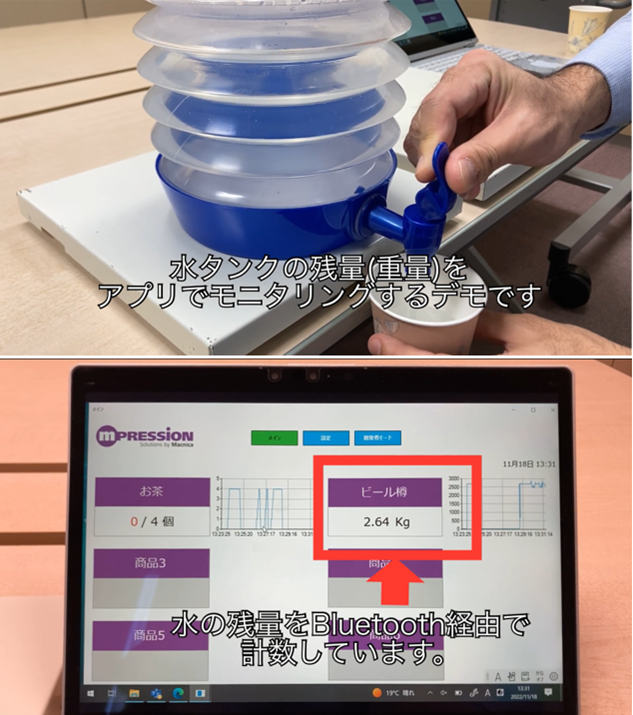
The next demo is a demo that uses an app to monitor the remaining amount (weight) of the water tank.
The remaining amount of water is measured and displayed on the app via Bluetooth. You can see that as the water in the water tank on the AI smart shelf decreases, the display in the "Beer Barrel" column in the app also decreases.
Demo 3: Alert email when product inventory falls below a certain number
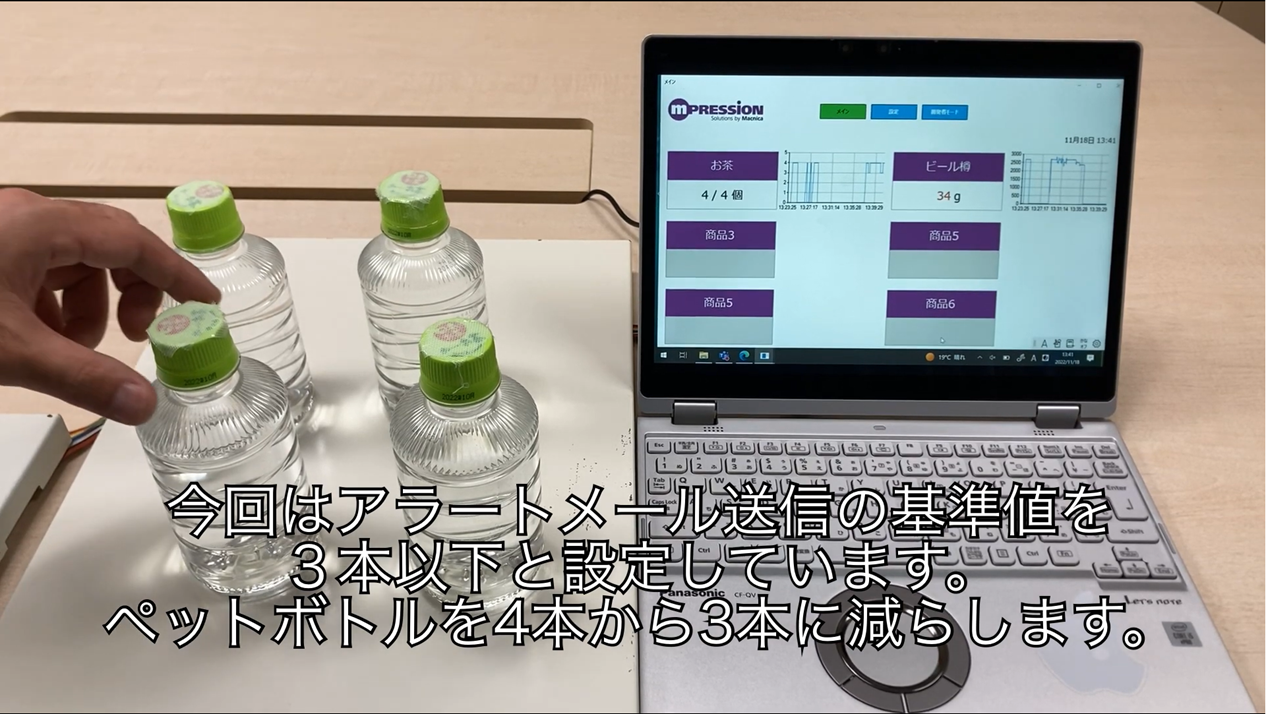
The last demo demonstrates a feature that sends an alert email when product inventory falls below a certain level. In this example, we will show a case where tea beverage inventory falls below a certain threshold.
The threshold for sending an alert email is set to 3 bottles or less. Let's try reducing the number of plastic bottles from 4 to 3.
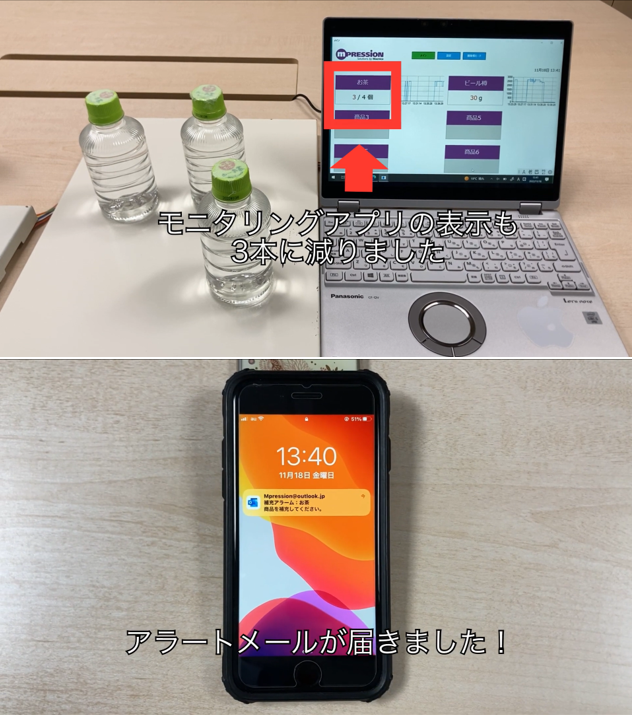
【result】
The number of displays on the monitoring app has been reduced to three.
Then, I received an alert email on my smartphone informing me of the replenishment of stock!
Possibility of even more intelligent AI smart shelves with advanced AI
With "AI Smart Shelf", we are considering developing smarter store operations by linking with external data. For example, we can determine the age, gender, and member information of visitors from data captured by cameras installed in stores, obtain weather information, temperature, questions, and data on traffic conditions in the surrounding area, and use them to predict demand. It is intended to be utilized for more advanced inventory management.
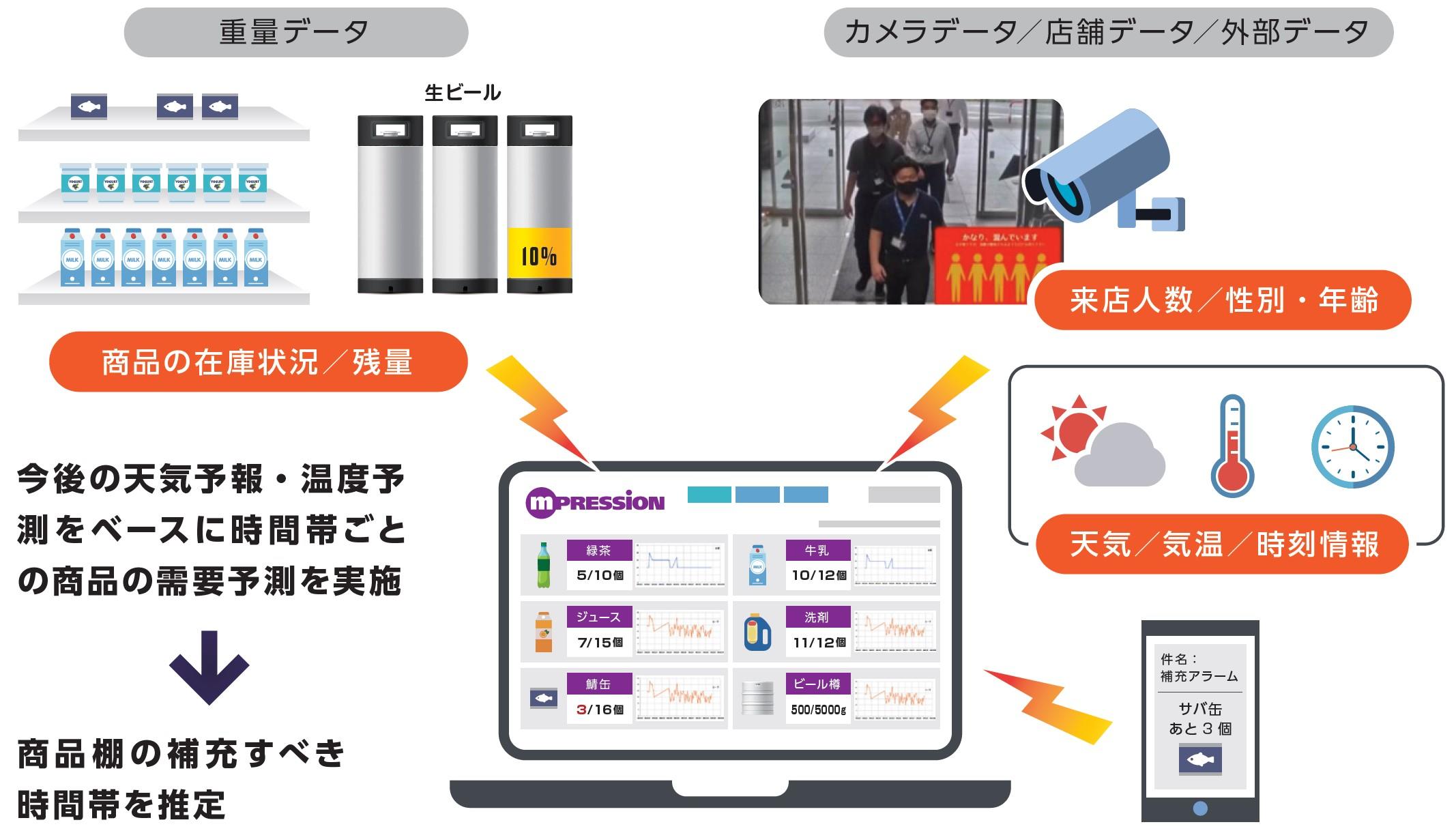
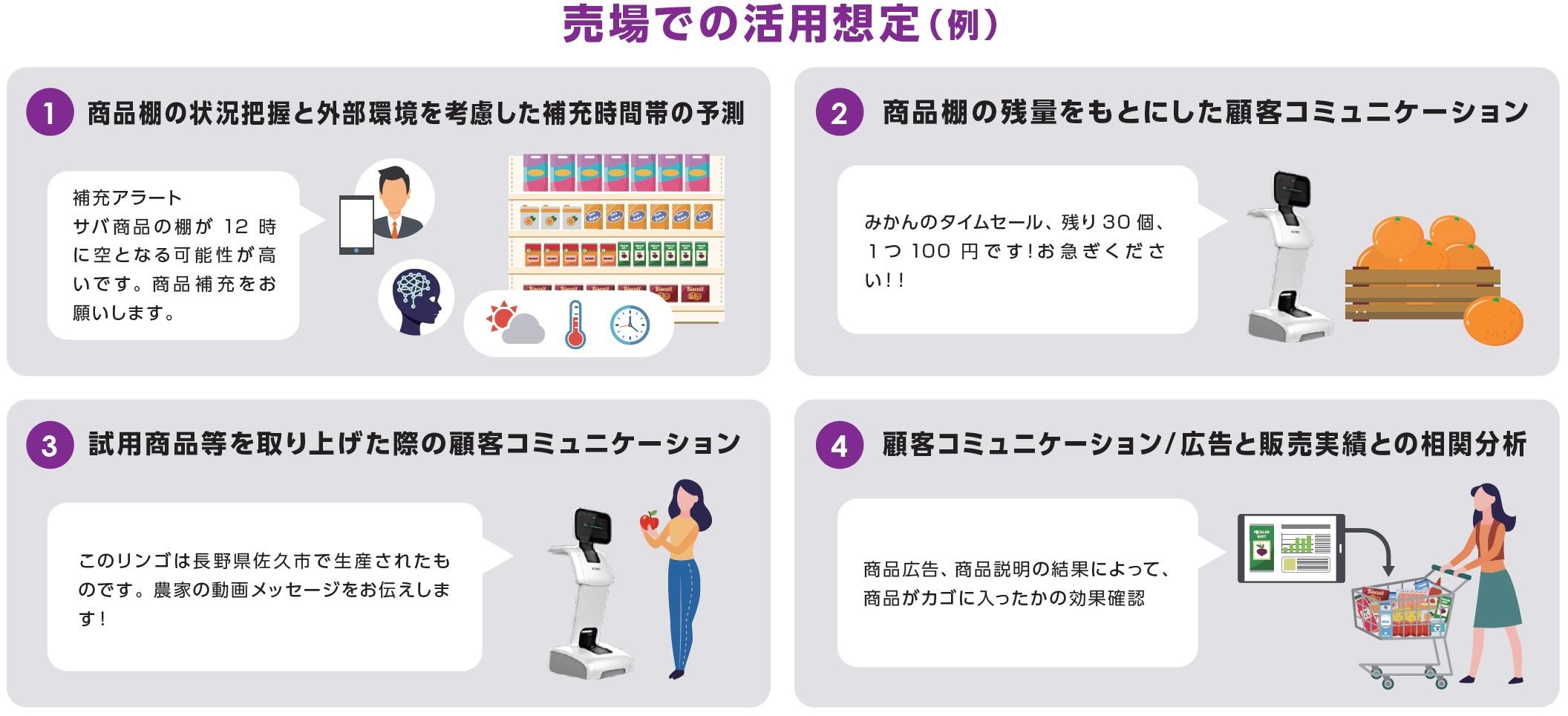
In addition, you can set replenishment schedules in advance based on weather, temperature, event information, etc., flexibly hold time sales according to inventory status, and analyze communication history with customers, leaflets, advertisements, and sales results. We can also expect contributions to store management other than smart management such as.
Weight Sensor Inventory Management FAQs
Q1. What kind of products are weight sensors suitable for managing?
A. It is ideal for managing products with a fixed inventory shape (industrial parts, beverages, stationery, etc.) and liquids where it is difficult to visually check the remaining amount (detergent, paint, beverage barrels, etc.). It is particularly effective for managing the number of "small parts" (converting from weight to number) that are difficult to count one by one.
Q2. What kind of cost reduction effect will be achieved by introducing this system?
A. It will reduce the labor costs of regular inventory checks. It is also expected to help curb excess inventory and prevent lost sales opportunities (reduced sales) due to stockouts.
Q3. What expansions are possible in the future?
A. Macnica is looking beyond simple inventory management to develop demand forecasting in conjunction with external data (camera attribute analysis, weather information, event information). This will enable advanced supply chain management that not only replenishes inventory after it runs low, but also replenishes it before it sells.
If you wonder, "Can we automate that inventory management at our site?"
Macnica 's manufacturing consulting service (monocon®) utilizes cutting-edge sensors and other devices, as well as AI technology, to create solutions that solve challenges in a wide range of industries.
The newly developed "AI Smart Shelf" has the potential to become a solution that can provide better value to customers while making up for staff shortages on the sales floor, back-of-house areas, in restaurants and izakayas, etc.
There's no need to study the different types of sensors or IT systems. Just contact Monocon® with your concerns about which shelves you want to manage and how you want to manage them. Even if you're just starting out with a memo in the conceptual stage, we're happy to help you create the optimal system, starting from scratch.
Manufacturing consulting service
For more information on our manufacturing consulting services, please click the button below.
Introducing other examples of DX for stores
Automatic inventory and remaining quantity management by weightWe made a coaster using this technology! When you're at a drinking party and your beer or drink is running low, it will flash to let you know, so you won't miss the chance to get a refill!
Improve your restaurant experience with refill coasters | Weight sensors can now detect remaining drink levels!

Family restaurants and cafesWe have developed a prototype of a "remaining drink amount sensor" that can efficiently replenish drinks by automatically managing the drink server. Functions such as low drink amount notifications can be demonstrated in real stores.
Automatic management of remaining amount using remaining amount sensor and IoT The remaining amount sensor ensures that your drink server will never be empty!