- Semiconductor BusinessHOME
- Products and Services of Macnica,Inc.
-
technical information

-
Events and Seminars
- Handling Manufacturer
- Support
- Inquiry
- Click here to purchase products
- Semiconductor business e-mail magazine registration


 Narrow down by specifying conditions
現在2240件がヒットしています。check

This is Sasaki in charge of power supply dock technology.
In this column, I would like to introduce some examples of problems related to power supplies that I encountered multiple times during various customer support sessions.
During business negotiations with a customer one day. . .
Caused by overvoltage breakdown! ?

Power circuit failures are very common.

Really. . .
Come to think of it, there is an engineer in our house who is having trouble with the power supply.
So I decided to have a meeting with the engineer.

If you repeatedly turn the power on and off, it may not start up properly. . .
(Perhaps the internal FET is damaged.
When I checked it, I was relieved because the internal FET was not damaged.
So what is the cause? ?
When I checked the waveform and circuit diagram, I found the following
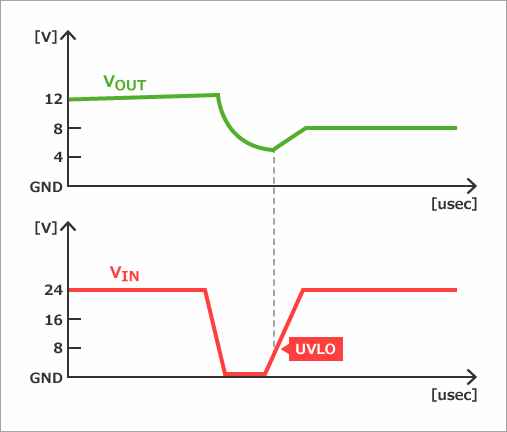
- While the power is repeatedly turned on and off, the output voltage stabilizes at a value lower than the set value.
- Place a large capacitor to output 12V
- When VIN rises, VOUT is about 5V when UVLO (3.5V) is exceeded (figure below)
(So that's it···)
The cause this time is that this power supply IC "does not support power startup in a pre-bias state."
What is "power supply start-up in pre-bias state"?
What is pre-biased power-up?
A voltage state in which the output voltage (VOUT) is equal to or higher than the input voltage (VIN) at power-on.
In this case, the output voltage was about 5V when the input voltage was 3.5V (UVLO), so
VIN < VOUT
Therefore, it can be said that the power supply is started in the pre-bias state.
The point of this time
Note the VIN and VOUT voltages at power-on!
(Is it started in a pre-bias state?)
application note
You can download an application note that clearly explains the operation of the bootstrap circuit and points to note when designing a DC/DC converter.
