- Semiconductor BusinessHOME
- Products and Services of Macnica,Inc.
-
technical information

-
Events and Seminars
- Handling Manufacturer
- Support
- Inquiry
- Click here to purchase products
- Semiconductor business e-mail magazine registration


 Narrow down by specifying conditions
現在2240件がヒットしています。check
This is Sasaki in charge of power supply dock technology.
In this column, I would like to introduce some examples of problems related to power supplies that I encountered multiple times during various customer support sessions.
One day, I received the following inquiry from a customer.
What causes the POL power supply to break during evaluation?

When I was evaluating POL (point-of-load) power supplies that are highly compatible with FPGAs, I was in trouble because the modules were broken one after another and there was no output. .
Visit us now and start a meeting.
While checking the data sheet, we interviewed the customer about the test conditions.

(As far as the test conditions are concerned, I can't find any cause for breakage...)
Therefore, we decided to actually show the test state.
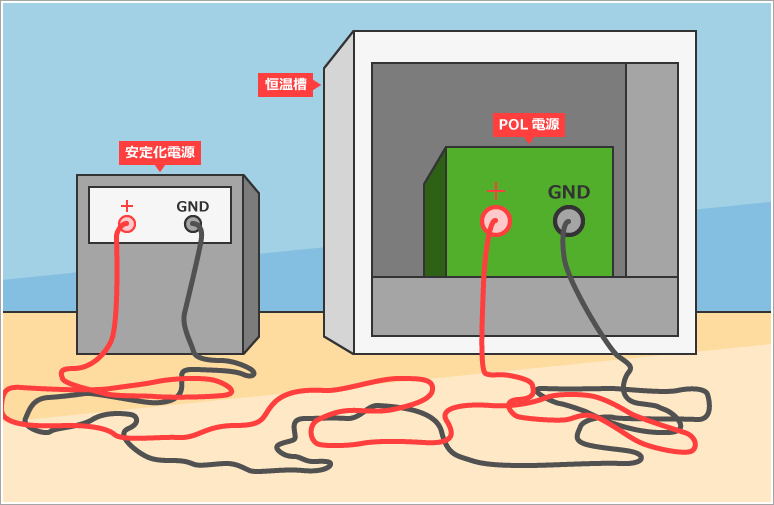
The stabilized power supply and the power supply module in the constant temperature chamber are connected with a copper wire, and the voltage is applied directly.
・・・! ?
In this state, are you applying voltage by turning on/off the regulated power supply switch?
yes, is there something wrong?
・・・With this test method, there is a high possibility that the input side of the power supply module is being applied with a voltage higher than the rating.
Let's take a look at the voltage waveform first.
Then, I used an oscilloscope to monitor the voltage at the output of the stabilized power supply and the input terminal of the power supply module.
Then...
Succeeded in capturing the voltage that causes damage to the power supply by turning the regulated power supply on/off!
actually···
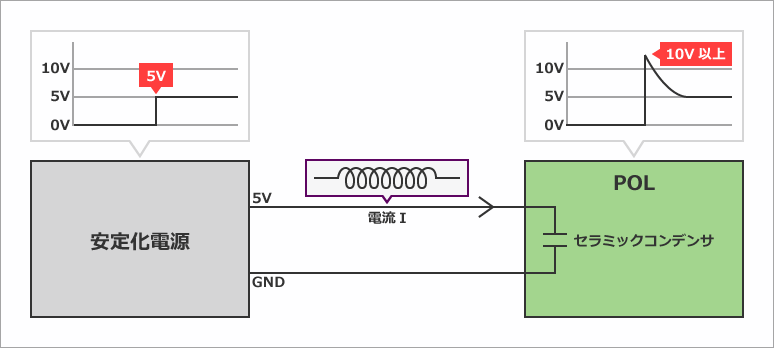
The regulated power supply showed the set 5V, but the input terminals of the module exceeded the absolute maximum rating of 7V, momentarily over 10V!
(I guess that was the reason...)
Cause of overvoltage → thin and long copper wire
In this test, we used a long, thin copper wire. Care must be taken with long and thin copper wires, as they have a large inductance.
Input filters for power supplies are often made only of ceramic capacitors, and when a voltage is applied suddenly, a large current is generated instantaneously due to the low ESR (equivalent series resistance) of ceramic capacitors, which causes a long and narrow Energy is stored in the inductance of the copper wire.
It appears that as the stored energy was transferred from the inductance to the ceramic capacitor, it created a large voltage spike (overvoltage) that caused the failure.
The point of this time
Pay attention to inductance when using long wiring!
Download application note
You can download an application note that explains in detail how overvoltage occurs due to long wiring and ceramic capacitors.

Click here for recommended articles/materials
Click here for recommended seminars/workshops
Learn the basics! Analog Circuit Technology Seminar