
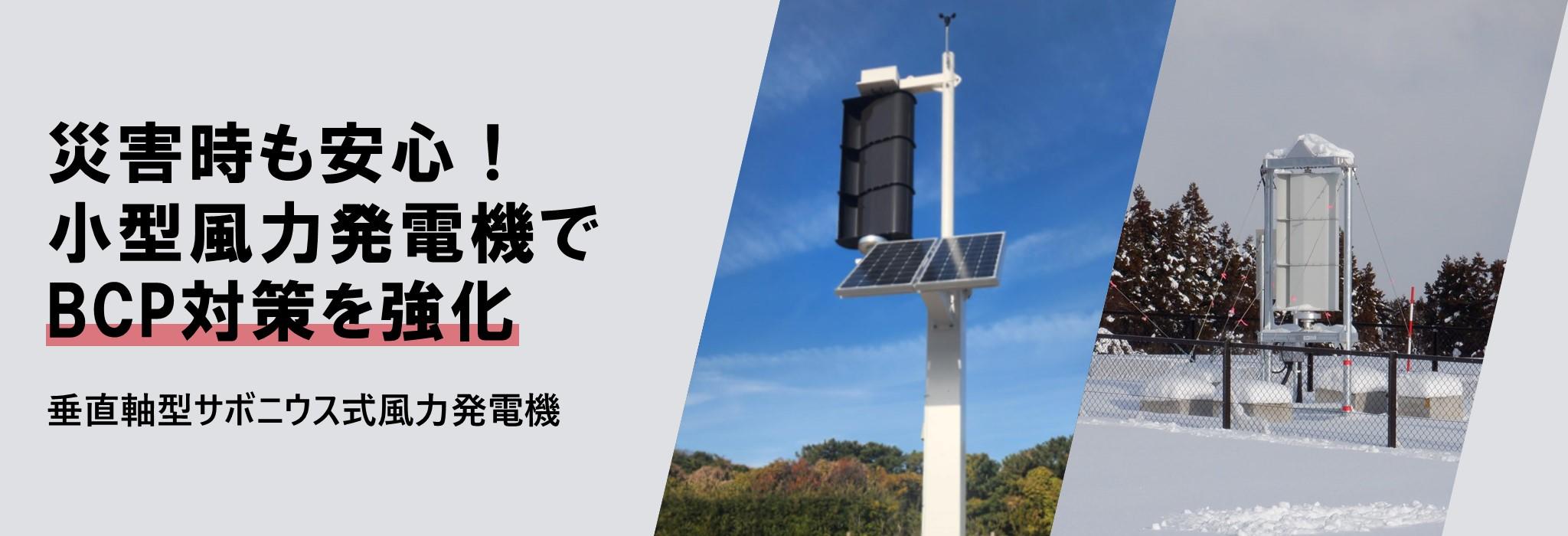
A stand-alone wind turbine that can supply power even during a power outage.
Utilizing renewable energy is also effective for disaster prevention and BCP measures for local governments and companies
Power supply issues during disasters and the importance of BCP measures
With the increasing frequency of natural disasters such as earthquakes and typhoons in recent years, securing electricity during disasters has become an urgent issue for local governments and businesses. Particularly in evacuation centers, parks, and schools, prolonged power outages can make it difficult to maintain communication, lighting, and smartphone charging, resulting in information outages and a decrease in safety.
For example, the emergency power supplies (UPS) of mobile base stations covering prefectural offices are recommended to be able to withstand a 72-hour power outage, but after that, there is a possibility that the power supply will be cut off and communications will be cut off. In preparation for such a situation, the introduction of emergency power supplies that utilize renewable energy is required as a BCP (Business Continuity Plan) measure.
A small wind turbine that is not affected by wind direction and can generate electricity even during disasters
The "Vertical Axis Savonius Wind Turbine" is a completely independent, small wind turbine that uses a hybrid of wind and solar power to generate electricity, making it independent of commercial power sources and capable of providing a stable power supply even in urban areas or during disasters.
The product lineup includes four types: the monopole type "Type M," the rooftop installation type "Type R," the cold climate specification "Type A," and the strong wind specification "Type E." With a structure that is not dependent on wind direction and can generate power even at low wind speeds, there is a high degree of freedom in installation location, making it suitable for a variety of environments, including urban areas, residential areas, cold climates, and coastal areas.
Main features of the vertical axis Savonius wind turbine
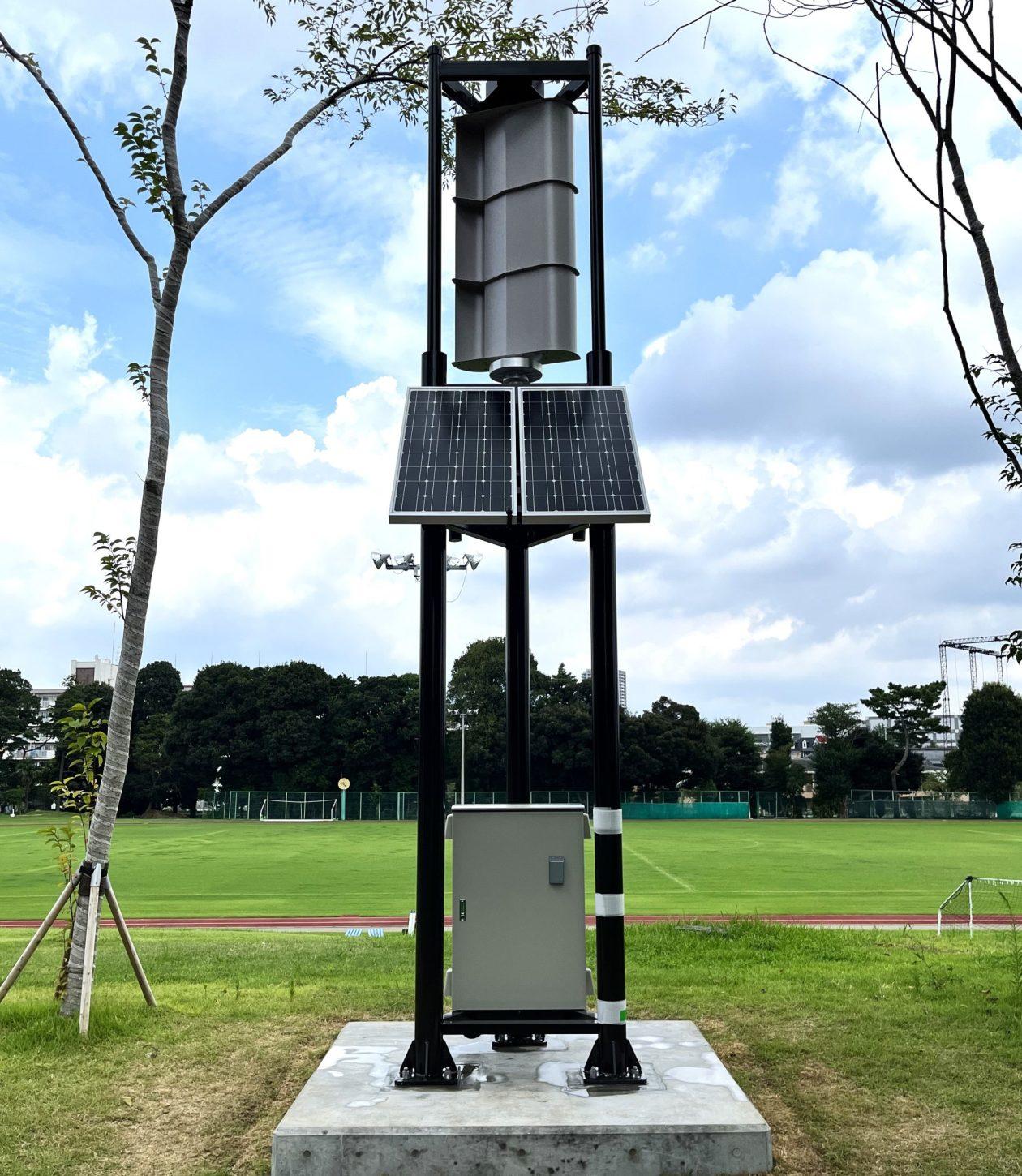
-
Vertical axis type that is not affected by wind direction
It generates electricity stably by receiving wind from all directions, regardless of wind direction, and demonstrates high power generation efficiency even in areas like Japan where typhoons are frequent and wind direction is unstable. -
Independent power source (off-grid)
This hybrid power generation system uses wind and solar power without connecting to a commercial power source, and can supply electricity even during power outages.It can also be used as an emergency power source in the event of a disaster. -
Low noise design (49dB)*
Thanks to its structure that minimizes wind noise, it can be installed safely in residential areas, schools, parks, etc. It achieves the same level of quietness as a home air conditioner.
*Measured value at a distance of 1m from the wind turbine when the wind speed is 7m/s -
Safety and security
A safe and secure wind turbine with a slow rotation speed that is unlikely to scare people. -
High durability and wind resistance
The patented high-strength structure is designed to withstand gusts and typhoons. The wind turbine alone has passed wind resistance tests of up to 80 m/s (the product itself can withstand wind speeds of 40 m/s and above). -
Scalability and optional features
Optional features necessary in the event of a disaster, such as satellite communications, Wi-Fi, surveillance cameras, and portable power sources, can be added, contributing to BCP measures and ensuring lifelines in evacuation shelters.
Active in a variety of places, from securing power during disasters to introducing renewable energy in urban areas
Vertical axis Savonius wind turbines are not affected by wind direction and are designed to generate electricity stably even at low wind speeds, making them suitable for a variety of environments, including urban areas, residential areas, coastal areas, remote islands, and cold regions.They can be used as an emergency power source in the event of a disaster, and also contribute to the use of renewable energy in peacetime.
It has been introduced in the following scenarios, demonstrating its benefits in each environment.
Usage scenarios and benefits of implementation
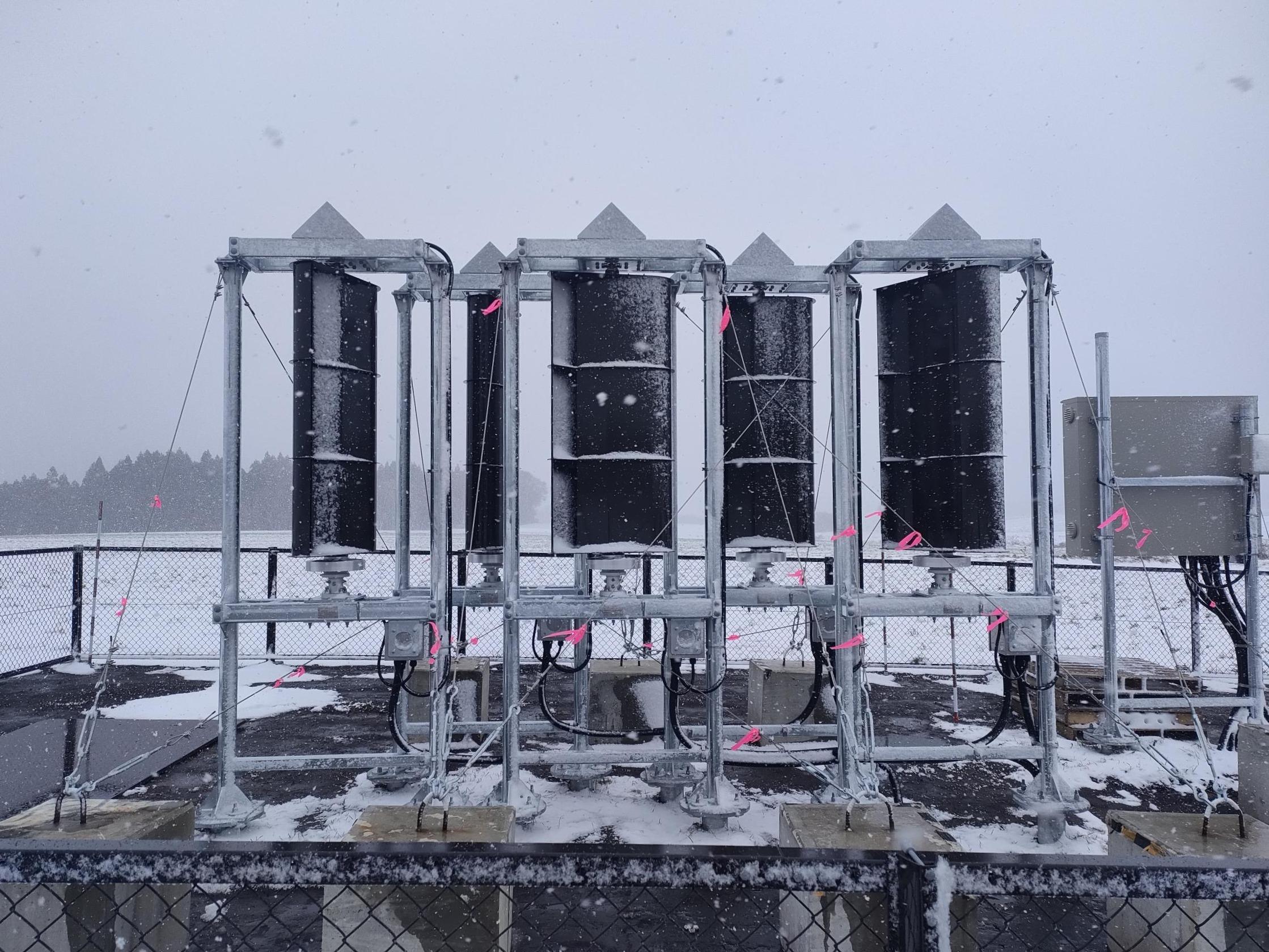
-
■ Evacuation facilities, parks, schools, and public facilities
・Communication, lighting, and smartphone charging are possible even during a power outage
・Effective for BCP measures as an independent power source that does not depend on commercial power
・Ensuring means of information transmission by adding satellite communication and Wi-Fi functions -
■ Urban/residential area installation
- Low noise design (49dB) allows for peace of mind in places where noise and scenery must be taken into consideration
- Compact design with an installation area of approximately 4.4 m², suitable for use in limited spaces
- The rotation speed is slow, so it is less likely to cause fear. -
■ Factories, warehouses, and corporate BCP bases
・Hybrid power generation with solar power makes power supply less susceptible to weather conditions
- Ensure the power, communications, and lighting necessary for business continuity in an emergency -
■ Coastal areas, remote islands, and areas with unstable wind conditions
・Highly durable design that can withstand wind speeds of up to 40 m/s, making it safe even in areas frequently hit by typhoons
・Contributes to securing electricity in areas where commercial power sources cannot reach, such as remote islands and mountainous areas - ■ Cold region/snowy region (Type A)
- Cold region model that can operate in temperatures as low as -30°C
- The use of special paint makes it resistant to ice and snow accumulation, and it has been introduced in Hokkaido, Tohoku, Hokuriku, and other areas.
Product specifications and specs
Type M (monopole type) / Type A (cold climate type) / Type E (strong wind type)
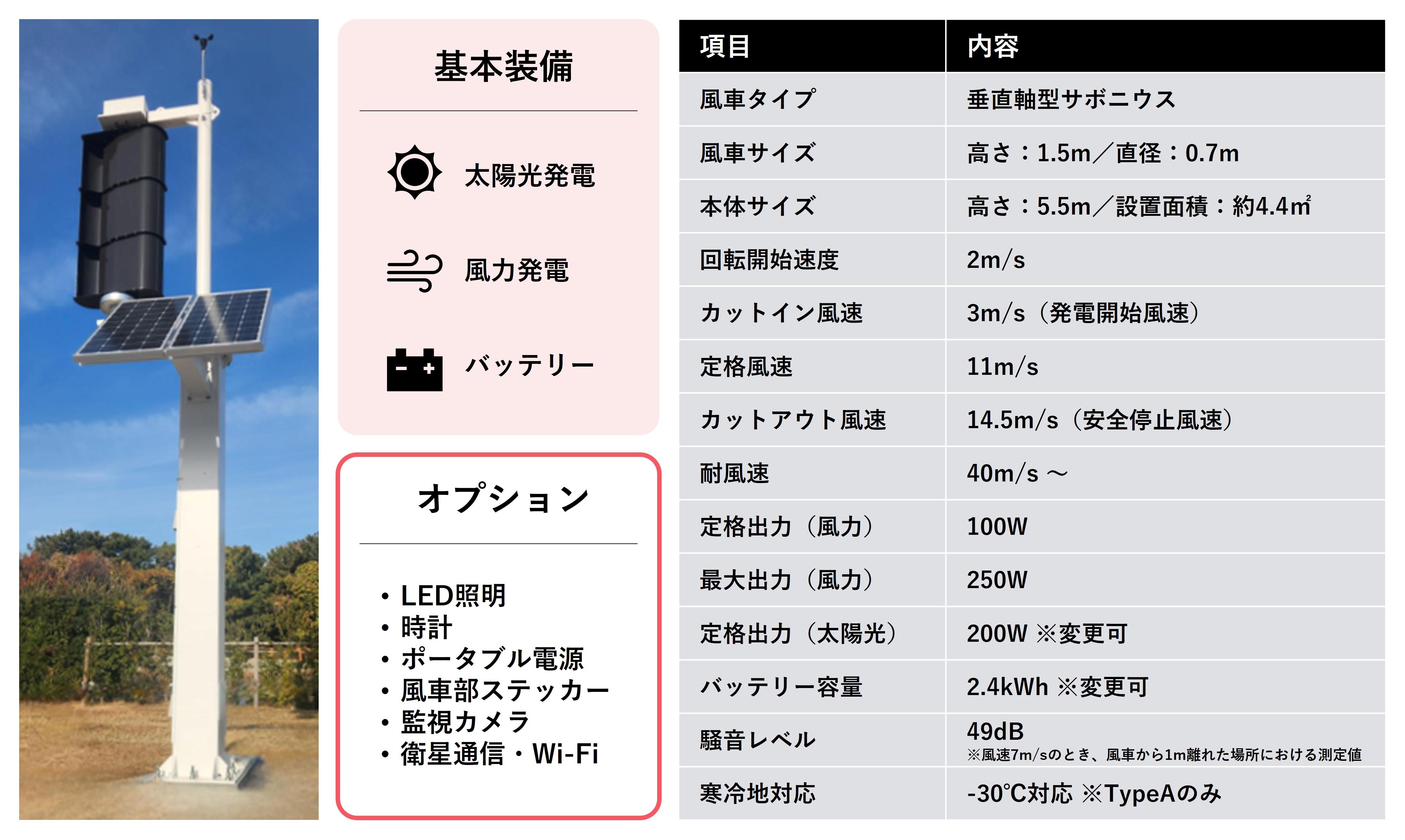
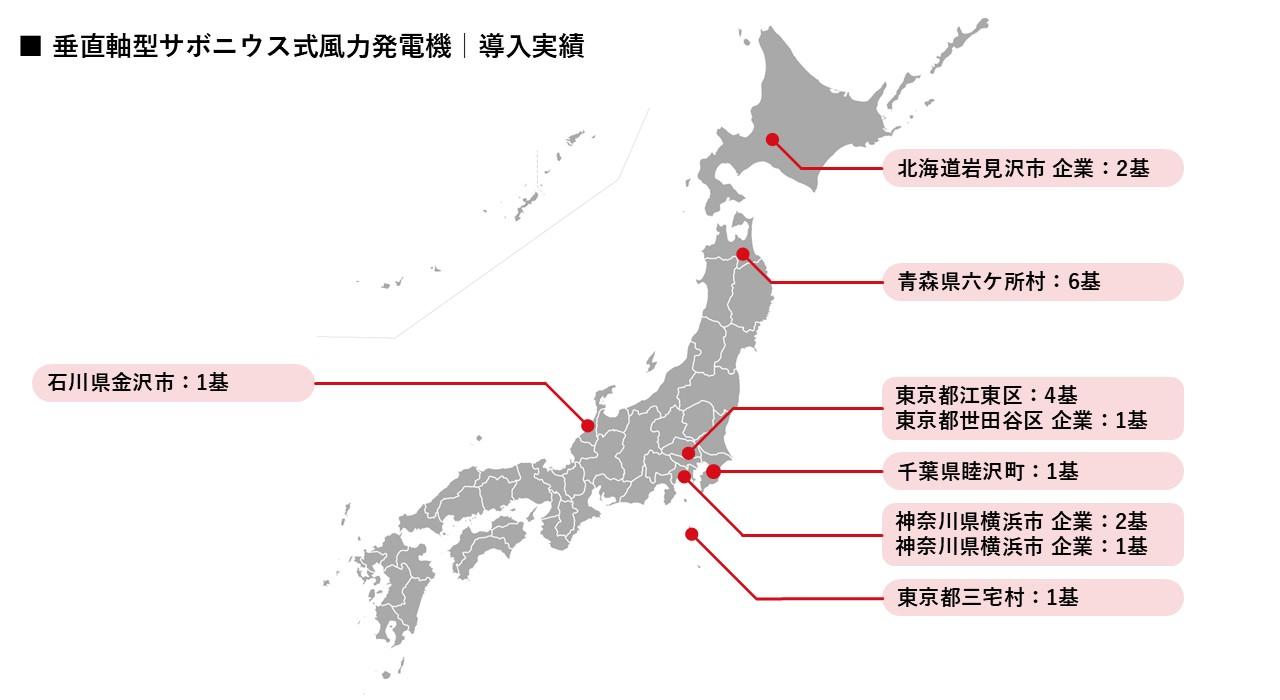
Demonstration cases and implementation results
It is being used mainly in the Tokyo metropolitan area of Japan to introduce renewable energy in urban areas, ensure communications and lighting during disasters, and as a BCP measure.
Inquiry
The "Vertical Axis Savonius Wind Turbine" is a hybrid power generation system that combines wind and solar power, meeting a variety of needs, including disaster response and BCP measures.
If you are a local government or company considering BCP measures, disaster response, or renewable energy utilization, please feel free to contact us. We will propose the optimal plan based on the installation environment and purpose.