- Semiconductor BusinessHOME
- Products and Services of Macnica,Inc.
-
technical information

-
Events and Seminars
- Handling Manufacturer
- Support
- Inquiry
- Click here to purchase products
- Semiconductor business e-mail magazine registration
What is AI implementation support?
Macnica 's AI implementation support service is a comprehensive service that addresses your business challenges, from Step 1: Use case selection → Step 2: PoC design → Step 3: Implementation and evaluation → Step 4: Operation and improvement. Effective use of AI does not come from simply selecting a model or implementing tools. Value is only created when multiple factors, such as business assumptions, data quality, on-site operation design, security and governance, and user experience design, are combined. We will design a process tailored to your company's circumstances, leveraging our many years of experience working with customers seeking to solve problems with AI.
AI can be applied in a wide range of areas, including inquiry response, document summarization, report generation, design support, inspection support, log analysis, supply chain visualization, equipment maintenance, and digital twin integration, but there is no need to tackle everything from the start. The important thing is to quickly launch a "minimum configuration that shows results," accumulate small successes, and then roll out the knowledge gained from these across the board.
AI implementation support is a framework for achieving both "initial success" and "continuous expansion."
Depending on your company's circumstances, Macnica will collaborate with multiple partners, leveraging its strength as a trading company, to work alongside you at a practical level in the areas required, including the selection of cloud, on-premise or edge, the development of models, tools and governance, and even the building of consensus between departments. The goal is not "AI is convenient because it exists," but rather "AI will further strengthen your operations and business." We will provide support to ensure you make steady progress towards that goal.
Challenges in introducing AI
Task
When companies move forward with AI adoption, they face the following challenges:
- Ambiguity in theme setting and difficulty in setting outcome indicators
・Staying at PoC level and not proceeding to production implementation
・Lack of in-house specialists makes technology selection and operation difficult
・ROI is unclear, delaying management decision-making
・Project stalled due to issues with data preparation and model accuracy
・The risk of the project collapsing due to excessively ambitious goals
Macnica 's "AI Implementation Support Service" aims to solve these issues by: A support model that emphasizes setting realistic goals and accumulating small successes We start by listening to your issues, Step 1: Use case selection → Step 2: PoC design → Step 3: Implementation and evaluation → Step 4: Operation and improvement We provide support for each phase, setting achievable goals at each step and steadily achieving results while minimizing risk. Furthermore, we leverage our comprehensive knowledge of semiconductors, AI hardware, and software to provide comprehensive support for technology selection and partner collaboration. This allows companies to steadily advance their AI implementation and maximize ROI.
Support Process
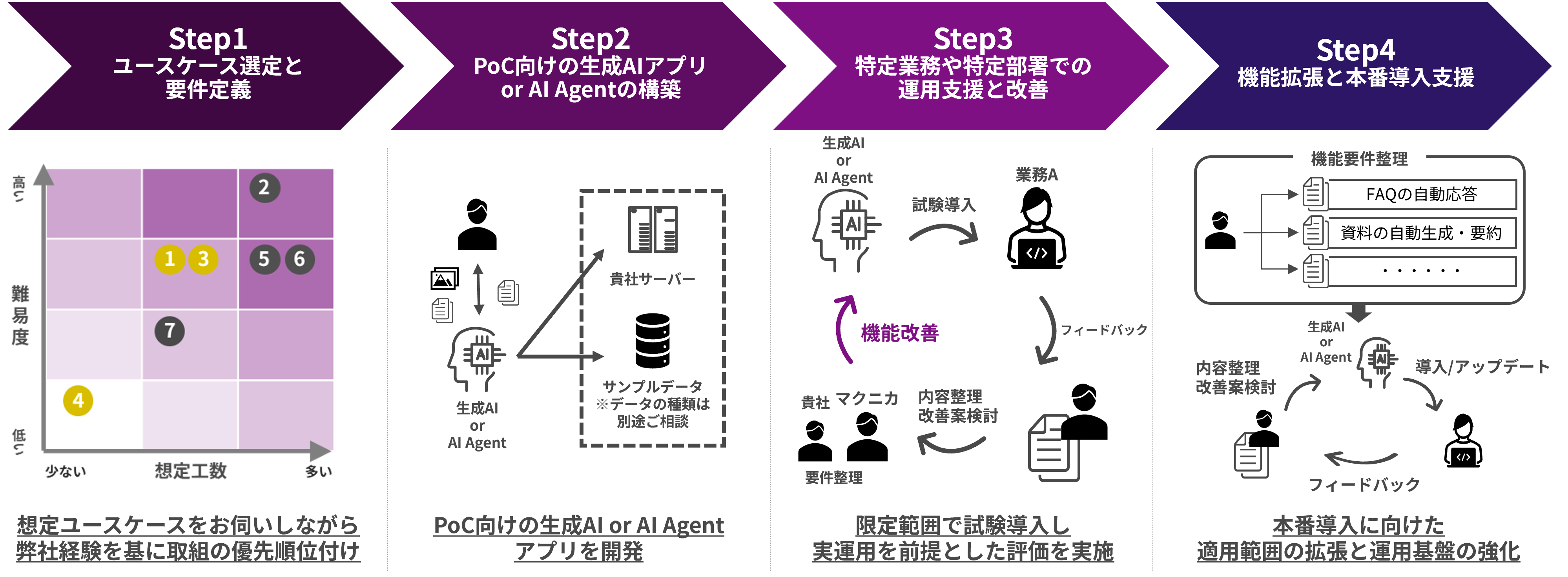
Step 1: Use case selection and requirements definition
First, we will utilize Macnica 's strength in collaboration with overseas suppliers to introduce overseas use cases and then conduct a brainstorming session. Next, we will identify use cases that are suitable for your company, taking into account both business goals and on-site issues. Since setting realistic goals is important at the beginning, we generally score AI initiatives based on factors such as the difficulty and estimated man-hours required, and start with themes that can produce results in a short period of time. We will define performance indicators (KPI/KGI), clarify the hypotheses to be verified in the PoC, the success conditions, and constraints, and specify the necessary data(*) and an inventory of them.
Step 2: Building a generative AI app/AI Agent for PoC
In a short period of time, we will build an app or agent with minimal functionality that can be evaluated. Specifically, we will implement prompt design, tool invocation (search, DB, internal API), evidence presentation (RAG, etc.), indicator measurement, etc., and prepare sample data and evaluation datasets.(*) Furthermore, we will conduct tests that reproduce the context of actual business operations. During the PoC period, we will refine performance and usability while going through an improvement cycle of log analysis → hypothesis → correction → reevaluation, and run sprints using feedback from the field as input.
Step 3: Operational support and improvement for specific tasks and departments
A limited trial implementation will be conducted, and evaluation will be carried out assuming actual operation. Mistake patterns, ambiguous questions, handling of business terminology, and knowledge gaps will be extracted from usage logs and feedback. Improvement measures will include expanding knowledge sources, hierarchizing prompts, modifying the UI, subdividing permissions, and automatically generating and updating FAQs. Support will also be provided as needed for creating manuals and training content, as well as for building a system that allows on-site staff to operate autonomously. From this step onwards, support will be provided in collaboration with the Company partners.
Step 4: Feature expansion and production implementation support
In preparation for full-scale implementation, we will expand the scope of application and strengthen the operational infrastructure. We will implement FAQ/knowledge base automation, workflow integration, advanced permission management, audit logs, reporting, and enhanced security. We will formulate a deployment plan (target departments, education, communication, and adoption measures) and continue to monitor success indicators. After implementation, we will implement improvements and updates through regular reviews to maximize long-term value. Throughout the entire process, we will design "sustainable AI" from both business and operational perspectives.
*Additional processing (data cleansing, pre-processing, etc.) may be required for data, which may affect schedules and costs. If it is determined that using your company's data is difficult, we may use dummy data or your company's publicly available information instead.
Click here for inquiries


Related page