- Semiconductor BusinessHOME
- Products and Services of Macnica,Inc.
-
technical information

-
Events and Seminars
- Handling Manufacturer
- Support
- Inquiry
- Click here to purchase products
- Semiconductor business e-mail magazine registration


 Narrow down by specifying conditions
現在2221件がヒットしています。check

In Introduction to Crosstalk, we said that there are two types of crosstalk: near-end crosstalk and far-end crosstalk. First, let's look at near-end crosstalk.
The higher the drive strength of the driver, the higher the initial amplitude of the rise of the driver output. Near-end crosstalk is roughly proportional to the initial amplitude of this offender's driver. This amplitude is the answer to the question, "How do you determine the value of the damping resistor?" is half the first amplitude (blue line) at the far end of Figure 2 of .
For example, with a characteristic impedance of 50 Ω and a driver drive capability of 8 mA, the far end initial amplitude is 1.2, so the driver amplitude is 1.2 ÷ 2 = 0.6 (footnote 1).
Assuming a driver drive strength of 16 mA, the initial amplitude is 1.5, so the near-end driver amplitude is 1.5 ÷ 2 = 0.75. Since there is a factor of 1.25 difference between 0.75 and 0.6, we can see that the amount of near-end crosstalk with the 16 mA driver is 25% higher than with the 8 mA driver.
"How do you decide the value of the damping resistor?] increases monotonically with x (the driver's drive strength with characteristic impedance taken into account), so the driver's drive strength must be lowered to suppress near-end crosstalk.
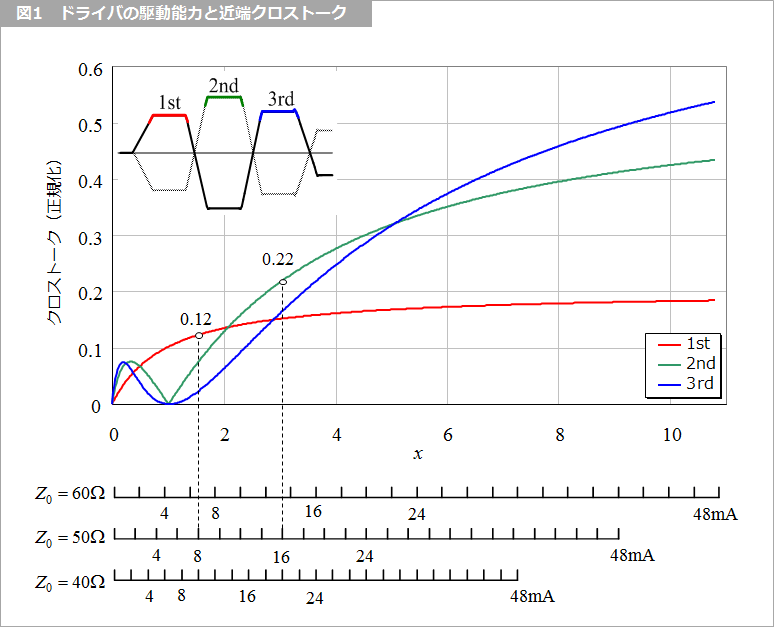
Figure 1 shows how to determine the value of the damping resistor. Figure 2 shows the amplitude of the first, second, and third crosstalk peaks, with the drive capability x of the driver taking into account the characteristic impedance on the horizontal axis (footnote 1). ).
It can be seen that the first peak is dominant while x is small, and the maximum value of the peak shifts to the second and third peaks as x increases. With a characteristic impedance of 50 Ω, the crosstalk is a maximum of 0.12 at the first peak when the driver has a drive capability of 8 mA, but at 16 mA the second peak is a maximum of 0.22 and It also increases by 1.8 times. When the peak maximum value moves to the second or third position, the slope with respect to x increases. Therefore, before moving to the second position, i.e., keeping x at 2 or less is advantageous for crosstalk.
The condition for suppressing the overshoot to 20% was x = 1.5, so countermeasures against rebound due to overshoot are also countermeasures against near-end crosstalk. Noise such as crosstalk on general signals can be as large as possible as long as clock timing is avoided. If the maximum value of the crosstalk peak is the 1st, there is often enough margin until the next clock. It will be detrimental to your movement.
Therefore, when the drive capability of the driver increases, not only does the peak value of the near-end crosstalk increase, but the maximum value of the peak shifts later, increasing the possibility of overlapping with the timing of the next clock. must also be considered.
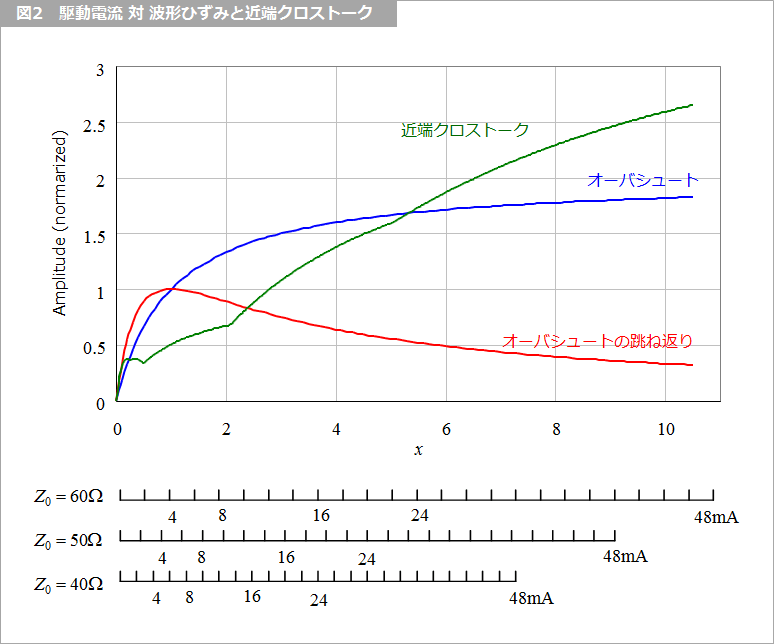
Fig. 2 shows the maximum peak value (envelope curve) in Fig. 1 and "How do you decide the value of the damping resistor?"] and Figure 2 are superimposed.
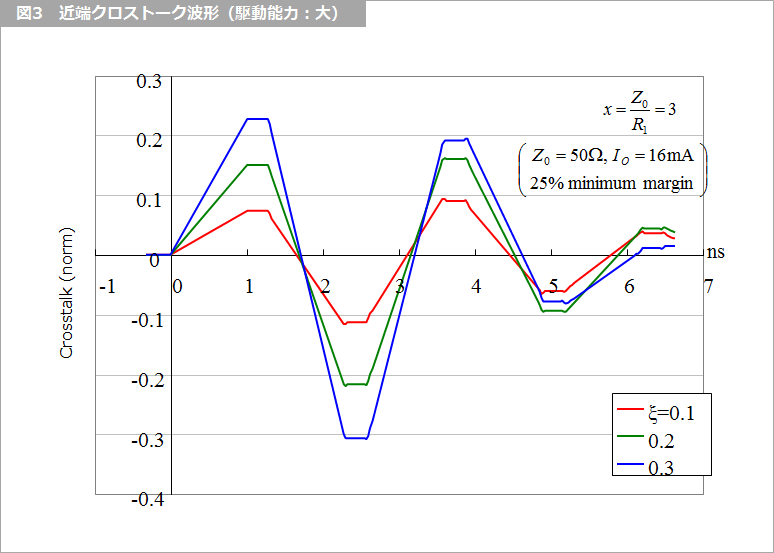
Figure 3 shows near-end crosstalk waveforms when the driver drive strength is large. You can see that the second peak value is larger than the first peak value.
In the same figure, the parameter ξ (small Greek letter Qusai) appears for the first time. You can think of ξ = 0.1 as a line with slightly smaller crosstalk and ξ = 0.3 as a line with slightly larger crosstalk.
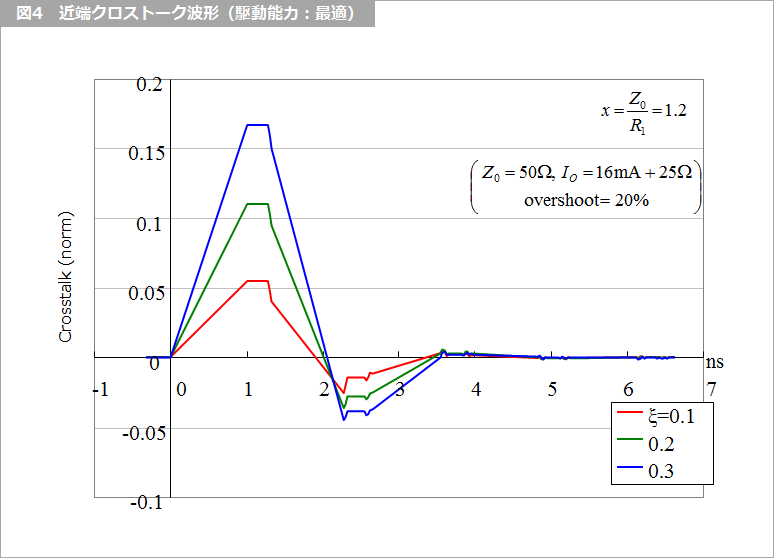
Figure 4 shows near-end crosstalk with 20% driver overshoot. The transmission waveform itself has almost no overshoot rebound (see "How do you determine the value of the damping resistor?"), and as shown in the figure, the crosstalk ends only at the first peak. It can be seen that crosstalk is suppressed when the transmission waveform is clean.
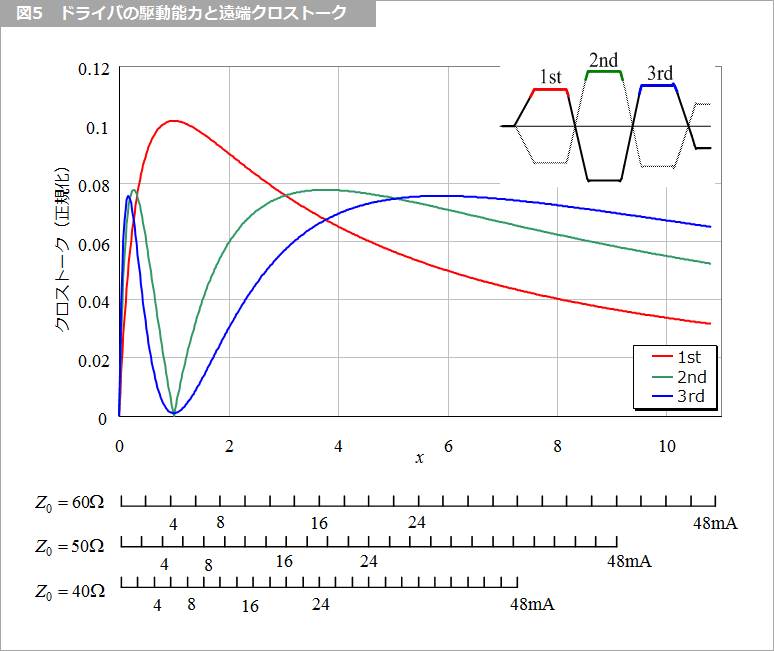
Next, far-end crosstalk is plotted against the drive strength of the driver in Figure 5 in the same way as near-end crosstalk in Figure 1. In the case of far-end crosstalk, if the culprit's driver has a small drive capability, the first one will be large, and if it is chosen large, the second and third drivers will increase, and so on. No optimal value found for As for far-end crosstalk, it is necessary to separate all lines even when separating the perpetrator and the victim, as described last time. Far-end crosstalk is troublesome because there is no such simple solution.
Footnote 1
The amplitude here is normalized to 1, so for a 3.3 V system, multiply by 3.3. A driver amplitude of 0.6 means 0.6 × 3.3 = 1.98 V in the 3.3 V system.
Footnote 2
The basic crosstalk factor is determined as the average of the capacitive and inductive coupling of the two lines. Capacitive coupling is the ratio between the capacitance between lines and its own ground capacitance, and inductive coupling is the ratio between the mutual inductance between lines and its own self-inductance.
What is Yuzo Usui's Specialist Column?
It is a series of columns that start from the basics, include themes that you can't hear anymore, themes for beginners, and also a slightly advanced level, all will be described in as easy-to-understand terms as possible.
Maybe there are other themes that interest you!