- Semiconductor BusinessHOME
- Products and Services of Macnica,Inc.
-
technical information

-
Events and Seminars
- Handling Manufacturer
- Support
- Inquiry
- Click here to purchase products
- Semiconductor business e-mail magazine registration


 Narrow down by specifying conditions
現在2237件がヒットしています。check

This article explains the dot commands available in SPICE. This time, we will explain the dot step command (.step) used in parametric analysis.
If you answer the last questionnaire, you can download the supplementary material for the dot step command (.step) in LTspice Help. The Help material is a netlist-based material, but if you would like to obtain an explanatory material that actually performs a simulation with the GUI like this article, please cooperate by answering the questionnaire.
The dot step command ( .step )
By using the .step command, it is possible to perform parametric analysis during various analyses.
Up to three .step settings are permitted.
*Parametric analysis: Repeated simulation and analysis while changing various parameters (conditions/values).
The following is an explanation of the syntax for the .step command, as explained in HELP.
① .step oct v1 x y z
Simulate voltage source V1 from x to y, z points per octave.
② .step I1 x y z
Simulate current source I1 from x to y with z steps.
③ .step param RLOAD LIST A B C
We simulate three times with the global parameter Rload as x , y , and z .
④ .step NPN 2N2222 (VAF) x y z
We simulate an NPN 2N2222 transistor by varying its VAF from x to y in z steps.
⑤ .step temp X Y Z
The temperature is simulated from X °C to Y °C in steps of Z °C.
Parametric Analysis Methods
Reference circuit readout
Here we will show you how to set up a parametric analysis using the .step command.
First, we will read out the reference circuit that will be the base. We will read out and use the JIG circuit of the ADP7105, an LDO product with a soft start function. Please refer to this article for how to read out the JIG circuit. Figure 1 shows the result of reading out the ADP7105 JIG circuit and checking the output voltage.
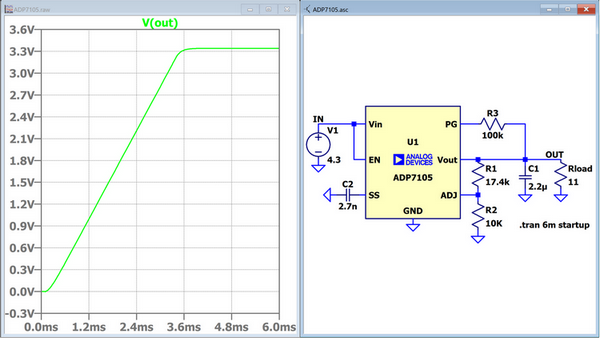
Let's use this JIG circuit file to check the soft start function supported by ADP7105. The soft start function can control the rise time of the power supply voltage by the capacitance of the capacitor connected to the SS pin. Let's use the .step command to check whether the rise time changes.
For the .step command, select Spice ditrective and write " .step param x list 0n 2.7n 6.8n 10n ". The value of x is set as the capacitance of the capacitor C2 connected to the SS pin, so right-click on the capacitance value and set it to { x }.
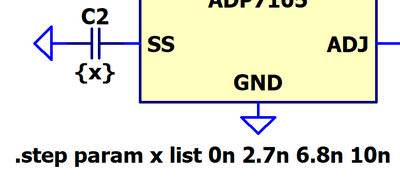
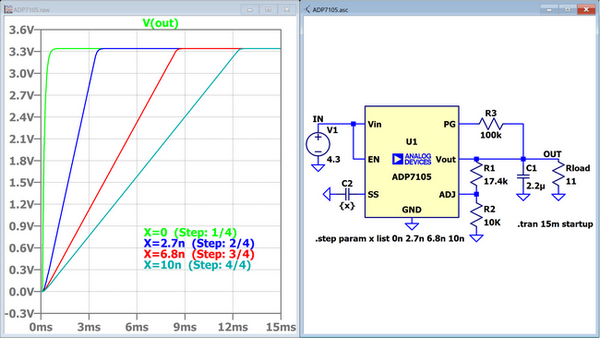
Since the capacitor capacity is set to 10nF, the rise time will be more than 10msec, so the transient analysis time is changed from 6msec to 15msec and the simulation is run.
The result of executing this is shown in Figure 3. We were able to confirm that the rise time was almost exactly as stated in the data sheet.
In this way, by using LTspice to perform a parametric analysis using the .step command, you can check in advance how characteristics will change due to differences in circuit constants, etc. This function is very useful because it allows you to use simulations to check the guidelines for constant settings that will be reflected in the actual device.
Download the supplementary material for the dot step command (.step)
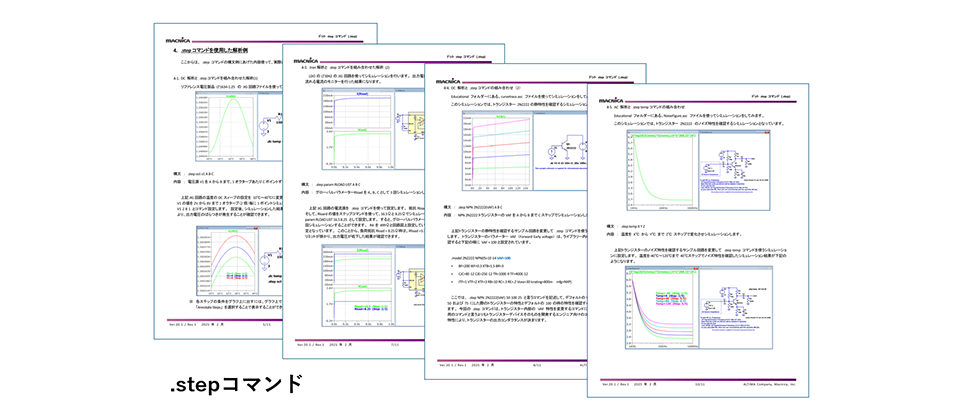
The explanation of the dot step command (.step) in the LTspice Help is based on a netlist, but if you fill out the survey, you can download a document that explains it in a GUI-based manner, just like this article. This document allows you to run a simulation using the JIG circuit or the reference circuit in the Educational folder for the .step command in the Help. After filling out the survey, we will send you a URL to download the supplementary material by email.
If you have any requests, such as what kind of seminars you would like us to hold in the future or what kind of technical materials you would like us to provide, please write your opinions in the free-form section of the survey. We would like to use your opinions to hold seminars and provide technical materials that will be useful to you.
At the end
If you have not used LTspice yet, please download it from the link below!
Please try once.
Click here to download LTspice
If you are just starting LTspice, we recommend that you look at the "Basic Edition" from the list below.
Click here for the list of Let's try using LTspice series
Also, if you would like to see a video on how to write a basic circuit and how to execute it, there is an on-demand seminar that does not require you to enter personal information. Detailed information about the seminar is also provided to those who fill in the questionnaire.
LTspice On-Demand Seminar - Function check with RC circuit -
We also regularly hold LTspice seminars for beginners. We hope you will join us as you will be able to learn the basic operations of LTspice.
Click here for information on LTspice seminar
Click here for recommended articles/materials
List of articles: Let's use LTspice Series
LTspice FAQ: FAQ list
List of technical articles: technical articles
Manufacturer introduction page: Analog Devices, Inc.
Click here for recommended seminars/workshops
Inquiry
If you have any questions regarding this article, please contact us below.
Analog Devices Manufacturer Information Top
If you want to go back to Analog Devices Manufacturer Information Top, please click below.