- Semiconductor BusinessHOME
- Products and Services of Macnica,Inc.
-
technical information

-
Events and Seminars
- Handling Manufacturer
- Support
- Inquiry
- Click here to purchase products
- Semiconductor business e-mail magazine registration


 Narrow down by specifying conditions
現在2147件がヒットしています。check

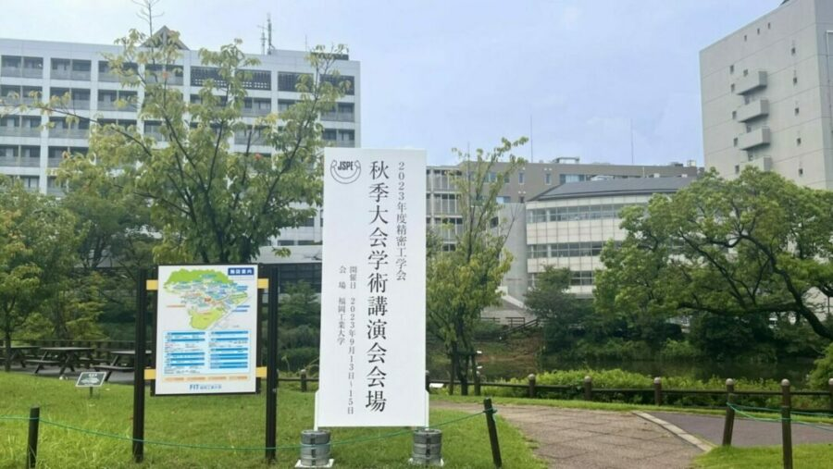
Research using the semiconductor strain sensor STREA was recently presented at the 2023 Japan Society of Precision Engineering Autumn Meeting Academic Lecture.
This research was conducted in collaboration with Shizuoka University, NT Tool Corporation, and Macnica, and this lecture by Shizuoka University marks the seventh presentation of the results.
This research, titled "Development of a cutting force measurement system for rotary tools and research into the detection of drill wear," achieved results in identifying the timing and location of drill breakage, which was difficult to achieve by measuring the spindle motor current.
The three companies have so far developed a system that enables wireless data communication and power supply to sensors (using a wireless power supply board developed by Macnica Applied Development), as well as long-term tool wear detection.
The image below shows the actual measurement system developed by the three companies.
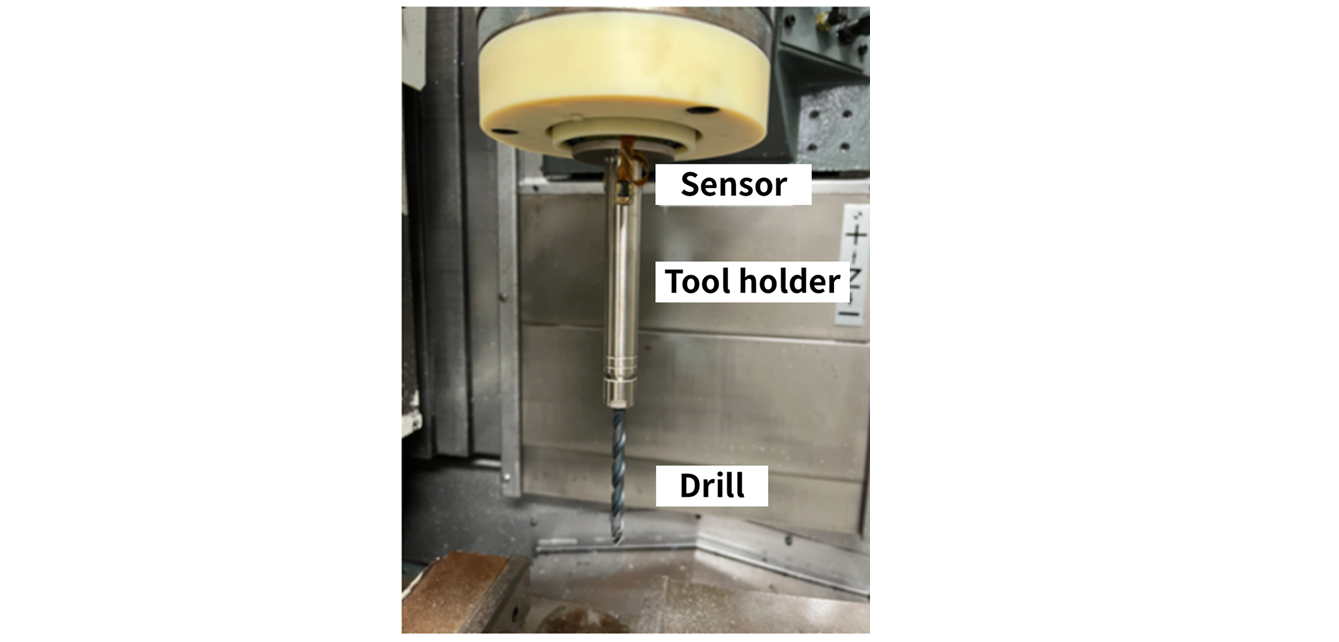
The semiconductor strain sensor STREAL is attached to a tool holder manufactured by NT Tools to measure the machining state of the rotary tool.
In this study, we conducted experiments from three perspectives to verify the effectiveness of this system.
1. Comparison with the monitoring method that measures the spindle motor current
First, we carried out actual drilling and examined the accuracy of detecting tool wear compared with a conventional measurement system (measuring the spindle motor current).
The following is the data from the experiment.
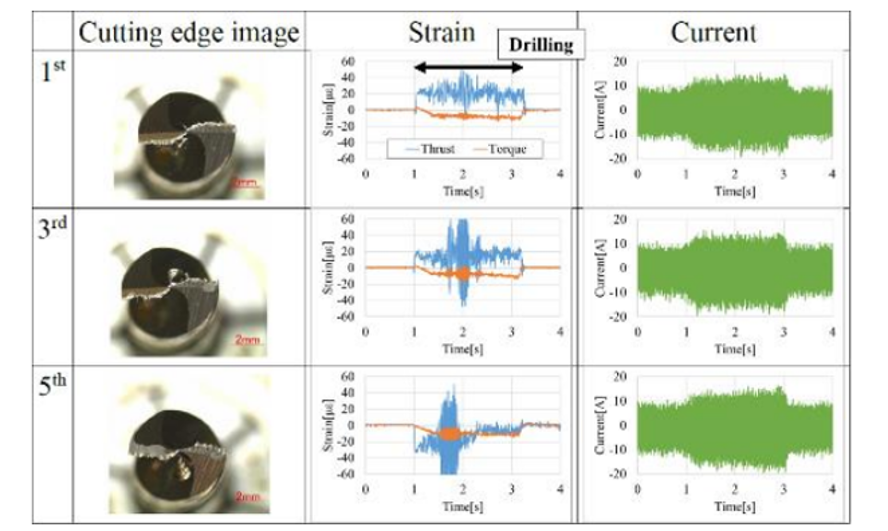
While conventional measurement systems show almost no change in output, STREAL was able to obtain data that indicated the presence or absence of chipping and the timing of damage.
(Experimental conditions: drill diameter Φ6, work material S50C, dry environment)
2. Tool damage detection for small diameter drills
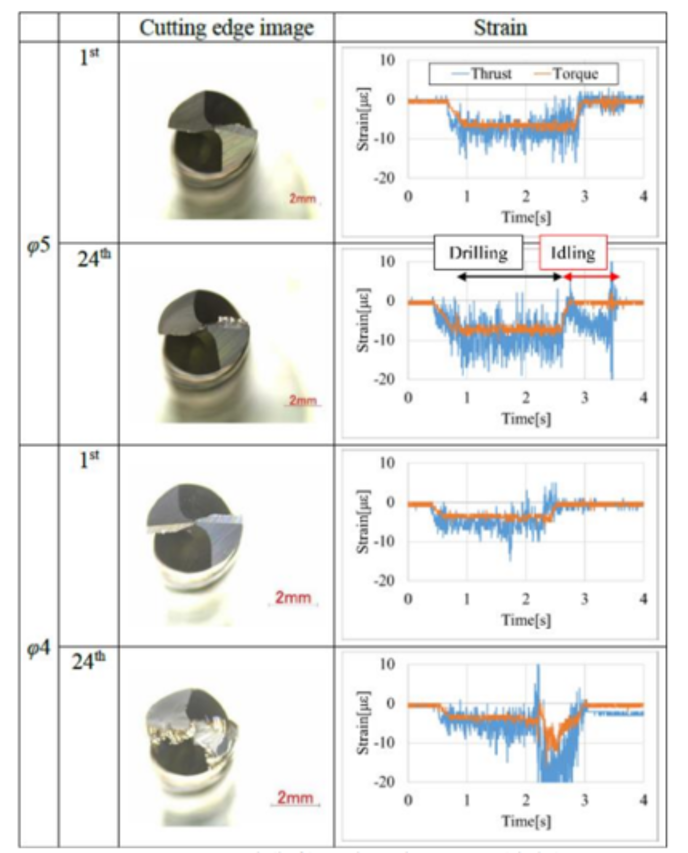
Next, we conducted the same experiment as above by changing the tool diameter, and also tested the measurement limit for tool wear detection for small diameter tools.
The diameter of the drill was changed from the φ6 used in the previous experiment to a smaller φ5 and φ4 drill, and the same drilling process as in 1 was carried out. It was also found that abnormalities can be detected with small diameter tools down to a φ4 drill.
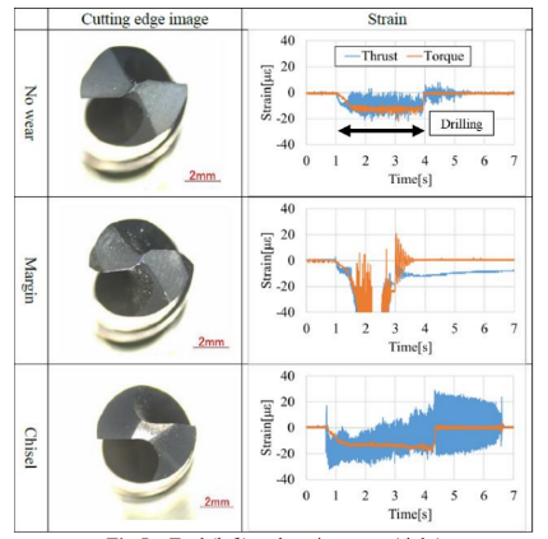
3. Estimation of cutting edge damage location by strain measurement
Finally, a part of the tool cutting edge was artificially worn or damaged, and a hole was drilled to test whether the waveform changed depending on the location of the wear or damage. Characteristic waveforms were confirmed for each worn or damaged location, suggesting that the location of the damage could be identified.
The venue was filled to capacity at the time of the lecture, and the presentation was such a great success that some listeners had to stand.
A person from Shizuoka University also saw the scene and commented, "It really made me realize how much attention STREAL and this measurement system are getting, and I'm pleased that we were able to announce the results of this research."
Regarding future plans, the Shizuoka University representative mentioned that they would like to continue research on the following issues: "Realizing the detection of wear and tear on small diameter drills of φ4 or less" and "Building a system that can automatically determine the type of defect based on the strain waveform data for each defect location at the time the waveform appears."
The three companies will continue to conduct research together, aiming to develop systems that are even more useful in manufacturing sites.
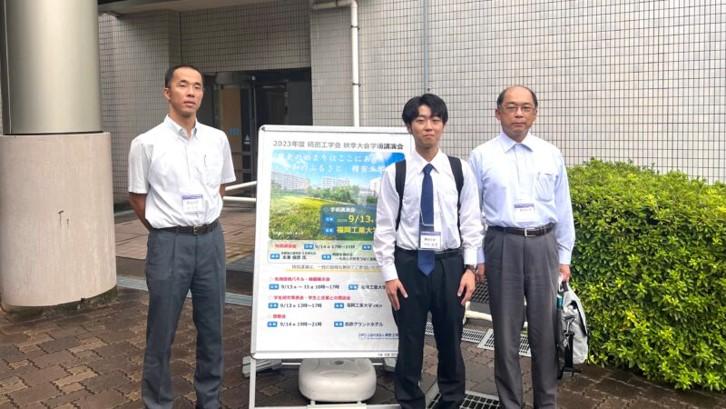
[Shizuoka University after the lecture / presenter Kawai, Professor Sakai, Associate Professor Shizu, and the lecture venue, Fukuoka Institute of Technology building]