- Semiconductor BusinessHOME
- Products and Services of Macnica,Inc.
-
technical information

-
Events and Seminars
- Handling Manufacturer
- Support
- Inquiry
- Click here to purchase products
- Semiconductor business e-mail magazine registration


 Narrow down by specifying conditions
現在2240件がヒットしています。check
【table of contents】
2. MIPI Aggregation in Integrated ECU
3. Splitter to multiple displays with E-Cockpit
4. Video Transmission Considering Functional Safety
5. FPGA Use Cases and Feasible Devices
6. Comes with Japanese materials! MIPI Reference Design
[What you can learn from this article]
・Demand for MIPI standards in electronic control of automobiles
・Examples of FPGA utilization based on actual examples
Based on actual examples, the following materials are available for FPGA utilization examples and feasible devices for each in-vehicle product! Please use all means.
▼▽▼▽▼▽▼▽▼▽▼▽▼▽
Introduction
In recent years, with the increase in definition of video signals handled by in-vehicle products, the amount of video data handled has increased, and the interfaces for video signals have also changed.
In addition, the number of in-vehicle products that handle video signals is increasing, and the types of interfaces for video signals in in-vehicle products are increasing. Since many applications that require high-definition video signals have been installed, MIPI I/F is becoming the standard among various video signals.
In the SoC installed inside the ECU of such applications, there is no interface compatibility between each device due to the inability to connect the MIPI I/F or the lack of MIPI I/F ports. cannot be directly connected to.
For these reasons, in the above applications, the need for interface conversion is increasing even among automotive products.
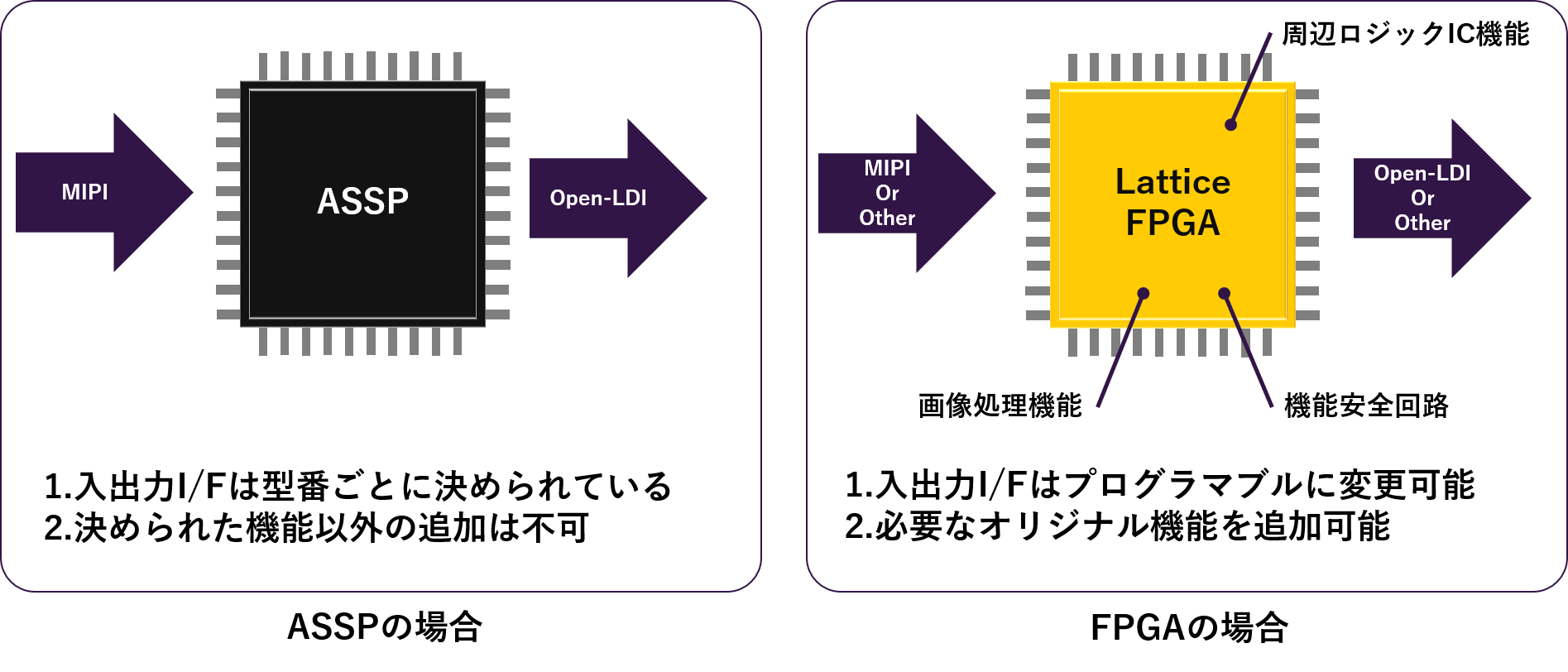
Interface conversion using FPGA is convenient when such interface conversion is necessary.
In particular, Lattice Semiconductor's FPGA has a wide range of AEC-Q100 certified devices that enable mutual interface conversion with various displays, including in-vehicle cameras inside and outside the vehicle, centered on MIPI I / F. I'm here.
We have many solutions that take advantage of the flexibility unique to FPGAs, such as adding peripheral logic ICs, image processing functions, and functional safety circuits that are difficult to achieve with ASSPs. On this page, we will introduce examples of FPGA utilization by Lattice semicondutor, mainly for interface conversion.
MIPI Aggregation in Integrated ECUs
Increase in the number of MIPI I/Fs and problems that arise with the trend of ECU integration
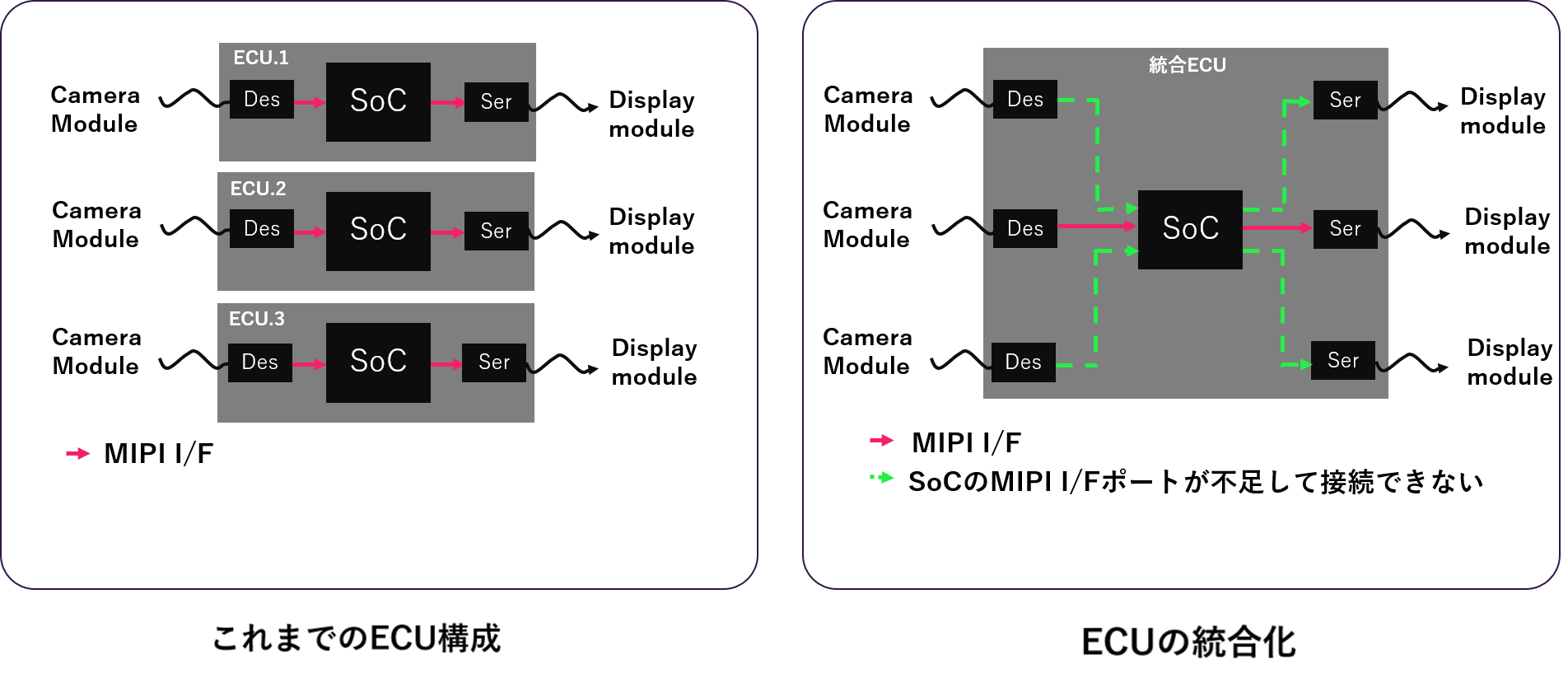
As automobiles become more electrically controlled, the number of ECUs installed in a single automobile has increased enormously, and the number of ECUs that handle video signals has also increased accordingly. Therefore, from the viewpoint of weight reduction and cost reduction, there is a trend toward integrating ECUs.
In automotive ECUs, video signals are transmitted to the SoC inside the ECU via the SERDES IC (deserializer, serializer). An increasing number of vendors are adopting the MIPI I/F as the I/F between the SERDES IC and SoC. For example, serializers that support I/Fs such as FPD-LINK III, GMSL, GVIF, and APIX, which are typical in the automotive industry, have MIPI I/F on either the input side or the output side. There are more and more things that support .
However, as the number of MIPI I/Fs handled within a single ECU increases due to ECU integration, there are more cases where conventional SoCs lack MIPI I/F ports and cannot be connected.
Solution for lack of MIPI I/F ports
The shortage of MIPI I/F ports due to ECU integration can be solved by FPGA.
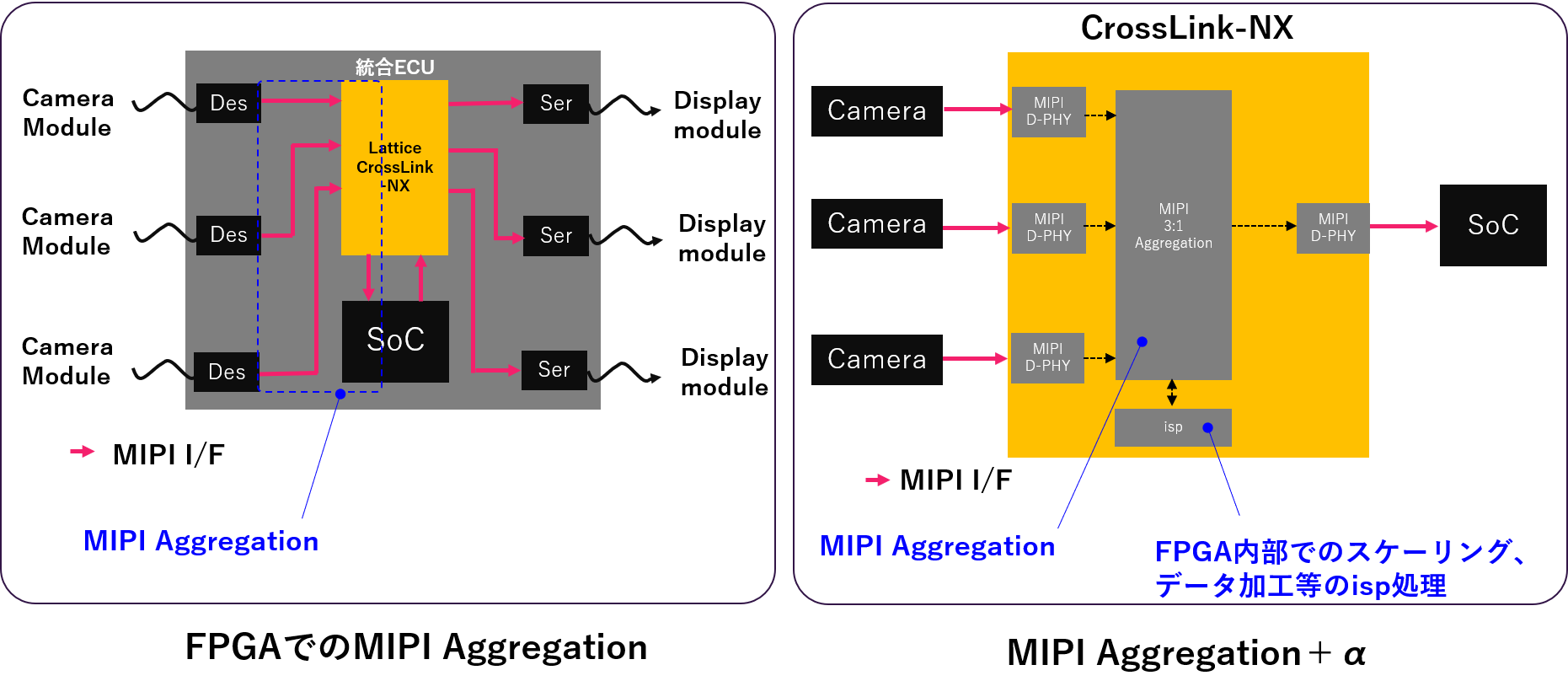
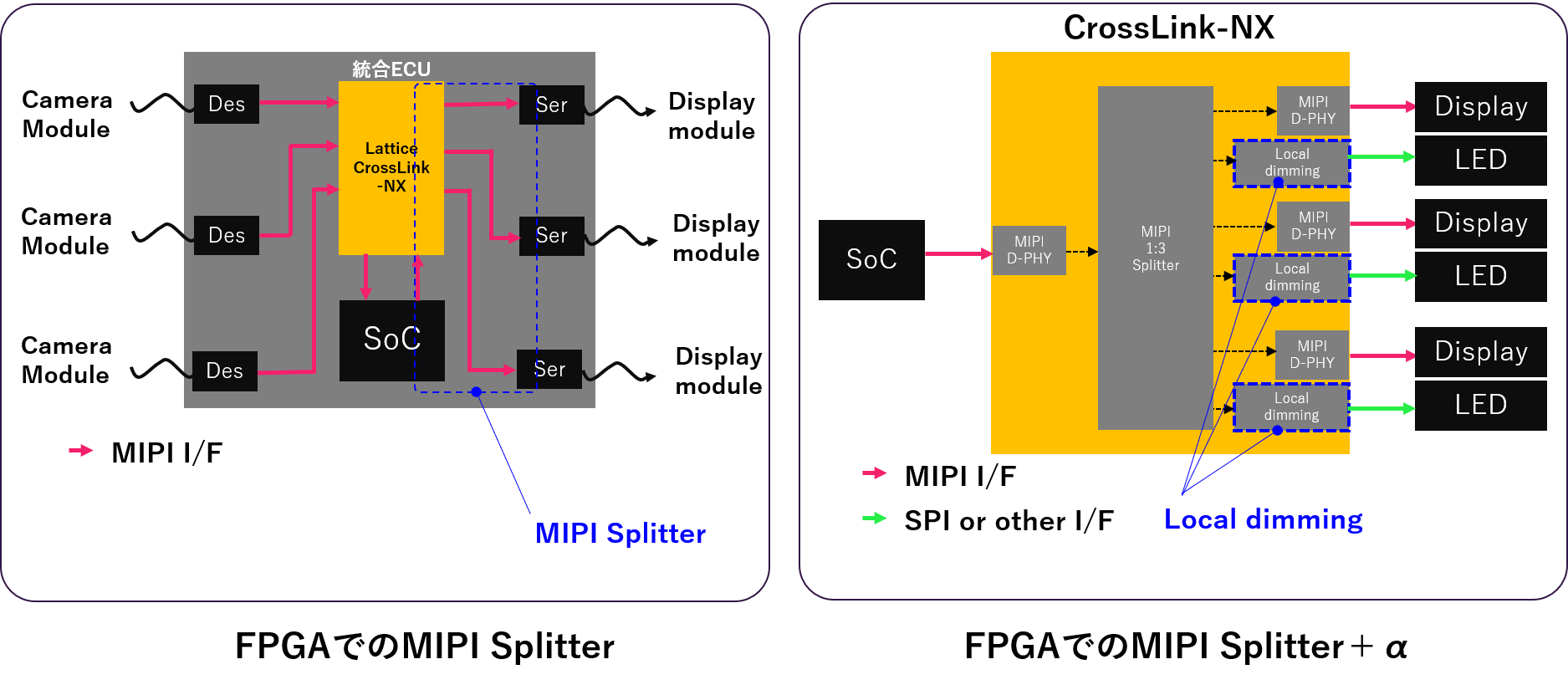
As shown in the left figure, MIPI aggregation, which outputs MIPI I/F 3ch input from the deserializer side of Serdes IC to MIPI I/F 1ch, solves the shortage of SoC MIPI I/F ports. In terms of speed, it is possible to secure the industry's fastest 4K-class bandwidth.
Lattice's CrossLink-NX FPGA has a MIPI I/F Max Rate of 2.5Gbps/lane due to MIPI Hard D-PHY. Therefore, even in the case below where 3ch MIPI I/F is output by 3x speed MIPI I/F 1ch, 3ch MIPI I/F on the input side can support up to Full-HD class per channel. becomes.
In addition to simple MIPI I/F 3:1 aggregation as shown in the right figure, it is also possible to convert the data format inside the FPGA and add image processing such as scaling. Since CrossLink-NX has an internal DSP block and DDR memory-I/F, adding such functions can be considered. This kind of MIPI I/F 3:1 aggregation + α function can be said to be an advantage unique to FPGA.
Splitter to multiple displays with E-Cockpit
The lack of MIPI I/F ports on SoC can be said to be the same on the serializer side of SERDES IC as shown in the figure below. If you need to connect to the serializer from SoC's MIPI I/F 1ch to multiple channels of MIPI I/F, use CrossLink-NX to achieve a splitter function that expands the MIPI I/F to multiple channels. is possible.
With CrossLink-NX, in addition to the splitter function, it is possible to perform in parallel image processing unique to the display system such as scaling processing that matches the subsequent display and TFT liquid crystal, clipping and distortion correction, and data format conversion of MIPI I/F. Is possible. In addition to the MIPI splitter function, it is also possible to realize local dimming control for the subsequent display with a single chip.
In recent years, the demand for local dimming control has increased in the automotive industry, and ICs dedicated to local dimming have been released. It is also possible to programmatically change the target segment area.
This kind of flexibility and extra functionality that is unique to FPGAs is an absolute advantage in the environment unique to the automotive market, such as sudden specification changes from OEMs and board design changes and customizations for each model. .
Video transmission considering functional safety
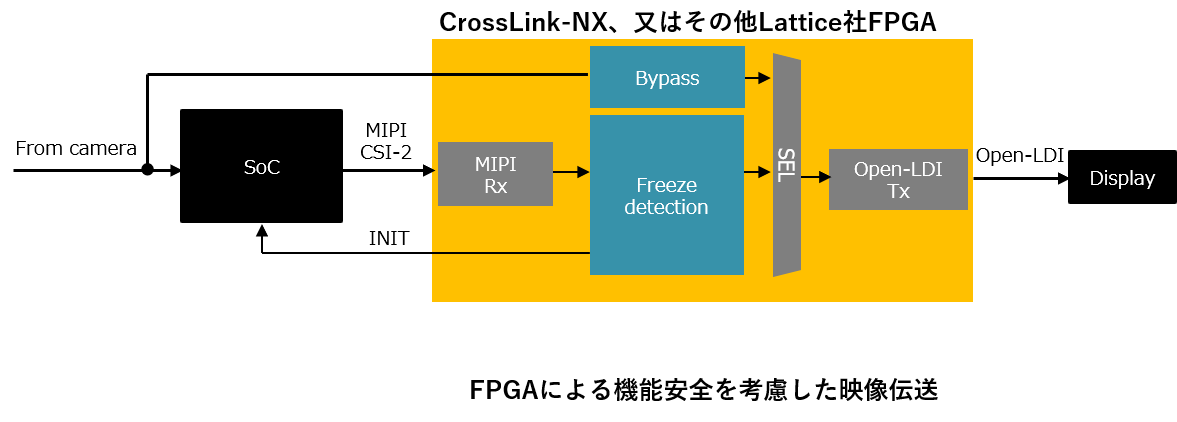
The figure below shows a case where a functional safety circuit is implemented together with the I/F conversion function that converts MIPI I/F to Open-LDI.
In this case, the Freeze detection function to recognize whether the video signal transmitted from the SoC is correctly transmitted without sticking and the Bypass transmission to display the video on the display without going through the SoC I set a line. Bypass transmission line is a bottleneck in SoC startup time, and considering the case where the video display start time regulation stipulated by the KT law cannot be observed, by providing a bypass transmission line in the FPGA, the necessary timing can be adjusted. It is a function that realizes immediate display with
Unlike other companies' FPGAs, Lattice semicondutor's FPGAs are mostly devices with a configuration time of several ms to several tens of ms, so they demonstrate their strengths in such applications that require immediate startup.
FPGA use cases and feasible devices
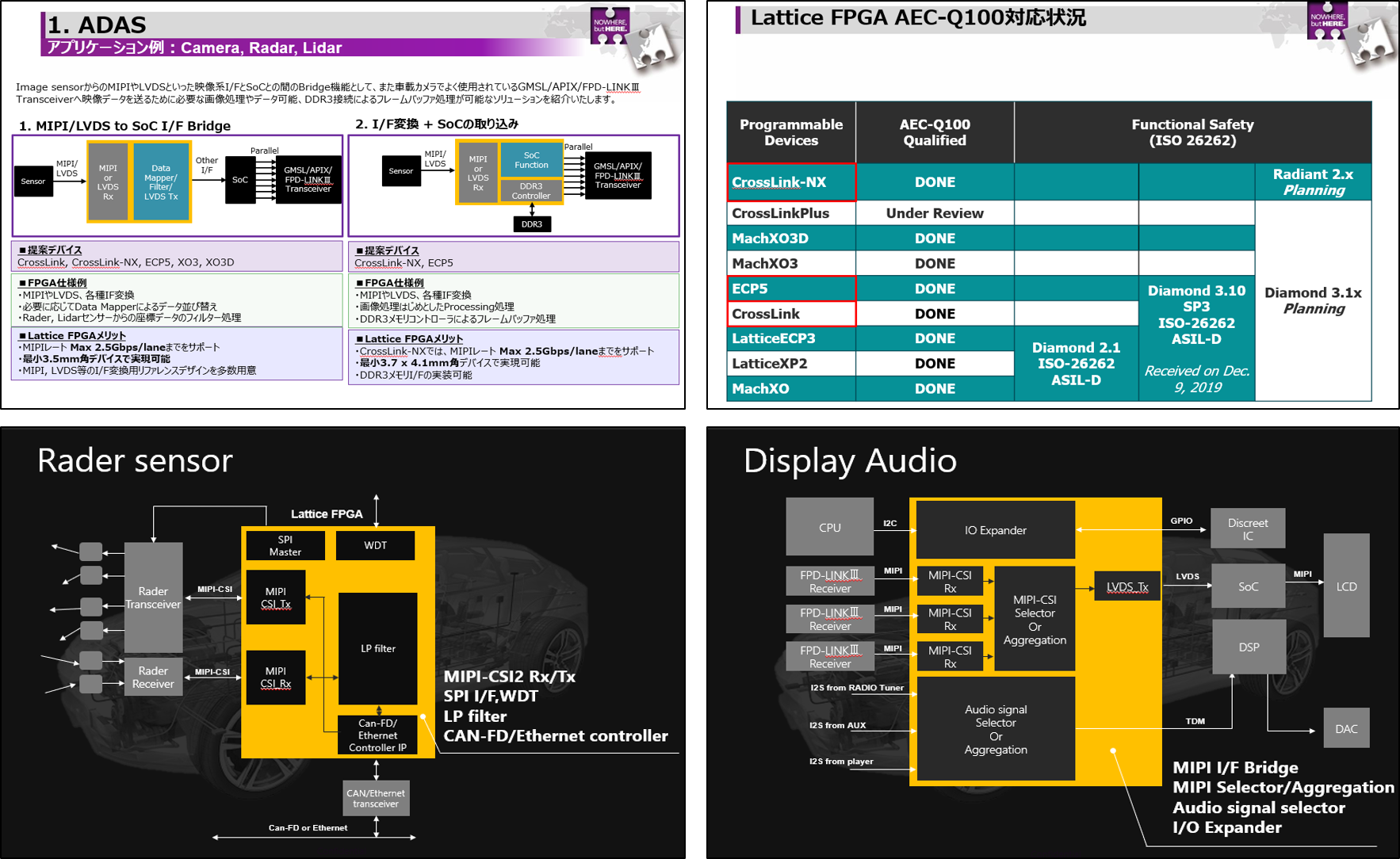
The examples of FPGA usage introduced on this page are limited to the minimum necessary functions, but in reality, additional functions that could not be introduced inside the FPGA and connections with peripheral parts are different from the actual examples. . In the materials that can be downloaded from the following, we introduce examples of FPGA utilization in each in-vehicle product based on actual examples, introduction of feasible devices, and a lot of content related to MIPI I / F, so please do not hesitate to use it in the future. Please use it for your development.
Includes Japanese materials! Macnica original reference design collection
Things that customers often ask us about
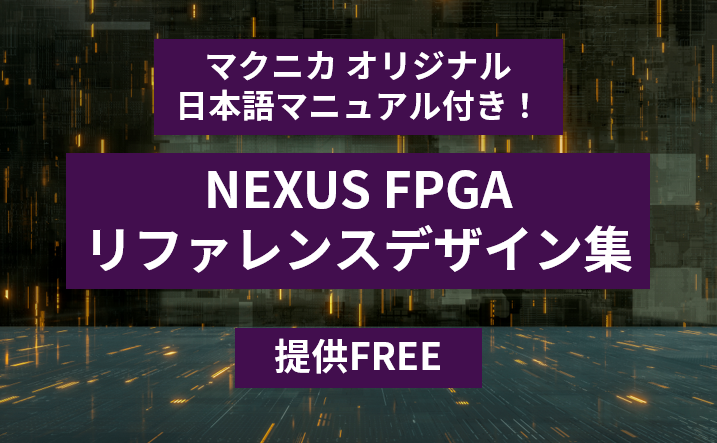
Created with Macnica original
This is the FPGA reference design page.
It is available for free.
[What you can get]
・Reference design project file set
・Simple manual materials
Inquiry
If you have any questions regarding this article, please contact us below.