- Semiconductor BusinessHOME
- Products and Services of Macnica,Inc.
-
technical information

-
Events and Seminars
- Handling Manufacturer
- Support
- Inquiry
- Click here to purchase products
- Semiconductor business e-mail magazine registration


 Narrow down by specifying conditions
現在2240件がヒットしています。check


Hello, this is Taro.
Last time, we mainly explained the principles of frequency division/multiplication in PLLs.
By utilizing the frequency division/multiplication principle of a PLL, it is possible to apply spread spectrum to a clock signal.
What is spread spectrum used for?
Spread spectrum in clocks is a method for eliminating EMI noise generated by the clock signal.
EMI (Electromagnetic Interference) refers to electromagnetic interference that a device or system emits to the outside world.
I have no connection to any record company. (lol)
Because the current flowing through the wiring changes due to the clock signal, EMI is inevitably emitted.
This EMI (Earth-Emissions Regulation) is defined by the FCC (Federal Communications Commission).
One possible EMI countermeasure is the implementation of a Faraday shield, but this increases the device package size.
By applying spread spectrum to the clock signal, EMI can be reduced without implementing Faraday shielding.
How can spread spectrum technology reduce EMI?
Spread spectrum reduces EMI by intentionally modulating the clock frequency.
Without spread spectrum, all the energy is concentrated at a single frequency.
By using spread spectrum technology, the usable frequency band is broadened, and energy is diffused.
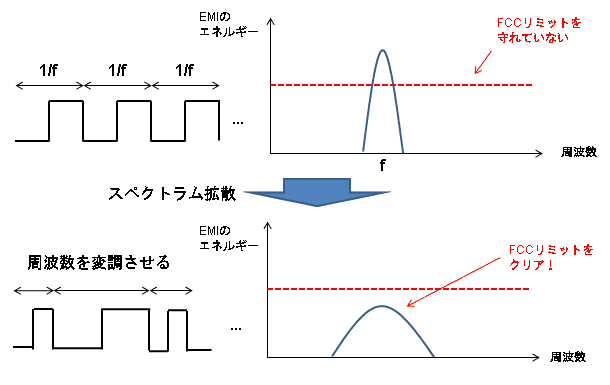
Principle of spread spectrum
And now, finally, we get to the PLL.
In the previous section, we explained that spread spectrum involves intentionally modulating the frequency, and this modulation is achieved using a PLL (Phase-Looped Loop)!
Spread spectrum is achieved by changing the frequency division ratio of the FB divider in a PLL.
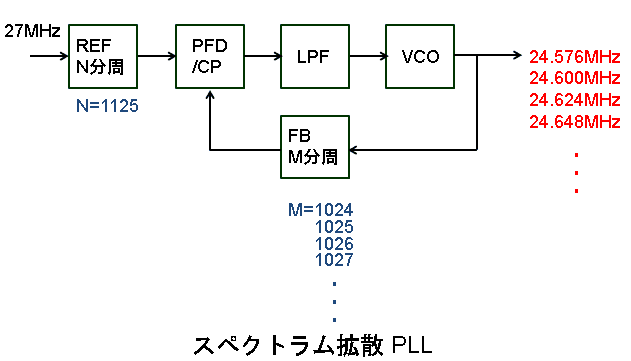
There are two types of spread spectrum methods: center spread and down spread.
Center spread diffuses the frequency range to a wide/low range.
On the other hand, downspread diffuses frequencies only to the lower end.
These are used depending on the guaranteed frequency of the downstream device.
Precautions when using spread spectrum
While spread spectrum is a welcome feature for reducing emitted EMI, there are some points to be aware of.
When using spread spectrum clocks in a system, it is important to unify the clock generators.
Some of you may have wondered about the clock waveform in the spread spectrum principle, but timing jitter occurs in spread spectrum clock signals.
Spread spectrum can be described as a technique that intentionally introduces timing jitter.
Because the frequency is constantly changing, the clock generator must be unified to maintain synchronization across the entire system.
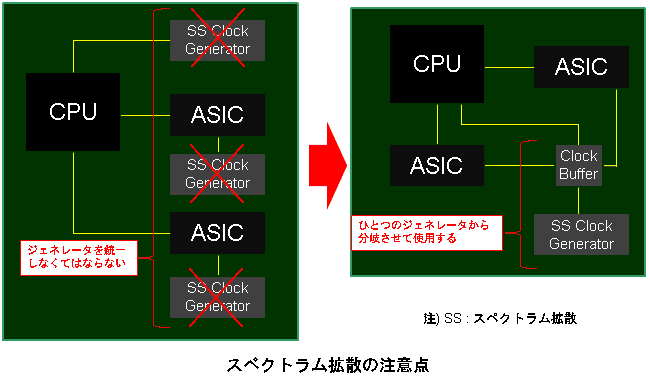
There is one more point we need to be careful about.
Therefore, if you are spreading a spread spectrum clock using a buffer, you must set the PLL loop bandwidth to be wide.
I'll write about the subtle relationship between PLL loop bandwidth and spread spectrum in my next post.