- Semiconductor BusinessHOME
- Products and Services of Macnica,Inc.
-
technical information

-
Events and Seminars
- Handling Manufacturer
- Support
- Inquiry
- Click here to purchase products
- Semiconductor business e-mail magazine registration


 Narrow down by specifying conditions
現在2247件がヒットしています。check
As mentioned in "WP.29 Regulation Compliance and CSMS/SUMS Implementation Guide," new autonomous driving vehicles and vehicles with OTA are required to comply with UN-R155. This article introduces UN-R155 and ISO/SAE21434, which can be used as an implementation guideline for UN-R155.
table of contents
Introduction: Why are "UN-R155" and "CSMS" important now?
As automobile functions become increasingly computer-controlled and sophisticated, cybersecurity threats are increasing year by year. To address this situation, the United Nations Economic Commission for Europe (UNECE) enacted UN-R155, making the introduction of a Cyber Security Management System (CSMS) mandatory. This regulation aims to ensure resistance to cyberattacks in the development, production, operation, and maintenance of vehicles, and has been in effect in many countries, including the EU, since 2022. In Japan, the Ministry of Land, Infrastructure, Transport and Tourism has incorporated UN-R155 into its vehicle type approval system, making it an urgent task for OEMs and suppliers to take action.
The role of CSMS
A CSMS is a system for managing and operating cybersecurity throughout an organization. UN-R155 requires the introduction of a CSMS as a prerequisite for type certification, and requires the following elements:
- Threat Analysis (TARA)
- Defining security requirements
- Audits and Continuous Improvement
- Establishment of an incident response system
CSMS is not just a technical measure, but a framework for organizational and continuous security management that applies to OEMs as well as suppliers.
Legal and regulatory trends in Japan (Ministry of Land, Infrastructure, Transport and Tourism type certification)
In Japan, the Ministry of Land, Infrastructure, Transport and Tourism has incorporated UN-R155 into domestic law, making it mandatory for new vehicles applying for type approval after July 2022 to implement a CSMS. As a result, cars sold in Japan are now required to have a cybersecurity system that complies with international standards. The following documents and systems are checked during type approval reviews.
- Clarification of the CSMS operation system and responsible person
- TARA implementation record
- Security Incident Response Procedures
- External audit history
In this way, compliance with UN-R155 has become a legal obligation in Japan as well, and is an important factor that directly affects a company's credibility and market competitiveness.
Differences and Relationships between UN-R155 and ISO/SAE 21434
When it comes to automotive cybersecurity, "UN-R155" and "ISO/SAE 21434" are frequently mentioned keywords. While the two standards are closely related, there are clear differences in purpose, scope, and legal binding force.
| Comparison items: | UN-R155: | ISO/SAE 21434: |
| nature | International legislation (UNECE WP.29) | Technical standards (ISO/SAE) |
| legally binding | Yes (required for type approval) | None (recommended but important) |
| Scope | Cybersecurity management for the entire vehicle | Automotive system development process |
| Requirements | CSMS implementation and operation | Risk analysis, design, verification, and maintenance |
| Subject of review | Organizational structure and operational records | Technical documentation and development process evidence |
Simply put, UN-R155 is a regulation that defines "what should be done," while ISO/SAE 21434 is a technical guideline that shows "how to achieve it."
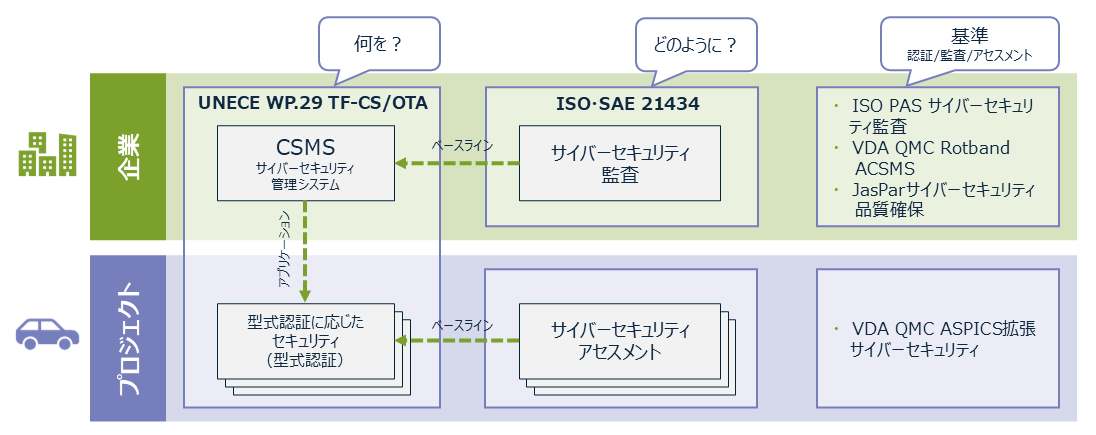
There is also a page that explains how to implement it, so please take a look.
OEM-Supplier Responsibilities and Implementation Issues
Under UN-R155, the OEM (automobile manufacturer) is responsible for managing cybersecurity for the entire vehicle. However, because the majority of the actual development of on-board systems and ECUs is carried out by Tier 1 and Tier 2 suppliers, a clear division of responsibilities and collaboration between the OEM and suppliers is essential.
| OEM's main responsibilities: | Primary responsibilities of Tier 1/Tier 2: |
|
・ CSMS construction and operation ・ Preparation of documents necessary for obtaining type certification - Present security requirements to suppliers ・Security audits of the entire supply chain |
・ Responding to security requirements presented by OEMs ・Implementation of development process in accordance with ISO/SAE 21434 ・Implementation of TARA and risk countermeasures ・Providing security evidence (design, verification, maintenance) |
In this way, the ideal structure is one in which the OEM is responsible for the overall design of the CSMS, and the supplier supports the technical implementation.
Issues and solutions when implementing CSMS from a supplier's perspective
Suppliers who want to implement a CSMS face practical challenges, such as meeting different security requirements from each OEM, managing security activities across multiple projects, a shortage of security specialists, and the time it takes to understand and apply ISO/SAE 21434. However, introducing a common framework and utilizing external support can be effective in overcoming these challenges.
| assignment: | explanation: | Solution: |
| Lack of resources | There are few security specialists within the company |
Utilizing external services and programs such as security consulting and security training |
| Tool Selection | I don't know what tools are suitable for TARA etc. |
Implement TARA efficiently with market-proven tools like ETAS's CycurRISK |
| Variability between projects | Different levels of support for different projects | Utilizing external consulting to standardize CSMS within the company and build a cross-sectional auditing system |
For suppliers to implement CSMS, close collaboration with OEMs and the establishment of internal systems are key. ETAS, which Macnica deals with, provides comprehensive support for suppliers' CSMS implementation by providing technical assistance, tools, and training to address these challenges.
CSMS support by ETAS
ETAS, which Macnica handles, has a wide range of achievements based on its many years of experience and know-how, including support for building CSMS, implementing TARA, supporting the building of security management systems (PSIRT), supporting the acquisition of type certification, and implementing security training, and it also employs many tools that can be used to implement TARA. Please take a look at their product lineup.
If you have any other concerns or questions about security, or would like to see specific solutions, please feel free to contact us.
ETAS manufacturer information TOP
If you want to return to ETAS Manufacturer Information Top, please click below.