- Semiconductor BusinessHOME
- Products and Services of Macnica,Inc.
-
technical information

-
Events and Seminars
- Handling Manufacturer
- Support
- Inquiry
- Click here to purchase products
- Semiconductor business e-mail magazine registration


 Narrow down by specifying conditions
現在2182件がヒットしています。check
As IoT and AI rapidly evolve, data utilization is becoming more prevalent in all kinds of products.
The foundation of this is sensing technology, which makes invisible changes visible.
In this article, we will explain the basics of sensing technology and how "strain" measurement can create value.
Social background that requires sensing
In recent years, advances in IoT, AI, and machine learning have led to the advancement of high functionality and automation in products and equipment.
To achieve this, accurate data collection and analysis is essential.
for example,
- Environmental data such as temperature, humidity, and illuminance
- Mechanical operation data such as current, force, and vibration
By accurately understanding this information in real time, the condition of machines and products can be visualized, leading to the maintenance of performance and the prevention of breakdowns.
Sensors and the sensing technology that makes use of them are responsible for collecting this data.
Sensors can be said to be the "sensory organs of products," capturing minute changes that are invisible to the naked eye and enabling device control and abnormality detection.
What are sensors and sensing?
A sensor is a device or equipment that detects physical or chemical changes and captures that information.
It senses all kinds of information, including temperature, humidity, pressure, and strain, and converts it into data.
If we compare it to humans, it functions like the five senses and is an important element in helping machines "understand the situation."
Examples of sensor types
・Physical sensors: Quantifying force, pressure, strain, etc.
Chemical sensors: measure the concentration of specific chemical substances
・Biosensor: Measures biological information
・Image sensor: converts light into an electrical signal
Combining these allows machines and robots to operate more sensitively and safely.
For example, in robots that work in cooperation with humans,
・Measure the distance between people using a distance sensor
・Image sensors identify the type and location of objects
- Torque and acceleration sensors control the amount of force and smoothness of movement
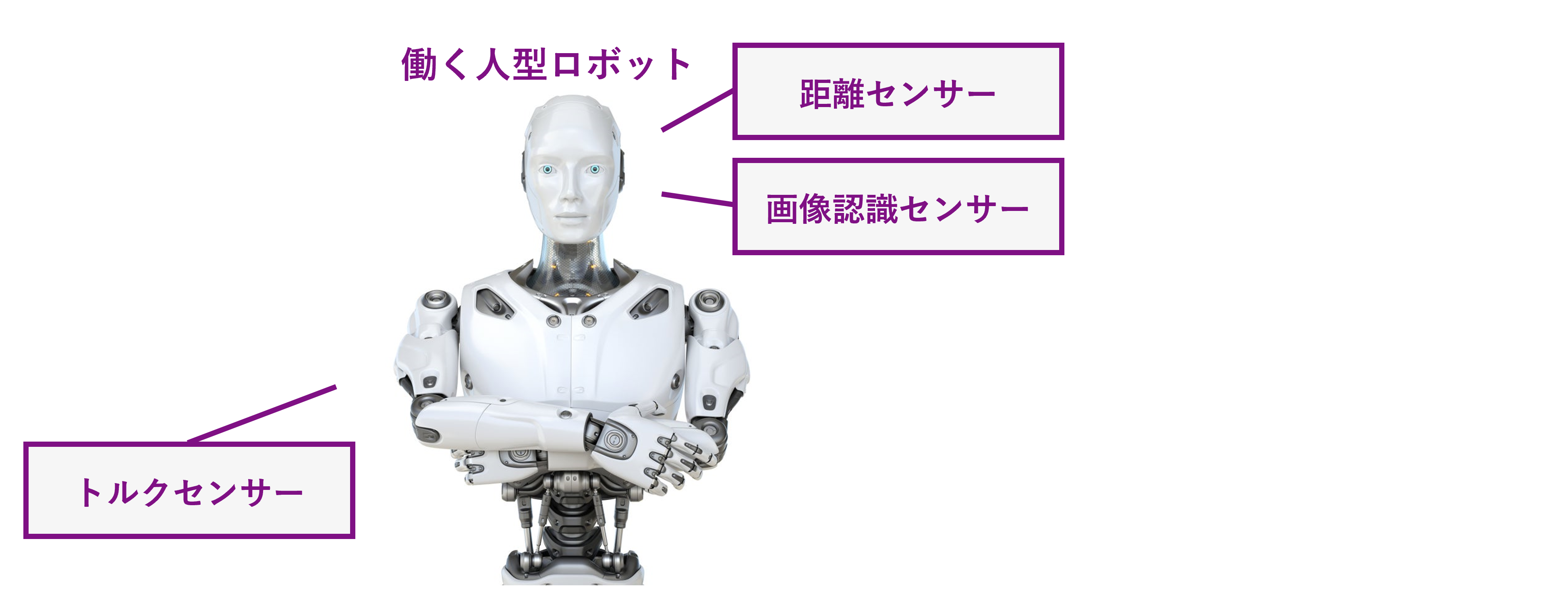
In this way, sensor information acts like the robot's eyes and hands, supporting highly accurate and safe operation.
What is the value of measuring strain?
Strain is
It expresses the degree of deformation when an object is stretched or contracted under the force of force.
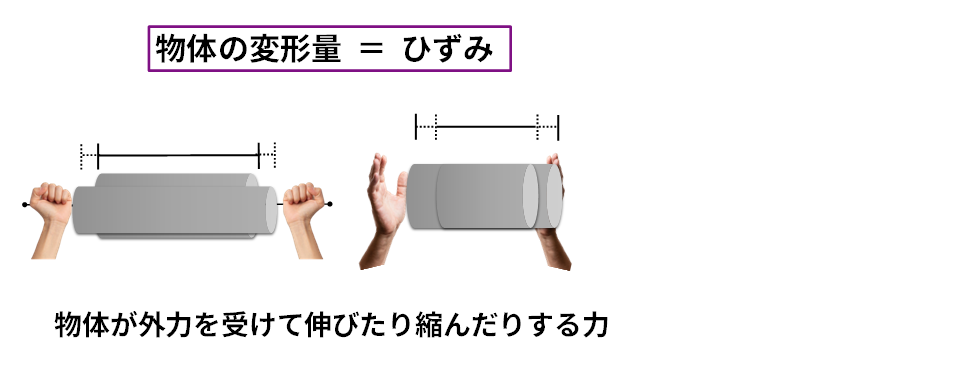
In other words, by measuring strain, we can estimate force and determine the state of an object.
Image of strain measurement
- Tensile strain: When a load is placed on the product, the stretch caused by the weight of the load can be detected.
- Compression strain: It can detect changes in the "crushing force" when a heavy object is placed on it.
- Distortion due to vibration and twisting: It is possible to detect even minute changes when parts or structures vibrate or deform.

These applications will enable use in a wide range of fields, including safety confirmation of equipment and structures, performance evaluation, and quality control.
Features of Macnica 's semiconductor strain sensor "STREAL"
Constant measurement by strain sensors is essential to understand the condition of the equipment and detect signs of abnormalities or deterioration.
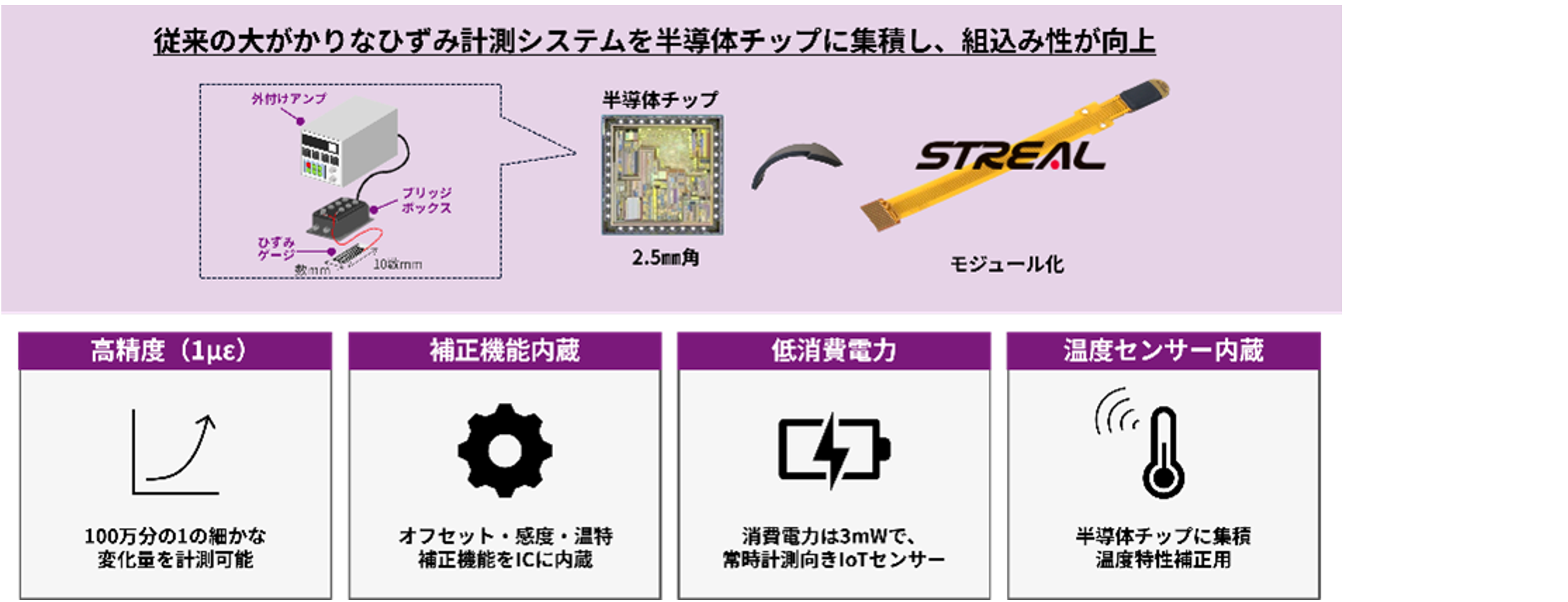
Previously, measurements using "strain gauges" were the norm, but
Peripheral devices become larger
・Easily affected by external noise
・High power consumption
These issues made it unsuitable for permanent incorporation into equipment.
This is where the semiconductor strain sensor "STREAL" developed by Macnica comes in.
It integrates a conventional measurement system into a chip measuring just 2.5mm square, and is optimized for embedded applications.
Three features of STREAL
-High-precision measurement (1με unit)
Capable of accurately detecting minute strain changes at the level of one part per million.
- Built-in correction function
Offset, sensitivity, temperature characteristics, etc. can be corrected to obtain a stable output.
・Low power consumption design
It operates on just 3mW and is battery-powered, allowing for long periods of operation.
These features make STREAL ideal for direct integration into equipment and IoT sensing applications.
For those who want to know more
We have an on-demand video available that explains the contents of this article in more detail.
We provide an easy-to-understand introduction to the structure of STREAL, examples of its use, and how to implement it.
If you are interested, please click on the banner below to apply!