- Semiconductor BusinessHOME
- Products and Services of Macnica,Inc.
-
technical information

-
Events and Seminars
- Handling Manufacturer
- Support
- Inquiry
- Click here to purchase products
- Semiconductor business e-mail magazine registration


 Narrow down by specifying conditions
現在2182件がヒットしています。check

Research using the semiconductor strain sensor STREAL was presented at the 2025 Annual Meeting of the Japan Society of Mechanical Engineers on Monday, September 8th. The presentation theme was "Estimating the steady-state wear state of drills using a cutting tool holder-mounted wireless torque and thrust measurement system," and summarized the research conducted in 2024.
This research is being conducted in collaboration with industry and academia by Shizuoka University (hereinafter referred to as Shizuoka University), NT Tool Corporation (hereinafter referred to as NT Tool), and Macnica, and the lecture by Shizuoka University will be the ninth presentation of results.
1. Overview
To improve productivity at production sites, technology that can monitor the condition of tools in real time during cutting is required. In this research, we propose a low-cost, highly reliable system that attaches STREAL to a rotary tool holder and measures torque and thrust wirelessly. Conventional piezoelectric cutting dynamometers are expensive, and strain gauge types have issues with accuracy and stability, but STREAL solves these issues with its features of high sensitivity, compact size, low power consumption, and low cost.
2. Past efforts
| season | Initiatives |
| From 2016 | Development of lathe processing monitoring technology |
| From 2020 | Study on abnormality detection method for drilling and end milling |
| From 2022 | Drilling monitoring with wireless torque and thrust measurement system |
| After 2024 |
Improved sensitivity through sensor improvements, high sampling rate (1KHz x 2ch achieved), |
3. Products provided and Macnica support
Products offered
・STREAL (SR300 series)
・Wireless power supply board
・Data collection device (evaluation kit)
・Dustproof and waterproof holder
Macnica Support
・Development and provision of STREAL
・Improvement of wireless power supply board and data collector (evaluation kit)
・Supports attaching sensors to NT Tool tool holders, temperature compensation, and assembly
・Reporting findings on measurement results and proposing evaluation plans
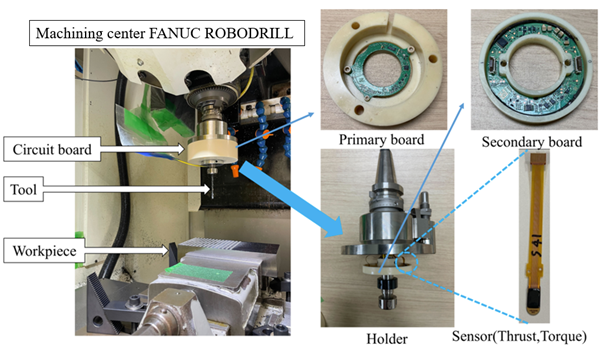
Figure: Rotary tool holder with strain sensor data transmitter board and data receiver sub-board mounted on a machining center
4. Presentation Summary
Using the FANUC ROBODRILL Machining Center, we conducted drilling experiments under conditions similar to those in actual production sites. We measured the strain caused by the thrust load and torque acting on the drill and compared the results with those of a commercially available piezoelectric cutting dynamometer.
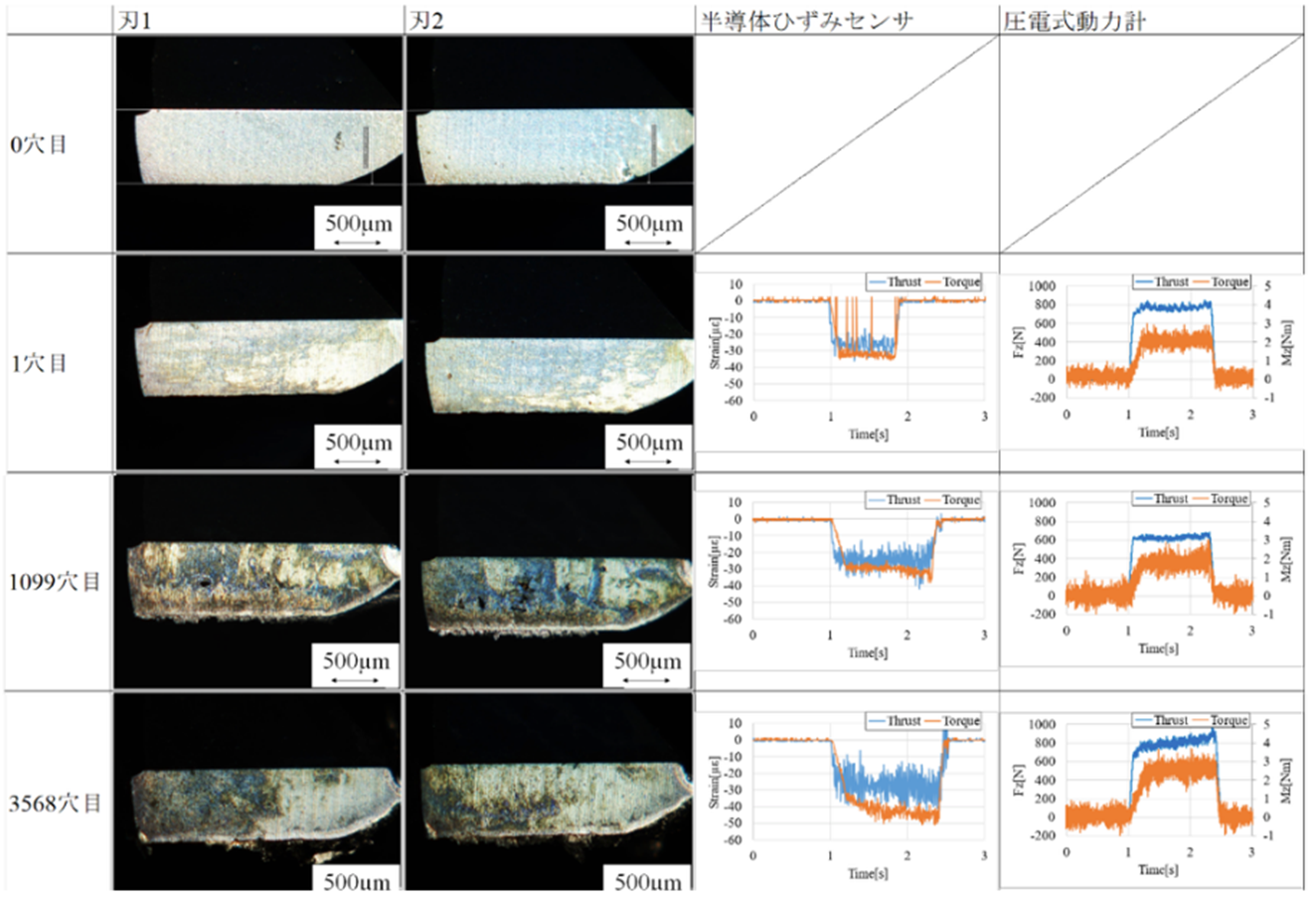
Figure: Optical microscope photograph of the drill bit during the test, and strain sensor and dynamometer measurement results
The experimental results showed that as the drill wear progressed, the measured strain and cutting resistance increased, with a particularly rapid increase observed when the wear width exceeded 80µm. A high correlation was confirmed between the measured strain and cutting resistance, and it was shown that by detecting the rapid increase in strain just before the tool life ends, it is possible to determine the appropriate timing for tool replacement.
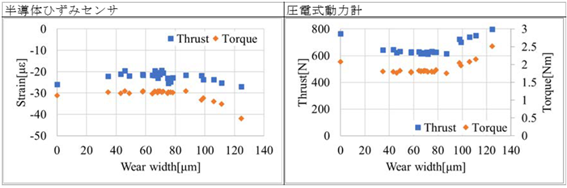
Figure: (Left graph) Relationship between the flank wear width of the drill and the strain value, (right graph) Relationship between the flank wear width of the drill and the thrust and torque measured by a cutting dynamometer
5. Future Outlook
This system can be applied not only to drilling, but also to machining other rotary tools such as end mills and taps. By optimizing the sensor placement and holder design to suit each type of tool, it is expected that tool condition monitoring will be possible in a wide range of machining sites. Furthermore, we will promote strengthening of competitiveness by considering expansion into various manufacturing industries such as automobiles, aircraft, and precision machinery, as well as overseas factories and global production bases.
6. Conclusion
This conference is at the forefront of machine tools and production systems, and DX and CPS are attracting increasing attention. This session was well attended by participants from other universities and major companies, and the venue was filled to capacity with some standing room only. The three companies will continue their research, aiming to develop systems that are more versatile and useful for manufacturing sites.
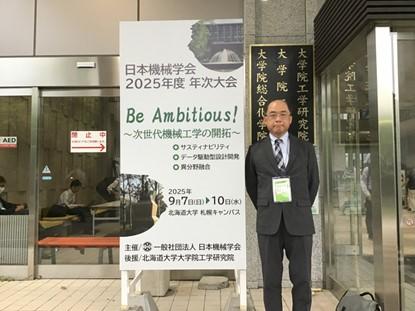
[Scene after the lecture: Professor Sakai, Shizuoka University / Lecture venue: Hokkaido University Sapporo Campus]