- Semiconductor BusinessHOME
- Products and Services of Macnica,Inc.
-
technical information

-
Events and Seminars
- Handling Manufacturer
- Support
- Inquiry
- Click here to purchase products
- Semiconductor business e-mail magazine registration


 Narrow down by specifying conditions
現在2226件がヒットしています。check
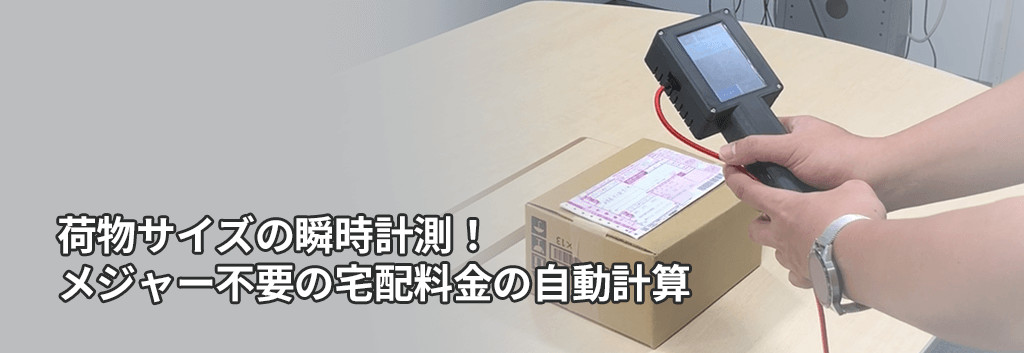
Is there a way to automatically measure the length, width, and height of an object without using a measuring tape?
In recent years, the demand for online shopping has expanded, leading to an increase in the volume of goods handled by logistics. However, receiving counters are facing labor shortages, and even "measuring for price calculation" is a time-consuming manual process. This issue is not limited to logistics receiving. From airline baggage and warehouse receiving inspections to food packaging lines, the practice of "measuring sizes by hand" is common across various industries. As the working population declines, there is a growing need to streamline various aspects of logistics operations.
To address these issues, we have developed a prototype terminal that "instantly measures package size and automatically calculates the shipping fee." By easily measuring package size using sensors, we expect to reduce the operational burden on logistics sites and receiving counters, and also reduce the possibility of errors. We will explain how this innovation became possible.
What is automated size measurement? A system that replaces "measuring by hand."
Automating size measurement means replacing manual measurement using measuring tapes and calipers with sensors and software. The basic process is simple.
- ① Measurement: The 3D sensor captures the shape of the object non-contact and calculates length x width x height (and volume if necessary).
- ② Connect: Automatically send measurement data to the cloud or business systems.
- ③ Use: Automate subsequent processes such as automatic calculation of freight charges, inspection records, and determination of packaging specifications.
The key point is that simply "measuring" is not enough to be effective. Only by linking the measured values with fare tables and inspection databases, and connecting the entire process from "measure → judge → record," can manual work and human error be eliminated. There are four main types of sensors that can be used for size measurement.
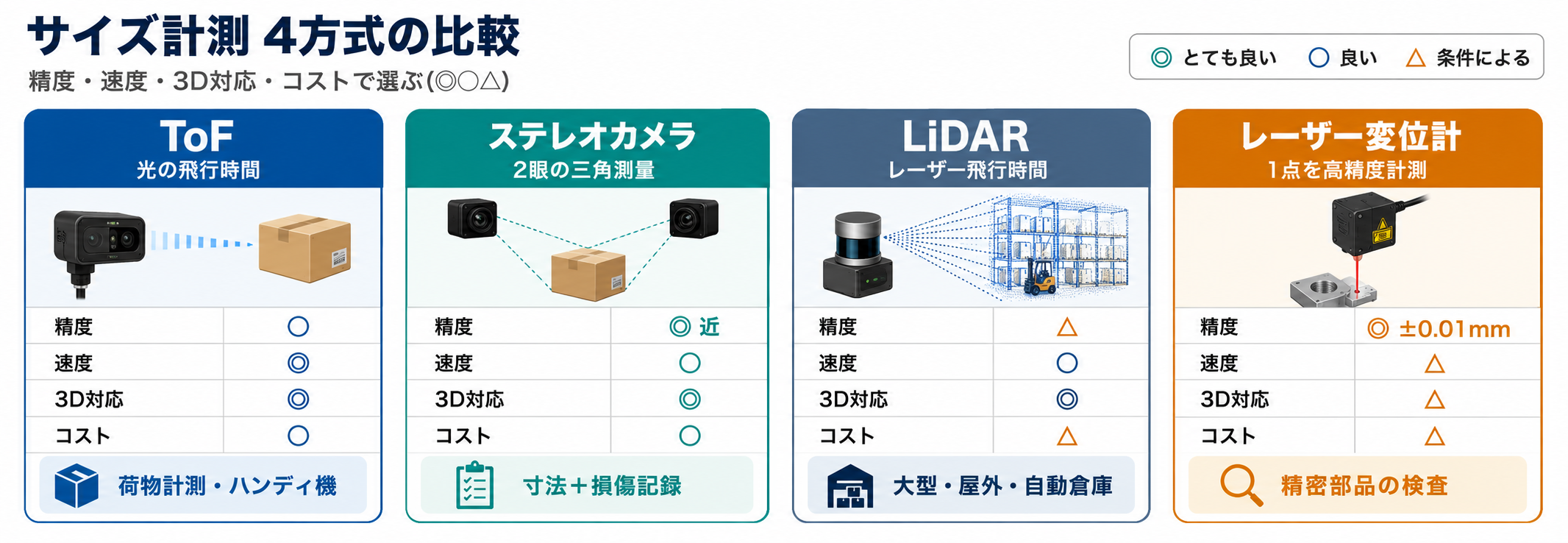
We compare four methods—ToF, stereo camera, LiDAR, and laser—based on accuracy, speed, 3D capabilities, and cost.
From these options, Macnica 's Manufacturing Consulting (MonoCon®) decided that it would be possible to easily measure the three dimensions of an object using a Time of Flight (ToF) sensor, which measures the time it takes for light to reach an object and thus the distance to the object, and developed the "Luggage Size Measurement & Automatic Price Calculation Terminal".
What is ToF (Time of Flight) sensor?
A ToF sensor calculates the distance to an object by measuring the time it takes for light to reflect from the object and return. In other words, ToF sensors are very useful for accurately measuring the size and position of objects.
ToF sensors have great potential in instantaneous measurement of baggage size. Using the ToF sensor, you can instantly and accurately measure the size of your luggage. This is much faster than measuring with a tape measure, and there is less measurement error. It also offers very high accuracy and reliability. This allows carriers and other users to calculate rates with confidence, and customers to trust in their accuracy.
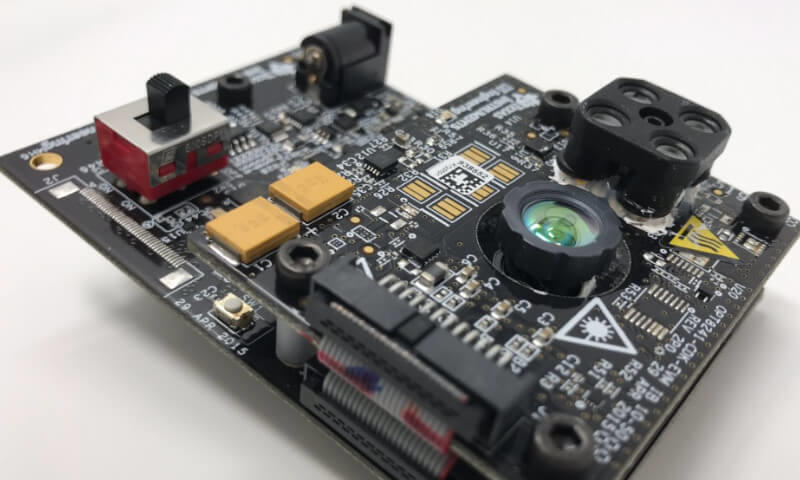
The specific principles and mechanisms are described in detail in the following article.
Introducing the principle and reference design of a ToF sensor that can also count people
"Package size measurement & automatic fee calculation terminal" that applies ToF sensors to streamline receiving operations
Manual measurements are not only time-consuming, but also prone to errors. Using traditional tape measure methods, measuring large boxes is extremely time-consuming and can result in measurement errors by the operator. To overcome these problems, metering and billing processes need to be automated. This saves time and effort and provides more accurate and reliable results.
The newly developed ``Luggage Size Measurement & Automatic Price Calculation Terminal PoC'' consists of a ToF sensor, OCR camera, LCD monitor, HDMI and Wi-Fi interfaces, and can solve the above issues.
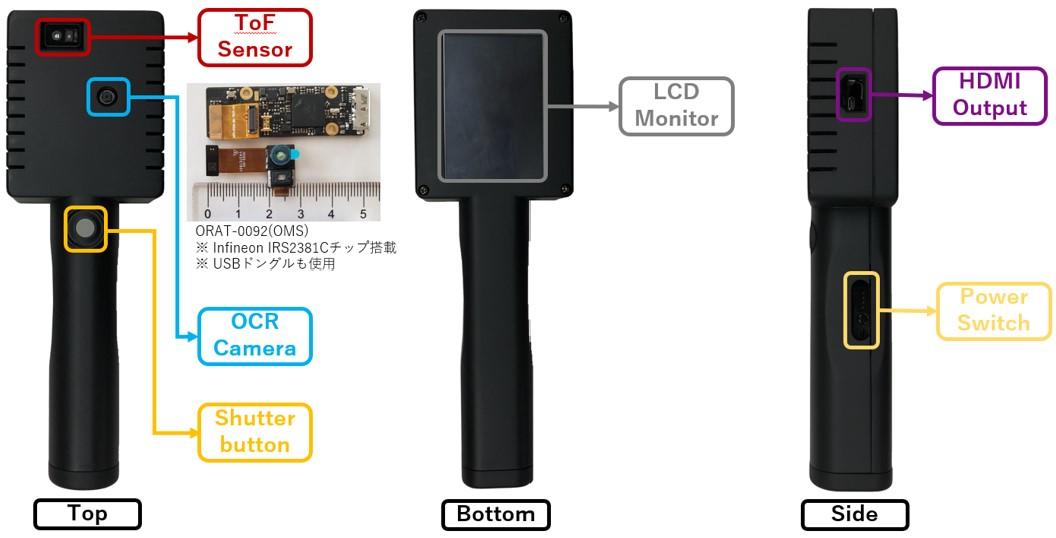
Prototype device for baggage size measurement and automatic fee calculation terminal
ORAT-0092(OMS)
* Equipped with Infineon IRS2381C chip
*Also uses USB dongle
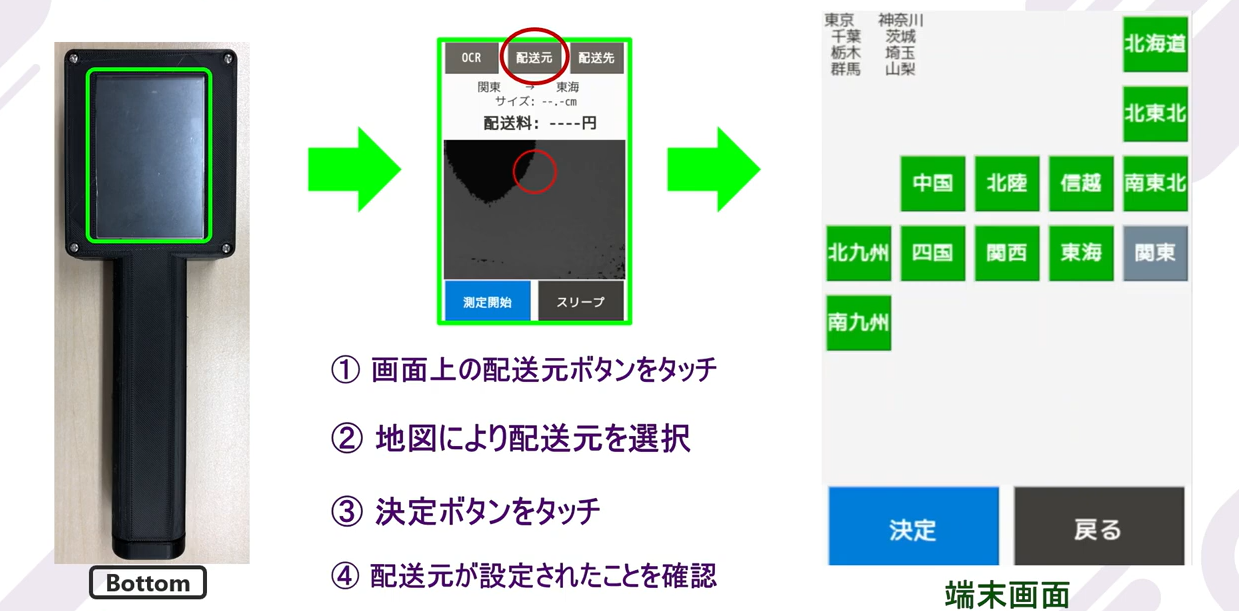
Shipping origin settings
1. Touch the shipping source button on the LCD monitor screen
2. Select delivery source based on map
3. Touch the OK button
4. Confirm that the shipping origin is set
Shipping destination settings
The reason why there is an OCR camera is to read the zip code written on the slip and set the area where the package will arrive. Since the area of the store where the item will be shipped from is fixed, set it in advance on the system.
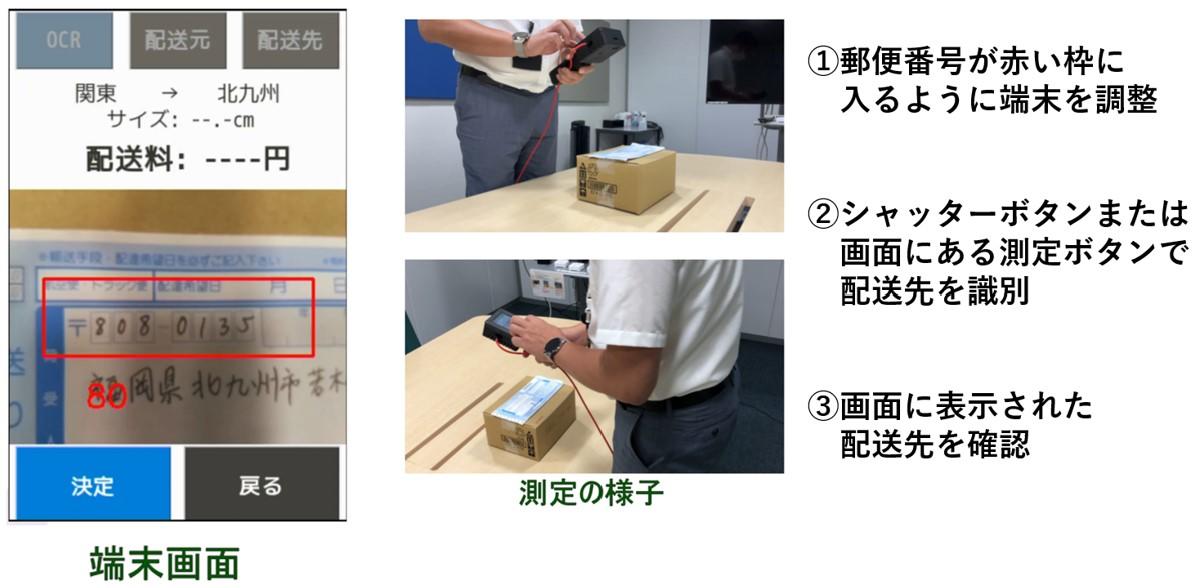
How to set the shipping address by scanning the postal code
size measurement
1. Adjust the device so that three sides of the box are on the screen
2. Measure the size of the box using the shutter button or the measurement button on the screen
3. Check the size and shipping charges displayed on the screen
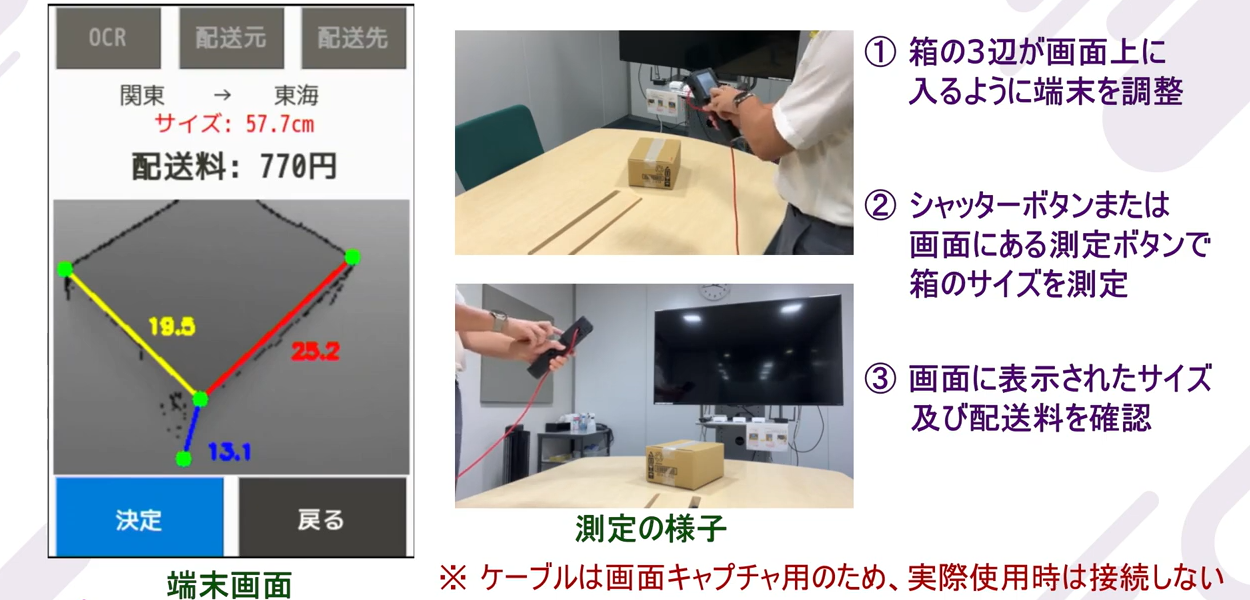
When measuring the external size, hold the terminal over the package and press the shutter button, and the ToF sensor will instantly measure it. The receiver can check the measured size on the LCD monitor. Once the departure/arrival location and external size are confirmed, the shipping fee will be automatically calculated and displayed on the screen. The acquired data can be transferred to a PC, etc. via Wi-Fi and linked.
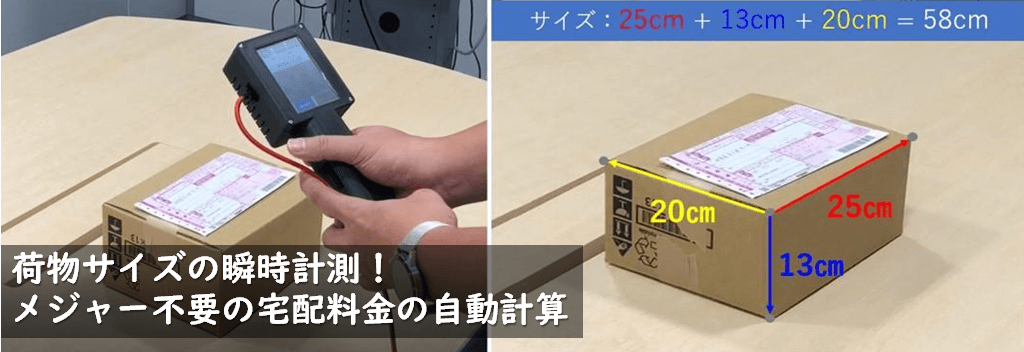
Luggage size measurement
In a proof-of-concept (PoC) conducted at Macnica, receiving packages using this terminal took significantly less time than the conventional manual method, which took 3 minutes, reducing the time to 10 seconds. Furthermore, since the terminal used in this PoC utilizes a general-purpose microcontroller, we believe that even greater reductions in reading and size measurement speeds can be expected with higher-performance equipment configurations.
Weight measurement is also possible with another system. It can also be applied to online shopping businesses and airline/railway sites.
Depending on the courier service, it may be necessary to measure the weight. In such cases, it is possible to link with "AI Smart Shelf", which was previously developed as a solution to support optimization of store operations.
![Automatic management of inventory and remaining amount using weight sensor + IoT [for retail stores and restaurants]](/business/semiconductor/articles/Mono_Article_Cover_6.png)
We believe that these systems can help improve the efficiency of various logistics sites. For example, an "online retailer" that ships a large number of packages every day can use this service to simplify the work of estimating shipping costs. “Airlines” and “high-speed trains” may charge additional fees depending on the passenger's luggage, and may leave it up to the customer to measure the luggage size. Systematization can also be expected to reduce the burden on customers who use transportation services.
FAQ (Frequently Asked Questions)
Q1. What is the measurement accuracy of the ToF sensor?
Typical ToF sensors have an accuracy of ± a few millimeters to ± 1 cm. This accuracy is sufficient for measuring the three dimensions of packages and managing their volume, but a laser displacement meter is necessary for inspecting precision parts (±0.01 mm). Conversely, for applications where shipping costs vary in 1 cm increments, such as "size 70," this level of stable accuracy is essential. The method should be chosen based on the accuracy required for the application.
Q2. Can you measure irregularly shaped or curved items such as suitcases and small bags?
Yes. ToF sensors and stereo cameras acquire 3D point clouds, so they can also measure the external dimensions of irregularly shaped objects. However, since it is necessary to design "which parts to measure" according to the standards of the delivery company or the site, custom development is the most suitable solution.
Q3. Can I record not only the dimensions but also any damage to the box (crushed or dented)?
Using a stereo camera allows you to acquire point clouds and color images simultaneously, enabling you to perform both dimensional measurement and damage detection with a single device. Recording "dimensions + condition" upon receiving goods into the warehouse can be used to track responsibility if damage is found at the destination. A key feature is its ability to achieve high accuracy at short distances.
Q4. Can it be integrated with existing fare tables and business systems?
With custom development, you can freely design API integrations with your existing systems, such as your company's freight tables, WMS (Warehouse Management System), MES (Manufacturing Execution System), and ERP. Measurement data can be sent to the cloud, automating everything from automatic calculation of delivery charges and report generation to billing.
Q5. I'd like to try it out on a small scale first. Can you provide a demo or proof-of-concept (PoC)?
MonoCon® offers support from demo unit rentals to proof-of-concept (PoC) projects. The typical process involves verifying accuracy and operation with actual measurement targets, confirming effectiveness, and then proceeding to mass production.
Widely applicable to various sites
The automation of size measurement is spreading to all kinds of workplaces where sizes are currently measured manually, from calculating delivery fees in logistics to shipping operations at airports and hotels, and receiving inspections and damage records in warehouses.
Selection process:
1. Simply measure a standard box-shaped package → Commercially available measuring instruments
2. We want a non-standard shape, to conform to on-site rules, and to make it handy. → In-house developed (ToF/stereo camera)
3. I also want to record the dimensions and the condition of the damage. → Stereo camera
4. We want to integrate with existing systems and mass-produce it as our own product. In-house development
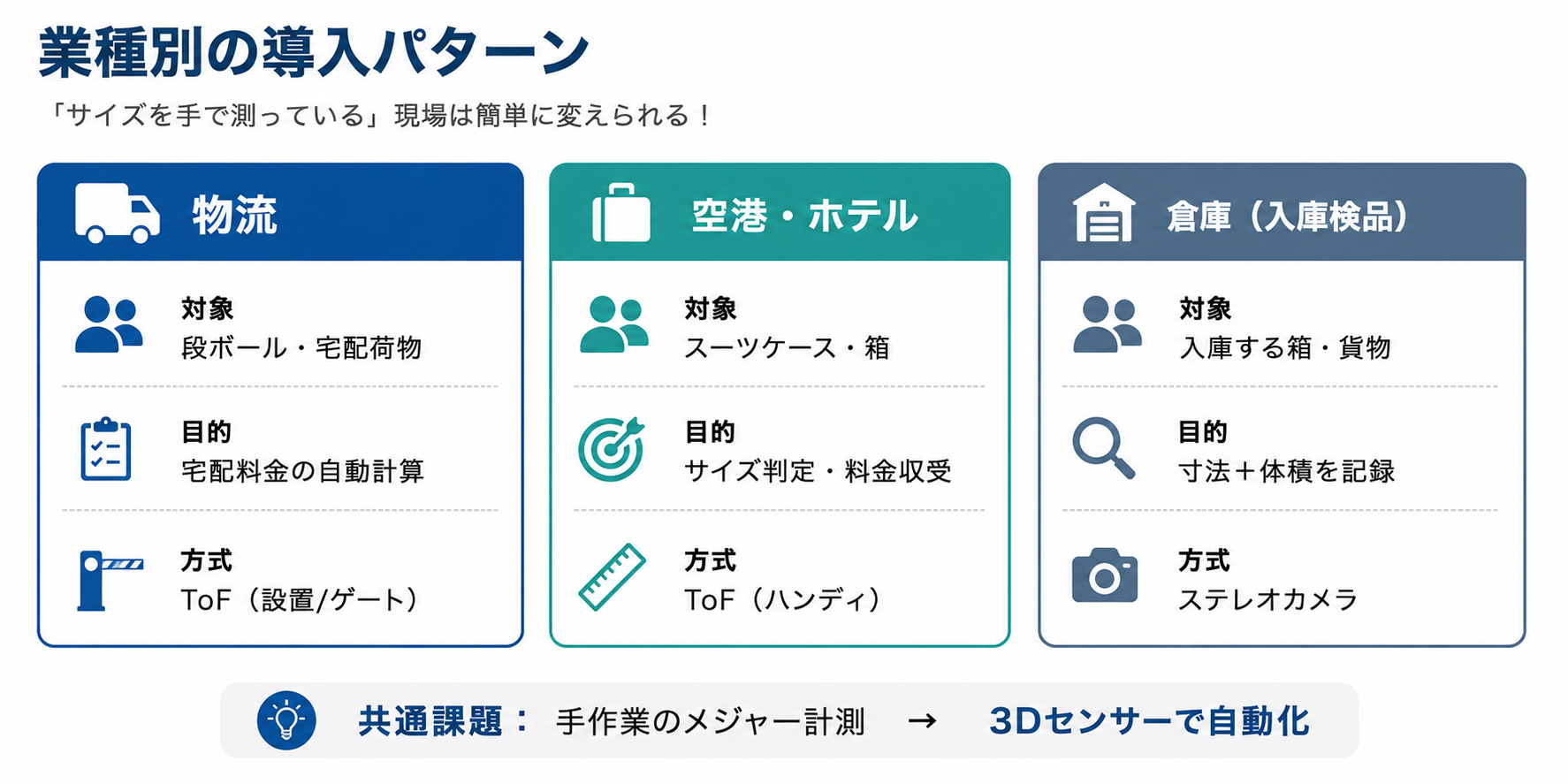
Macnica MonoCon® leverages devices such as sensors and technologies such as software and AI to create solutions for a variety of business challenges.
This time, we developed a terminal that measures the external dimensions of parcels, with the aim of reducing stress for both stores and customers during package receiving, particularly in convenience stores. This solution is expected to reduce the operational burden on employees in all logistics settings while also improving the customer experience.
This technology has potential applications in a variety of settings, including transportation companies, airport baggage handling, factory inspections, and shoe size measurement. If you still have tasks that involve manually measuring with a tape measure, there's a high probability that these can be automated with sensors. Please feel free to contact us to discuss any problems you're currently facing.
Manufacturing consulting service
Please refer to the button below for details of our manufacturing consulting service.
Related article
- Automatic inventory and remaining quantity management using weight sensors + IoT [For retail stores and restaurants] (Combined measurement of weight and size)
- Turning ideas into reality: Proof of concept (PoC) support
- How to Conduct a Hardware Proof of Concept (PoC): 5 Steps, Costs, Duration, and Failure Examples
- An introduction to the principle and reference design of a ToF sensor capable of counting people.