- Semiconductor BusinessHOME
- Products and Services of Macnica,Inc.
-
technical information

-
Events and Seminars
- Handling Manufacturer
- Support
- Inquiry
- Click here to purchase products
- Semiconductor business e-mail magazine registration


 Narrow down by specifying conditions
現在2263件がヒットしています。check
What is a ripple filter?
When AC power is rectified, "pulsating current" and "using a smoothing circuit to convert this pulsating current into direct current" are
"Alternating current (AC) and direct current (DC) power’ said. This smoothing circuit is a kind of low-pass filter. This filter is called a ripple filter in the sense that it suppresses components such as ripples superimposed on the DC voltage.
A low-pass filter consists of LC or RC, but LC is used except for low power, because a voltage drop occurs when R enters the current path.
The following describes the principle of the ripple filter. In an actual circuit, a simpler ripple filter can be used because the regulator is used in the subsequent stage, or it is sometimes used in the subsequent stage of the regulator to remove high-frequency components that cannot be eliminated by the regulator at high frequencies.
Low-pass filter with LC
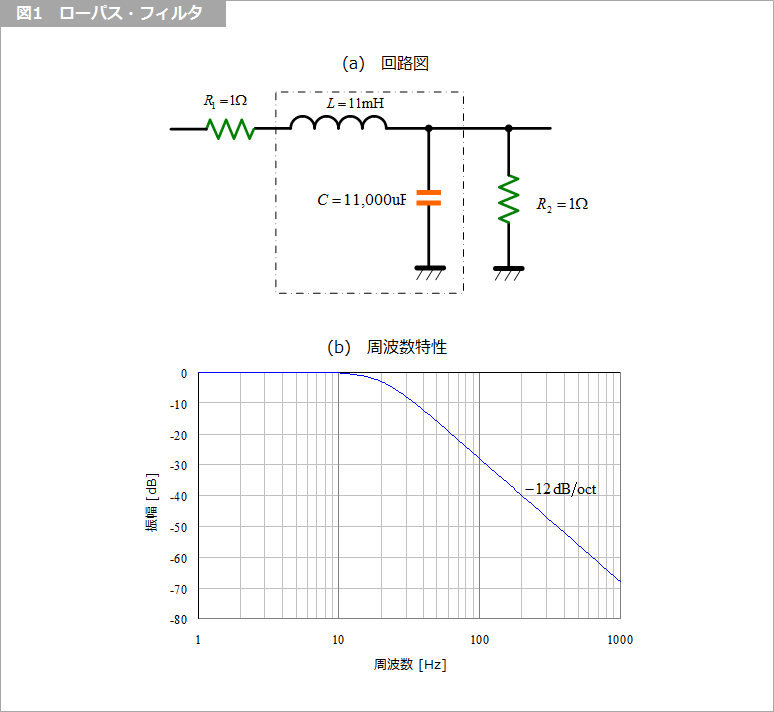
A low pass filter is formed by cascading L and C. Figure 1 is the basic 2nd order lowpass filter.
Filter characteristics are basically determined by impedance and cutoff frequency. Impedance matching is important for filters used on analog signals, but less so for ripple filters.
For the circuit in Figure 1, the impedance is Z = √(L/C) and the cutoff frequency is ωC = √(2/LC).
For example, if the impedance is 1 Ω and the cutoff frequency is 20 Hz, then L = 11 mH and C = 11,000 uF.
Being a 2nd order filter, it has a roll-off characteristic of -12 dB/oct (footnote 1). A cascade connection with LCL or CLC results in a 3rd order filter, and a higher order filter can be realized by increasing the number of stages.
In the case of low power, a filter may be configured with R and C, but connecting in multiple stages does not increase the order in the usual sense.
Ripple flow and low-pass filter
Figure 2 shows the frequency spectrum of pulsating current and the change in the spectrum when passing through a second-order low-pass filter. In the actual combination of the rectifier circuit and the smoothing circuit, the spectrum is not as simple as that shown in Fig. 2 because it is via a diode, but please view it as an approximate trend.
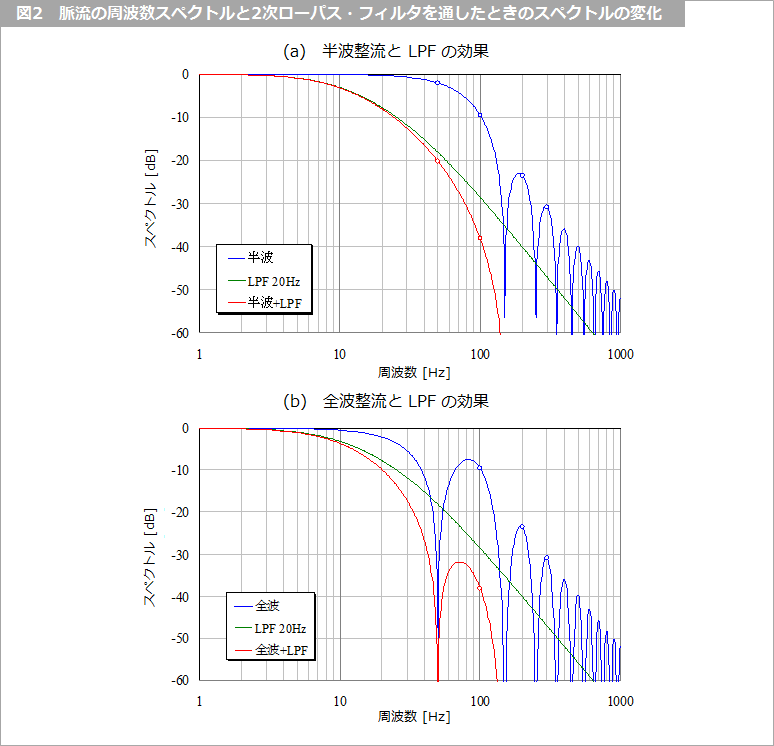
Figure 2(a) is for a half-wave rectified waveform, and the 50 Hz component of the fundamental wave is attenuated by 16 dB from -2 to -18 dB.
Figure 2(b) shows the case of the full-wave rectified waveform. The lowest frequency component is 100 Hz, but it is attenuated by about 28 dB.
If the cutoff frequency of the filter is set to 50 Hz, the 50 Hz fundamental wave is hardly attenuated, especially in the case of half-wave rectification.
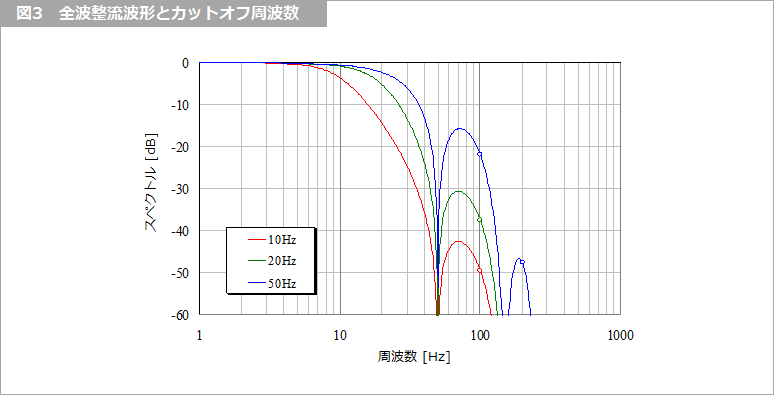
Figure 3 shows the changes in the spectrum for full-wave rectification when the cutoff frequency is changed to 10 Hz, 20 Hz, and 50 Hz. It turns out that we need a sufficiently low cutoff frequency.
To make capacitors and inductors smaller
The above is for commercial frequencies. Since the frequency is 50 Hz or 60 Hz, both the capacitor and inductor values must be increased to obtain a filter cutoff frequency sufficient to cut the pulsating component at this frequency. The example 11 mH inductor and 11,000 uF capacitor would be difficult to implement or would be prohibitively large.
These values are inversely proportional to the frequency (footnote 2), so at 500 kHz, they are 1/10,000 of 50 Hz, and 1.1 uH and 1.1 uF are practically acceptable areas.
Last time, I said that the frequency of the switching method should be selected from several 100 kHz to several MHz.
Footnote 1
"oct" is the musical octave meaning of double the frequency. That is, when the frequency is doubled, the amplitude is -12 dB (1/4). The same characteristic can also be expressed as -40 dB/dec. 'dec' means 10 times, and an order of magnitude higher in frequency results in an amplitude of -40 dB (100 times lower).
Footnote 2
The square root of the product of the L and C values is inversely proportional to frequency.
What is Yuzo Usui's Specialist Column?
It is a series of columns that start from the basics, include themes that you can't hear anymore, themes for beginners, and also a slightly advanced level, all will be described in as easy-to-understand terms as possible.
Maybe there are other themes that interest you!