- Semiconductor BusinessHOME
- Products and Services of Macnica,Inc.
-
technical information

-
Events and Seminars
- Handling Manufacturer
- Support
- Inquiry
- Click here to purchase products
- Semiconductor business e-mail magazine registration


 Narrow down by specifying conditions
現在2240件がヒットしています。check
Isolated SPI controller that can be extended up to 100m in harsh noise environments
"LTC6820" is an isoSPI isolated communication interface provided by Analog Devices.
The LTC6820 provides bidirectional SPI communication between two isolated devices over a single twisted pair connection.
By simply installing this device and placing a general-purpose transformer, it is possible to simultaneously achieve noise-resistant differential communication and isolated communication without spending development time. This eliminates the need for isolated power supplies and photocouplers that were required for conventional isolated RS485, etc., reducing costs, making this product ideal for interfaces for industrial measurement equipment.
This article will discuss the following features of the LTC6820:
- Easy isolated differential conversion for SPI interface without software changes
- With a general-purpose transformer and a general-purpose twisted pair cable, 100m communication is possible even in a high-noise environment.
- Reduces costs by eliminating the need for isolated power supplies, optocouplers, and format conversion
1. Easy isolated differential conversion without software changes for SPI interface
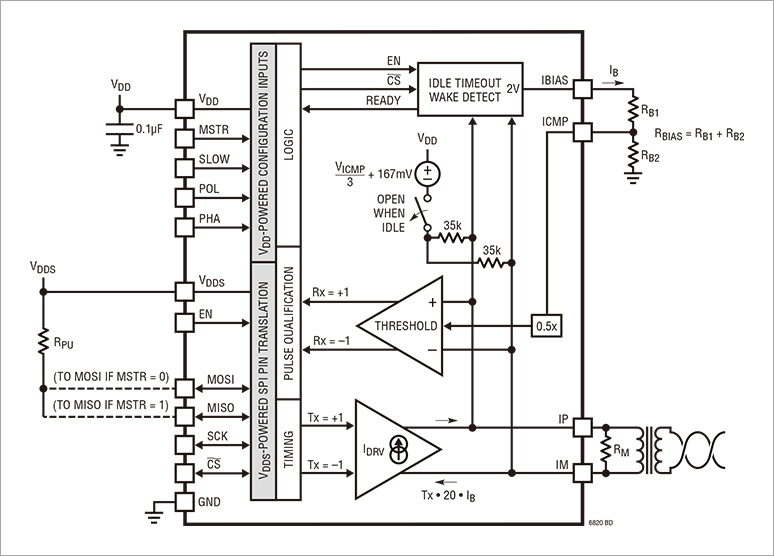
The LTC6820 encodes a logic state into a signal and transmits that signal across an isolation barrier to another LTC6820.
The receiving LTC6820 decodes the transmitted signal and drives the slave bus to the appropriate logic state. A precision window comparator in the receiver detects the differential signal. The drive current and comparator threshold are set by a simple external resistor divider, allowing the system to be optimized for the required cable length and desired signal-to-noise ratio performance.
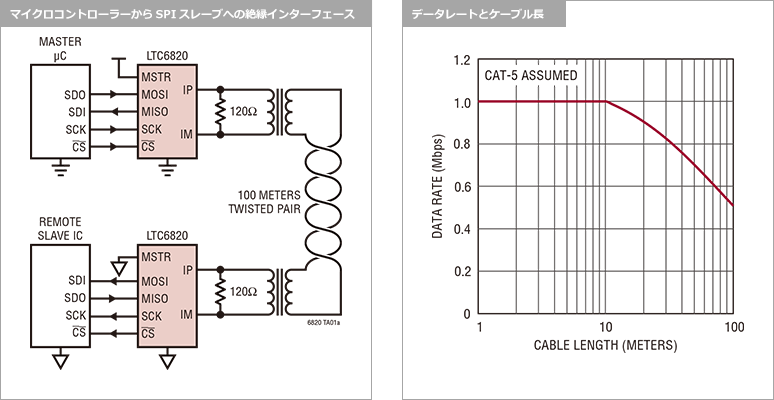
2. With a general-purpose transformer and a general-purpose twisted pair cable, 100m communication is possible even in a high noise environment.
The isolation barrier can be constructed using a simple pulse transformer bridge to achieve hundreds of volts of isolation.
The LTC6820 drives differential signals with matched sink and source currents, eliminating the need for a center tap on the transformer and reducing EMI.
3. Cost reduction due to no need for isolated power supply, optocoupler, or format change
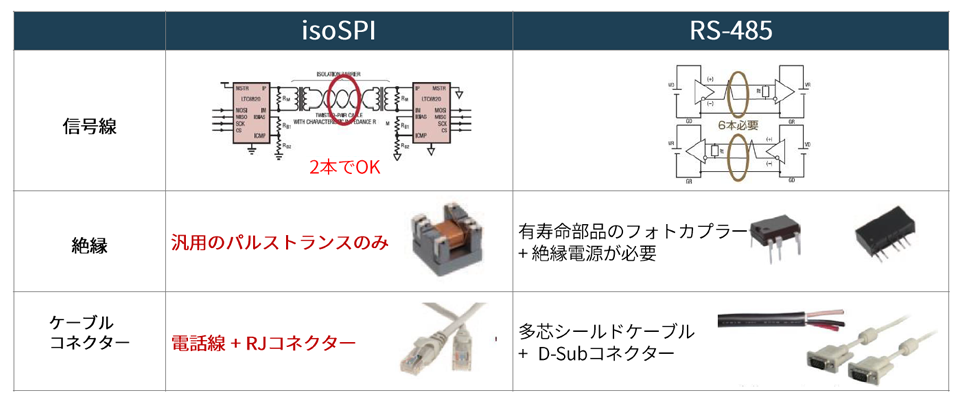
Compared to isolated RS485, the number of cables, isolated power supplies, and photocouplers are reduced, resulting in a simpler system configuration and reduced costs.
When the sensor and MCU are mounted on the same board, serial interfaces such as SPI and I2C are often used.
However, when the sensor and control boards are far enough apart (1m or more), it is popular to use an interface such as UART/RS485 to transmit data from the sensor board to the MCU on the control board. However, to do this, the sensor's interface (SPI/I2C) must be formatted into UART/RS485 or similar by the MCU or similar device.
Using the LT6820, you can route SPI data without having to convert it to another interface format.
"DC1941D" evaluation kit for immediate evaluation
The DC1941D evaluation kit is available to quickly evaluate the LTC6820.
The DC1941D can be set as master or slave by jumper settings.
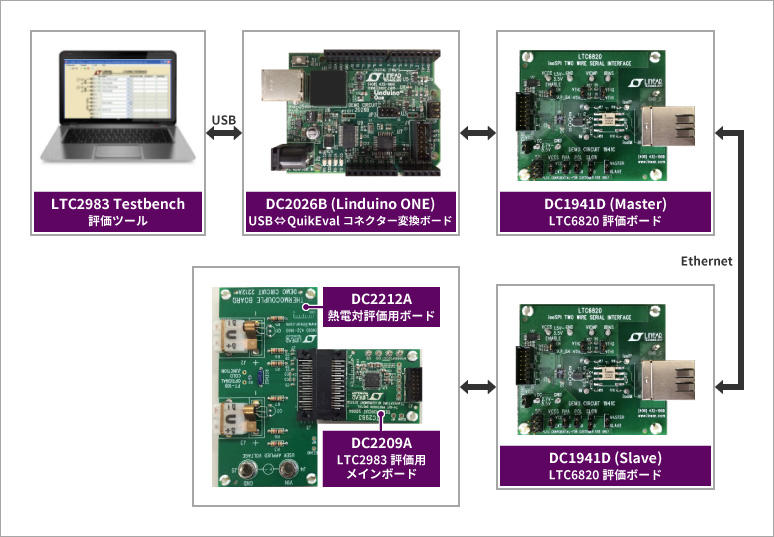
SPI communication is possible by connecting two DC1941Ds with an Ethernet cable.
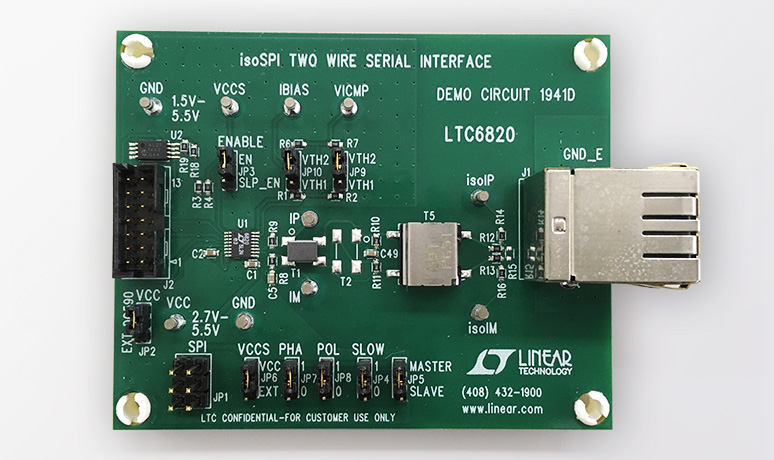
This evaluation board has a 14-pin ribbon cable connector, allowing it to be connected to another evaluation board for evaluation.
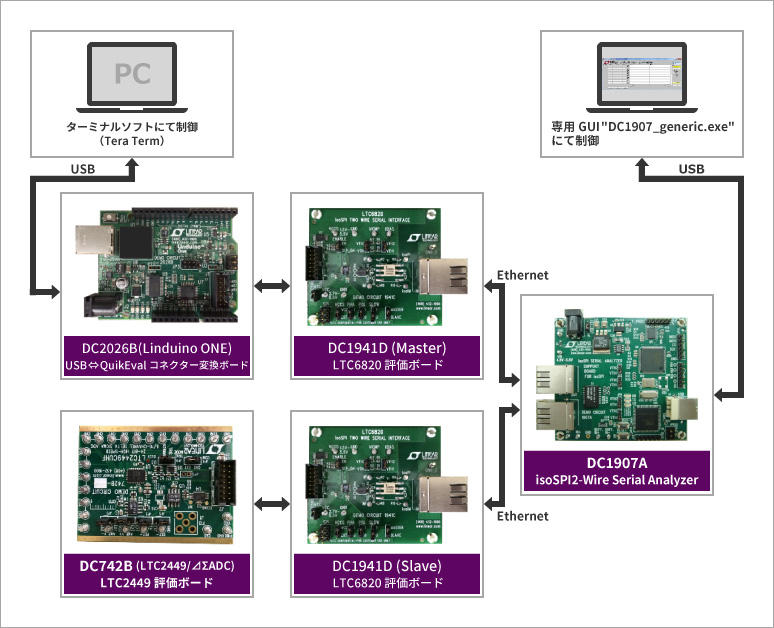
In addition, it is possible to monitor SPI communication between master and slave by using the DC1907A evaluation kit (isoSPI2-Wire Serial Analyzer).
By connecting the SPI output of DC1941D to DC1907A and then connecting the DC1907A to a PC via USB, it becomes possible to analyze SPI communications using applications for DC1907A.
Application example
- Systems with sensors with SPI interface
- industrial network communication
- Battery monitor system
- remote sensor
Product Summary
| Type name | LTC6820 |
| Features |
|
Click here to purchase products
Click here for manufacturer site/other related links
Inquiry
If you have any questions regarding this article, please contact us below.
Analog Devices Manufacturer Information Top
If you want to return to Analog Devices Manufacturer Information Top, please click the button below.