- Semiconductor BusinessHOME
- Products and Services of Macnica,Inc.
-
technical information

-
Events and Seminars
- Handling Manufacturer
- Support
- Inquiry
- Click here to purchase products
- Semiconductor business e-mail magazine registration


 Narrow down by specifying conditions
現在2240件がヒットしています。check

Many semiconductor devices, such as FPGAs, require multiple power supplies. Because they must adhere to a specific power supply sequence, they may require power supply on/off control pins and output capacitor discharge functions.
This article discusses important considerations for FPGA power sequencing and introduces useful sequencing ICs.
Things to check before sequencing
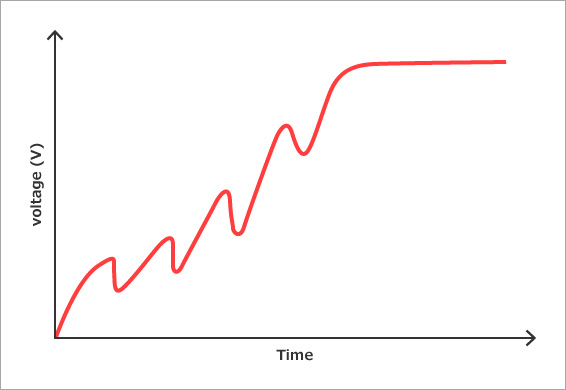
Before considering the power sequence, it's crucial to check the slew rate of the output voltage of the power ICs and modules. The power sequence must be followed to suppress the inrush current when power is turned on. However, if the slew rate of the output voltage of the power IC is steep, the inrush current will be large.
Some recent switching regulators have a built-in soft-start function. This has the advantage of reducing the number of peripheral components and simplifying the circuit. However, in cases where many capacitors are used to improve the response performance to load fluctuations, such as in FPGAs and DSPs, the inrush current during power-up may be large. Switching regulators with built-in soft-start do not have slew rate control, so the inrush current can be large, and power-up problems such as the voltage not increasing monotonically may occur. It is necessary to carefully check whether there are any problems.
Regulation of power sequence
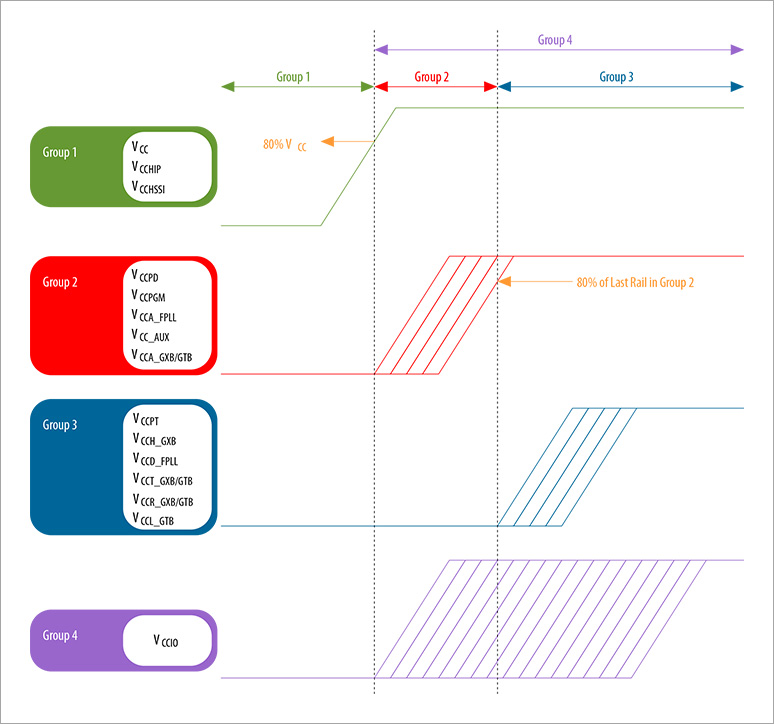
Once you've confirmed that the power supply's output voltage slew rate is correct, the next step is to check the power supply sequence. The FPGA's startup sequence is determined by grouping multiple power lines, with Group A being the first power line, Group B being the second, and so on.
Figure 2 shows the power supply sequence required by the Altera® FPGA Stratix® V. Failure to follow this sequence can result in a large rush current, affecting reliability, so caution is necessary. During power-down, the power supply must be turned off in the reverse order of power-up.
Tracking function
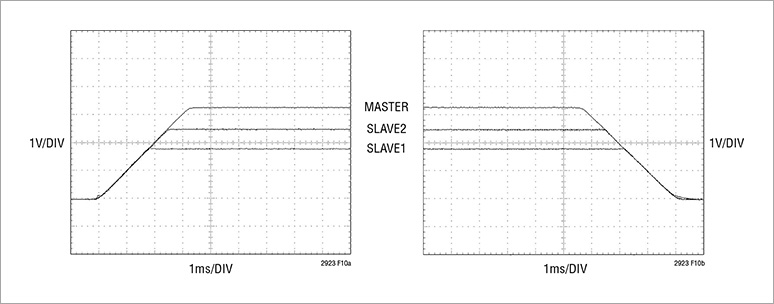
Using the tracking function ensures that the output voltages of grouped power supplies rise simultaneously. Generally, power supply ICs and modules have different rise voltage slew rates depending on their model number. As a result, even if the power supply activation signals are simultaneous, the output voltage rise times will be staggered.
By using the tracking function, even if power supplies with different slew rates are used, it becomes possible to raise and lower the voltage at the same slew rate, as shown in Figure 3.
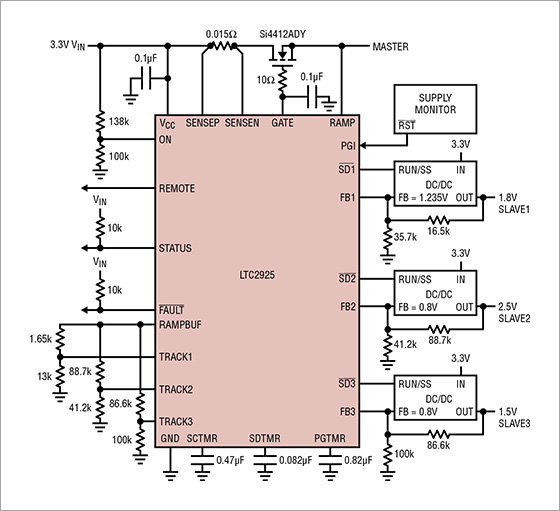
Analog Devices' LTC2923 is an IC that enables tracking control.
Sequence control
Because FPGAs require multiple power supplies, designing sequence control using resistors and capacitors becomes extremely complex. While it is possible to freely perform sequence control using a microcontroller, this requires software development, and if 12V is supplied as the main power supply, a circuit design is needed to initially power only the microcontroller, making the hardware design complex as well.
Furthermore, recent FPGAs and DSPs require off-sequence control, and since off-sequence control cannot be performed using resistors and capacitors, a solution for sequence control is necessary.
Analog Devices' PSM (Power System Management)
For FPGA power sequencing, we suggest the PSM series LTC2977 from Analog Devices.
PSM products do not require software development like microcontrollers. The power supply sequence can be easily customized by changing the internal EEPROM register settings using the GUI shown in Figure 5.
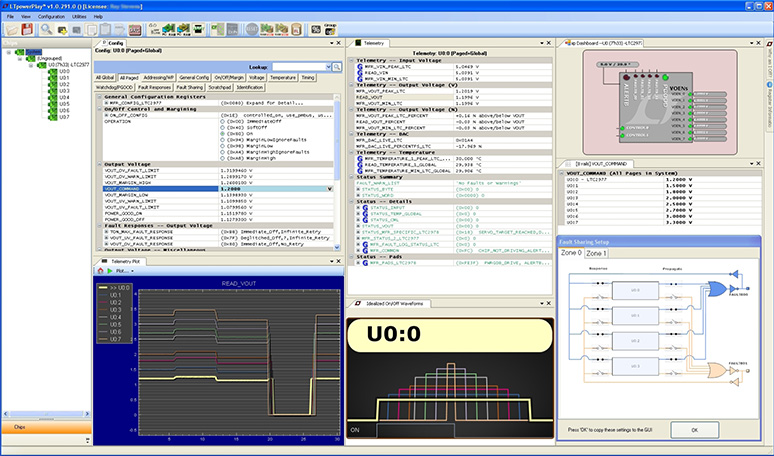
Furthermore, the LTC2977 has an operating voltage range of 15V, allowing it to be directly powered by a 12V power supply commonly used in industrial equipment. This eliminates the need for a separate power supply circuit controlled independently of the FPGA, unlike microcontrollers. This makes it possible to implement the power on/off sequence required by the FPGA with a simple circuit configuration.
Click here to purchase recommended articles/materials/products.
Important considerations for FPGA power sequencing (LDO edition)
LTC2977IUPTRPBF
LTC2923IDEPBF
Inquiry
If you have any questions regarding this article, please contact us below.
Analog Devices Manufacturer Information Top
Analog Devices Manufacturer Information If you would like to return to the top page, please click below.