- Semiconductor BusinessHOME
- Products and Services of Macnica,Inc.
-
technical information

-
Events and Seminars
- Handling Manufacturer
- Support
- Inquiry
- Click here to purchase products
- Semiconductor business e-mail magazine registration

UAV
Unmanned Underwater Vehicle (ROV)

There are three different power system designs: the first uses long wires, the second uses a battery, and the third uses short wires. Apart from this difference, all configurations can be equipped with the same equipment.
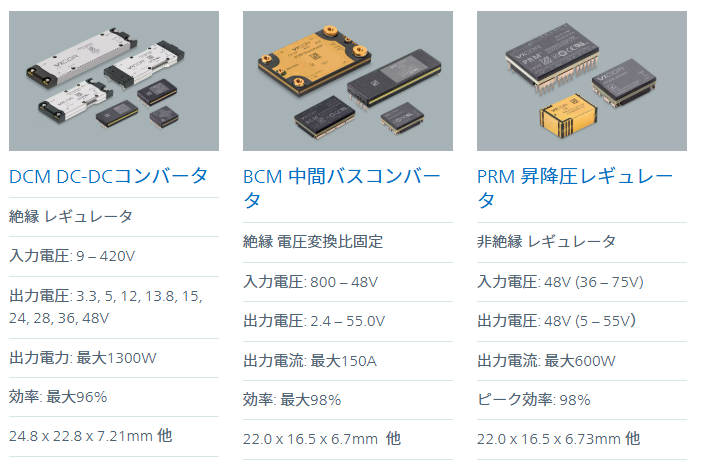
A superior power delivery network (PDN) is built using a combination of high efficiency, high density power modules from Vicor. The first example uses a Vicor DCM DC-DC converter to convert 400V over long wires to 48V. The second example uses a PRM buck-boost DC-DC converter to regulate the voltage from redundant 48V batteries to 48V. Both examples use a high efficiency, fixed ratio, low voltage BCM to convert 48V to the voltage required to power the onboard equipment.
In the third example, a short-wire configuration, a high-voltage BCM is placed upstream of the power supply system to supply 72 V. The BCM is a DC-DC converter that uses Vicor's proprietary SAC (Sine Amplitude Converter) technology and supports input voltages from 36 V to 800 V. It has a fixed voltage conversion ratio (K factor) and is available in a variety of settings, making it suitable for a wide range of applications.
The High Voltage BCM has a power density of 2,400W/in³ and a peak efficiency of 98%. Multiple BCMs can be connected in parallel for higher power output, or the outputs can be connected in series for higher voltage output.
Configuration example
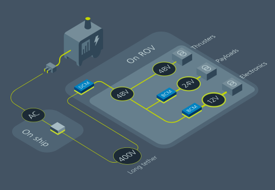
When the wire is long, 400V rectified AC is fed directly to the wire. In the ROV, the voltage is received by the wire, and is insulated and converted to 48V and stabilized by the DC-DC converter DCM. The DCM uses an input voltage range that corresponds to the voltage received from the wire. The stabilized 48V bus voltage is fed directly to the thrusters. To power other onboard equipment, two BCMs are used to convert the 48V bus voltage to 24V and 12V with a high conversion efficiency of 95%.
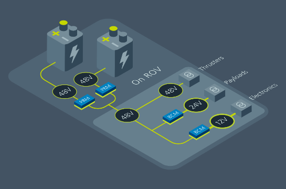
When the ROV is powered by two redundant 48V batteries, the voltage of each battery is regulated to 48V by a step-up/step-down DC-DC converter PRM and then connected together.
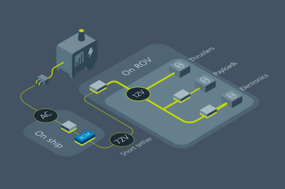
If the wire is short, use a high-voltage BCM. The 400V rectified AC power supply of the host platform is converted to 72V using a BCM with the output connected in series, and then powered to the wire. Inside the ROV, the 72V is stepped down to 12V.
Unmanned Underwater Vehicle (ROV)
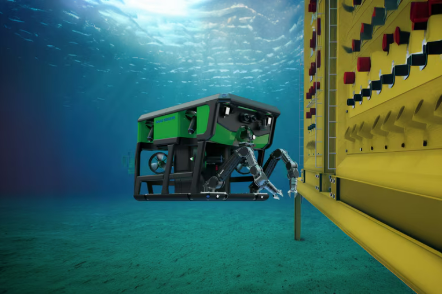
The eWROV is the world's most capable fully electric work class ROV. eWROV solves heat dissipation challenges, significantly expands payload space, and reduces the size and weight of electronics. Using high voltage DC power, it achieves performance equivalent to a 250 horsepower hydraulic subsea vehicle while significantly reducing cable size and weight. Unlike traditional hydraulic ROVs, eWROV is a fully electric system, eliminating the need for large amounts of hydraulic fluid and improving efficiency, reducing environmental impact and risk.
Configuration example
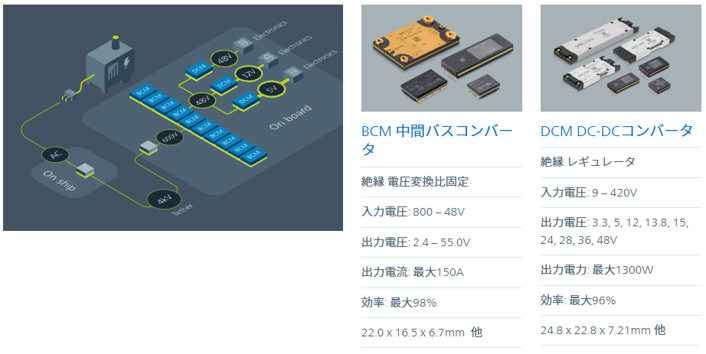
Extremely high power density enables the eWROV 's advanced capabilities by providing significantly more space for payloads and outperforming hydraulic ROVs. The Power Delivery Network (PDN) is centered around 600V DC power transmission and voltage conversion using Vicor fixed ratio bus converters (BCMs) and voltage regulated DC-DC converters (DCMs) to provide high performance low voltage power for the subsystems. Vicor 's wide selection of thermally efficient power modules allows the Power Delivery Network subsystems to be customized to specific industry standards of 24V and 48V. These voltages are required for on-board computers, sensors, video cameras, lighting and navigation equipment. The smaller power supply frees up space within the eWROV to accommodate additional electronics, improving overall performance and data transmission speeds.
drone
Corded Drone
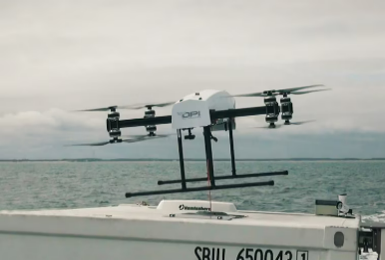
After early experiments with small, tethered, airship-like drones failed due to the difficulty of keeping them stationary in high winds, and then again for more demanding remote communications, intelligence, and reconnaissance (ISR) applications, we developed a new category of tethered drone that can hover in place, ascend and descend vertically, have enormous power, and can hover for weeks in harsh environments.
Military/industrial grade Unmanned Multi-Rotor Aerial Repeater (UMAR) tethered drones can operate at altitudes up to 500 feet and have an operating time of over 400 hours thanks to the thin, lightweight wires that allow for continuous power. This requires very thin, lightweight wires, and the host vessel must power the multi-rotor drones at very high voltages (500-800V) to reduce current levels dramatically. This allows the drones to be more maneuverable and to carry more payload. The high-voltage converter must also be as small and lightweight as possible. UMAR has eight rotors that are intricately interconnected with PCB circuits, and reducing the size of the power conversion components allows for additional value-added components to be installed.
Configuration example
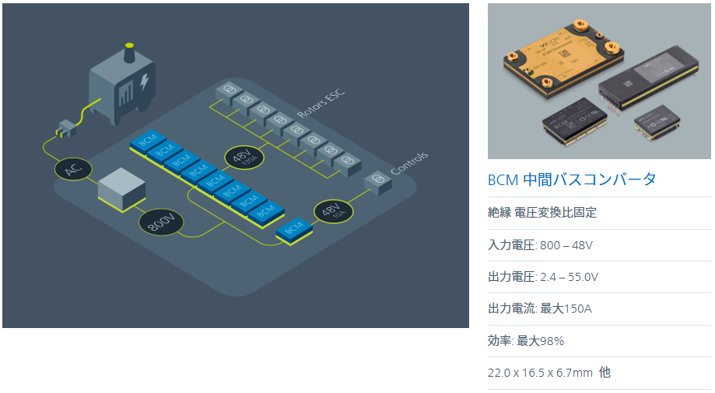
The Power Delivery Network (PDN) is comprised of Vicor's high-voltage BCM4144 in a low-profile VIA package (4.35 x 1.4 x 0.37in) that provides highly efficient 800V to 50V voltage conversion inside the UMAR tethered drone. The BCM's small size and ability to be mounted anywhere were necessary to enable the power-dense board configuration. Eight Vicor high-voltage BCMs are connected in parallel to power the UMAR's eight independent rotors, sharing power between rotors for redundancy. Combined with the built-in filters inside the BCM, this results in extremely low EMI noise.
Hydrogen fuel cell power pack for UAVs
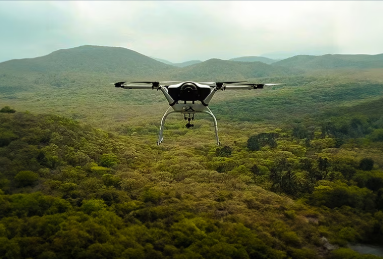
DMI is the first in the world to commercialize a revolutionary hydrogen fuel cell power pack with four to five times the energy density of batteries, extending drone flight time to a maximum of two hours. With drones equipped with hydrogen fuel cell power packs that have an extended range, DMI is providing humanitarian aid worldwide. They have transported masks and emergency supplies from the U.S. mainland to the Virgin Islands, and medical AEDs from mainland Korea to Jeju Island, delivering them to the top of Hallasan, the highest mountain in Korea.
The power pack has two main power delivery networks (PDNs) that power the drone's rotors and the intelligent controller that controls the two fuel cell stacks. Since the output voltage can vary over a wide range from 40 to 74V, the power train is designed to precisely regulate the voltage and ensure that it can deliver 48V, 12A to the rotor motors and 12V, 8A to the fuel cell stack control board and fans.
Configuration example
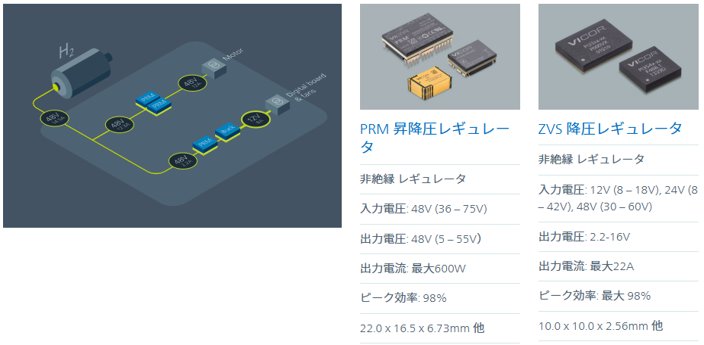
To achieve a highly efficient and energy dense power delivery network (PDN), DMI used Vicor PRM™ buck-boost regulators and Vicor ZVS buck regulators. The PRM accepts up to 74V of hydrogen fuel cell stack open circuit voltage (OCV) input and regulates it to 48V. The PDN feeding the rotor consists of two parallel PRM buck-boost regulators (PRM48AF480T400A00) delivering the 12A required by the rotor. The PDN for the digital control board in the fuel cell stack uses a 48V to 12V ZVS buck regulator (PI3546-00-LGIZ) in series with a low power PRM (PRM48AH480T200A00).
Inquiry
If you have any questions about any of our products, please feel free to contact us.
To VICOR maker information TOP
If you want to return to VICOR manufacturer information TOP, please click below.