- Semiconductor BusinessHOME
- Products and Services of Macnica,Inc.
-
technical information

-
Events and Seminars
- Handling Manufacturer
- Support
- Inquiry
- Click here to purchase products
- Semiconductor business e-mail magazine registration
Product Summary
DisplayPort is an interface standard for inputting and outputting video to monitors and displays, and is used in many applications such as video dongles and docking stations. Synaptics' DisplayPort IC is a Multi Stream Transport (MST) hub product with a built-in receiver/transmitter function that can range from DisplayPort input to DisplayPort/HDMI output, improving work efficiency with multiple displays and saving space around your PC. Masu.
Synaptics acquired IDT's video interface business in 2012, and in recent years has released products that comply with the latest standards such as HDMI 2.1 and DisplayPort 2.0. All video IP such as DisplayPort, HDMI Serdes, HDCP, DL codec, and MA-USB are developed in-house, and we have a high share of the docking station market.
What are Multi Stream Transport (MST) hub products?
Multi Stream Transport (MST) is a feature added in DisplayPort 1.2 and later that allows multiple independent video streams to be output from a single DisplayPort. Hub connections and daisy chain connections allow you to display different images on multiple displays.
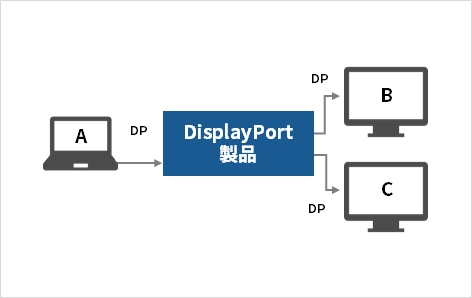
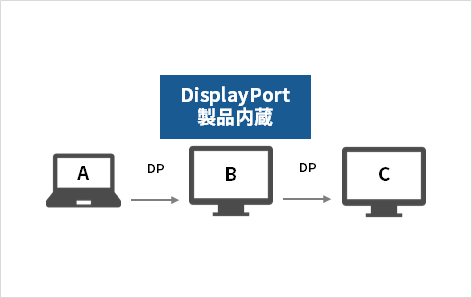
Specific usage examples are as follows.
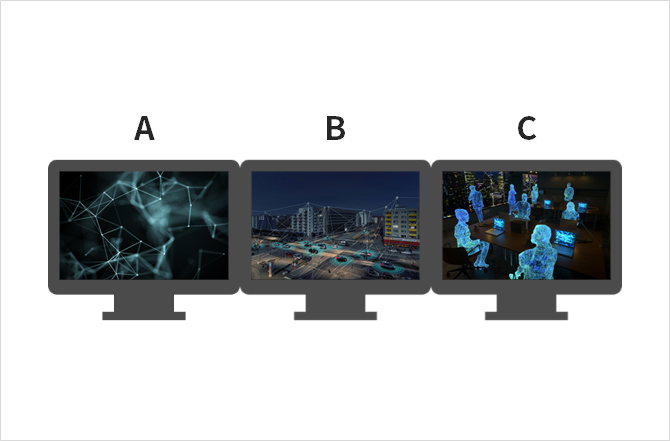
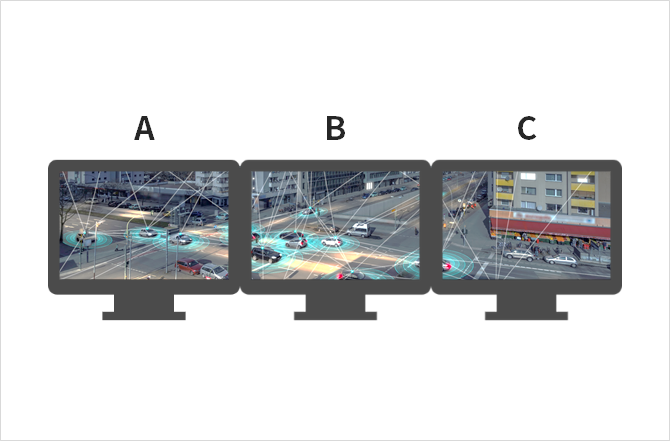
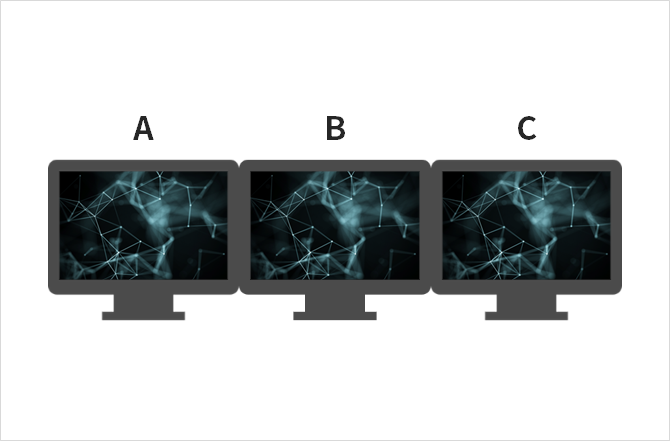
(Supplementary note) The ability to output one video stream from one DisplayPort is called Single Stream Transport (SST).
Product details
Panamera series (VMM5XXX)
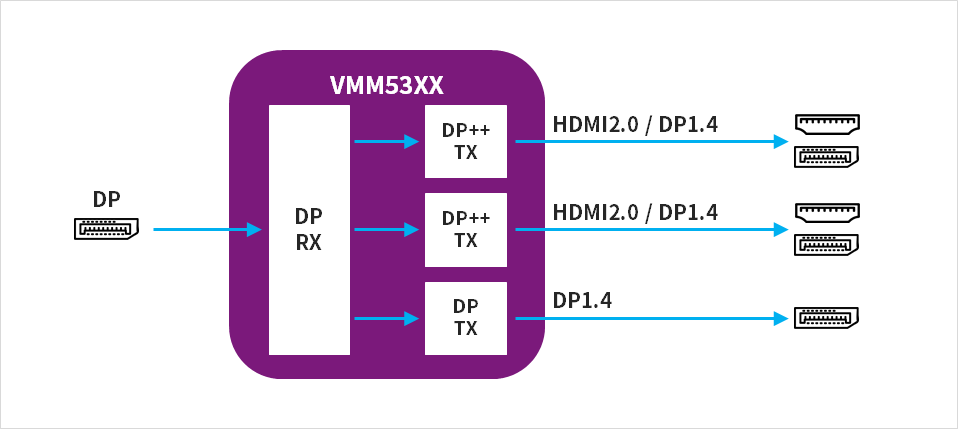
The Panamera series is an MST hub product with built-in receiver/transmitter functionality that allows up to 3 video outputs (Displayport or HDMI) from 1 DisplayPort input.
The main feature is the ability to provide multiple high-resolution video outputs.
Using DSC (Display Stream Compression: monitor image compression and transmission technology), up to three 4K60Hz video outputs can be output, and even in non-DSC (non-compression, DSC function OFF), Synaptics' patented DisplayExpand™ function allows 4K60Hz video output Up to two video output systems can be output simultaneously. HDCP v2.3 is implemented in accordance with industry standards for video content protection/security related to HDMI and DisplayPort video output.
Cayenne series (VMM8XXX, VMM6XXX)
Like Panamera, the Cayenne series integrates DisplayPort receiver/transmitter functionality and MST hub functionality.
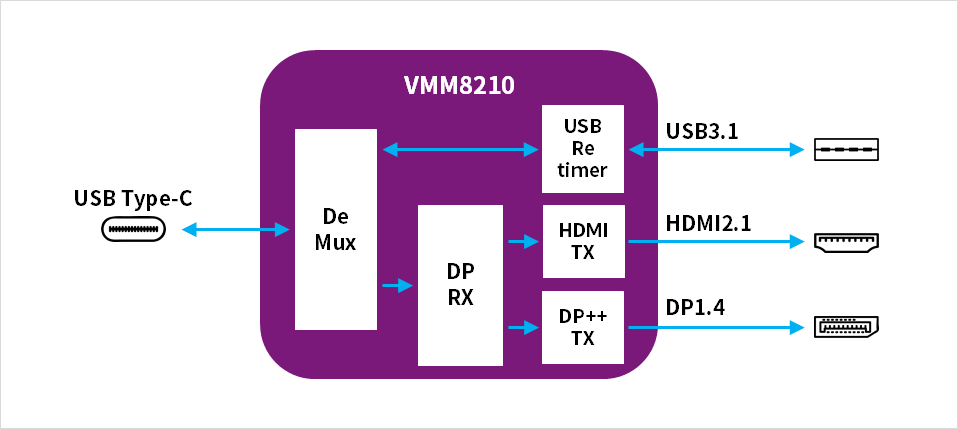
The biggest feature is that it supports USB Type-C input.
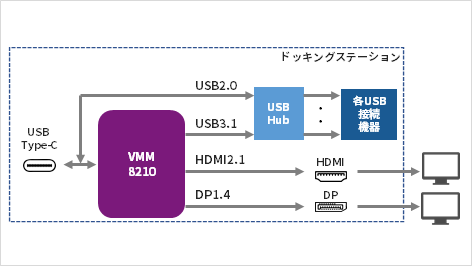
A single USB Type-C input cable can output multiple video streams of HDMI2.1, DisplayPort1.4, and USB3.1. It also supports USB Alternate Mode and is compliant with DisplayPort, Thunderbolt3, and USB4 sources.
In addition, the Cayenne series is the next generation product of the Panamera series, with further improvements in lower power consumption and higher density packaging.
·Low power consumption
Achieves approximately 50% lower power consumption than the Panamera series, and is suitable for bus-powered accessories and industrial applications.
Efficient thermal design with little heat dissipation is possible, such as a small form factor design.
・High-density packaging
Built-in USB Alternate Mode demultiplexer and USB retimer, required peripheral components are power supply, crystal oscillator,
Since it only uses flash memory, it is possible to design a system at low cost.
Product lineup
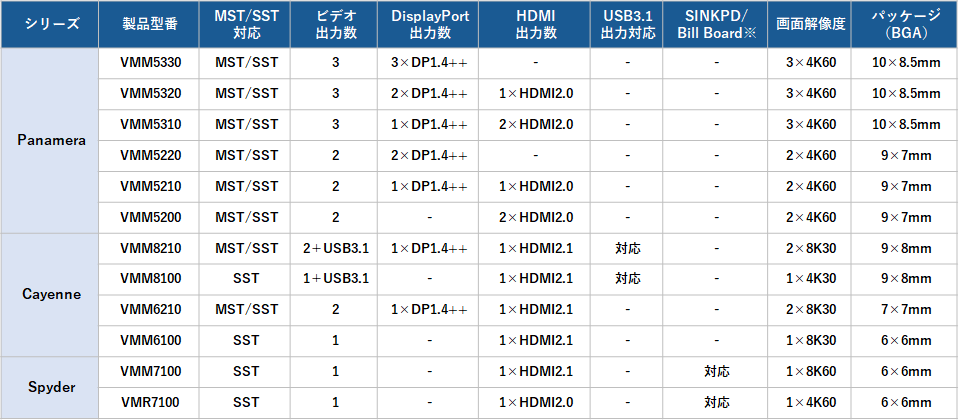
(*Additional note) Bill Board is a function that notifies you whether the connected device supports USB Alternate Mode. When a device that supports USB Alternate Mode is connected to a host device that does not support it, the user can be notified that the device does not support USB Alternate Mode.
Application example
video dongle
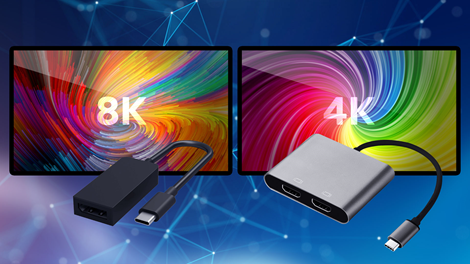
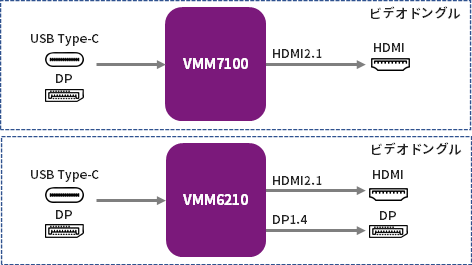
A video dongle is a small application that can connect DisplayPort to HDMI protocol conversion equipment and multiple displays. Input signals are compatible with DP and USB Alternate Mode sources. A single USB Type-C cable supplies power to the dongle and communicates in USB Alternate Mode, allowing for a very simple system configuration.
docking station
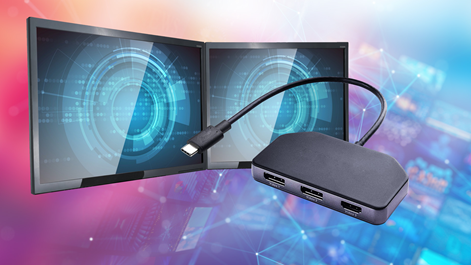
A docking station is an application that can connect multiple displays and has multiple USB ports. It is widely used in offices and telework because it can improve work efficiency and simplify work space.
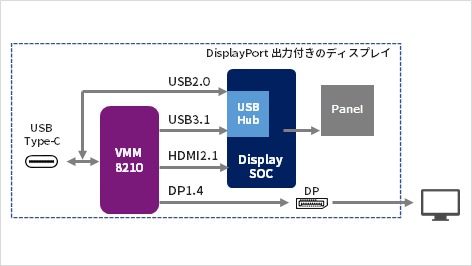
Display with DisplayPort output
Displays with DisplayPort output can be daisy-chained between displays using a DisplayPort cable (or USB Type-C cable).
Contact Us