- Semiconductor BusinessHOME
- Products and Services of Macnica,Inc.
-
technical information

-
Events and Seminars
- Handling Manufacturer
- Support
- Inquiry
- Click here to purchase products
- Semiconductor business e-mail magazine registration
Overview
CUnet is a multi-master remote I/O control network capable of digital I/O, analog I/O, and positioning control.
It can connect up to 64 nodes and share up to 512 bytes of data while enabling I/O control.
By using CUnet, you can not only control DIOs, but also perform analog control via serial communication in a simple and inexpensive way, replacing traditional parallel connections.
Furthermore, for motor control within the device, positioning control using an I/O-level network is also possible, provided that the positioning control is within the range supported by CUnet (MKY44MC series).
This allows you to use CUnet (MKY44MC series) to change control systems that previously used expensive motor drivers and servo motors to a more cost-effective configuration.
CUnet is a network that aims to do what can be done at the I/O level, at the I/O level!
This ensures appropriate cost, speed, and noise immunity for I/O control within the device.
Features
- Multi-master/multi-slave configuration
• Up to 64 nodes can be connected.
- Up to 512 bytes of shared memory
- Supports digital I/O, analog I/O, and positioning control.
RS485-based network
The CPU can be controlled solely by reading and writing to shared memory.
• Also suitable for motor control applications (MKY44MC series)
| series name |
MEM mode IC |
MEM mode IC |
MEM mode IC |
IO mode IC |
IO mode IC |
| Model number |
MKY43 |
MKY49 |
MKY44-SPI |
MKY46 |
MKY44-IO32A |
| package | 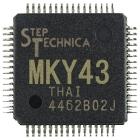 |
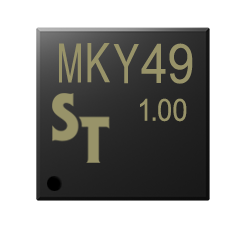 |
 |
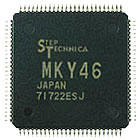 |
 |
| function |
Data (memory) |
Data (memory) |
Data (memory) |
32DIN/DOUT |
32DIN/DOUT with filter |
| Operating voltage |
3.3V (5V tolerant) |
3.3V |
3.3V |
5.0V |
3.3V |
| Features |
• Email functionality supported |
• Email functionality supported |
• Email functionality supported |
・CPU not required |
・CPU not required |
| series name |
IO mode IC |
IO mode IC |
IO mode IC |
IO mode IC |
IO mode IC |
| Model number |
MKY44-AD12A |
MKY44-AD16A |
MKY44-AD16B |
MKY44-DA16A |
MKY44-DA16B |
| package |  |
 |
 |
 |
 |
| function |
Data (memory) |
Data (memory) |
Data (memory) |
32DIN/DOUT |
32DIN/DOUT with filter |
| Operating voltage |
3.3V |
3.3V |
3.3V |
3.3V |
3.3V |
| Features |
・CPU not required |
・CPU not required |
・CPU not required |
・CPU not required |
・CPU not required |
| series name | IO mode IC (Positioning slave) |
IO mode IC (Positioning slave) |
IO mode IC (Slave) |
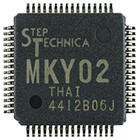
HUB-IC |
| Model number | MKY44-MC01A | MKY44-MC02A | MKY44-FS00A | MKY02 |
| package |  |
 |
 |
 |
| function | 24kpps single-axis motor control Rotary encoder input 1ch General-purpose DI/O |
12.5kpps motor control, 2 axes Rotary encoder input 2ch General-purpose DI/O |
Improved speed during I/O communication | - |
| Operating voltage | 3.3V | 3.3V | 3.3V | 3.3V (5V tolerant) |
| Features |
・CPU not required |
・CPU not required |
- Used when communicating between I/O modes |
・CPU not required |
| series name | Support IC |
| Model number | ST44SW |
| package |  |
| function | SA, DOSA, and BPS terminal expansion for some MKY44 series models. |
| Operating voltage | 3.3V |
| Features | Switchable between binary and decimal modes. |
*ST44SW is an IC used to "expand the communication setting switch" when using MKY44.
Network Specifications
| Communication method | CUnet communication (multi-master broadcast system) |
| communication medium | RS485 |
| communication speed | 12Mbps / 6Mbps / 3Mbps |
| Number of connected nodes | Up to 64 nodes |
| Data sharing volume | Maximum 512 bytes |
| Communication distance | Maximum 100-300m |
| topology | Bus configuration (tree and star configurations are possible when using a HUB) |
response speed
| 12Mbps | 6Mbps | 3Mbps | |
| 2 nodes | 102.00μs | 204.00μs | 408.00μs |
| 8 nodes | 265.00μs | 530.00μs | 1060.00μs |
| 16 nodes | 501.00μs | 1002.00μs | 2004.00μs |
| 32 nodes | 1037.00μs | 2074.00μs | 4148.00μs |
| 64 nodes | 2365.00μs | 4730.00μs | 9460.00μs |
*The above response speed is based on the assumption that the self-occupied area of one node is 8 bytes.
Communication range when using a HUB
| 12Mbps | 6Mbps | 3Mbps | |
| HUB1 | 200m | 400m | 600m |
| HUB2 | 300m | 600m | 900m |
CUnet network configuration
CUnet is a multi-master:multi-slave remote I/O control network.
Up to 64 CUnet ICs can be connected to this single network, and the master and slaves communicate automatically at all times.
The CUnet IC has both a master IC and a slave IC equipped with 512 bytes of memory, and because it is a data-sharing network,
Once one communication cycle is complete, the memory information of all CUnet ICs becomes identical (data sharing).
Therefore, a CPU connected to the master IC can control the I/O of each slave simply by reading and writing to the master IC's memory.
Network connectivity utilizes multidrop cabling using RS485, but T-branching and cable extension are also possible by using the HUB-IC (MKY02).
special features
① Email function (P2P communication)
Compatible ICs can communicate one-to-one with each other, up to a maximum of 256 bytes.
- Separate system from data sharing
- Does not affect cycle time
- For low-frequency data such as parameter transfer
② GMM (Global Memory Monitor)
This feature allows for secure monitoring while the network is operating.
Shared memory
• Register information
③ Error monitoring function
Communication errors can be checked using registers or error notification bits.
- Which device did it occur on?
Is it continuing?
Inquiry / Quotation
For inquiries or price quotes regarding this product, please contact us here.