- Semiconductor BusinessHOME
- Products and Services of Macnica,Inc.
-
technical information

-
Events and Seminars
- Handling Manufacturer
- Support
- Inquiry
- Click here to purchase products
- Semiconductor business e-mail magazine registration
Release overview
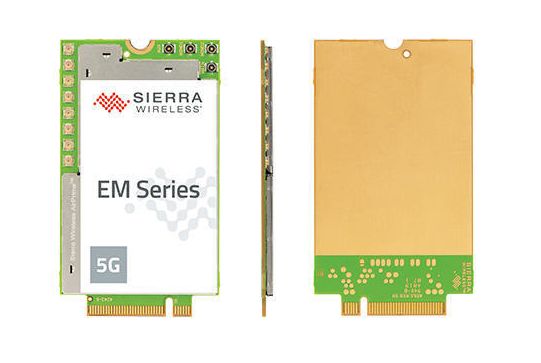
Sierra Wireless has released a module compatible with the next-generation communication standard "5G": EM919x. EM919x is based on Qualcomm's 5G RF chip: Snapdragon X55 and is an M.2 format module.
External view of module
Product lineup
| model number | NR mmWave | NR Sub-6 | LTE Category 20 |
| EM9190 | 〇 | 〇 | 〇 |
| EM9191 | × | 〇 | 〇 |
| EM7690 | × | × | 〇 |
All of the above lineups are compatible with 3gpp Release-15. This is against the backdrop of the global situation in which 5G services are being partially launched using existing LTE services when deploying 5G services. Therefore, we plan to support the New Radio standard (5G full function) in the future.
Module specification
|
model number |
EM9190 |
|
|
Air Interface |
NR mmWave NR Sub-6GHz LTE Category-20 HSPA+/WCDMA |
|
|
Dimensions (WxDxH[mm]) |
52 x 30 x 2.38 |
|
|
Power supply voltage [V] |
3.3 [V] typ. (3.135 to 4.4 [V]) |
|
|
External I/F |
connector shape |
M.2 form factor |
|
Host IF |
PCIe 3.0 1-lane USB 3.1 Gen2 |
|
|
(Peak) |
Downlink |
~7.53 [Gbps] (8 layers LTE + mmWave) |
|
Uplink |
~2.98 [Gbps] (8 layers LTE + mmWave) |
|
|
domestic carrier |
Docomo KDDI SoftBank |
|
|
Corresponding frequency |
5G NR Sub-6 GHz n1, n2, n3, n5, n28, n41, n66, n71, n77, n78, n79
5G mmWave n257, n258, n260, n261
LTE Category-20 B1, B2, B3, B4, B5, B7, B8, B12, B13, B14, B17, B18, B19, B20, B25, B26, B28, B29, B30, B32, B34, B38, B39, B40, B41, B42, B46, B48, B66, B71
HSPA+/WCDMA Band 1,2,3,4,5,6,8,9,19 |
|
|
Temperature range [℃] |
Normal operation |
Class-A: -30~+70 Class-B: -40~+85 |
|
Storage environment |
-40~+85 |
|
schedule
| Domestic Radio Law Acquisition | It has been acquired |
| Carrier IOT acquisition | 2020 Q4 - 2021 Q1 |
*Depending on the test situation, the schedule may change, so please contact us for the latest information.
What is the next-generation standard “5G”?
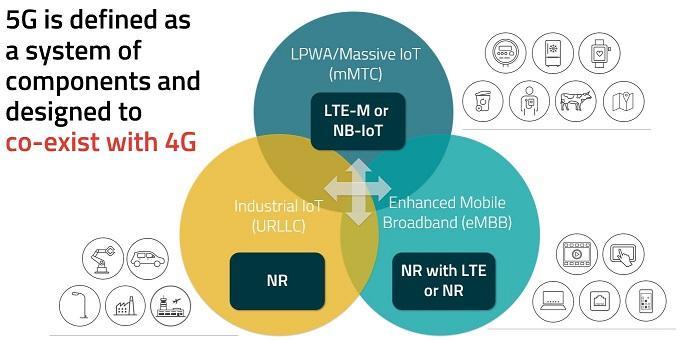
Here, we will introduce what the next-generation communication standard "5G" is in the first place.
There are three KPIs for 5G:
①: eMBB: Large capacity communication
(2): mMTC: Simultaneous multiplex connection
③: URLCC: Ultra-low latency communication
① eMBB
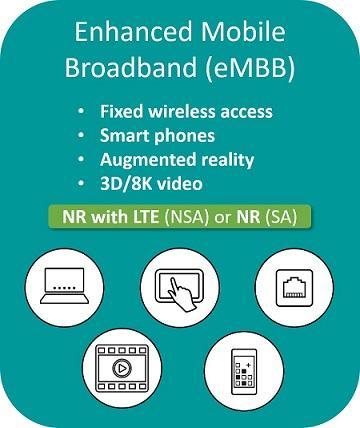
eMBB (Enhanced Mobile BroadBand) refers to high-capacity communication. Throughput has been significantly improved over conventional LTE communication, with a theoretical value of 215G[bps] or more (applied to the New Radio standard), and Sierra Wireless' verification has confirmed a throughput of 5 to 7G[bps] at peak times. I'm here. In addition, the communication latency is also improved, and it is expected to be reduced from the conventional 15 [ms] (LTE) to about 3 to 5 [ms].
What is NSA/SA
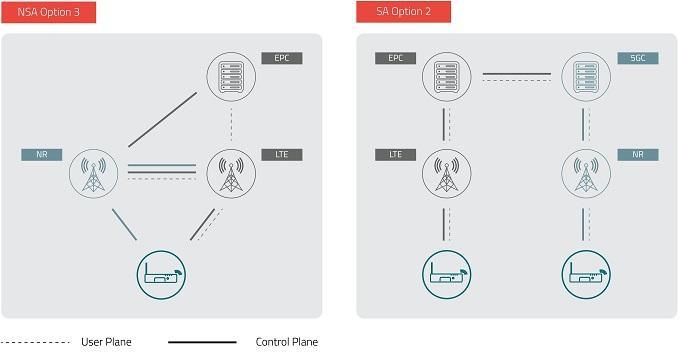
<NSA: Non-Stand Alone>
It will be a combination of the LTE network core network EPC and the newly installed 5G base station (en-gNB). Among the packets from wireless terminals, the Control-Plane (C-Plane) layer, which handles data used for wireless communication, is controlled by LTE macrocells, while the User-Plane (U-Plane) layer, which handles user data, etc., is controlled It is realized by controlling each by small cell by 5G base station.
<SA: Stand Alone>
Both C-Plane and U-Plane are configured to be controlled by 5G base stations/core networks. As a result, all 5G technologies (eMBB, mMTC, URLCC) can be controlled in one network, and "network slicing" that is applied to each application can be realized. Of course, it is also compatible with NSA, and communication with existing LTE terminals is also possible.
② mMTC
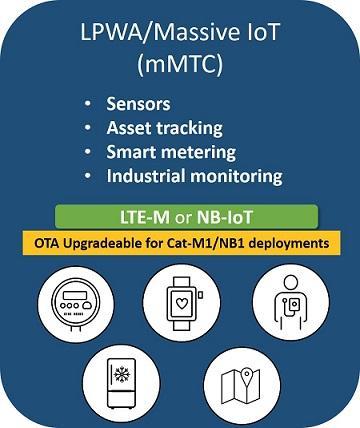
mMTC (massive Machine Type Communication) refers to multiple connections. While LTE communication allows simultaneous connection of up to 100,000 devices per square kilometer, mMTC is a specification that guarantees communication even if up to 1 million devices are connected simultaneously, which is 10 times the current number.
With multiple connections of devices, it is expected to be introduced to applications that have not been converted to IoT so far. Along with that, there are concerns about the battery side. mMTC is expected to be the next-generation standard for LTE Category-M1/NB-IoT LPWA communication on LTE networks, and can be introduced from existing LTE-M/NB-IoT via Firmware Update.
<Expected Applications>
Smart meters, wearable devices, etc.
③ URLCC

URLCC (Ultra-Reliable and Low Latency Communications) refers to highly reliable low latency communications. With eMBB, as mentioned above, the LTE network has a communication latency of 15 [ms], but by introducing URLCC, a latency of 0.1 [ms] / network reliability = 5 nines (99.999%) is guaranteed. This is expected mainly for remote monitoring/control.
Since URLCC will be introduced after the New Radio standard (NR Release 16), it is said that the service will start around 2022.
<Expected Applications>
V2X (Automotive), FA equipment, etc.
Next-generation wireless system to realize 5G
5G will use the new “Sub-6GHz” and “mmWave” communication methods. This is a communication method that uses a slightly higher frequency band than the frequency used in conventional LTE, and the range is divided into FR1/FR2. Of these, FR1 corresponds to Sub-6GHz and FR2 corresponds to New Radio mmWave.
<Sub-6GHz>
Sub-6GHz is a carrier communication method using a frequency band close to the 6GHz band. In Japan, 3.7GHz and 4.5GHz bands will be newly used. Since the frequency band is similar to that of conventional LTE, there is a high possibility that LTE technology can be followed in terms of antenna design and certification, so it can be expected to be applied to a wide range of applications.
mmWave
mmWave uses frequencies in the 30G to 300GHz band and is called millimeter waves because the wavelength is 10mms or less. Conventionally, it is mainly used for satellite communication, and 3gpp defines the 24.2G to 52.6GHz band as 5G communication use. As a feature, it has the property of a wave that has a strong straightness and does not go around obstacles, and depending on the frequency, there are bands where oxygen absorption occurs, making it difficult to use for long-distance communication. Other points to keep in mind when designing are as follows.
<Power consumption>
An increase in current consumption is due to an increase in peak current during high-speed communication. Sierra Wireless suggests that using mmWave will increase power consumption by +4[W], and if the application is CPE (Customer Premise Equipment), power consumption will increase by up to +50[W].
<Heat resistance>
One example is the critical impact of heat generated by RF components associated with high-speed communication. However, the Sierra Wireless module can monitor the module temperature at the software level. For example, it has functions such as periodically monitoring the temperature with AT Command and safely stopping the system when the temperature threshold is exceeded. increase. We also provide a thermal model during communication, which can be used for prior temperature rise verification.
<Antenna design>
As mentioned above, mmWave is greatly affected by the environment, so Sierra Wireless recommends implementing Characterization/Calibration in the product form. Conventional antenna design involves designing the characteristic impedance of the RF line on the board and improving EMI within the device, but mmWave communication uses a new module-type antenna. It is necessary to adjust not only the installation position of the antenna in the product form, but also the antenna module itself. A typical example is the design of "beamforming."
beam forming
beamforming principle
Massive MIMO antenna example
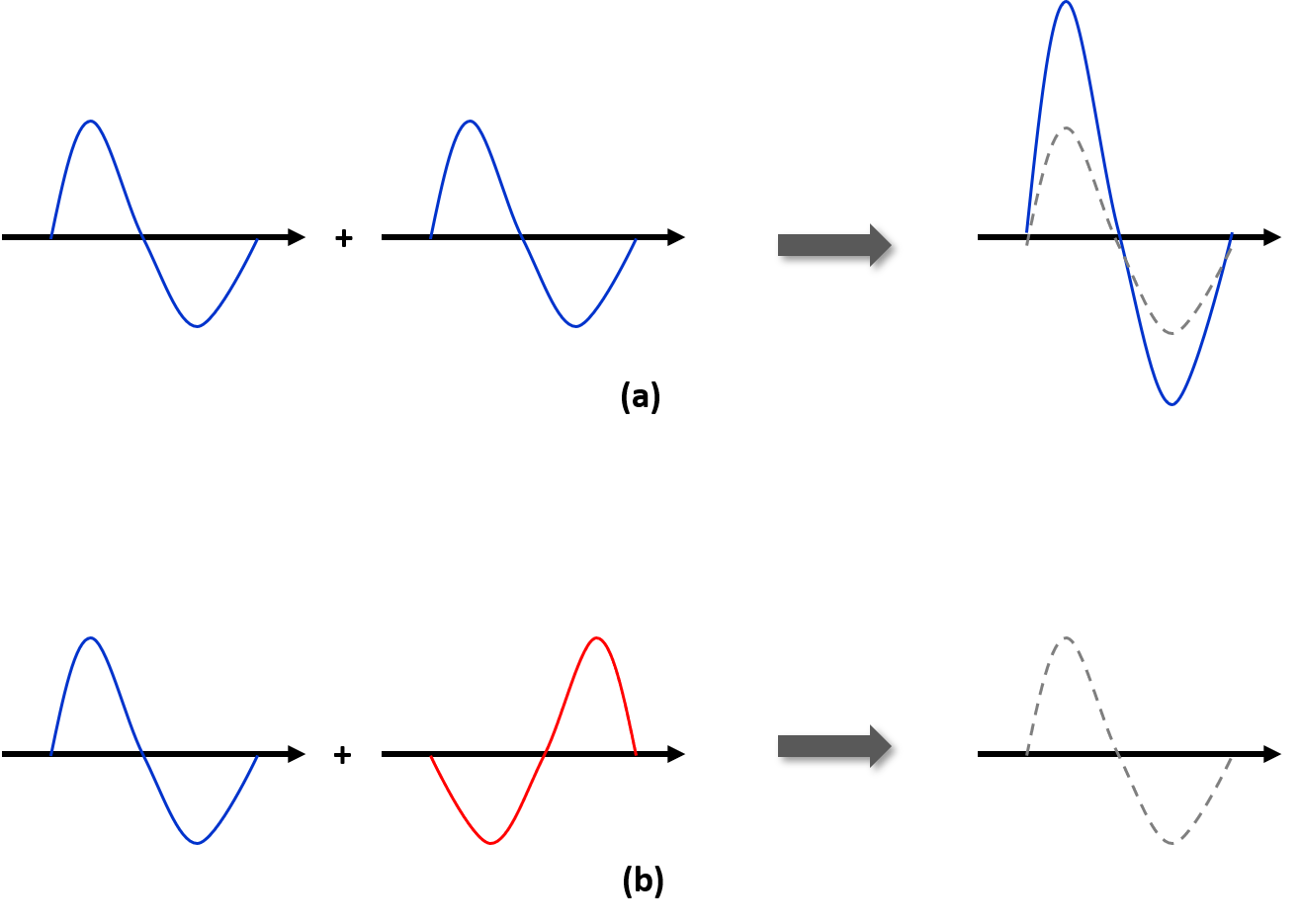
Beam Forming is a technology that enhances the directivity of radio waves in a given direction. Conventionally, radio waves are radiated in all directions with a specific frequency centered on a transmitting antenna, but beamforming is a technology that focuses the radio wave radiation direction in one direction and increases the gain. As mentioned above, mmWave is a frequency band that has the property of being difficult to propagate to the opposite side compared to LTE, so beamforming improves propagation in specific directions/frequencies.
The principle of beamforming is "phase". When frequencies are in-phase, the amplitude is amplified (a), and when they are out of phase, the amplitude is attenuated or canceled (b). Using this property, beamforming oscillates and amplifies the frequency of the same phase as the original frequency among the frequencies contained in the transmitted radio wave, and oscillates the frequency of the opposite phase for the reflected wave (noise) generated by the transmission. to cancel. This allows the expected data to be propagated over longer distances in the expected direction using the mmWave frequency band.
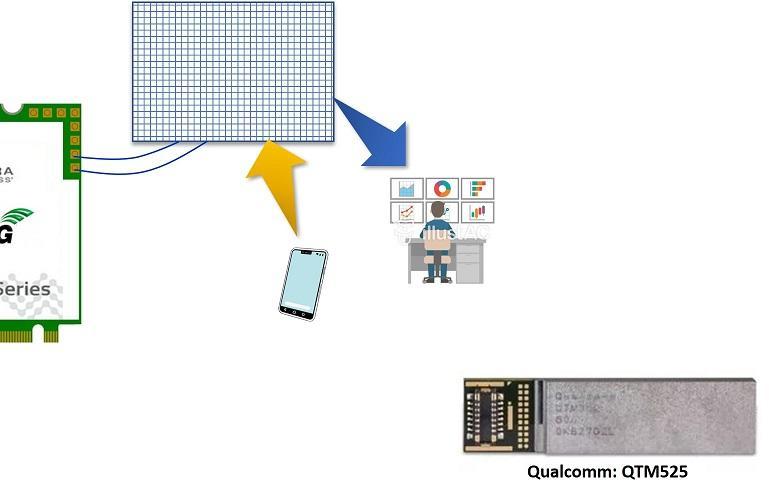
Beamforming is achieved by Massive MIMO antennas. This is a modularized antenna IC that can receive and transmit from up to 128 arrays and adjust beamforming to these arrays. Sierra Wireless recommends Qualcomm: QTM525/QTM527.
Related Links
Inquiry
If you have any questions regarding the contents of this press release, please contact us using the information below.
Semtech Manufacturer Information Top Page
If you would like to return to the Semtech manufacturer information top page, please click below.