- Semiconductor BusinessHOME
- Products and Services of Macnica,Inc.
-
technical information

-
Events and Seminars
- Handling Manufacturer
- Support
- Inquiry
- Click here to purchase products
- Semiconductor business e-mail magazine registration

Overview
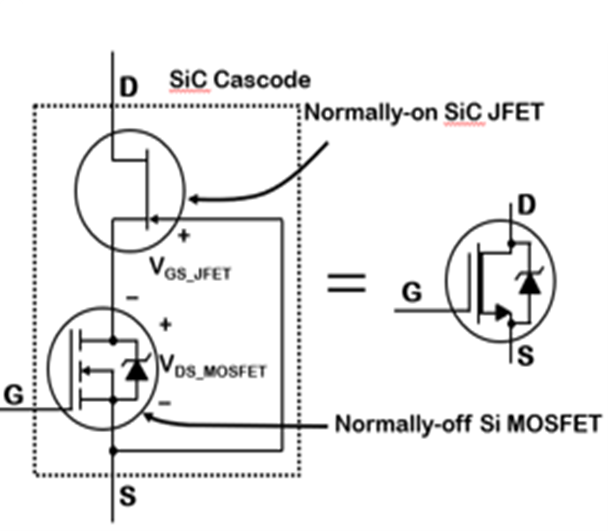
As shown in the diagram on the right, this product has a Si MOSFET and SiC JFET internally cascode-connected in a single package, allowing it to be designed in the same way as conventional silicon MOSFETs.
Another advantage is that it does not require a negative power supply and can be driven with existing gate circuits and general-purpose gate drivers. The advantages of cascode JFETs are explained below.
Advantage 1: No negative power supply required
The recommended operating voltage of VGS for cascode JFETs is very user friendly.
The gate voltage threshold is 4.8V at 25°C. Therefore, a negative power supply is not required because the gate voltage threshold is high.
As shown in the figure below, the recommended operating VGS of a cascode JFET is 0 to 12V, the same as that of a general silicon MOSFET.
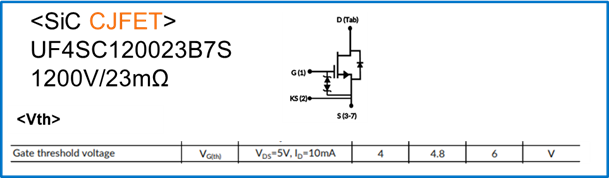
Ordinary SiC MOSFETs can have a low gate voltage threshold, requiring a negative power supply to completely turn them off.
Advantage 2: Can be driven by existing gate circuits
Next, the absolute maximum rating of VGS for cascode JFETs is ± 20V, the same as for general silicon MOSFETs.
This allows it to be driven by existing gate circuits and general-purpose gate drivers.
Advantage 3: Low on-resistance
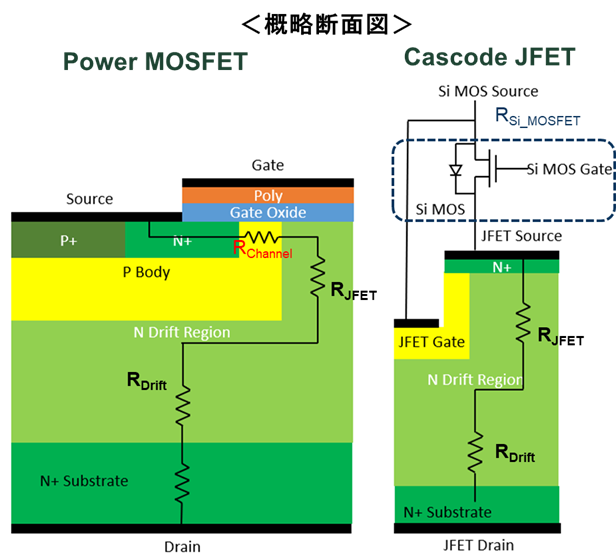
Because this cascode JFET uses a SiC JFET, it does not have the channel resistance of other companies' typical SiC MOSFETs, making it possible to reduce the total on-resistance to about 1/4 to 1/2, thereby achieving low on-resistance (see the schematic cross-section diagram below).
However, although the cascode connection increases the ON resistance of the Si MOSFET, because it is a low-voltage Si MOSFET, this is only about 1/10 of the channel resistance, so the effect can be ignored.
Advantage 4: Low VF
Next, the characteristics of the body diode, which are related to switching characteristics,
First of all, the body diode of a typical SiC MOSFET uses SiC, so VF is high, at 3.5 V or higher. In addition, the Qrr characteristics are not very good, and the value increases very quickly depending on the temperature.
However, in a cascode JFET, the body diode is made of silicon.
Current flows from source to drain through the body diode of the Si MOSFET and through the JFET, with the SiC JFET itself acting as just a resistor.
The body diode characteristics are those of a low-voltage MOSFET, with a low VF of 1.5V.
Cascode JFET product page
Please check the ONSEMI website for the lineup of cascode JFETs that offer these advantages.
Inquiry / Quotation
If you have any questions about this product or would like a quote, please contact us using the form below.
Onsemi Manufacturer information Top
If you want to go back to ONSEMI Manufacturer Information Top, please click below.