- Semiconductor BusinessHOME
- Products and Services of Macnica,Inc.
-
technical information

-
Events and Seminars
- Handling Manufacturer
- Support
- Inquiry
- Click here to purchase products
- Semiconductor business e-mail magazine registration
AFE (Analog Front End) converts weak analog signals from sensors into digital signals with high precision
When measuring a weak analog signal from a sensor with an ADC, it is common to implement an operational amplifier in the front stage to amplify the signal before converting it into a digital signal using the ADC.
Although it is often implemented using discrete products, the board circuit configuration needs to be customized to suit the type of sensor and its error precision, which requires development time and know-how.
The analog front-end (AFE) is a product that realizes the conditioning functions required for measuring these sensors in a single chip.
The AFE is also called a Sensor Signal Conditioner (SSC).
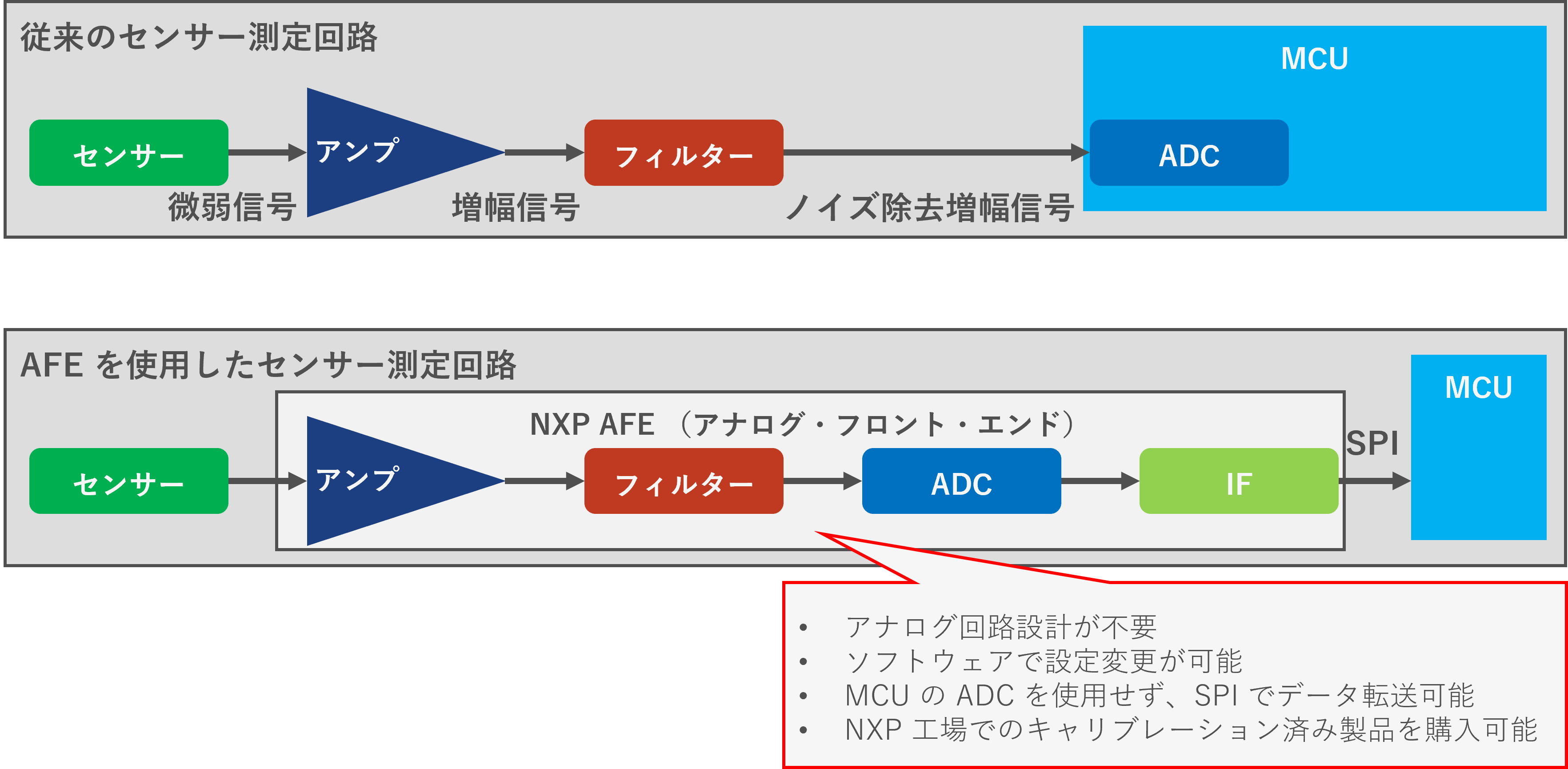
By using NXP's AFE, you can get the following benefits:
- A large number of analog signals can be input, and "amplification," "digital conversion," and "filter processing" can be achieved on a single chip. This reduces the number of circuit design steps and the number of components mounted on the board.
- Can be set with SW for voltage, current, resistance, RTD (resistance temperature detector), and thermocouple. Reduces circuit design man-hours and allows functions to be changed with SW after design.
NXP factory calibrated versions available for purchase, reducing testing and development costs
Please see the NXP AFE manufacturer homepage here.
Analog Front End | NXP Semiconductors
For detailed feature and application information on NXP AFE, please see this document.
Features of NXP's AFE (Analog Front-End) products
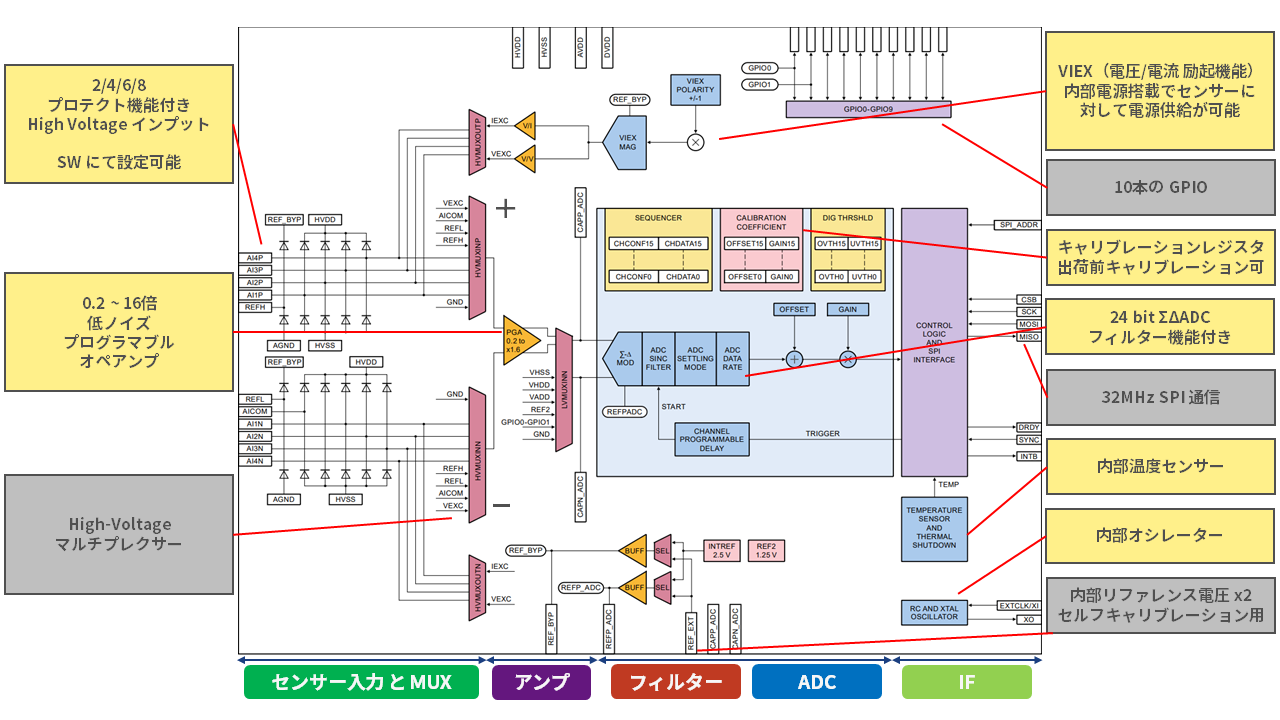
High Voltage Input with Protection Function
- Capable of inputting single-ended or differential analog signals up to ±25V, and equipped with an overvoltage protection function up to ±36V
-Can be set to "voltage", "current", "resistance", "resistance temperature detector (RTD)", or "thermocouple" using the switch
Low Noise Programmable Op Amps (PGAs)
- Equipped with a low-noise programmable op-amp that can be set from 0.2 to 16 times, it can amplify weak signals before converting them to digital form.
Equipped with VIEX (voltage/current excitation function) internal power supply
・AFE can supply power to the sensor and can also measure resistance temperature detectors (RTDs)
RTD measurement system with NAFE13388/73388 family of devices (nxp.com)
- Sensor connection loss or disconnection can be detected by detecting open Analog Input channels
Calibration register included
- Devices can be pre-calibrated by NXP before shipping
24-bit ΣΔADC with filter function
NAFE11388: 7.5 to 288 kSPS
NAFE71388: 15 SPS to 576 kSPS
Others
・Can be connected to a downstream microcontroller via 32MHz SPI communication
- 10 GPIOs
- Internal temperature sensor (full readout ±3⁰C accuracy)
- Internal oscillator (accuracy: 0.2%)
- Fault detection and predictive diagnostic system
- CRC error detection
・Operating temperature range TA: -40℃ to 125℃
Package: 64 pin, 9mm x 9mm x 0.85mm VQFN
Product Selection Guide
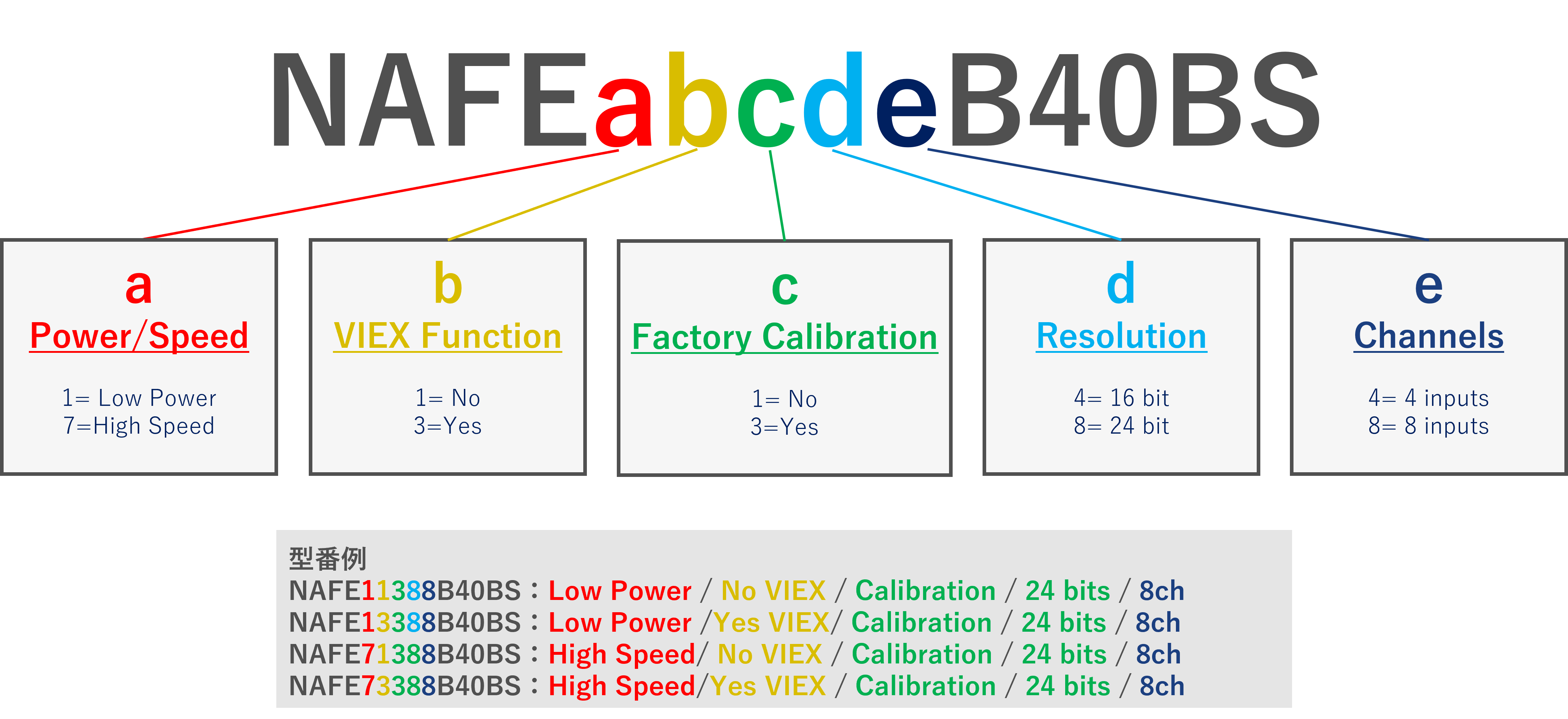
The model number selection method is as shown in the diagram above.
Depending on the need for VIEX functions, you can choose from the following two types.
・NAFEx1388: VIEX (voltage/current excitation function) without internal power supply
Highly Configurable 8 Channel ±25 V Universal Input Analog Front-End | NXP Semiconductors
・NAFEx3388: VIEX (voltage/current excitation function) with internal power supply
Please see the NXP AFE manufacturer homepage here.
NXP AFE evaluation environment
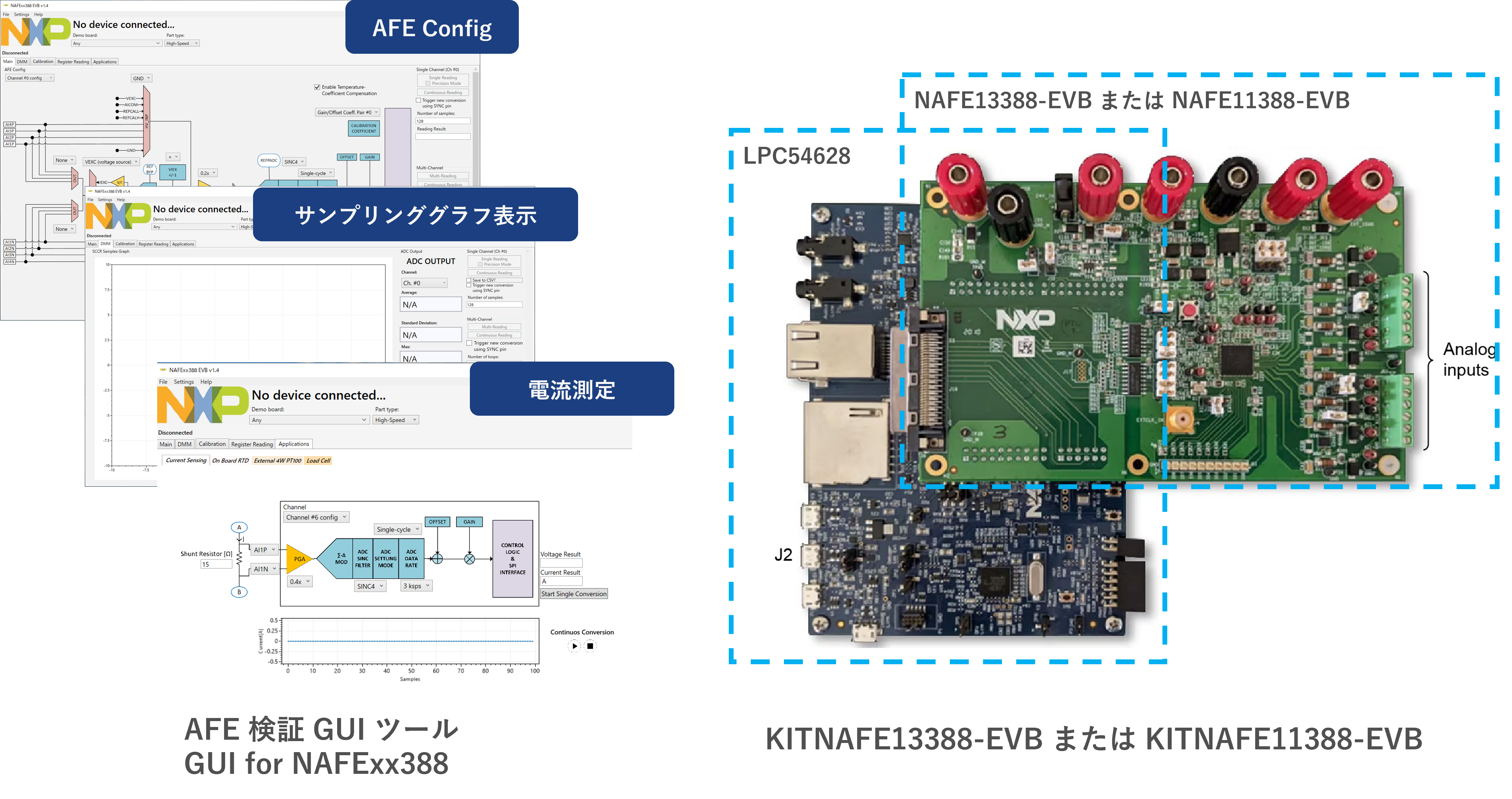
As an evaluation environment for the NXP AFE, a board with an LPC54628 MCU is available.
NAFExx388-EVB 8 Channels Universal Input AFE Evaluation Board | NXP Semiconductors
A GUI tool for AFE verification is available.
"Changing the internal settings of the AFE," "Displaying ADC waveforms," "AFE calibration," and "GUI for displaying settings and information for each application"
You can use it to perform detailed AFE verification.
|
Evaluation Board Name |
AFEFeatures |
Microcomputer Board |
document |
|
No VIEX (internal power supply) |
none | ||
|
Includes LPC54628 MCU |
|||
|
VIEX (internal power supply) available |
none | ||
|
Includes LPC54628 MCU |