- Semiconductor BusinessHOME
- Products and Services of Macnica,Inc.
-
technical information

-
Events and Seminars
- Handling Manufacturer
- Support
- Inquiry
- Click here to purchase products
- Semiconductor business e-mail magazine registration
Product Summary
Arduino® VENTUNO Q is It runs on Ubuntu/Debian-based Linux environments.Qualcomm® Dragonwing™ IQ8(IQ-8275)System-on-a-chip(SoC)and,STMicroelectronics® STM32H5Microcontroller(MCU)This is a dual-architecture platform for robotics and edge AI that integrates various technologies. It offers AI computing performance of up to 40 dense TOPS and low-latency, high-precision real-time control on a single board, supporting everything from on-device LLM/VLM inference to motor control and robot development.
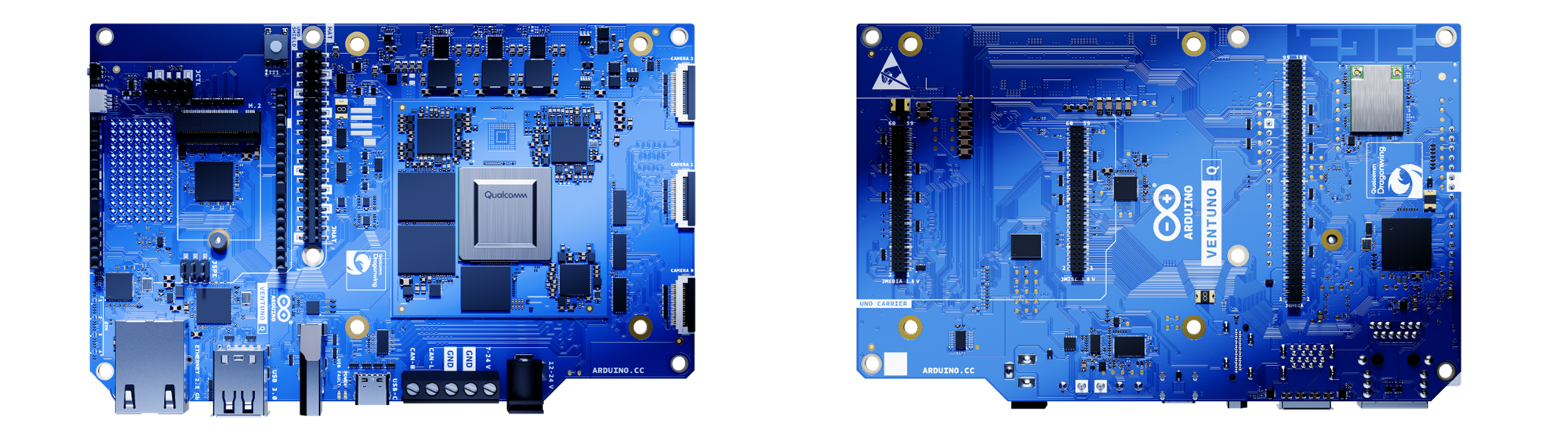
Processor specifications
Qualcomm Dragonwing™ IQ-8275 (SoC)
Octa-core Arm® Kryo CPU(Gold Prime × 2 @ 2.35GHz, Gold × 2 @ 2.1GHz, Silver × 4 @ 1.95GHz)
• Adreno 623 GPU(3D graphics accelerator)
・Qualcomm Spectra 692 ISP
• Hexagon Tensor Processor(NPU)up to 40 TOPS
STM32H5F5 Arm® Cortex®-M33 (MCU)
・Arm® Cortex®-M33 up to 250 MHz
• Flash memory 4MB
・SRAM 1.5MB
• Floating-point unit(FPU)
Features
Dual Brain Architecture
Dual-Brain configuration integrating high-performance computing and real-time control into a single card.
|
Brain |
device |
role |
|
AI Core |
Qualcomm Dragonwing™ IQ8 |
AI computations with a maximum density of 40 TOPS. Handles advanced computer vision and local LLM. |
|
MCU core |
STM32H5 microcontroller |
Responsible for the low-latency, high-precision control required for complex motor control and robotics. |
A variety of AI models that are ready to use
A suite of AI models optimized for the VENTUNO Q's built-in NPU can be utilized.
You can access a rich library of AI resources via Edge Impulse and Qualcomm AI Hub. Customization options are also available to suit your specific challenges.
Local LLM: Advanced natural language understanding powered by Qwen, fully on-device and cloud-independent, without data transmission.
Local VLM: Integration of visual recognition and natural language understanding using Qwen VLM. Supports image caption generation, scene description, OCR, etc.
TTS & ASR: Melo TTS and Whisper enable natural speech recognition, transcription, and human-like voice responses in offline environments.
Gesture Recognition: Recognition of hand and finger movements and sign language using MediaPipe. For touchless UI and human-robot interaction.
Object Tracking: Real-time tracking of people, vehicles, and objects using YOLO-X (supports multiple cameras).
Posture Detection: Tracks body posture, joint positions, and movement patterns using PoseNet. Applications include fitness, safety monitoring, and interactive games.
Specializing in robotics and physical control.
VENTUNO Q is designed for systems that move, control, and respond to the physical world with precision and reliability.
ROS 2 compatible: Supports ROS 2 (Robot Operating System 2), enabling advanced real-time robot development.
Arduino App Lab Robotics Bricks: Equipped with robotics-specific Bricks that bundle complex functions into reusable components.
Real-time motion control: By responding immediately to GPIO, PWM, and CAN-FD, low-latency motor control and high reliability for functional safety are achieved.
Integrated Development Environment
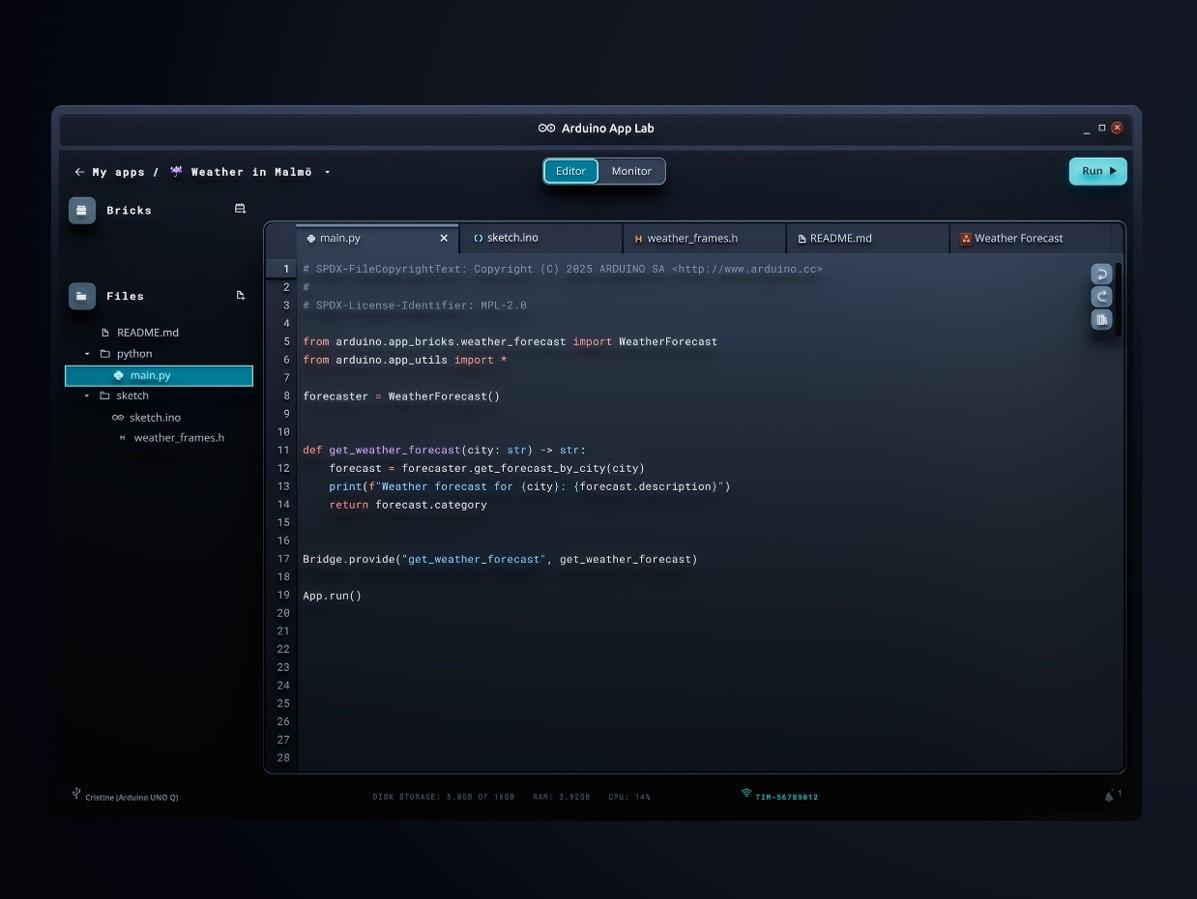
Arduino® App Lab: Develop, learn, and deploy on a single platform. Develop Arduino sketches, Python scripts, and AI models in a single, consistent environment. Arduino App Lab seamlessly bridges embedded programming, Linux development, and edge AI, allowing you to build entire applications in one environment.
Two setup modes
You can use it in your preferred mode, whether connected to a single-board computer or a PC, to suit your workflow.
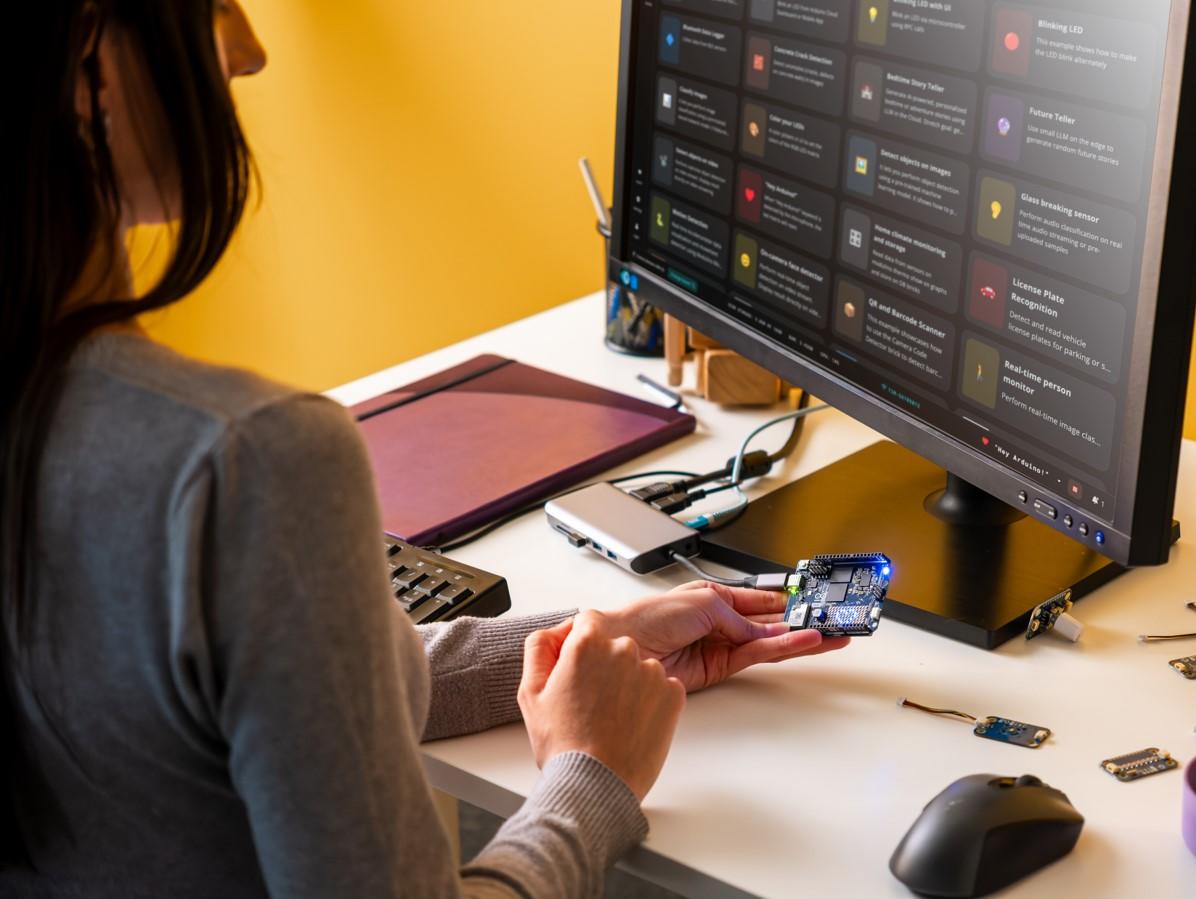
Single-board computer(SBC)mode: Connect a monitor, keyboard, and mouse, and Arduino App Lab will immediately launch, operating as a Linux desktop environment.
PC connection mode: Laptop via USB-C or network/Connect to your desktop and run Arduino App Lab on your PC.
Detailed specifications
|
Microprocessor (MPU) |
Qualcomm Dragonwing™ IQ8 (IQ-8275): CPU: 8-core Qualcomm® Kryo™ GPU: Qualcomm® Adreno™ 623 NPU: Qualcomm® Hexagon™ 40 dense TOPS Qualcomm Spectra 692 ISP OS: Ubuntu or Debian upstream |
|
Microcontroller (MCU) |
STM32H5F5: Arm® Cortex® M33 at 250MHz 4MB flash 1.5MB RAM OS: Arduino core on Zephyr |
|
RAM |
16GB LPDDR5 |
|
Storage |
64GB eMMC M.2 connector for NVME Gen.4 external storage |
|
Connectivity |
Wi-Fi® 6 2.4/5/6 GHz with onboard antenna Bluetooth® 5.3 with onboard antenna 1x 2.5Gbit RJ45 |
|
Camera |
USB camera support 3x MIPI CSI connectors muxed with 2x MIPI CSI on JMEDIA header |
|
Video |
1x HDMI muxed with MIPI DSI on JMEDIA header Video output (DP Alt mode) support via USB-C MIPI DSI pins on JMEDIA header |
|
Audio |
2x Microphone IN / Headphone OUT / Ear OUT / Line OUT on JMISC header |
|
Power Supply |
From USB-C connector 5 VDC max at 3 A 5.5x2.1 mm Power Jack 12-24 VDC Screw Terminal 7-24 VDC 7-24 V on JOMEGA |
|
USB |
1x USB-C port with host/device role switching, power role switch and video output 2x USB 3.0 Type A 2x USB 3.0 on JOMEGA header |
|
CAN |
1x CAN-FD PHY on screw terminal 3x CAN-FD (no PHY) on JOMEGA header 1x CAN-FD (no PHY) on UNO Shield headers |
|
Dimensions |
160x100x25.8 mm |
Those interested in purchasing, please click here.
The Arduino VENTUNO Q will be available for purchase from Macnica-Mouser, an online retailer of semiconductors and electronic components.
We are currently in the process of obtaining the necessary radio wave regulations. Once we begin sales in Japan, we will announce it on this website and via our email newsletter.

Inquiry
If you have any questions about the contents of this page or would like detailed product information, please contact us here.