- Semiconductor BusinessHOME
- Products and Services of Macnica,Inc.
-
technical information

-
Events and Seminars
- Handling Manufacturer
- Support
- Inquiry
- Click here to purchase products
- Semiconductor business e-mail magazine registration


 Narrow down by specifying conditions
現在2159件がヒットしています。check

While the 2022 FIFA World Cup held in Qatar was fascinated by the brilliant performances of the players, black technology was a hot topic in the global IoT industry. Croatia player due to offside decision just before Penalties was canceled, and the number of passes that led to the winning goal of a Japanese player
“1 The VAR (Video Assistant Referee) played an important role in this World Cup, such as online judgment even though it was "Miri".
“VAR” is a technology introduced at the 2018 Russia World Cup, and as mentioned above, it played an extremely important role in determining the match results at the 2022 Qatar World Cup. The "VAR system" can not only identify fouls, but also monitor the positions and movements of players and the ball on the field with a high degree of accuracy.
In this World Cup, Ecuador scored the first goal against Qatar, the host country, with a penalty kick, and this penalty was the first goal in the World Cup to be decided by "VAR technology".
"VAR" makes quick and accurate decisions when resolving disputes with referees and tournament officials, and when making sure the game is played according to the correct rules. In short, a new era of technology is bringing about a new revolution in football.
But how accurate are the “VAR” results? How can we provide referees with accurate and reliable data and images, quickly and multilaterally?
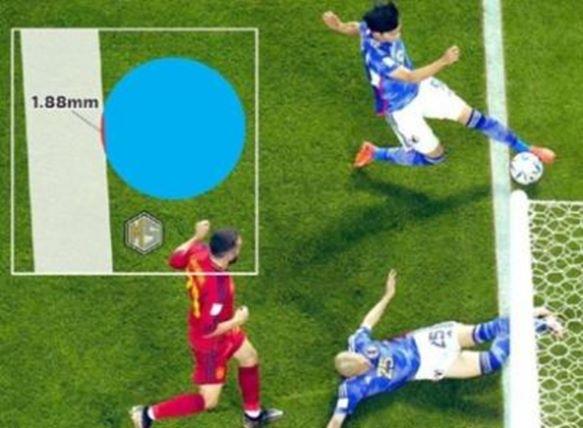
Source:FIFA
Core technology of VAR system
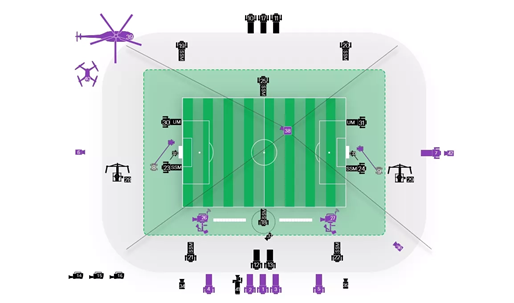
Source:FIFA
A quick judge of the "VAR system" is 12 field-mounted tracking cameras and a ball-embedded UWB (ultra-wideband sensor) and IMU (inertial measurement unit). It relies on a chip with two independent sensors working simultaneously.
The “UWB” receives and relays precise position data to base stations, while the “IMU” detects ball speed and direction data. This data is sent to the video operation room 500 times per second.
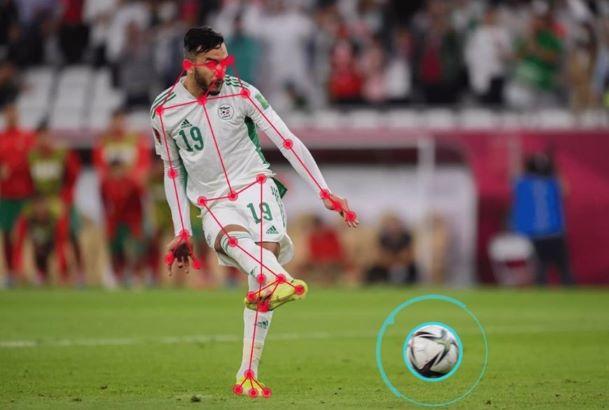
Source:FIFA
The workflow of “VAR technology” is basically similar to IoT solutions.
From front-end data collection, to communication with UWB base stations, to back-end data analysis, it effectively integrates motion sensors, location, communication and edge computing.
At the heart of these IoT functions is the interaction of two sets of sensors to ensure accurate data collection, but delays in data transmission.
Analyzing soccer data in real time requires “edge computing” processing.
When the UWB base station receives soccer data, an edge computing processor installed near the field calculates speed, movement and distance almost simultaneously, and uses 12 tracking cameras to recognize the movement of soccer players and act accordingly. to adjust.
Ubiquitous Edge Computing
“Edge computing” is playing an integral role in many areas of people's lives, not just football fields, but intelligent furniture, industrial control, and autonomous driving cars.
As new applications are developed, the demands on the wearable device's internal storage and its tasks are becoming more demanding.
From OS storage to data buffering, temporary storage of photos and videos, network buffering calculations, etc., the functions have gradually become more complex, and the requirements for reading speed and storage capacity have also increased.
With the arrival of the AIoT (Artificial Intelligence of Things) era, many operational tasks are being put into edge terminals, and in order to bring about the recognition of keywords and images,
There is a need for AI and machine learning models with massive data storage in internal memory.
As mentioned earlier, application scenarios have relatively high demands on latency, and data must flow through edge computing processors.
As such, “internal storage” has become a “defining factor” in cutting-edge computing.
What internal storage is needed for edge computing?
Wearables not only expect products to run smoothly, but also to collect data accurately, to be energy efficient, and to have maximum battery life. For applications such as smart bracelets and TWS earphones, “HYPERRAM” is the best choice as it offers the following advantages:
Ultra-Low Power Consumption: HYPERRAM achieves “ultra-low power consumption” in normal operation and hybrid sleep mode.
The 8V, 64Mbit HYPERRAM consumes 70uW standby power at room temperature and only 35uW in hybrid sleep mode.
• Simplified design: pSRAM has 31 signal pins, while HYPERRAM has only 13. In other words, it “drastically simplifies the design and production process.”
・ Space-saving: A small pin count package with few host controller interfaces reduces the board footprint.
For applications that require higher real-time data transfer capability, storage capacity, data bandwidth, and stability, “DRAM” is the better choice. Taking a car as an example, having enough data bandwidth and storage capacity to support real-time data transfer and processing, as "millisecond" delays can be disastrous while driving. memory is required.
Winbond offers a series of "DRAM products" such as LPDDR, LPDDR2, LPDDR3 and LPDDR4, which are suitable for applications requiring low power consumption. In addition, sales of 2 to 4 Gbit LPDDR4/4X have also started. The latest LPDDR4/4X models have the following features:
・Employs a small 100BGA package of only 5× 10mm2
・Compliant with JEDEC JED209-4 standard, contributing to energy saving and low carbonization
・4267Mbps data transfer suitable for consumer use
・Ideal for applications that require high data throughput in a small package
Small sensors underpin the fairness and accuracy of football, and this can be attributed to the chips that support the underlying technology.
The IoT will lead our lives to a more connected world, which will increase our reliance on internal memory.
Click here for related links
Inquiry / Quotation
If you have any questions, samples, or requests for quotations regarding this product, please contact us using the form below.
Back to Winbond Manufacturer Information Top
If you want to return to Winbond manufacturer information top page, please click below.