- Semiconductor BusinessHOME
- Products and Services of Macnica,Inc.
-
technical information

-
Events and Seminars
- Handling Manufacturer
- Support
- Inquiry
- Click here to purchase products
- Semiconductor business e-mail magazine registration


 Narrow down by specifying conditions
現在2200件がヒットしています。check

In the previous article, we optimized the simple water level sensor for examining the principle, so in this article, we will explain the optimization results. In addition, we will introduce the technical issues that became apparent as a result of measuring the water level with a simple water level sensor. Of course, at the IoT/M2M exhibition, we are exhibiting products that have implemented measures to address technical issues.
Part 1 Prototype method of water level sensor
Part 2 Explanation of the detection principle
Part 3 How to optimize?
Part 4 Optimized water level sensor
Optimized resonance amplitude
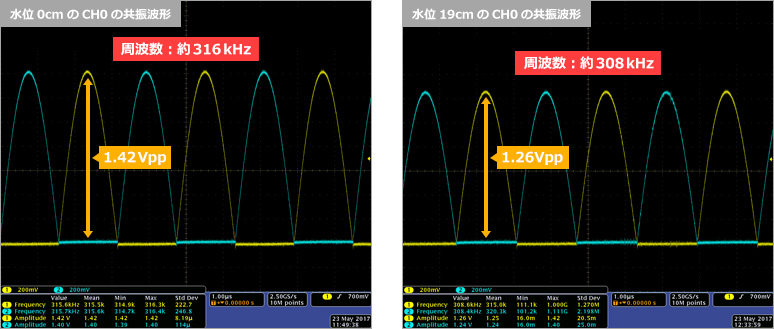
When I actually observe the differential signal of CH0 with an oscilloscope, it oscillates at about 316kHz when the water level is 0cm, and about 308kHz when the water level is 19cm. As the water level rises, the capacitance value of the sensor increases, resulting in a slight decrease in the resonance frequency.
On the other hand, when the water level is 0 cm, the resonance amplitude is about 1.42 Vpp, and when the water level is 19 cm, the resonance amplitude is about 1.26 Vpp, which is within the recommended range of resonance amplitude. If desired, the resonance amplitude can be increased by increasing the sensor drive current setting. However, current consumption will increase.
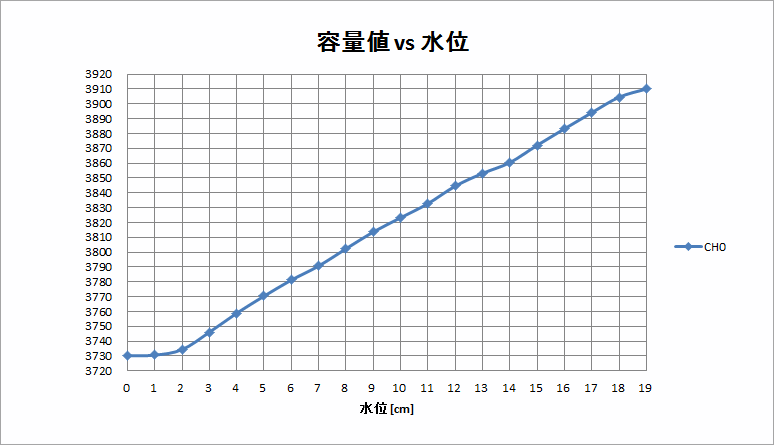
Comparison of capacitance values before and after optimization
Optimizing the resonance amplitude resulted in 3730pF at a water level of 0cm and 3910pF at a water level of 19cm.
We plotted how much the capacitance value changed from when the water level was 0 cm, and compared the results before and after optimization on the same playing field. After optimization, the amount of change in capacitance value due to water level changes was 180pF, and although the same sensor was used, the amount of change was about twice that of the default setting. In addition, the capacitance detection sensitivity is improved when the water level is low (0 cm to 4 cm).
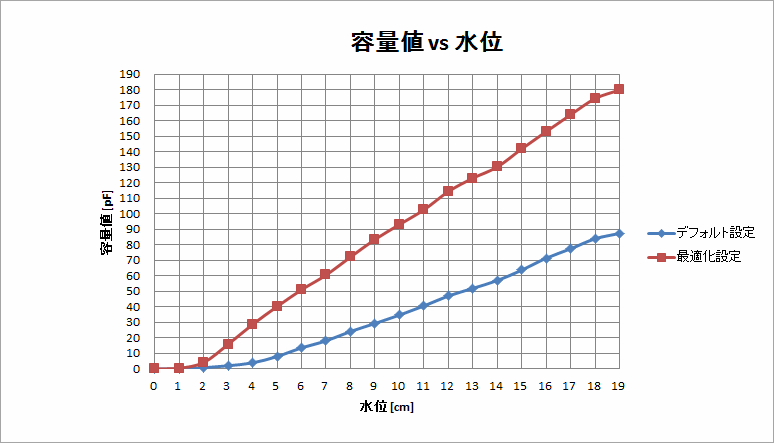
Before optimization, the cause was that the resonance amplitude was outside the recommended range and the input glitch filter was set incorrectly. In this way, even if the same sensor is used, the characteristics will vary greatly depending on the LC resonant circuit constants and GUI settings.
Seven more technical issues that became apparent
As a result of measuring the water level with a simple water level sensor for examining the principle, the technical issues that came to light are as follows.
1. Sensitivity from behind the sensor
The FDC2214 has a detection sensitivity of the 1fF level, and simply touching the sensor installation surface from the outside of the acrylic case changes the capacitance value, making it appear as if the water level has changed. Countermeasures such as applying a shield to the back of the sensor are required.
2. Sensitivity of insulated copper wire used to connect to the sensor
Touching the coated copper wire connecting the sensor and the FDC2214 changes the capacitance value, making it appear as if the water level has changed. Countermeasures such as changing to shielded cables are required.
3. Shape of sensor pattern and sensitivity to water level change
In addition to the simple sensor pattern introduced this time, we investigated the sensitivity to water level changes for different sensor patterns. Although it is not possible to describe the details, it is necessary to determine the sensor pattern in consideration of the measurement accuracy and the cost of the sensor.
4. Response to environmental changes
The detected capacitance value changes due to environmental changes. For example, a function that captures environmental temperature changes and performs automatic calibration is required.
5. Difference in change in capacitance due to object
In this study of the principle, measurements were performed using tap water as the target, but simply changing the tap water to green tea changes the amount of change in the capacitance value. If the object is fixed, it can be detected as an impurity, but if the object is diverse, it is necessary to detect the substance itself.
6. Waterproof performance
A cover film was used for waterproofing, but it is necessary to deal with waterproof performance and dirty water. The sensitivity of the sensor is affected by the material and thickness used as a waterproof measure.
7. Water Level Conversion Algorithm
We measured the change in the capacitance value with respect to the water level change, but for actual use, we need an algorithm to convert the capacitance value to the water level. Although we cannot describe the details of the water level measurement algorithm exhibited at the IoT/M2M exhibition, we used a simple method to convert the acquired capacitance value to the water level.
At the end
How did you like the article I sent you in all 4 times? There were a lot of things I didn't realize until I actually tried it with my own hands.
The exhibition scenery at the IoT/M2M exhibition is introduced in the IoT PoV verification model exhibition corner water level measurement example, so please take a look!
Contact Us
If you would like more information about the FDC2214EVM introduced in this article or any of TI's sensors, please contact us here.
*This article was written based on the product status at the time. When considering a product, please confirm the latest information with the manufacturer or distributor before proceeding.


Related Information
Let's make a capacitive water level sensor
Part 1 Prototype method of water level sensor
Part 2 Explanation of the detection principle
Part 3 How to optimize?
Part 4 Optimized water level sensor