- Semiconductor BusinessHOME
- Products and Services of Macnica,Inc.
-
technical information

-
Events and Seminars
- Handling Manufacturer
- Support
- Inquiry
- Click here to purchase products
- Semiconductor business e-mail magazine registration


 Narrow down by specifying conditions
現在2230件がヒットしています。check

Introduction
I think that those who design around clocks select parts based on the type of resonator (resonator) or oscillator.
This time, I would like to shine a spotlight on oscillators and focus on the basics, and how to choose and types of oscillators.
Which do you use, vibrator or oscillator?
A simple table summarizes oscillators and oscillators.
The most obvious difference is that no matching is required.
A vibrator is a passive component that uses a ceramic or crystal vibrating piece that has a piezoelectric effect.
In order to vibrate, it is necessary to use an oscillator circuit (IC).
An oscillator is a one-chip device that packages a vibrator and an oscillation circuit.
| ① Type | vibrator | oscillator |
| ② Oscillation circuit | required | unnecessary |
| ③ Matching | required | unnecessary |
| ④Others | Fundamentally cheaper than oscillators | It is necessary to prepare the power supply voltage for driving on the board |
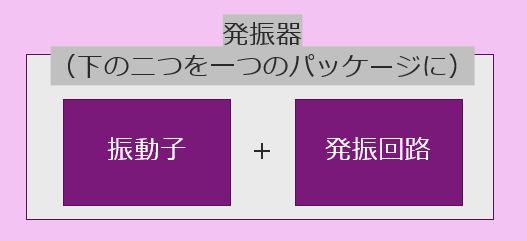
Oscillator Eliminates Matching
As mentioned above, the fact that no matching is required is a great advantage of oscillators.
When a resonator is adopted, specifically, the manufacturer or designer of the oscillator circuit IC performs a matching evaluation with the oscillator circuit.
Not only does this require a lot of man-hours, but if the load capacitances of the vibrator and oscillator circuit do not match, the following problems will occur.
・No oscillation
・Specific frequency cannot be obtained (unstable)
・Frequency changes or stops due to changes in power supply or temperature.
It can be said that using an oscillator is a great advantage in order to avoid such evaluation man-hours and troubles in advance.
In addition, even in cases where frequency accuracy is required that cannot be met with oscillators, it is possible to cover it with oscillator specifications.
Oscillator type
|
(Package oscillator) |
The most versatile oscillator that takes advantage of the oscillator's frequency stability No temperature compensation or control |
|
(temperature compensated oscillator) |
Oscillator with added temperature compensation circuit to suppress frequency fluctuation due to changes in ambient temperature |
|
(Oscillator with thermostat) |
An oscillator that minimizes frequency fluctuations due to changes in ambient temperature by keeping the temperature of the oscillator/resonator constant using a constant temperature bath. Most accurate and used in harsh environments |
|
(voltage controlled oscillator) |
Oscillator that can control output frequency by applying voltage from outside |
|
DCXO (digitally controlled oscillator) |
Oscillator whose output frequency can be controlled by an external digital signal |
|
SSXO (spread spectrum oscillator) |
Oscillator with spread spectrum capability Ideal for EMI noise countermeasures, etc. |
|
programmable oscillator |
As the name suggests, an oscillator whose specifications can be determined by writing a program Flexibility to meet required specifications |
Advantages of adopting SiTime MEMS oscillators
The main advantages of SiTime's MEMS oscillators over general crystal products are as follows.
・Strength against surrounding environment such as vibration and impact (environmental performance)
・Defect rate
・ Aging characteristics
・Change in oscillation frequency due to temperature change
・Programmable performance (all products are programmable)
·supply chain
These factors include the differences in materials, internal structures, and production processes due to the use of silicon MEMS.
At the end
What did you think.
This time, we have summarized the selection criteria and types of oscillators and oscillators.
Among oscillators, SiTime's MEMS oscillators have various features due to their technology using MEMS.
Please feel free to contact us if you are unsure about your selection.