- Semiconductor BusinessHOME
- Products and Services of Macnica,Inc.
-
technical information

-
Events and Seminars
- Handling Manufacturer
- Support
- Inquiry
- Click here to purchase products
- Semiconductor business e-mail magazine registration


 Narrow down by specifying conditions
現在2224件がヒットしています。check

Channel Sounding
One of the new features added to the Bluetooth standard "Bluetooth 6.0" announced in September 2024 is "Channel Sounding."
Formerly known as High Accuracy Distance Measurement (HADM), this technology uses PBR (Phase-Based Ranging), RTT (Round-Trip Time-Based Ranging) to accurately measure the distance between two BLE devices.
This technology will enable next-generation wireless access and proximity solutions to further enrich users' lives.
In this article, we will take a closer look at how channel sounding works, use cases, and Silicon Labs' solutions.
[Free In-Person Event Held in Tokyo and Osaka (2 venues)]
We will be holding a special event, "Silicon Labs Wireless Tech Innovation Day," where you can learn about the latest wireless technologies supporting the evolution of the IoT market and Silicon Labs' solutions that accelerate their implementation, all in one day.
Osaka event: Friday, September 11, 2026, 13:00-17:30
Tokyo event: September 30, 2026 (Wednesday), 13:00-17:30
How Channel Sounding Works
Channel sounding estimates the distance between two BLE devices, designated as the Initiator and the Reflector.
・Initiator: A device that calculates the distance from your aircraft to the opponent's aircraft
Reflector: A device that responds to the Initiator
It operates in the 2.4GHz band and exchanges information across up to 72 channels to improve communication reliability and efficiency. It also supports up to 4 antenna paths between devices and allows for 8 antenna combinations to minimize multipath effects and improve accuracy. Channel sounding uses PBR andRTT for precise alignment across the entire 2.4GHz band.
PBR (Phase-Based Ranging)
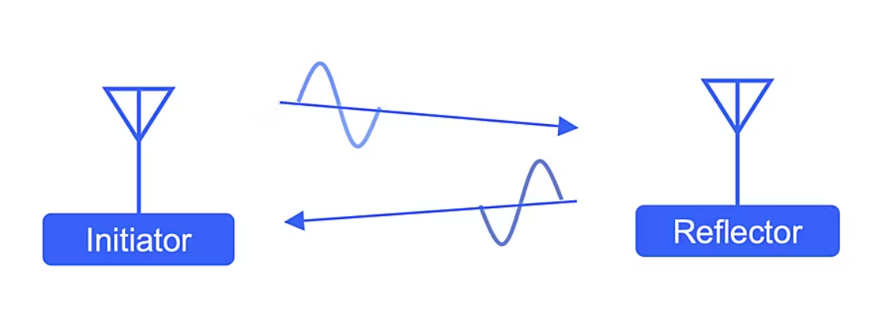
PBR calculates distance using the principle of phase rotation of an RF signal.
In this process, the Initiator transmits a signal with specific frequency and amplitude information, and the Reflector measures the phase of this received signal before transmitting a response. By comparing the phase difference between the signals from both devices, their relative distance can be determined. PBR offers significant security advantages, especially compared to methods like RSSI (Received Signal Strength Indicator). The manipulation of phase information is complex, making PBR a more secure technique for distance measurement.
RTT (Round Trip Time)
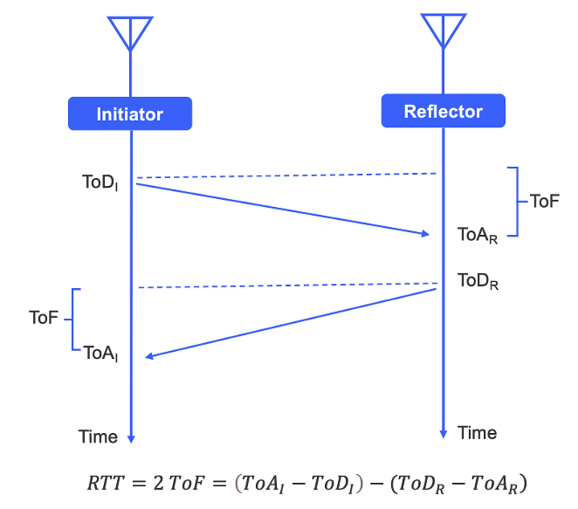
RTT refers to the time it takes for a signal to travel from the Initiator to the Reflector and back. Distance can be estimated by calculating the Time of Flight (ToF), which is the time it takes for a packet exchange between the Initiator and the Reflector. To achieve this, both devices record the Time of Arrival (ToA) and Time of Departure (ToD). Analyzing the difference between the ToA and ToD of the Initiator and the Reflector provides the data required for reliable distance calculation. Also, in terms of security, RTT is considered to be highly secure since time cannot be reversed.
Use Case
The diagram below is an example of a channel sounding use case.
It will enable next-generation wireless access and proximity solutions, and its functions are expected to be used in a variety of fields and applications.
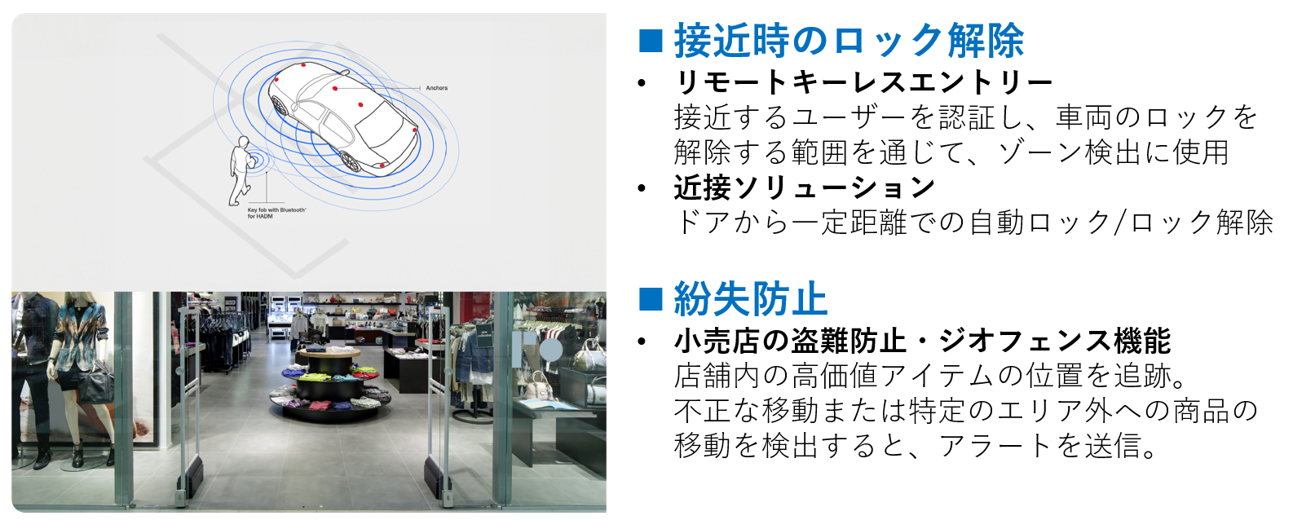
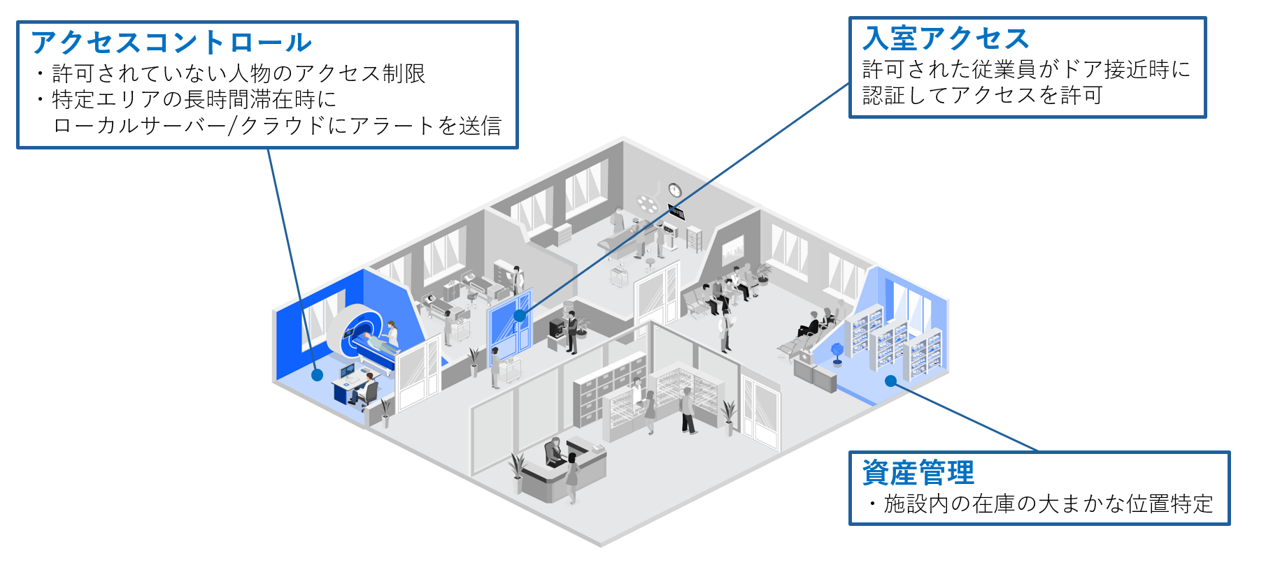
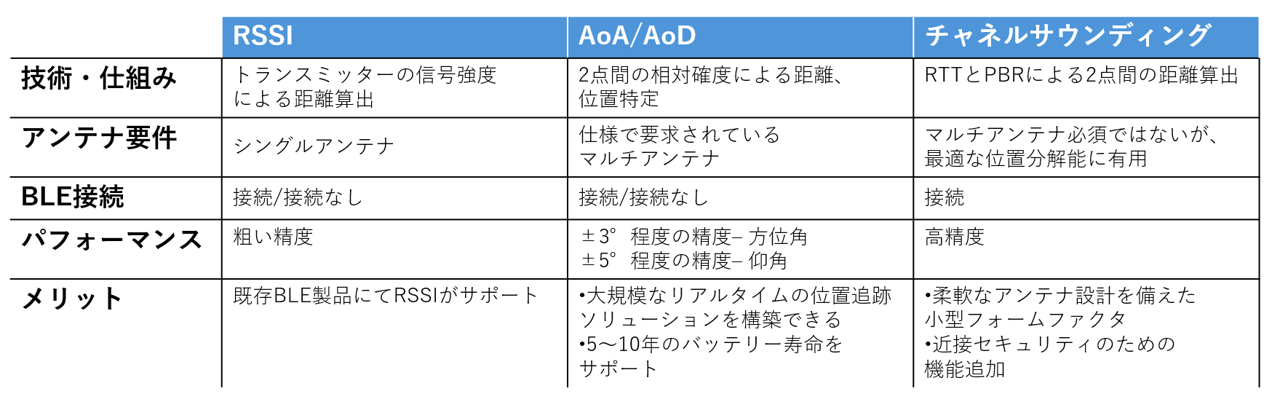
Features of various positioning solutions
With so many positioning solutions available on the market today, it's important to choose the best one for your IoT project.
Compared to conventional ranging solutions, channel sounding enables high-precision ranging while miniaturizing device size.
This could become an option for applications that have been difficult to realize until now.
Silicon Labs Evaluation Kits/Solutions
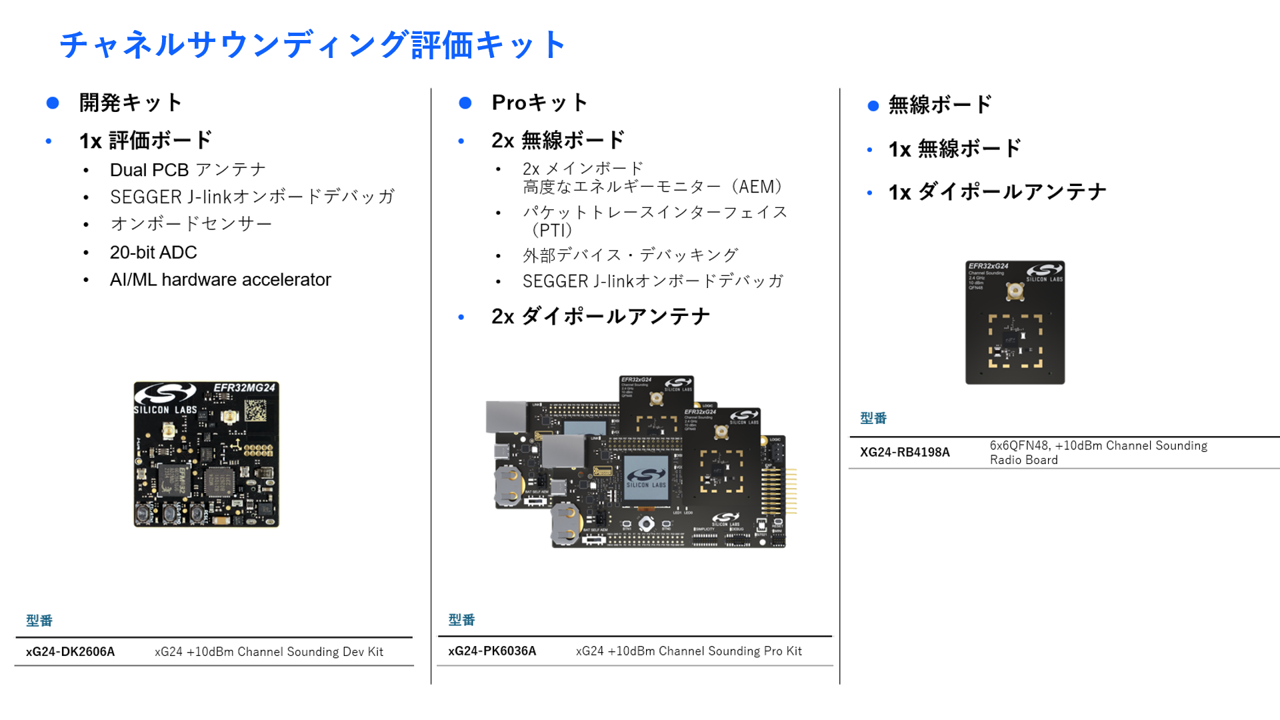
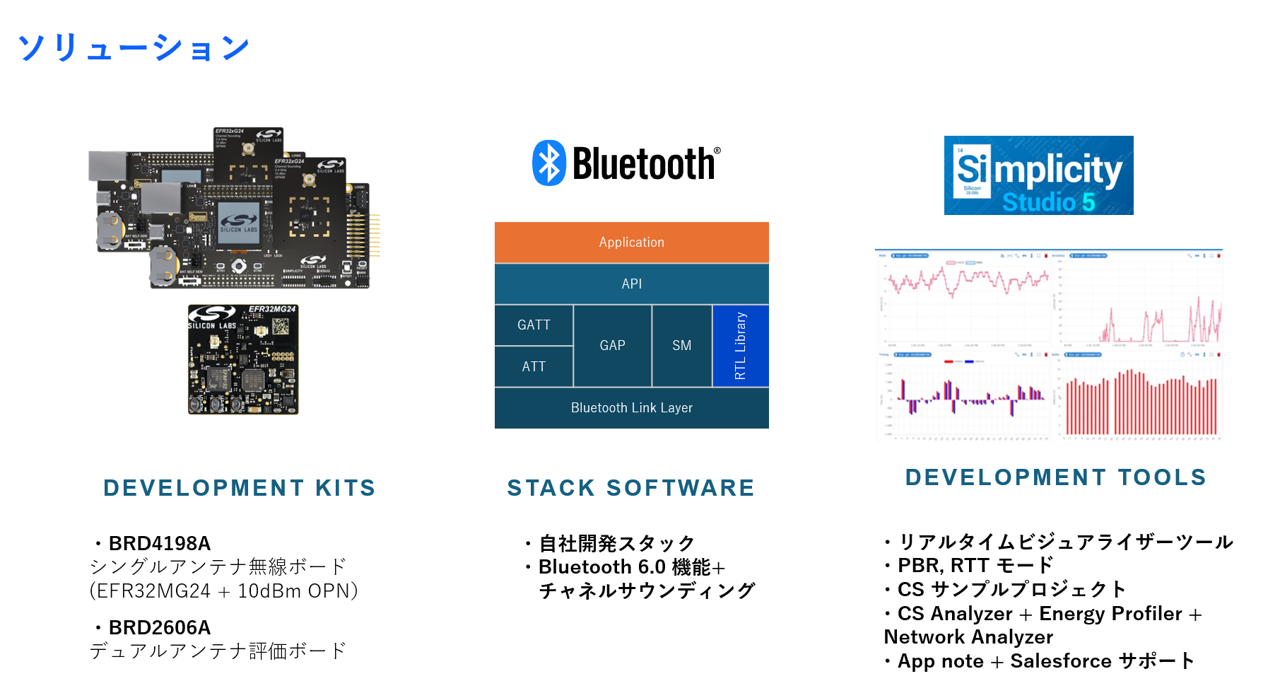
Shown below are the channel sounding evaluation kits and solutions offered by Silicon Labs.
Silicon Labs has been working from an early stage to prepare an evaluation environment so that customers can actually touch the product and evaluate its channel sounding performance.
After purchasing the evaluation board, you can easily set up a project using Silicon Labs' free Simplicity Studio and evaluate it using the real-time visualizer tool.
If you are interested in the evaluation and evaluation environment of Bluetooth channel sounding, please contact us.
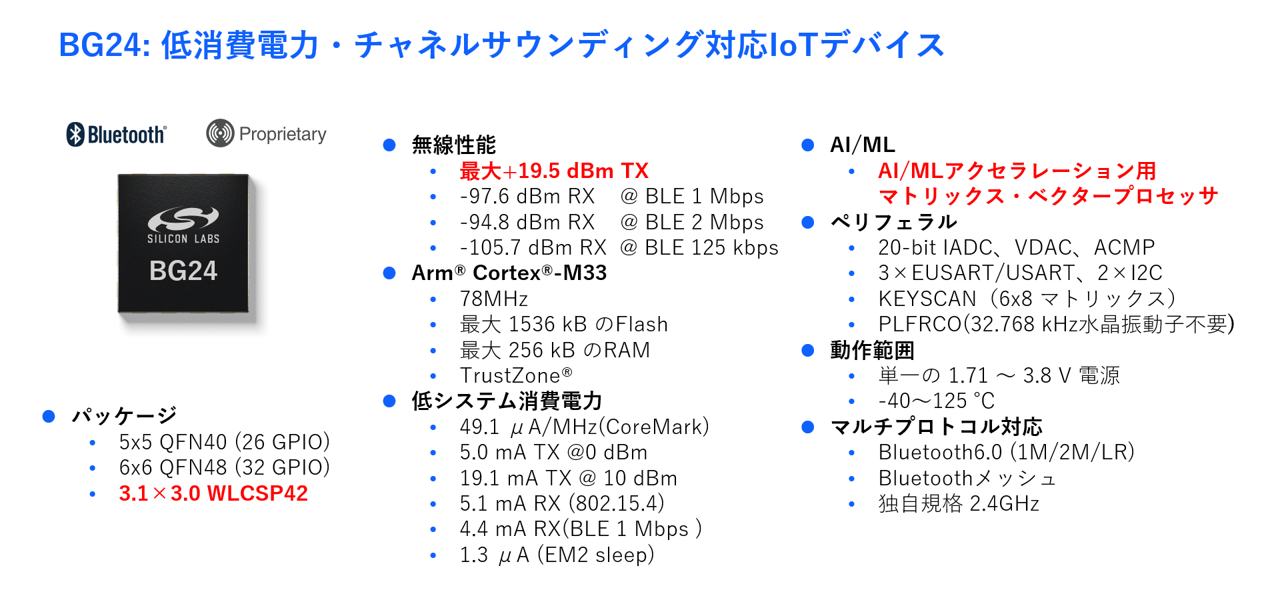
Low power consumption and channel sounding compatible wireless microcontroller "EFR32BG24"
Silicon Labs' EFR32BG24 (BG24) offers key features such as channel sounding support, high-performance 2.4 GHz RF, low power consumption, AI/ML hardware accelerators and AECQ-100 qualification, making it an ideal device for ranging and IoT wireless connectivity using Bluetooth Low Energy and Bluetooth mesh for smart home, lighting and portable medical products.
Related Information
Inquiry
If you have any questions regarding this product, please contact us using the form below.
Bluetooth standard "Bluetooth 6.0" certification
Silicon Labs'xG24 SoCs and xGM240 modules are now Bluetooth 6.0 qualified. Customers now have access to a variety of solutions to streamline certification for their development needs.