- Semiconductor BusinessHOME
- Products and Services of Macnica,Inc.
-
technical information

-
Events and Seminars
- Handling Manufacturer
- Support
- Inquiry
- Click here to purchase products
- Semiconductor business e-mail magazine registration


 Narrow down by specifying conditions
現在2176件がヒットしています。check

[Column] We conducted an ST 2110-30 audio transmission experiment using multiple Ethernet adapter cards.
1. Introduction
In recent years, IP-based media transmission technology has rapidly become popular in the broadcasting and production industries, replacing traditional SDI.
The core standard is SMPTE ® ST 2110, which enables efficient transmission of various media, including video, audio, and metadata, over IP networks.
Our products are available in on-premise and cloud environments. ST 2110 -20 / -30 / -40 etc. Software development kits available M2S SDK (Macnica Media Streaming SDK) *1 There is.
In this column, I will describe our company's transmission experiments using ST 2110-30, the audio transmission standard. Although ST 2110-30 requires a narrower network bandwidth than video transmission, it is beginning to be used in a variety of devices, such as audio mixers, routers, and switchers.
Our M2S SDK is compatible not only with dedicated network interface cards equipped with high-performance FPGAs (supporting hardware offload) used for ST 2110-20/-30/-40 packet processing, but also with cheaper, general-purpose Ethernet adapter cards used for ST 2110-30 packet processing in combination with software.
The M2S SDK can be used in combination with various adapter cards depending on the functionality and performance you want to achieve, andyou can reuse your existing software assets as they are even with different hardware configurations.
In this column, we will provide an overview of a transmission experiment using Macnica 's M2S SDK, which complies with the audio transmission standard ST2110-30.
*1. M2S SDK (Macnica Media Streaming SDK): A software development kit compatible with SMPTE ST 2110 for use in on-premise and cloud environments. Compatible with general-purpose Ethernet, it can be used in a wide range of ways depending on the application, and its API-based ease of development is a key feature of the product.
2. Experimental configuration
General-purpose products with the same specifications PC of 2 Prepare a table, 1 The PC (below, PC-A)for 1G of RJ45 (LAN connector) but 2 General-purpose port Ethernet adapter cards (Hereinafter, general-purpose Ethernet) equipped, 2 The PC (below, PC-B)for 10G of SFP but 2 There is a port NVIDIA® ConnectX® NIC *2 (below, ConnectX) is now included.
In addition, PC-B uses NVIDIA Rivermax® SDK *3 (hereinafter referred to as Rivermax SDK), which can optimize data streaming, and is equipped with a function that allows it to act as a simple PTP Grandmaster.
Detailed PC and NIC configurations are shown in Table 1.
Table 1: PC & NIC configuration summary table
| classification | item | PC-A | PC-B |
|
PC |
OS |
Ubuntu 22.04 |
|
|
CPU |
Intel® Core™ i9 13900H |
||
|
RAM |
32GB(DDR5) |
||
|
ROM |
1TB(M.2 SSD) |
||
|
NIC |
Onboard NIC |
General-purpose Ethernet |
ConnectX |
|
speed |
1 G |
10 G |
|
|
connector |
RJ45 |
SFPs |
|
|
number of ports |
2 |
2 |
|
|
Packet Transmission Method |
OS usage |
Use of Rivermax SDK |
|
|
remarks |
|
Uses simplified PTP Grandmaster functionality |
|
General-purpose Ethernet is available at reasonable prices and in a wide variety of product lineups, making it easy to achieve the optimal configuration for your application while keeping costs down.
Meanwhile, the combination of ConnectX and Rivermax SDK allows for configuration to meet strict timing and traffic flow requirements.
*2.NVIDIA® ConnectX® NIC: A NIC that achieves advanced hardware offload and acceleration.
*3.NVIDIA Rivermax® SDK: Software development kit that optimizes high-bandwidth, low-latency data streaming over networks
3. Experimental configuration (overall configuration)
This time, we compared the results when Encap was performed on a Linux PC [PC-A] equipped with general-purpose Ethernet, and when Encap was performed on ST 2110-30 on a Linux PC [PC-B] equipped with NVIDIA ConnectX.
The sound source was an audio waveform automatically generated by a PC, the number of channels was 16, and the transmission packet interval was 0.125 ms.
Additionally, to check whether the audio is being transmitted correctly over the network, the audio is transmitted via SDI and the actual sound is confirmed using speakers connected to an SDI waveform monitor.
The overall configuration is shown in Figure 1, and the actual configuration is shown in Figures 2 and 3.
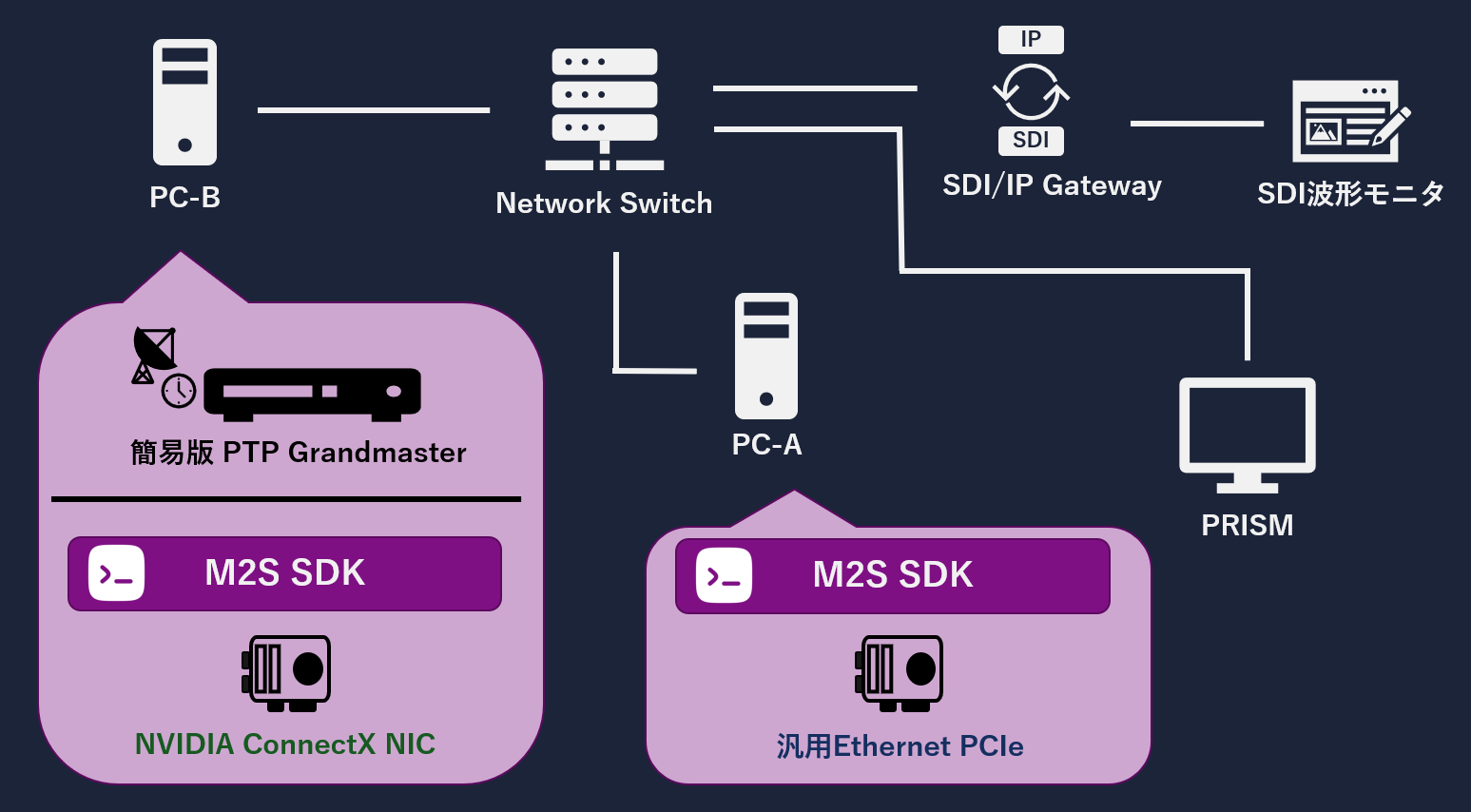
Figure 1: Overall diagram of the experimental setup
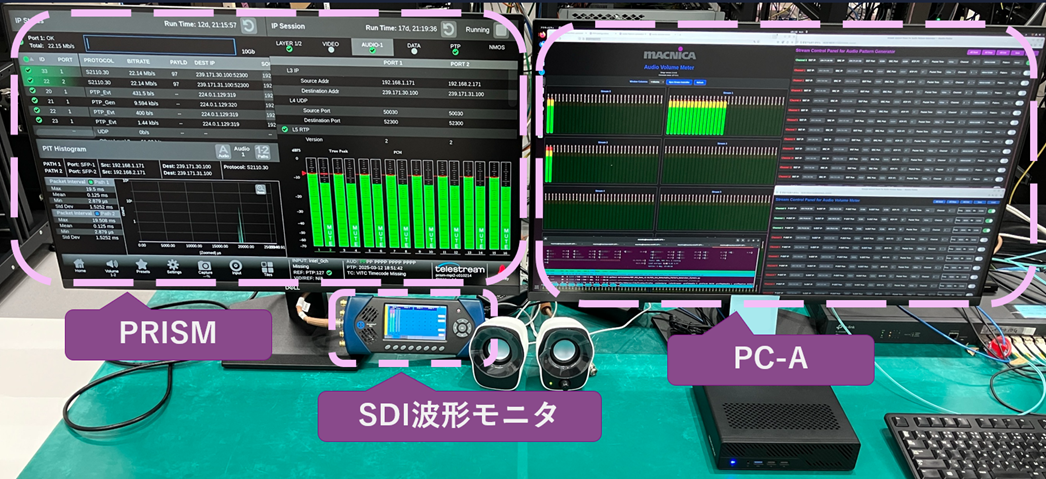
Figure 2: Actual configuration image ①
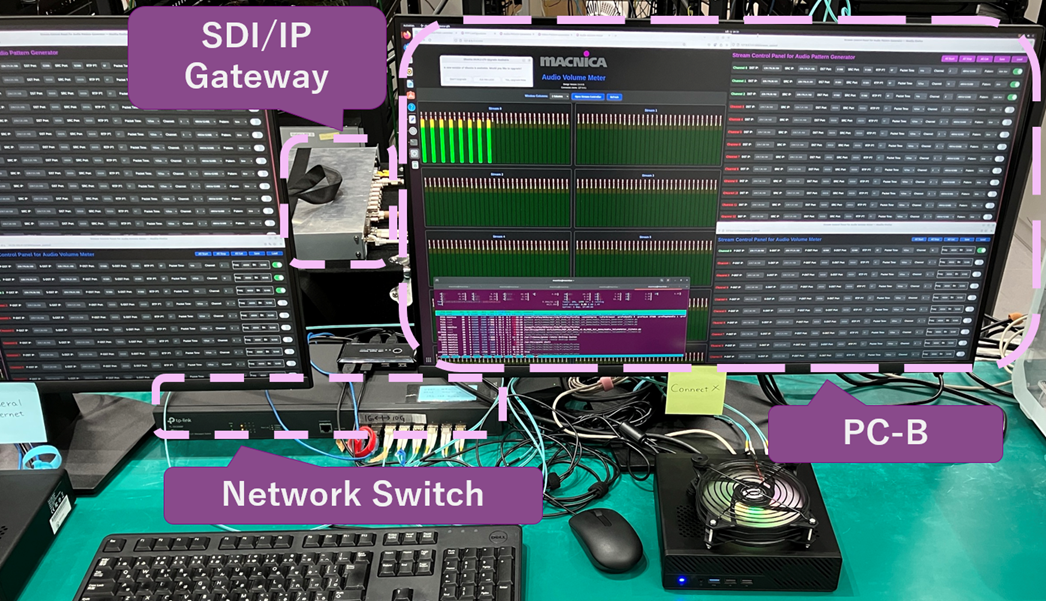
Figure 3: Actual configuration image ②
4. Experimental details
Experiment 1
In experiment 1, we performed ST 2110-30 Encapsulation using a general-purpose Ethernet-equipped PC [PC-A] (part 1 in Figure 4).
The encapsulated ST 2110-30 is decapped by three devices: the ConnectX-equipped PC [PC-B], the SDI/IP Gateway, and PRISM (parts ②-a, -b, and -c in Figure 4).
The details of Experiment 1 are shown in Figure 4.
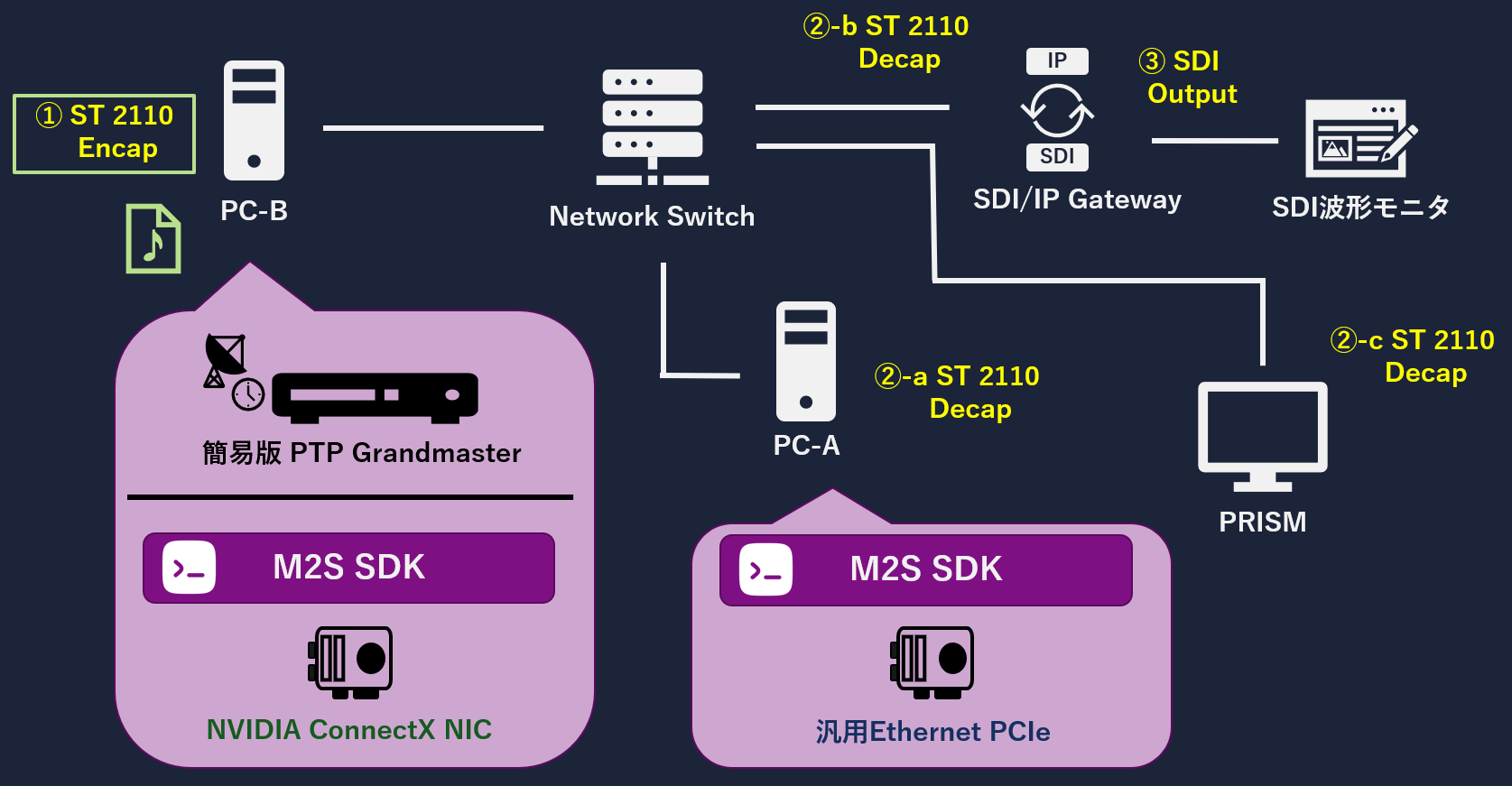
Figure 4: Details of Experiment ①
In experiment 2, we will encap the ST 2110-30 using the ConnectX-equipped PC [PC-B] (part 1 in Figure 5).
The encapsulated ST 2110-30 is decapped by three devices: a general-purpose Ethernet-equipped PC [PC-A], an SDI/IP Gateway, and a PRISM (see parts ②-a, -b, and -c in Figure 5).
The details of Experiment ② are shown in Figure 5.
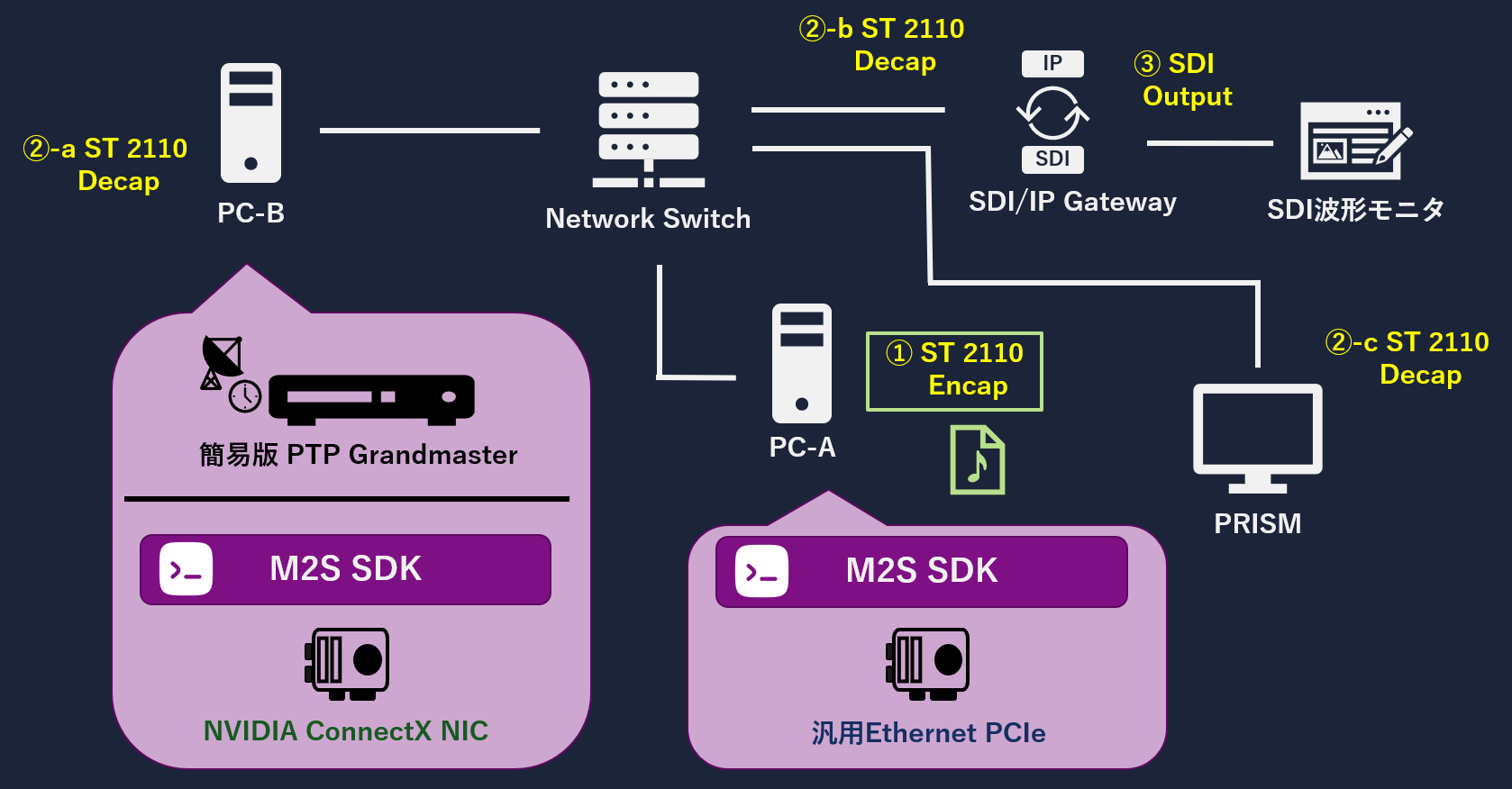
Figure 5: Details of Experiment ②
5. Verification results
[Auditory check]
We actually listened to the sound through a speaker, but at the level of simply listening to the sound, no difference was found between Experiments 1 and 2.
[Check packet interval]
Regarding the difference between a general-purpose Ethernet-equipped PC [PC-A] and a ConnectX-equipped PC [PC-B], we focused on the packet intervals and actually confirmed the packet intervals using PRISM.
The results of Experiment 1 are shown in Figure 6.
The average packet interval encapped by the general-purpose Ethernet-equipped PC [PC-A] in Experiment 1 was an accurate value of 0.125 ms.
However, when checking the packet interval graph and maximum / minimum values, fluctuations occur in the range of approximately 2.9 μs to 19.5 ms.
The general-purpose Ethernet used in this example supports PTP, but packets are sent using OS functions.
In terms of OS functions, we believe that the above-mentioned variations in packet transmission timing occurred due to factors such as the load of the OS and other applications and the timing of interrupt processing.
Therefore, we will continue to optimize the algorithm to more accurately time packets.
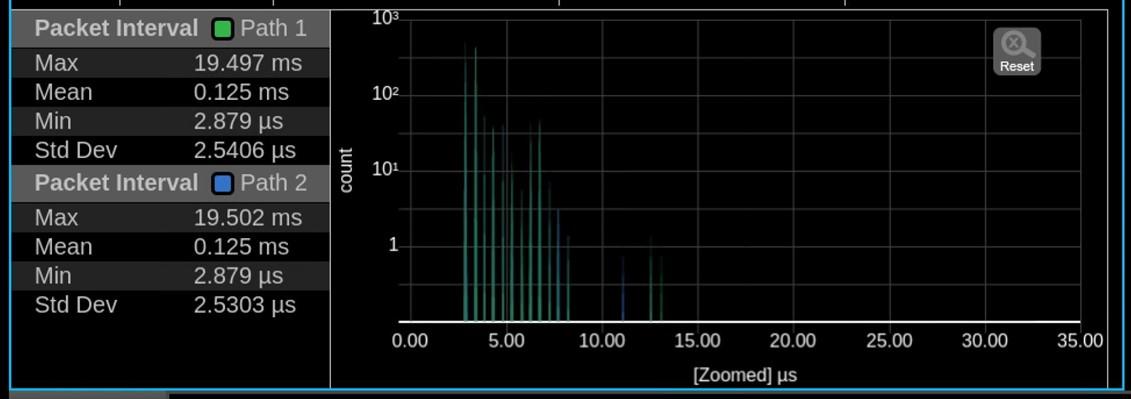
Figure 6: Results of Experiment 1
On the other hand, the results of experiment ② are shown in Figure 7.
On the other hand, the packet intervals encapsulated from the ConnectX side in Experiment ② had an average value of 0.125 ms and a range of approximately 0.121 to 0.129 ms.
As a result, packets were sent with a maximum error of approximately 40 μs.
In the case of ConnectX, you can use the Rivermax SDK, which has the function of sending packets at the exact time, so packets can be sent at the exact time.
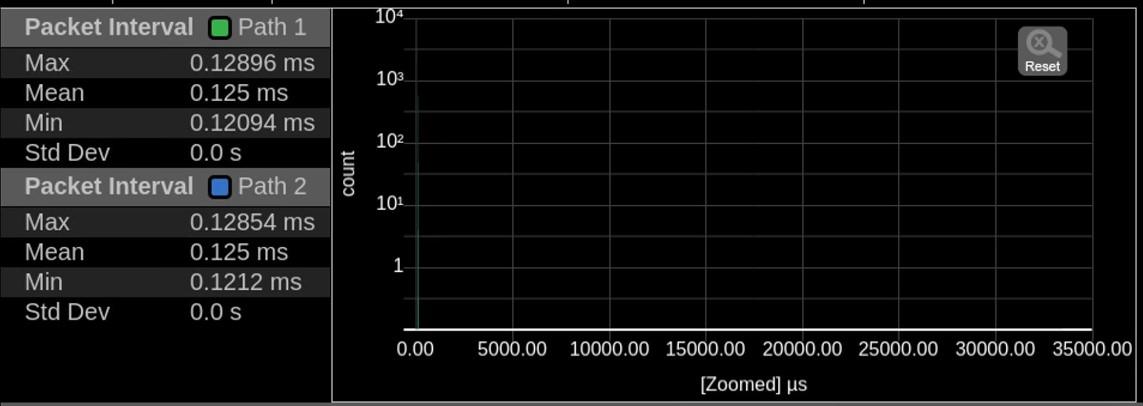
Figure 7: Results of Experiment 2
6. Conclusion
This time, we compared the results of encapsulating ST 2110-30 on a PC with a general-purpose Ethernet interface with those of encapsulating on a PC with NVIDIA ConnectX.
With general-purpose Ethernet, fluctuations in the range of approximately 2.9 μs to 19.5 ms occur when packets are sent, making it impossible to send packets with accurate timing.
General-purpose Ethernet packet transmission uses OS functions, but it appears that packets could not be sent at the correct timing due to factors such as the load of the OS and other applications and the timing of interrupt processing.
In the future, we will continue to optimize the algorithm to more accurately time packets.
In the case of ConnectX, you can use the Rivermax SDK, which has the function of sending packets at the exact time, so packets can be sent at the exact time.
Therefore, we believe that using general-purpose Ethernet may be an option for systems that do not require strict accuracy in packet transmission timing, or for systems that require cost control and require optimal configuration for the intended use.
On the other hand, if strict timing and traffic flow requirements are required, we believe that building a system using a combination of ConnectX and Rivermax SDK is a more appropriate option.
In addition to the M2S SDK products introduced here, Macnica offers a wide range of Media Over IP solutions.
We offer the MEP100, a 100G SmartNIC that supports major SMPTE and NMOS standards, including ST 2110-22 (JPEG XS).
The biggest feature of the MEP100 is that it has the ability to process the ST 2110 protocol within the FPGA, and because the DMA controller is implemented in hardware, packet processing and JPEG XS conversion can be performed without having to process within the CPU or GPU.
This means that more CPU and GPU resources can be allocated to your applications.
If you are interested in Media Over IP or would like to discuss anything, please feel free to contact us.
postscript
Our MEP100 was selected as Product of the Year at the NAB Show 2025, held in Las Vegas, USA from April 5th to 9th, 2025!
The MEP100 is a 100G Smart NIC that complies with ST 2110 and has attracted interest from many customers, including data centers and broadcasting stations both in Japan and overseas.