- Semiconductor BusinessHOME
- Products and Services of Macnica,Inc.
-
technical information

-
Events and Seminars
- Handling Manufacturer
- Support
- Inquiry
- Click here to purchase products
- Semiconductor business e-mail magazine registration


 Narrow down by specifying conditions
現在2201件がヒットしています。check
Introduction
The keyword "band gap" is essential to understanding the essence of semiconductors. In the previous article, we explained that semiconductors are "materials that have a band gap."
This time, we will introduce a technology that allows for "free manipulation" of the band gap.
*For the previous article, please refer to the article below.
What is a band gap again?
A band gap is the "region in which electrons cannot exist" that exists between the valence band and conduction band, among the energy bands in which electrons in a material can exist.
The size of this gap determines whether a material is classified as a conductor, semiconductor, or insulator.
For example, silicon (Si) has a bandgap of approximately 1.1 eV and functions as a semiconductor at room temperature.
On the other hand, gallium nitride (GaN) has a wider bandgap of about 3.4 eV, and aluminum nitride (AlN) has a wider bandgap of about 6.2 eV, and these are called "wide bandgap semiconductors."
How to manipulate the band gap
The size and properties of these bandgaps can be intentionally changed by adjusting the composition and structure of the material, making it possible to optimize the electrical and optical properties of semiconductors according to the purpose.
For example, compound semiconductors such as GaN, AlN, gallium arsenide (GaAs, commonly called gallium arsenide), indium phosphide (InP), and aluminum gallium nitride (AlGaN, commonly called AlGaN) combine multiple elements to adjust the band gap to the intended size and characteristics.
The widely used silicon is used by changing the carrier concentration and band structure by adding impurities. The figure below shows the difference in band structure between the undoped state and n-type and p-type doping.
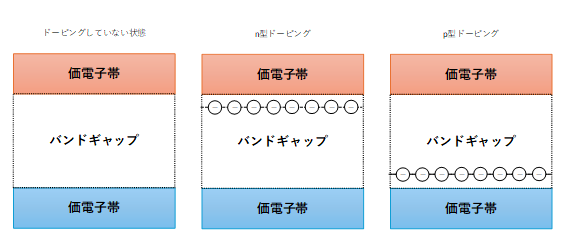
In n-type semiconductors made by n-type doping, pentavalent impurity elements such as phosphorus (P) and arsenic (As) are added (doped).
These elements have one extra valence electron, which exists in the donor level just below the conduction band. At room temperature, this electron easily moves into the conduction band, increasing the number of free electrons and improving conductivity.
In p-type semiconductors, which are made by p-type doping, trivalent impurity elements such as boron (B) or aluminum (Al) are added.
These have one less valence electron, forming an acceptor level just above the valence band. When an electron moves from the valence band to the acceptor level, a hole is created in the valence band, which functions as a carrier.
By freely manipulating the band gap in this way, LEDs (light-emitting diodes) can change the wavelength of light emitted depending on the size of the band gap, and multi-junction solar cells can efficiently absorb a wide range of light by stacking materials with multiple band gaps.
Additionally, the Esaki diode (tunnel diode), developed by Dr. Leona Esaki, a Nobel Prize winner in Physics, combines the properties of different bandgaps to form a quantum well structure and control the behavior of electrons.
In recent years, materials that go beyond the conventional concept of band gaps, such as two-dimensional materials (such as graphene) and one-dimensional semiconductors (carbon nanotubes), have appeared. It is becoming possible to change the band gap of these materials in real time by applying an external electric field or irradiating light.
References
[1] Nobuo Mikoshiba (1982) "Physics of Semiconductors" Baifukan
[2] Yasuhiko Nishikubo (2021) “Illustrated Introduction to the Basics and Mechanisms of the Latest Semiconductors [3rd Edition]” Hidewa System
Inquiry
If you are interested in the content introduced in this article, please feel free to contact us.
Onsemi Manufacturer information Top
If you want to go back to ONSEMI Manufacturer Information Top, please click below.