- Semiconductor BusinessHOME
- Products and Services of Macnica,Inc.
-
technical information

-
Events and Seminars
- Handling Manufacturer
- Support
- Inquiry
- Click here to purchase products
- Semiconductor business e-mail magazine registration


 Narrow down by specifying conditions
現在2207件がヒットしています。check

A very distinctive cascode-connected "SiC cascode JFET"
In this article, we will explain ON Semiconductor's "SiC Cascode JFET", which has a very distinctive cascode connection.
Cascoded Devices from ON Semiconductor
A simplified circuit diagram of the inside of an actual device is shown in the figure below. As you can see, the SiC-JFET and Si-MOSFET are connected in cascode. This type of connection makes it look like a Si-MOSFET is connected to the user, greatly improving usability. Also, SiC-JFETs are normally on, meaning that when the gate or other parts are open, they turn on and enter a dangerous mode, but by connecting them in cascode, they can be made normally off. ON Semiconductor is the only company currently developing this type of SiC.
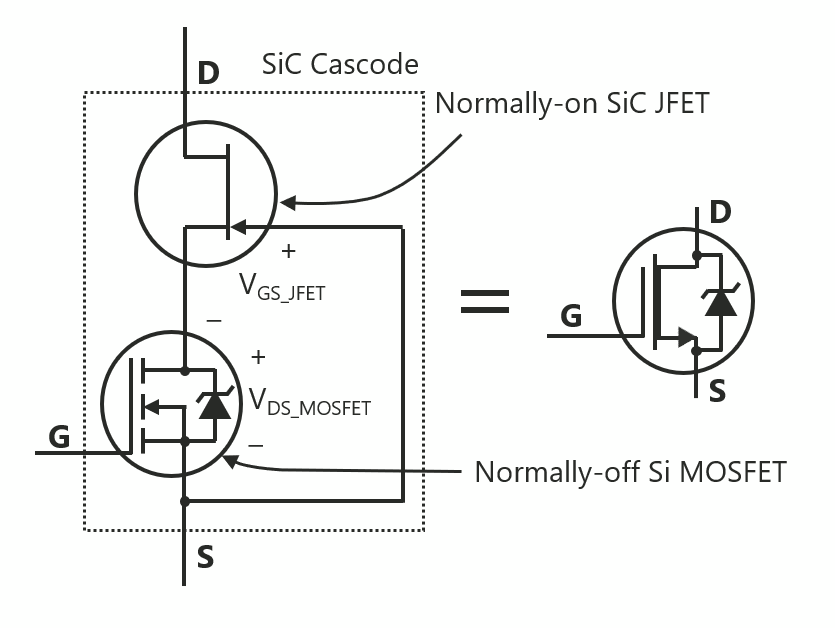
ON Semiconductor's cascode-connected "SiC cascode JFET"
Why ON Semiconductor's SiC cascode JFET devices have low on-resistance per unit area
The diagram below shows a simplified cross-sectional structure of a typical SiC MOSFET and an ON Semiconductor SiC cascode JFET connected in cascode. We will analyze the on-resistance when voltage is applied, and the parameters RDRIFT and RJFET are almost the same for both SiC MOSFETs and SiC JFETs. However, SiC MOSFETs have something called channel resistance, which is very high.
Looking at ON Semiconductor's SiC cascode JFET, the JFET does not have the channel resistance of the SiC MOSFET, but it does have the on-resistance of the Si MOSFET. This Si MOSFET is designed by ON Semiconductor and has a very low on-resistance. This makes it 10% or less of the on-resistance of the entire FET, resulting in a low total on-resistance.
This is why ON Semiconductor's SiC cascode JFETs have such low on-resistance. Now that we understand the low on-resistance of the devices, we can next explain the ease of driving the SiC cascode JFET series.
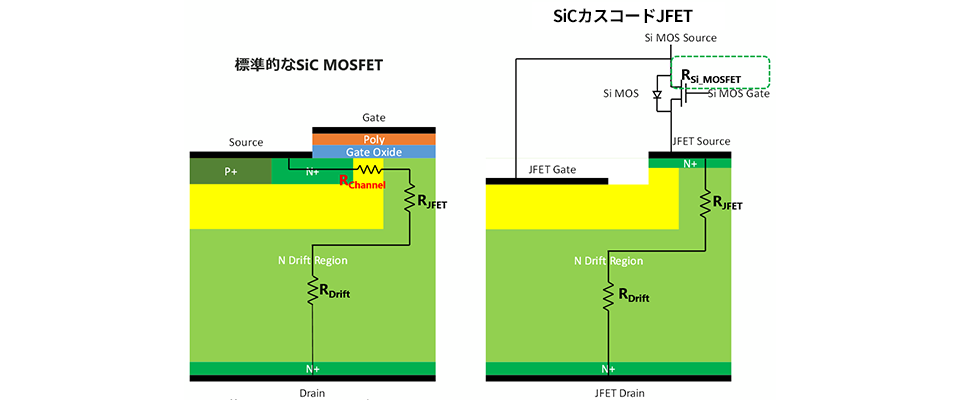
Simplified cross-section of a typical SiC MOSFET and ON Semiconductor's SiC cascode JFET
Ease of driving ON Semiconductor devices
Next, we will explain the ease of driving SiC-FETs. A typical SiC MOSFET requires a negative voltage such as -5V to be completely off. A high voltage such as 15V is required to be completely on. Also, in many cases, VGS can only tolerate up to -7V. This is due to the channel structure of SiC MOSFETs, which means that there is little margin in the drive voltage compared to the VGS withstand voltage. Above is a graph of the maximum VGS rating and the recommended VGS operating voltage, but SiC MOSFETs do not have much margin, and exceeding the maximum rating will affect the device's lifespan. Looking at ON Semiconductor's SiC cascode JFET, VGS is 0 to 12V and the withstand voltage is ±20V, which is about the same as a typical Si MOSFET. As you can see from this value, it is very robust compared to SiC MOSFETs, which expands the options for gate drive circuits.
This means that existing drivers for Si-MOSFETs, SiC-MOSFETs, IGBTs, etc. can be used as is, meaning that customers who are currently designing applications using Si-MOSFETs do not need to prepare a new negative power supply, etc.
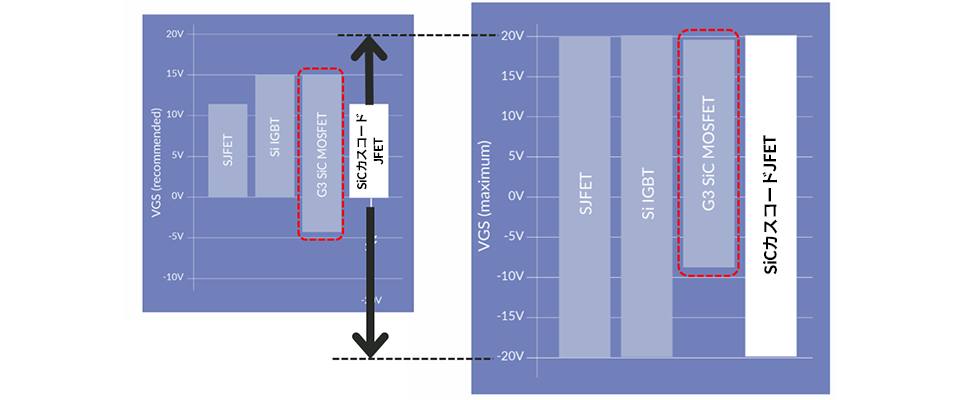
Recommended operating voltage for VGS and absolute maximum ratings
Related Information
For information about ON Semiconductor's distinctive SiC cascode JFET series, please refer to the product lineup in the link below or contact us individually.
Inquiry
If you have any questions regarding this article, please contact us below.
On Semiconductor Manufacturer Information Top Page
If you want to go back to ONSEMI maker information top page, please click below.