- Semiconductor BusinessHOME
- Products and Services of Macnica,Inc.
-
technical information

-
Events and Seminars
- Handling Manufacturer
- Support
- Inquiry
- Click here to purchase products
- Semiconductor business e-mail magazine registration


 Narrow down by specifying conditions
There are currently 2236 results.
![[Comprehensive Explanation] MIPI is not difficult! Newbies learn the MIPI standard from scratch ~ Basics Part 3 DSI ② ~](/business/semiconductor/articles/0004ee9b117a10887cf6e5889a1888cc_27.png)
Hello! I'm Hiromin from Lattice team rookie FAE!
This blog is my study process about MIPI standards.
What is MIPI? What are the differences between the DSI/CSI-2 standards? How to design with Lattice FPGA?
From the basics to applications, I would like to tell you everything I have learned!
Now, this time, I would like to learn about MIPI DSI according to the table of contents below.
You can also go directly to the part you want to learn by the links below, please check it out!
[What you can learn from this article]
Learn about DSI!
・ What are the specifications specific to DSI?
・ Click here to download MIPI DSI Encyclopedia!
Please click the link below to read the previous article, Part 2 MIPI DSI ①!
Byte Data and Pixel Data
By the last time, we studied the details of each packet.
From here, I would like to study the remaining items.
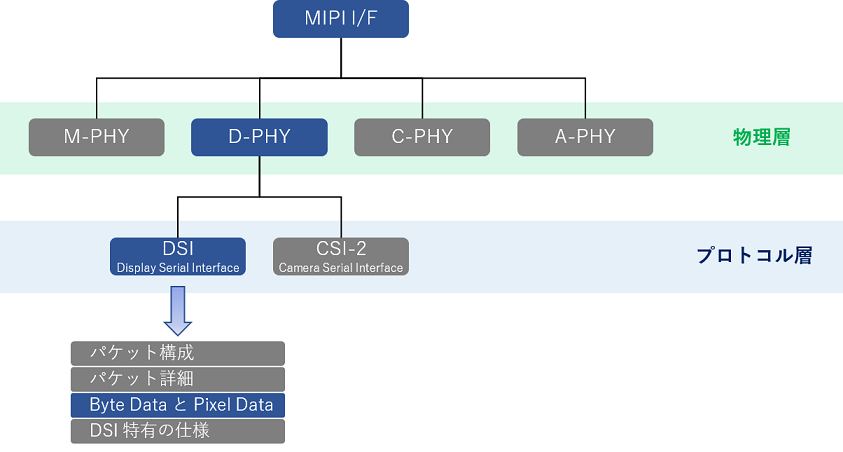
Let's start learning about Byte Data Pixel Data!
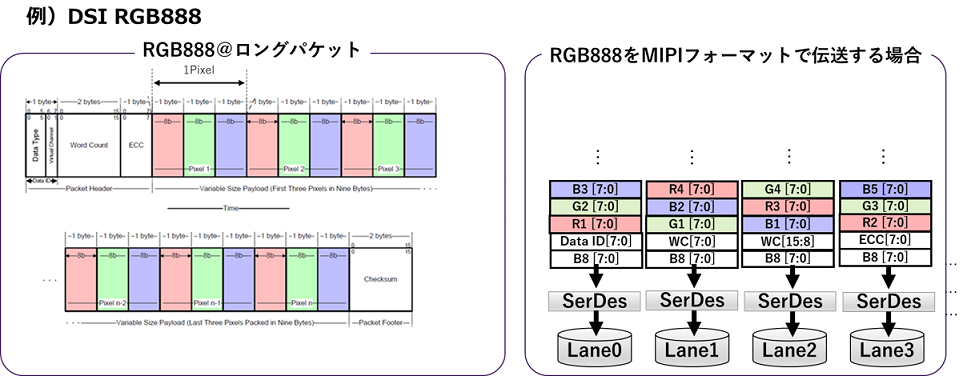
First, I would like to refer to the DSI RGB888 example.
RGB888 is a color format, and there are other formats such as YUV and YCbCr.
Each of the three primary colors, R = red, G = green, and B = blue, is represented by a total of 24 bits of 8 bits.
例えば、RGB888の場合、それぞれ 8bit のデータとして、1pixel 合計24bit で構成されています。
MIPI has a fixed rule to handle all data in units of 1 byte.
In the case of RGB888, packing is not necessary because this rule fits.
Also, regarding how to send MIPI data, as shown on the right side of the figure below
MIPI transfers data in fixed sequences of data called lane distribution functions.
As before, this is also a fixed rule of the MIPI standard.
If there are multiple lanes such as Lane0 1st stage, Lane1 1st stage, Lane2 1st stage, and Lane3 1st stage, they are output in parallel.
In case of serial lane, it becomes serial output.
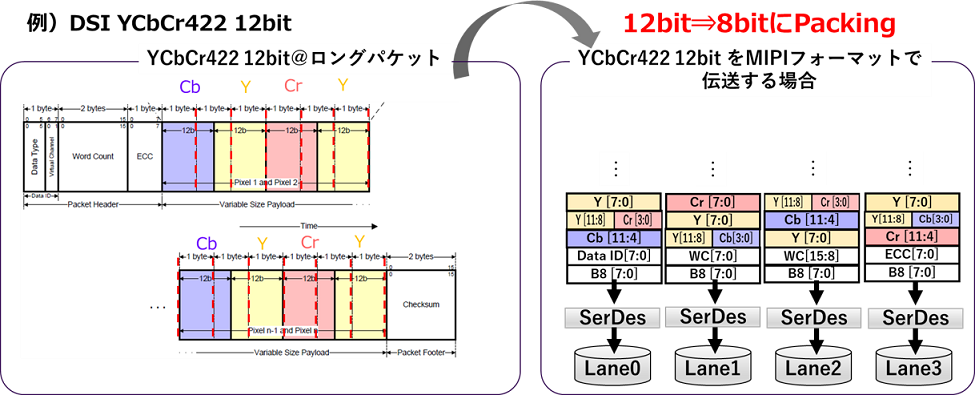
Next, let's check the case of DSI YCbCr422 12bit!
YCbCr is a method of expressing colors using three types of luminance component Y, Cb obtained by subtracting luminance from blue, and Cr obtained by subtracting luminance from red.
どうやらRGBよりもデータ量が少なくて済む、効率的な方法のようです。
It consists of 12 bits each for Y, Cb, and Cr. However, MIPI had rules for sending data in 8-bit units, right?
Therefore, it becomes necessary to perform packing for formats that do not comply with MIPI rules.
Packing means decoding from the original data width to 8bit. This makes it possible to transfer as MIPI data.
After that, as before, by the lane distribution function
If there are multiple lanes, transfer the data.
It doesn't seem to change even if the format changes here!
Now you understand the concepts of Byte Data and Pixel Data!
Next, we will study the MIPI DSI specific specifications.
What are the DSI specific specifications?
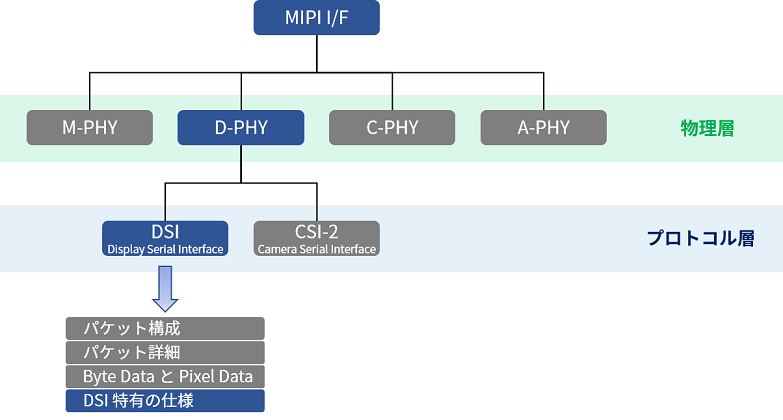
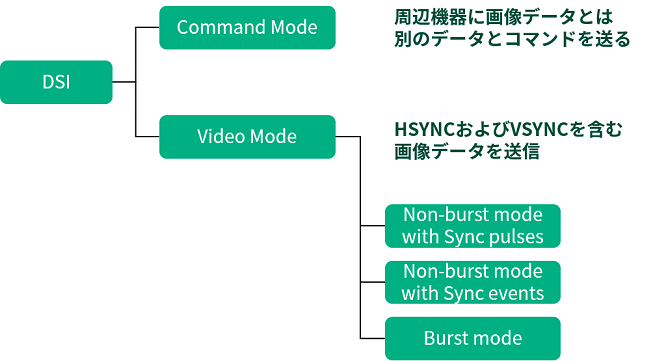
As shown in the figure below, there are two major DSIs:
It can be divided into Command Mode and Video Mode.
Command Mode sends data and commands separate from image data to peripherals.
On the other hand, Video Mode transmits image data including HSYNC/VSYNC.
In addition, Video Mode is further divided into three Modes.
These modes differ depending on the device, so care must be taken when dealing with DSI.
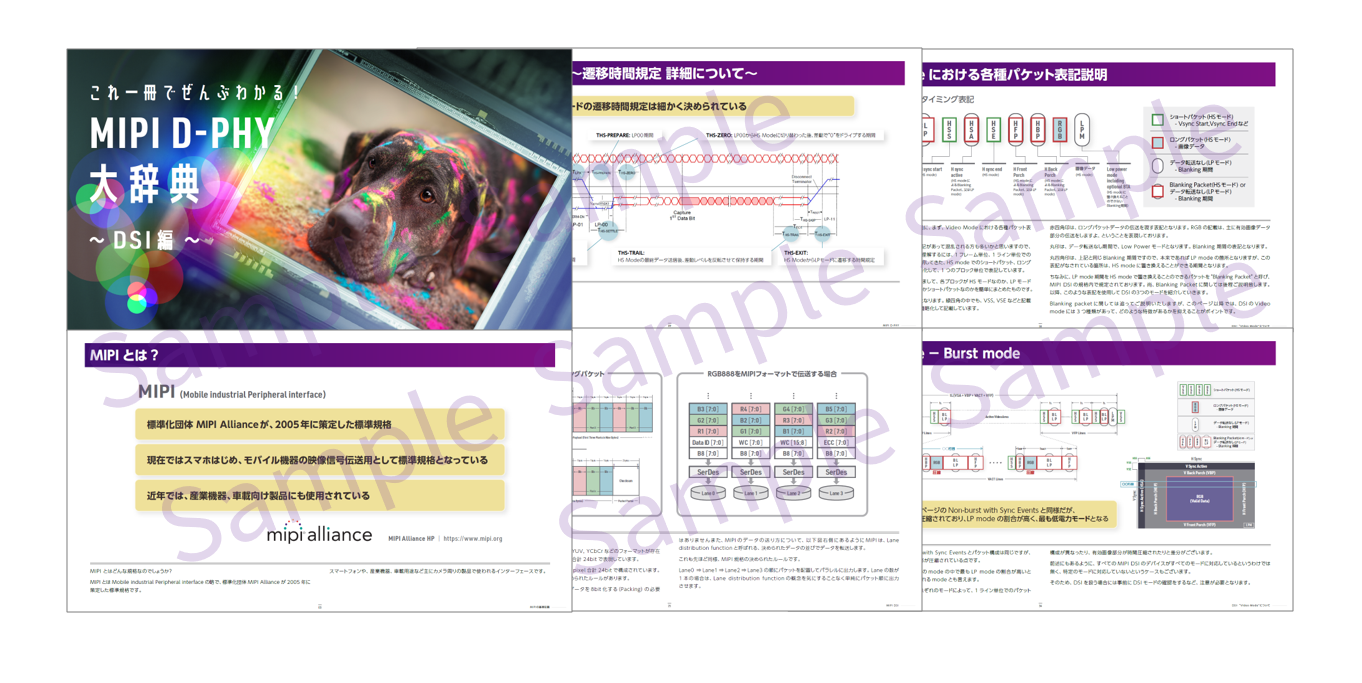
"Everything" of MIPI DSI in one document
Regarding DSI, there are details of each mode that I haven't explained yet, but from here on it's difficult for Hiromin to understand and share with everyone.
Therefore, while listening to MIPI Maestro G senior who covers all of MIPI standards,
We have created a document that describes all the necessary contents of MIPI DSI, including the contents explained in the first article and the second article!
Please feel free to download it and use it as a reference for your development with MIPI D-PHY and DSI.
▼▽▼▽▼▽▼▽▼▽▼▽▼▽▼▽▼▽▼▽▼▽
You can understand everything in this one book! MIPI D-PHY Encyclopedia ~DSI Edition~
In the next article, I would like to study MIPI CSI-2!
Well, see you next time in the 4th installment, CSI-2! Bye~

New Engineer's Struggle ~MIPI Standard Version~
The MIPI standard is a communications standard that has become widely used in recent years for display interfaces and image sensor output interfaces.
I know the name of the standard, but what about the communication bandwidth? What protocol is used for transmission?
This article focuses on DSI/CSI within MIPI and is intended for newcomers to learn from scratch.
We write articles about MIPI standards with the motto of making them easier to understand and more enjoyable than other articles.
Would you like to study with new recruits?