- Semiconductor BusinessHOME
- Products and Services of Macnica,Inc.
-
technical information

-
Events and Seminars
- Handling Manufacturer
- Support
- Inquiry
- Click here to purchase products
- Semiconductor business e-mail magazine registration


 Narrow down by specifying conditions
現在2240件がヒットしています。check


Hi! I'm Taro.
This time, I'll be writing about timing products.
As I wrote in a previous column, clock products include not only those that output clock signals, but also buffers and synthesizers.
Furthermore, oscillators, buffers, and synthesizers each come in many varieties depending on their specifications.
"There are so many options, it's hard to know what's best."...I often hear people say this.
発振器の分類
Oscillators are classified as follows according to the principle of clock signal generation:
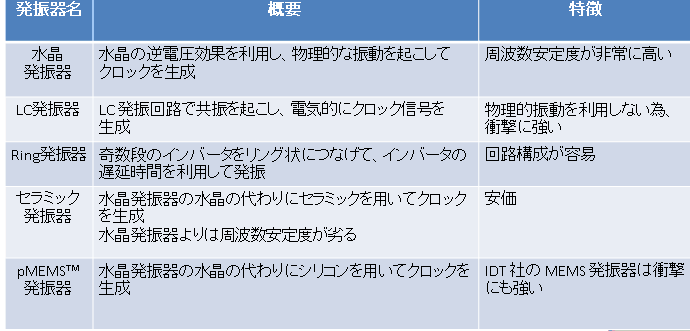
We can propose the most suitable oscillator based on your product specifications and requirements.
If you have any questions or concerns regarding timing products, please contact us.
About clock generators
Oscillators are not the only products that supply clock signals.
A clock generator can also output a clock signal.
A clock generator is a device that creates a desired frequency from a source oscillator, such as a crystal oscillator, and outputs that frequency.
Note: As explained in a previous column, a synthesizer creates the desired frequency from the input signal and outputs it.
Clock generators and synthesizers are differentiated by the following features:
- Number of outputs
- Possible output frequency
- Program feasibility
- Type of source oscillator (reference signal/crystal oscillator, etc.) etc…
This article summarizes key points to consider when selecting a clock generator/synthesizer, as well as important considerations for its use.
The advantages of using a clock generator are cost reduction, reduced board area, and reduced jitter.
For example, instead of using multiple oscillators of the same frequency, replacing them with a clock generator reduces the number of components in the crystal oscillator.
As a result, the cost of the circuit board can be reduced.
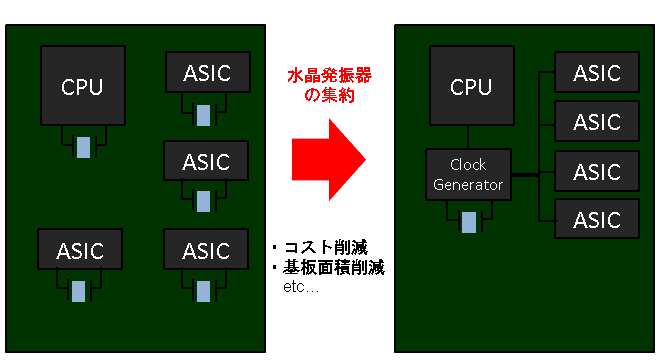
When using a clock generator in this way, the number of outputs becomes important.
However, the number of output wires is not the only important factor. Depending on the downstream device, you must also pay attention to skew.
Skew refers to the magnitude of the delay between the outputs of a buffer or multiple clock generators.
This is different from Jitter!
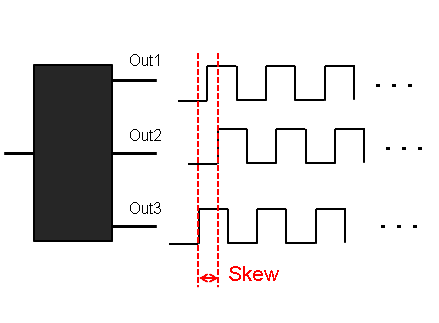
Timing products with multiple outputs often exhibit skews like the one shown in the diagram above.
Just because signals are output from the same clock generator doesn't necessarily mean they are synchronized.
After selecting a timing product based on the number of output lines, please pay attention to the Skew in the datasheet.
Some clock generators allow you to program the output frequency and the amplitude of the output signal.
These products are equipped with memory such as EEPROM, allowing the output frequency to be programmed via I2C communication after implementation.
Therefore, it is possible to design the circuit board even if the frequency to be used has not yet been determined.
Additionally, clock generators for PCI Express® products and Intel® products are also available.
With a wide variety of types and functions available, please feel free to contact us regarding timing products such as clock generators!