- Semiconductor BusinessHOME
- Products and Services of Macnica,Inc.
-
technical information

-
Events and Seminars
- Handling Manufacturer
- Support
- Inquiry
- Click here to purchase products
- Semiconductor business e-mail magazine registration


 Narrow down by specifying conditions
現在2165件がヒットしています。check
Why are wide bandgap semiconductors attracting attention?
From smartphones to EVs and renewable energy, semiconductors are used in many of the devices that support our daily lives.
Among these, the term "wide bandgap (WBG) semiconductor" has been frequently heard in recent years.
According to a survey by Fortune Business Insights, the WBG semiconductor marketis estimated to be worth US$2.08 billion in 2024, and is predicted to expand to US$6.22 billion by2034 (*1). This represents a high compound annual growth rate (CAGR) of 14.71%, indicating that WBG semiconductors are a market with great growth potential going forward.
*1 Source: WIDE BAND GAP SEMICONDUCTOR MARKET SIZE AND FUTURE OUTLOOK (Fortune Business Insights)
Wide Band Gap Semiconductor Market Size, Share [2032]
WBG semiconductors have a wider bandgap than conventional silicon (Si), enabling them to achieve device characteristics such as high breakdown voltage, low loss, and high-speed switching. As a result, the use of WBG devices enables applications to achieve higher capacity, higher efficiency, and higher frequencies, contributing to further improvements in energy efficiency and equipment performance.
With this technological evolution as a backdrop, we are entering an era where new materials such as SiC (silicon carbide) and GaN (gallium nitride) are used depending on the application, while still using Si as the base.
What is a band gap?
The band gap is the energy range in which electrons cannot exist.
The wider this width, the greater the breakdown field tends to be, allowing semiconductor devices to operate stably even in harsh environments such as high voltages, high temperatures, and high frequencies.
The breakdown field is an index that indicates the limit of the voltage that a semiconductor can withstand. Generally, there is a trade-off between increasing the withstand voltage and increasing the on-resistance (a cause of loss and heat generation that occurs when current flows).
However, this trade-off can be alleviated with materials with a high breakdown field, so even at the same breakdown voltage, SiC and GaN have lower on-resistance and lower loss and heat generation than Si. This makes it possible to miniaturize devices while still maintaining heat dissipation performance.
- Si: Well-balanced properties and used in a wide range of fields
- SiC/GaN: Next-generation materials with wide band gaps that complement Si
The wide band gap provides the following benefits:
・The dielectric breakdown field is increased, allowing high-voltage devices to be made smaller.
: Because the material itself can withstand high voltages, there is no need to stack thick semiconductor layers, making it possible to reduce the size while maintaining the same voltage resistance.
・Excellent thermal conductivity and heat resistance, reducing the cooling load
:It has a strong ability to dissipate heat and its characteristics remain stable even in high-temperature environments, allowing for the downsizing of cooling equipment, which can contribute to improving the efficiency and weight reduction of the entire system.
・Suitable for high-speed switching, leading to reduced power loss
:Because the current can be switched on and off in a short time, the loss (heat) generated during switching is reduced. High frequency operation is possible, which also leads to the miniaturization of peripheral components.
These characteristics contribute greatly to improving power conversion efficiency and making the entire system smaller and lighter.
Comparison of features by material
Here, we will briefly summarize the features of Si, which is currently widely used, and SiC andGaN, which are increasingly being used as new options.
|
material |
Main Features |
Main applications |
|
Si |
It has been used for many years and the manufacturing technology is mature. Stable supply Cost advantage: low cost and mass production Proven track record and highly reliable |
All electronic devices PCs, smartphones, home appliances, in-car devices, etc. |
|
SiC |
High voltage resistance and high efficiency Low on-resistance and small switching losses Stable operation with minimal cooling burden even at high temperatures |
EV inverter Industrial Power Supplies Renewable Energy Equipment railroad |
|
GaN |
Strong in high-speed communication and high-frequency operation Ultra-fast switching Peripheral components of the power supply circuit can be made smaller |
communication equipment Data Center Power Supplies quick charger 5G base station |
Main features and applications of Si-SiC-GaN
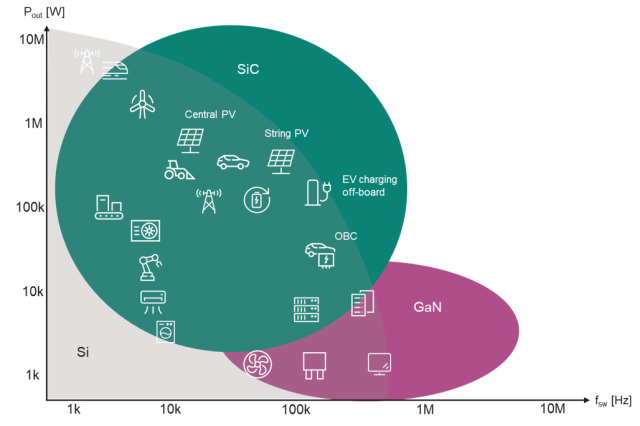
Si-SiC-GaN position graph
Silicon remains a major material supporting a wide range of fields.
On the other hand, SiC is advantageous in areas where higher voltage resistance and efficiency are required, while GaN is advantageous in areas where higher frequencies and miniaturization are important.
Making the most of each material's unique characteristics and using them appropriately is becoming increasingly important in the development of next-generation electronic devices.
Want to know more about wide bandgap semiconductors?
This article provides a brief overview of the basics of Si, SiC, and GaN.
If you would like to know more about the features and application trends of SiC and GaN, which are increasingly being used as next-generation semiconductors, please see the article below.