- Semiconductor BusinessHOME
- Products and Services of Macnica,Inc.
-
technical information

-
Events and Seminars
- Handling Manufacturer
- Support
- Inquiry
- Click here to purchase products
- Semiconductor business e-mail magazine registration


 Narrow down by specifying conditions
現在2159件がヒットしています。check

How is the "sound" that we hear created?
We are surrounded by sound every day. Human voices, music, the sound of a car engine, the sound of the wind -- all of these are things that we can "hear" with our ears, but in reality they are "vibrations" that travel through the air. However, when asked, "What is sound?", it can be surprisingly difficult to explain.
For those involved in audio technology and acoustic design, it is very important to understand "what is sound?" before even thinking about "how to process sound." This is because without knowing the properties of sound, it is impossible to correctly understand the meaning of the signal picked up by a microphone or how the sound coming out of a speaker is transmitted.
In this article, we'll start by going back to the basics and asking, "What is sound?" We'll provide a simple explanation of how sound waves work and how the human hearing system works. This will serve as an introduction to audio development and a foundation for mastering general-purpose audio development tools like Audio Weaver, so let's explore the true nature of sound together.
What is sound? The true nature of "waves" that travel through the air
Even with our eyes closed, we can experience the world through sound.
Someone's voice, the sound of the wind, a siren in the distance -- all of these are "vibrations" that travel through the air. For example, when you pluck a guitar string, the string vibrates, and the vibration pushes and pulls the air apart. This "push and pull" of the air spreads out like a wave and eventually reaches our ears. This is "sound." In this way, sound is a wave (sound wave) that travels through the air, and although it is invisible to the eye, it is a "movement" that certainly exists. These waves have the characteristic of vibrating in the same direction as the air particles, and are called longitudinal waves or compressional waves.
*If you would like to know more about longitudinal waves, the following explanatory page is also useful.
Sound waves have several characteristics.
・ Frequency (Hz): The number of vibrations per second. This is related to the "pitch" of the sound.
・ Amplitude: The size of the wave. It is related to the loudness (volume) of the sound.
・ Speed of sound: The speed at which sound travels through air. At a temperature of 20°C, it is approximately 340 m/s.
By understanding these properties, we can not only "feel" sound, but also "handle" it. In the next section, we will look at how the human ear perceives these sound waves and how hearing works.
There are three points to how we perceive sound
When we hear a sound, we get various impressions such as "high-pitched," "loud," "beautiful," etc. In fact, these impressions are determined by three properties of the sound.
① Height (frequency)
The "pitch" of a sound is determined by the speed at which the air vibrates, or frequency (Hz). The higher the frequency, the higher the sound is perceived, and the lower the frequency, the lower the sound is perceived. For example, the high keys on a piano have a high frequency, and the low keys have a low frequency.
② Magnitude (amplitude)
The "loudness" of a sound is determined by the strength of the vibration, or amplitude. The larger the amplitude, the greater the change in air pressure, and the sound is perceived as "loud." Conversely, if the amplitude is small, the sound is "quiet."
③ Timbre (waveform complexity)
Even if instruments have the same pitch and size, the impression of sound varies depending on the instrument because they have different timbres. This is determined by the complexity of the sound waveform and the harmonic components it contains. For example, even if a violin and a flute produce the same pitch, they sound different because they have different timbres.
Understanding these three properties will make the purpose and methods of audio signal processing clearer. In the next section, we will look at how the human ear perceives these sounds, and how hearing works.
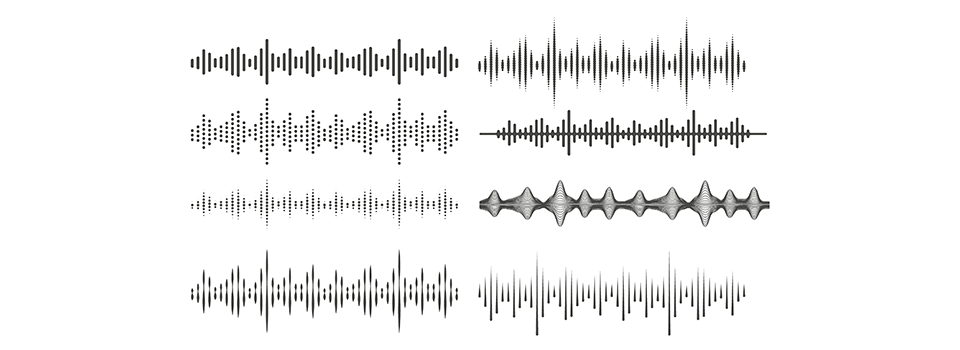
How sound waves become "sound" - A simple explanation of how the ear works
Sound is a wave that travels through the air, but that alone does not mean that we can "hear." We sense sound because sensors called ears receive the sound waves and transmit them to the brain.
The ear is divided into three main parts.
① Outer ear
This is the part that collects sound waves that travel through the air. Sound waves pass through the ear canal and reach the eardrum.
② Middle ear
When the eardrum vibrates in response to sound waves, the movement is transmitted to small bones called ossicles, which act as levers to efficiently transmit the vibrations to the inner ear.
③ Inner ear
The vibrations reach an organ filled with fluid called the cochlea. Inside the cochlea are sensors called hair cells that convert the vibrations into electrical signals and send them to the brain via the auditory nerve. Our brains recognize these signals as "sound," and that's how we "hear" sound.
*By the way, the human ear can generally detect frequencies between 20Hz and 20,000Hz (20kHz).
This range is called the "audible range" and can change depending on age and environment.
In this way, from the time sound waves reach the ear until they are perceived as "sound," there is a process of physical vibration → mechanical transmission → electrical signal → recognition by the brain. By understanding this mechanism, we can see what audio signal processing is trying to imitate.
In the next section, we'll look at how this understanding of sound can be applied to speech processing technology.
Understanding sound helps you understand speech processing
As we have seen so far, sound is a vibration of the air, which humans perceive as "pitch," "volume," and "tone." The ear has a mechanism for converting sound waves into electrical signals and transmitting them to the brain.
This series of steps is actually very similar to the basic concept of audio signal processing. Sound is picked up by a microphone, converted into a digital signal, processed as needed, and output to a speaker or app - this process can be said to mimic how human hearing works. Understanding the differences in sound frequency, amplitude, and waveform makes it easier to determine what kind of processing is needed, what should be emphasized, and what should be removed. For example, processes such as noise reduction, speech enhancement, and echo cancellation are designed based on the properties of sound and the characteristics of human hearing.
Related Information
We would like to introduce "Audio Weaver," an audio development platform from DSP Concepts that is useful for developing audio processing.
Inquiry
If you have any questions about this article, please contact us using the form below.
DSP Concepts Manufacturer Information Top
DSP Concepts Manufacturer Information If you would like to return to the top page, please click below.